One Year Later, It’s time to Get Back to the Basics – Part 1

As most of you know, I moved here one year ago from the United States. I left behind a 15 year career as an analyst with Wells Fargo to set up a business here in the Philippines to train analysts. Over the past year, my path has diverged and expanded to encompass several different analytics solutions including social media outsourcing, recruitment analytics training for corporate HR professionals and speaking engagements at schools promoting analytics careers in the IT-BPO industry. I have trained close to 200 people from a large cross section of schools and companies.

This morning I started thinking though about why I came here in the first place. Are there more analyst jobs out there then their is talent available for them? When I first started looking at the demand side, I analyzed things like looking at postings in job street with the term analyst in them… I got back over 1000 postings. A year later I do the same thing, but am now getting back 1300 postings.

My analysis has always been that there are several factors which make a training program like I have developed not only necessary, but imperative.

First off there is not a lot of analytics related education being taught at the college level. You see it in some programs at some schools, but overall higher education is not producing analytics talent ready to fill the jobs.

Secondly, there is such a dichotomy of skills required for the job postings… soft or people skills like communication and cross-department project work combined with the technical skills in specific programming languages or experience with certain types of analytics tools. It is very hard to find people who can balance the art and science of analytics and no one here is training people on both… its all one or the other.

The third reason why a training program like mine is important is the job requirements are getting increasingly complex in both quantity and quality. Traditional methods of recruiting don’t work well for analyst positions because most recruiters are focused almost exclusively in the technical skills and not of the soft skills. It is very hard to assess someone for curiosity or the ability to conceptualize big data schemes in a way that can be explained both to techie developers and people skill focused managers. To make things more challenging, few companies are trying to retain and train up analytics talent within, they instead turn to recruiters to pirate or poach talent from somewhere else.

The need for training approaches that are innovative and effective is growing much, much faster than most people are able to grasp. The massively overwhelming amount of data we have to analyze in our businesses each and very day is mind numbing.


A couple of analytics solutions for Real Estate? Pretty cool stuff!

http://www.prweb.com/releases/2013/4/prweb10634977.htm

http://www.zdnet.com/manhattan-software-unveils-big-data-analytics-for-real-estate-7000015291/

Trying to bring an analytics approach to real estate sales is something that is starting to pick up steam in the U.S. How long until someone here in the Philippines figures this out? Hmmm…. sounds like an intriguing opportunity!

🙂

Data Engineer? Data Scientist? I love all the new terms for data nerds

Here is an infograph on Data Engineers, something one of my trainees came up with at the direction of my assistant.

15_Alvin_Data_Engineer

I love it! So much information wrapped into an eye catching visual. I’m proud of you Alvin. This is really good stuff! Anyone looking for top-notch analytic talent who gets both big data (the science)  and data visualization (the art), look no further. We have them here at DMAI!


How Marketing Legend Guy Kawasaki Manages His Social Media Presence

http://blog.hubspot.com/how-guy-kawasaki-manages-social-media?utm_source=buffer&utm_medium=facebook&utm_campaign=Buffer&utm_content=buffer68edc

For those following me, you know I am Guy’s number one fan, so I was in heaven when I cam e across this post. I’m doing a lot of this, but need to amp things up a little to get closer to where I want to be…. which is the Analytics Expert of the Philippines!!!

Two Interesting Articles Related to the Analytics Talent Gap

http://www.hispanicbusiness.com/2013/5/1/as_big_data_becomes_big_business.html

http://sloanreview.mit.edu/article/predicted-to-perform-how-to-hire-analytic-talent

Several key bullet points:

  • People who wield computers to analyze large amounts of digital information are  in high demand.420
  • Businesses today control massive and growing streams of information that flow  from cash registers, patient records, smartphones, warehouses, the sensors in  your Nikes, databases, Facebook and good old-fashioned loyalty cards.
  • The challenge is finding people who can put it all together and make better  strategy. Everyone from the Central Intelligence Agency to Gander Mountain is on  the hunt.
  • “I would challenge you to describe to me an organization of any size in any  industry or not-for-profit setting that will not be leveraging this,” said Isaac  Cheifetz, a headhunter working to find the Mayo Clinic a head of information  management and analytics. “Name one. I can’t.”
  • Businesses have the data to keep sale racks thin, streamline shipping and get  more people to click ads. What they need are better analysts. It’s a new kind of  job, and it’s coming to your workplace if it’s not already there.
  • The McKinsey Institute predicted in 2011 that a big-data boom would create up to  190,000 new deep-analytics positions in the United States, and demand for 1.5  million data-savvy managers.
  • Fifty-five percent of big data analytics projects are abandoned.
  • The most significant challenge with analytics projects, according to the survey? Finding talent. Most (80%) of the respondents said that the top two reasons analytics projects fail are that managers lack the right expertise in-house to “connect the dots” around data to form appropriate insights, and that projects lack business context around data.
  • “A popular approach is to hire for skills,” said Roberts. “You’re going to have a lot of failures if you just say ‘I need SPSS, R, SAS’ or some other skill. Business and technology are evolving so fast now. You need someone [who] is compelled to learn and keep up with what is new. So, it’s the curiosity to learn the skill that is the fingerprint. Not the skill itself.”
  • Creativity and curiosity, she says, are far more important than established skills.
  • Another misstep is not recognizing the difference between candidates being curious or just detail-oriented — both very different attributes. The way to determine the difference? Asking questions that get at curiosity.
  • Finally, HR managers should be aware that analytical professionals are just that — analytical. As a general rule, they are not likely to be charismatic and may not present well in an interview.

These bullet points are very similar to the section of my Introduction to Analytics PowerPoint about who are analysts and why we need more of them!

Reposting an interesting article – How to write more successful blog post!

http://www.linkedin.com/today/post/article/20130429113637-15077789-how-to-write-more-successful-blog-posts

1) Write an amazing headline.

The value of a powerful headline simply cannot be overlooked. It’s the only thing a potential reader sees, it is the catalyst for social media sharing and it has power beyond any other part of your post to attract readers. Your headline should give readers an intriguing clue into what you will be saying. Lists, action verbs and questions are great ways to draw readers in. Remember, when readers tweet your article, or share it on Facebook, LinkedIn or another social platform, the only thing people may see is the headline.


2) Pictures are worth a thousand words.

There’s no escaping it: humans are visual creatures. We’re drawn to images and photographs. Graphs, infographics, sentimental imagery and stunning beauty are all excellent ways to draw an audience in, keep them there through the end of your post, and help drive more views through Pinterest and Facebook, where images reign supreme. If you can include a pic of a cute animal or child, even better.(Or both – say hi to my girls Charlotte & Kate and our cat Chiquita!)

3) Bullet points are extremely useful. Here’s why:

—–> They attract the reader’s attention. You were likely drawn straight to these bullet points when you read this article.

—–> They make data simple and easy to understand. When you see these bullets, with their key insights in bold, you know just what you need to read right away.

—–> They make it easier to reference key points. When heading back to an article at a later date, it is easy to find the most important information if it’s in bullet form.

4) Make your audience look good when they share your post.

Of course, great content with clear takeaway value in your blog post is most important. But remember, people are ego-driven. Ask yourself, before you hit the publish button, “When people share this post, how will they look smarter, or funnier, or more helpful, or more interesting to their networks?”

5) Call for engagement in your conclusion.

When you conclude your blog post, make sure you ask readers to share the post. Ask them thought-provoking questions, and invite them to share their answers and thoughts as comments on your post. The more engaged your readers are, the more they’ll want to share – and keep coming back.

Does more time mean more profits for a small business owner?

Reposting from the Small Business Manila site… Does more time mean more profits for a small business owner? 417789_10151477823381716_2054840398_n

For me it sure does.

Small business owners are working more hours, even 7 days a week, leaving them less and less time for rest and relaxation. How much, in actual dollars, do owners value an extra hour of time per day?

To a small business owner, TIME is both the #1 commodity as well as the #1 asset. You cannot buy time, and despite many proclamations to the opposite, you can’t even save it. It passes, unrelentingly. So your most important use of your most important commodity / asset is simply how to SPEND your time.

Read more at Business2Community via http://bit.ly/Zubvkm.
Photo from garbled.com.

As a Small Business Owner and Entrepreneur… each hour is a measureable commodity that I have to use wisely.

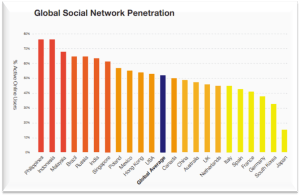
Social Media in the Philippines

Picture1

I use this in some of my training classes to demonstrate the opportunity social media presents for businesses here in the Philippines .

Some interesting bullet points about Social Media in the Philippines.

  • The Philippine is the leading country in the world that uses social media.
  • 95% of the Filipinos are using social media.
  • The average web user in the Philippines is just 23 years old, while almost 6 out of 10 social media users are below the age of 24.
  • Filipinos spent 21.5 hours per week.
  • 90% of them are using Facebook.

Source: http://www.techbullets.blogspot.com

Dan Meyer = CEO, Blogger, and Analytics Edutainer

http://en.wikipedia.org/wiki/Edutainment

I came across a word today I had not heard before… edutainer. Dr. Hans Rosling (my hero) of www.gapminder.org was quoted as be one of the foremost edutainers in the world. He uses an entertaining style to educate and I is famous for the enthusiasm and passion that comes about when he presents data. I am of the same mold. I see training/teaching as a form of edutainment.

The line between a good teacher and a stand up comic is very thin… both make money standing in front of people and talking about things they know. Some of the best teacher we ever had are the ones whose passion made science or history fun. And the line between trainer and game show host is also pretty thin. You have to be witty, engaging and charming to a wide audience to keep them coming back.

So yeah, I am proud to say that I am an edutainer… part teacher, part stand-up comic, part trainer, put game show host. You put it all together and you get what happens at my analytics trainings… you learn, you have fun, you gain skill and you are entertained.

P.S. If you read this blog via Facebook, Twitter or LinkedIn, please circle back to the wordpress page and like the blog. The first five people who do so will go on the waiting list to get an advance copy of my e-book, Making Data-Driven Decisions as soon as its published.

Thanks!