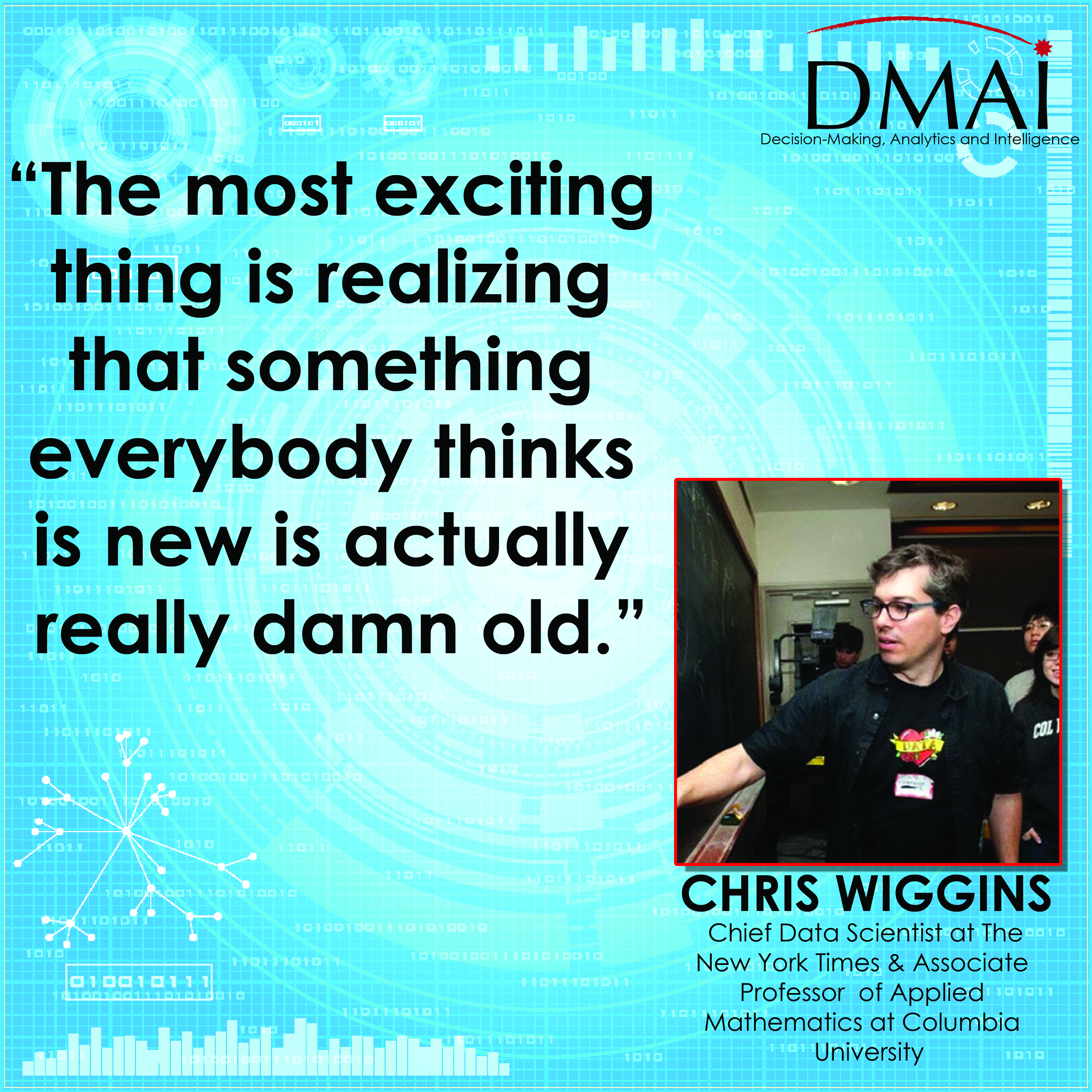
When What Is New Is Actually Old

I saw this quote and thought it was worth sharing… often I remind people that most problems have already been solved by someone else. One of the keys to being a good analyst is having a network that you can go to when you are stuck and ask around to see if anyone else has already figured it out.

Print

DMAI has been blessed with a very successful year so far in 2015 and is starting to look towards 2016 planning. Let’s see if there is some more opportunities out there for us to teach some people to rediscover things again using analytics!

11 Days Of Analytics Training in Just Over 3 Weeks

By the end of next week, I am on target to have completed at least 4 hours of analytics training in 11 of the past 25 days.

This tells me two things… the need for analytics training here in the Philippines has never been greater and I need to move finding an in-house business analyst who can also do training higher up my priority list.

Ideally, someone with some business dashboard building experience, knows the BPO industry and is passionate about teaching other people how to be good analysts.

Qualified candidates are in short supply, but I know there are some out there who will make a great addition to the DMAI Science Team we are now building.

If you or anyone you know is interested, please connect with me on LinkedIn or send me an email @ danmeyer@dmaiph.com

There is an ever increasing analytics pie out there and the time is ripe to not just be a good analyst, but get into helping create a whole wave of analysts.

Be a creator, not just a user!

DMAI_GrowMoreDMAI_shemac081815 copy

Another Chance To Start Over

http://sethgodin.typepad.com/seths_blog/2015/09/another-chance-to-start-over.html

Sharing Seth’s blog… another well timed post that seems to be directed at my life specifically.

Another chance to start over

Every day that you begin with a colleague, a partner, a customer… it might as well be a fresh start.

There’s little upside in two strikes, a grudge, probation. When we give people the benefit of the doubt, we have a chance to engage with their best selves.

If someone can’t earn that fresh start, by all means, make the choice not to work with them again. Ask your customer to move on, recommend someone who might serve them better.

But for everyone else, today is another chance to be great.

11393144_10153432064897425_1344991735431472090_n

Fundamentals of Business Analytics > Taking A Big Step Towards Implementation

Working on a training power point for a week long Fundamentals of Business Analytics class I will be teaching in two weeks.

A full week of training on business analytics is a new challenge and will serve as a precursor to a full blown semester long class. The audience here is made up of faculty who will be teaching classes as prescribed by the 2013 CHED Memo on infusing business analytics into the business administration curriculum.

I will break the class down into 5 section, each covering some of the course and learning objectives outlined in the memo.Here are the topics:

Day One: Introduction to Business Analytics

Day Two: Big Data & Data Warehousing

Day Three: The Three Type of Analytics   (Descriptive, Predictive & Prescriptive)

Day Four: Business Intelligence, Data   Visualization & Business Dashboards

Day Five: Analytics & Decision-Making

Whether you dream of being an analyst, aspire to be a better analyst or hope to surround yourself with people skilled in analytics, you have to strive to be different.

You have to look at data as having the answers and analytics as the key to determining which answers are the ones you need.

Working from this starting point, we will build a knowledge base that will give us a solid grasp of the Fundamentals of Business Analytics (FBA).

That is the core message I will inpart on the audience as no amount of skills based training along will make a successful analyst. You have to have a context to work within and that will be the biggest challenge of all, as the students will not have any experience at all.

Looking forward to seeing how this goes… its a laboratory for testing out how to train the trainer to train analysts out of a population of 3rd year college students.

420

Infusing HR Analytics into Organizational Behavior and Human Resource Management Classes

One of the things I have been working on is helping a top school here in the Philippines develop a strategy to infuse more HR Analytics into their Organizational Behavior and Human Resource Management Classes.

This effort is a precursor to a class specifically on HR Analytics, which is to the best of my knowledge, the first ever here in the Philippines.

So as I put more thought into the syllabus of each class, it occurred to me that a good way to approach analytics is to introduce it slowly over the length of the 3 classes, which follow in a natural progression.

Starting with the OB class, we can focus on how to identify data in an organization that will be useful to a HR team to measure things over time. To help really get at causality of human behavior on a wide scale, you need to have the data to understand context.

In the HR Management class, we will spend more time working on the inventory part of analytics, which is to bring the data into an analysis and reporting structure that helps us discover patterns and trends based on that data.

Then the HR Analytics class, we will then proceed on how to integrate the data and the analysis into tool like a business dashboard.

At a high level, the students will gain an appreciation for the wealth of data HR can access in an organization and how the analysis and reporting of this data can lead to more data-driven decision making.

Its great to have an understanding of why people leave a job, and to have good reporting on attrition patterns, but you also need to have the ability to enable strategic action based on data and not just observation or simple metrics.

That is what our students will be able to do that will separate them from other Psychology grads entering the workforce. They will be ready day one to be HR Analysts who can bring a much needed data centric skills set to a very people driven discipline.

If you are a school administrator or professor and need to get more analytics in your course work so your students are better prepared for the analytics centric jobs, connect with me. I can show you how. I even have a textbook you can use. My new book Putting Your Data to Work is ideal for the nascent analytics learner.

9b9b0d_9e1b0bda82a944ed9d8845fb26bc2b7b-png_256


Analytics Education – Facilitating a mastery of the fundamentals of analytics is what DMAIPH does best.

All across the world, companies are scrambling to hire analytics talent to optimize the big data they have in their businesses. We can empower students and their instructors with the knowledge they need to prepare for careers in analytics.

Contact DMAIPH now at analytics@dmaiph.com or connect with me directly so we can set a guest lecturer date, On-the-Job Training experience or other analytics education solution specifically tailored to your needs.

 

BI Professionals Spend 50-90% of Their Time ‘Cleaning’ Raw Data for Analytics

Sharing this…

Last year, the NYT shined a light on big data’s “janitor” problem – that data scientists and business intelligence pros spend too much time cleaning, not evaluating data. But how big of an issue is it, really?

Xplenty just wrapped a commissioned study of +200 BI pros and found that a third spend 50-90% of their time just cleaning raw data. This is one of the first reports to tie an actual # to the ETL process.

Source: bigdataanalyticsnews.com

From my days at Wells Fargo being an analyst I know how hard it was to maximize your analysis and communication time and minimize time spent finding and cleaning data. This was especially true for me as I was using more unstructured data to do things like competitive intelligence then structured data.

I see it being even more of a challenge now because the % of unstructured data in any business has exploded the past few years. Being able to mine valuable insights from unstructured data is a time consumer, at least until you get a process in place to extract and refresh the data using some kind of technology.

In addition, businesses continue to find new data points to bring into their data warehouses, dramatically increasing the amount of structured data.

What this means is a lot of analysts are spending a lot more time looking through mountains of data to figure out exactly which data to use. Its not going to get easier.

Good data gathering methodologies and nimble BI tools can help cut down on some of the workload, but in the end we just keep making data faster then we have the ability to truly process it.

There is just no replacing the human factor of someone knowledgeable about the business who can interpret the data and decide what data to use and what not to use.

Which makes life even more challenging, because once we determine what data we want to use, we still often have to take the raw data and clean it up so it is valid and so it will fit nicely into our BI tools.

3.8.2

If you have having trouble figuring out what data to use in your business and if you find yourself spending far too much time cleaning the data, perhaps DMAI can help. We have a Data Science team ready to assist your organization with just these types of challenges.

Thank Your Mentors!

“Although I consider you more friend then mentor, you are one of the key people in my professional life. Your help, guidance and inspiration, especially during my first year here in the Philippines helped set the stage for the new level of success I have been blessed with this year. For that I owe you my humble thanks for being a mentor to me as well as a trusted friend.”

This is a message I shared with some of my mentors here in Manila.

LinkedIn recently sent members an email suggesting they send thanks to their mentors. Pretty cool idea.

Mentor is defined as someone who teaches or gives help and advice to a less experienced and often younger person. I love being a mentor and have many less experienced and younger people I have taught/helped over the years, but even mentors need mentors.

Which makes me truly blessed as I have a long list of people helping guide me.

IMG_1224

Multitasking Is A Productivity Killer

Multitasking is a productivity Killer. Picked this up at a HR conference I was at last week. It was a theme during a couple of the presentations.

Multitasking as a competency is not the same as multitasking across projects and tasks during a day. That is good time management and the ability to prioritize what you work on.

The myth of multitasking, that you can do multiple things at the same time is a just that… a myth. Less than 10% of the world’s population is actually able to carry out two distinct tasks at the same time.

One of the speakers listed the Pros and Cons of multitasking:

  • Pros of Multitasking: Reduce Cost by having one person do the jobs of many people.
  • Cons of Multitasking: sense of being overburdened, stressed out, loss of focus, poor quality, high attrition, inflated sense of importance and value

As you can see not much comes from trying to force someone to do too much.

10592010_10152674958362425_1982237172_n

Back when I was an analyst with Wells Fargo, one of the keys to my success was that I didnt multitask when I had to focus on high priority projects. I would put my headphones on and block out the world. Often I would even close my Outlook and my browser. Giving 100% to a project for a few hours always led to a better finished product. And it feels awesome to have a sense of accomplishment.

I still do this. When Im focused in on a project I tell people I’m busy. I get away from distractions. And I focus in like a laser.

Multitasking is indeed a productivity killer and not falling prey to it is one of the reasons Im as successful today as I am.

The Average Keeps Getting Lower And I Refuse To Tolerate This – Updated

Updated on 10/27/16

http://sethgodin.typepad.com/seths_blog/2015/08/the-average.html

The average

 Everything you do is either going to raise your average or lower it.

 The next hire.

 The quality of the chickpeas you serve.

 The service experience on register 4.

 Each interaction is a choice. A choice to raise your average or lower it.

 Progress is almost always a series of choices, an inexorable move toward mediocrity, or its opposite.

I can totally relate to this. We are a society more and more inclined to settling for the average, and are even ok with it when the average trends lower.

One place I see it happening more than most is in talent management. The demand so far outweighs the supply of good talent; we keep lowering the bar.

Frist it was 4 year degree required. Then it was some college. Now its high school grad.

In just a few years we have gone from a high bar to also most no bar.

Same day hiring. No interview required. No test or assessment. Just how up and get a job.

I hate this.

This new reality taking hold across the Philippines  is deeply concerning to me.

It is unacceptable to me to be involved with anything that is just average, and I just get crazy when I see people doing things to lower the average on purpose.

There is another way.

If you have good analytics, you can be better at setting a realistic bar and not just going lower to meet requirements.

No more mediocrity. No more playing to the average and definitely purposely lowering the average.

I just refuse to tolerate it anymore!

Let me show you how to use the data in your business to turn things around.

Stop the insanity of fueling high turnover and low employee engagement that is lowering the quality of service to a dangerous place.

Who is with me?

If you are, the you will might enjoy reading my new book, Putting Your Data to Work. I can help you use your data.

HR & Recruitment Analytics – The recruitment and retention of top talent is the biggest challenge facing just about every organization. DMAIPH is a leading expert in empowering HR & Recruitment teams with analytics techniques to optimize their talent acquisition and management processes. Contact DMAIPH now at analytics@dmaiph.com or connect with me directly to learn how to get more analytics in your HR & Recruitment process so you can rise to the top in the ever quickening demand for top talent.

Analytics 3.0, Big Data Equals Big Insights: Learning to Use Big Data to Build a Smarter Global Workforce

That was the title of my quick introduction to Big Data for HR to a crowd of about 1,000 HR professionals yesterday. My agenda was to talk about:

  • Using Big Data in HR to empower more Data-Driven Decision-Making
  • Extracting Key Business Insights using Big Data
  • A Big Data Analytics centered approach to building A Smarter Global Workforce

I must say it was pretty awesome as the topic generated a lot of discussion about the biggest challenges facing HR professionals when it comes to Big Data.

11960185_923787737670982_7880910083394419466_n

Not surprisingly, one of the top challenges the attendees are facing back at work is getting their managers to support Big Data initiatives. There is such a great need for awareness of what Big Data is all about and how analytics is used to extract the right data to give decision-makers the ability to make smarter decision.

To start off, I suggestesd they think of HR Analytics like a Pyramid

Start with the base and gather all the HR Big Data

Build to the middle of using HR specific Analytics

Strategic Focus comes out ofthe top and you get Actionable Insights

If you can show that a Big Data approach adds value, optimizes processes and provide a strong return on investment. Basically you need to use data to support the use of more data.

Identifying data sources and analytical resources can provide guidance in understanding your organization’s needs and capability to adopt a talent-centric data-driven approach.

Having a data-centric culture is the first step in optimizing the Big Data in your business.

And my final word of advice was that you have to be the one to champion Big Data. You can’t wait for someone else to. As a leader in HR, you need to be the one pushing the issue of how to use Big Data to to the forefront.