What Does A Business Analyst Actually Do?

For the sake of the CHED course on business analytics, lets look a little more closely at business analysts.

The International Institute of Business Analysis (IIBA) describes the role as “a liaison among stakeholders in order to understand the structure, policies, and operations of an organization, and to recommend solutions that enable the organization to achieve its goals.”

With that in mind, the next question often asked is, “What does a business analyst do?”

This is a reasonable question, because the fact is a business analyst is not limited to doing one thing. He or she wears multiple hats. He or she will be skilled in communication, negotiation, listening, and will also need to be a good team leader. They have to be good at solving problems. This means he or she will have the skills necessary to look at data and other relevant information in order to determine where the losses are within a company. They also have to understand the technology used to capture, store and analyze the data used in their company. It takes a lot to be a good business analyst.

This is where things like deep thinking and curiosity really separate good analysts from great analysts. Of the many  essential skills a business analyst will utilize here are my top 3:

(1) – Know the data. They will compare the past facts and figures to the current numbers, this will give the analyst the information to deduce or predict failure within the company.

(2) – Know the business – A business analyst is always an objective listener. They will determine the needs that management want by speaking to shareholders. This requires the analyst to ask questions, to find out what is needed, which will more than likely lead to new discoveries that may have been overlooked previously.

(3) – Know the players – Within a business there are usually different departments. A Business analyst will seek to associate and involve them-self with the various departments. This will help them identify conflicts within the various departments, which can be used to bring departments together.

As you can see it takes a lot to be a business analyst. BAs are truly a rare breed of technology loving people, who can solve problems and work well with others.

FBA0001

What Kind Of Analyst Do You Want To Be?

“The main part of intellectual education is not the acquisition of facts but learning how to make facts live.” – Oliver Wendell Holmes

An ANALYST is a person who analyzes and is skilled in analysis. Business Analysts (BA) are required to find, analyze and report business data to support business optimization.

The job functions of an analyst very greatly from business to business and even within each business job functions can vary from analyst to analyst. However at their core, you will find that just about anyone with analyst in the title has several things in common.

Based on the book, the Accidental Analyst, four character traits that most analysts have are:

  • PASSION for helping people solve real problems
  • KNOWLEDGE of the business being analyzed
  • EXPOSURE to thinking analytically and problem solving tools
  • EXPERIENCE using data to solve problems

In addition most analysts have certain personality types:

  • reflective
  • intuitive
  • deep-thinkers
  • and able to make quick judgments

These findings show a consistency across analysts no matter if their focus in on reporting, analysis and/or research, if they are working with small structured data sets or volumes of unstructured big data or if they are actively working to optimize the business or just providing information.

IMG_7737.JPG

Per CHED some of the analytics jobs graduates of the program should be ready for:

  • Jr. Business Analyst
  • Operations Assistant
  • (Web) Site Analyst
  • Marketing Officer
  • Jr. Operations Analyst
  • Financial Analyst
  • Supply Chain Analyst
  • Human Resources Associate
  • Training Associate
  • Administrative Associate
  • Accounting Analyst
  • Quality Assurance Analyst
  • Facilities Associate
  • Planning/Budget Analyst
  • Insurance Analyst
  • Social Media Analyst
  • Virtual Assistant
  • Customer Service Rep
  • Finance Analyst
  • Accounts Payable Analyst
  • Travel Analyst
  • Expense Analyst
  • General Accounting Analyst

This list is hardly exhaustive. On a typical day on jobstreet.com you will see hundreds of job titles that includes analyst in the title.

So I guess the next question to ask is, “What kind of analytics and analyst jobs interest you the most? ”

The Fundamental of Business Analytics – Business Analytics is the application of talent, technology and technique on business data for the purpose of extracting insights and discovering opportunities. DMAIPH specializes in empowering organizations, schools, and businesses with a mastery of the fundamentals of business analytics. Contact DMAIPH now at analytics@dmaiph.com or connect with me directly to find out how you can strengthen your business analytics fundamentals.

Why We Need Business Analysts! > The Philippines Is Quickly Becoming A Hub For Analytics

Most business leaders know that they need more analytics based decision making in their operations, however few have figured out how to obtain it as analytics software or engaging high priced consultants doesn’t suffice.

Businesses are challenged with endless streams of data of immense volume, variety and velocity coming from global marketplaces and from a multitude of social media platforms that didn’t exist until recently.

Per CHED, Business analytics is essentially about:

  • providing better insights;
  • particularly from extensive use of operational data stored in transactional systems;
  • statistical and quantitative analyses;
  • explanatory and predictive modeling;
  • facts-based management;
  • to drive decision-making for optimal results

Dictionary.com defines insight as “an instance of apprehending the true nature of a thing, especially through intuitive understanding.” Business Analytics allows a business to get the cause of something, to find an explanation or a reason that something has happened.

BA is also very useful to understand who, where, why, how and in what way customers interact with the business. BA lets us know who the customers are based on demographic breakdowns like age, sex, education level, etc. BA tells us how much of what product is bought, where the product is bought from, how often it is bought. And BA brings us insights into why the product was bought.

MSP24321b65h584fd76h9i00006996g957h01de5g6

Business analytics has long been used to understand things like which sales person is the most successful or which market is the most profitable by looking at the operational data stored in the transactional systems of that business.

Just about every business has at least some basic way of calculating profit, validating inventory and measuring success. These transactional data points are generally housed in a data storage system that can be accessed to view reports. This is the core of business analytics.

BA gets a lot more insightful when business decision-makers have the ability to look at statistical and quantitative analysis of that data. Often this is not only done by the decision-makers, but by analysts who can dedicate more time to discovering, investigating and analyzing the data.

Businesses that are able to employ even more advanced analytics by using data models. In the hands of a good analyst, models allow one to quickly and easily adjust the analysis based on using different variables. Building models is especially important when working with large data sets or what’s called Big Data. Models also let analysts not only look backwards at what has happened, but allows analysts to look into the future.

When you look at any successful business, odds are that they have solid business analytics in place. The leadership team is generally provided with reports that allow a fact-based management of the business. As opposed to businesses that are run based on intuition or gut feel, businesses that invest in analytics generally make better decisions.

In the hypercompetitive global market of today, even the smallest and most simple businesses need some level of business analytics to be able to make smart choices to optimize results and be successful.

Five Tips To Make A Great Dashboard > DMAI Analysts Master These Skills

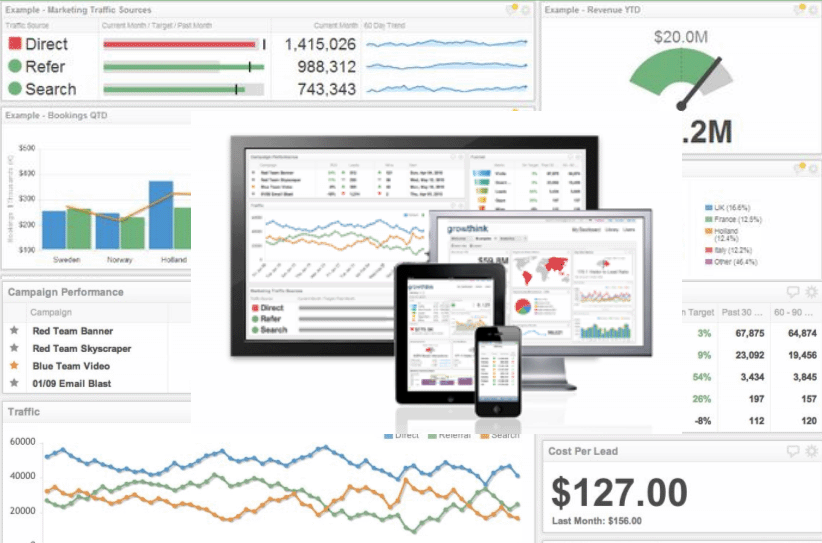
A business dashboard allows decision-makers to better manage their business, and thus improve sales and profits. Here are five tips to make a successful business dashboard:

1) Personalize. Tailor your dashboard to the role of the user, designing it around metrics specific to the individual. Accommodate your users no matter where they are located.

2) Self-sufficient. Dashboards should guide business users to relevant insight without help from IT. Dashboards should be intuitive and provide simple access to business data using menu filters and drill-down functions. Also, users should have access to FAQs, help ­files, how-to videos, and an online user community so they can feel con­fident when using their dashboard.

3) Interactive. Dashboards are not a static experience. Users should be able to apply filters and adjust values on a chart, for example, to plan for various scenarios. They should also be able to write-back to the data source if permitted. Drill-down capabilities are particularly useful because users can delve into charts to get further details with just one click. Interactive dashboards keep users engaged and focused.

4) Dynamic. Static dashboards rely on historical data, neglect your organization’s present performance and set you up for failure, warns Forrester Research. Successful dashboards are dynamic and reflect the real-time changes of your business’ performance. They also offer ad-hoc capability so users can manipulate variables for further analysis and drill-down functionality so users can find root causes.

5) Accessible. Dashboards should be accessible from any device so users can view their data anywhere, anytime. Mobile dashboards are easy to deploy if your BI system supports web apps, which can be developed once and deployed anywhere – on any PC, smartphone, or tablets.

The bottom line is that dashboards should be analytical tools, not just pretty pictures. The ultimate measure of dashboard success is adoption. When users come to see their dashboards as indispensable, you know you’ve done well as a dashboard designer.

DMAI specializes in designing business dashboards, training staff to use them effectively and in providing staff who can build, manage and enhance business dashboards

Growthink_Dashboard_Hero_w_Background_PSD_0

Five Uses For Business Dashboards > DMAI Can Build You One Or Provide You Support To Build Your Own

Research from Aberdeen Group shows the average company that uses business dashboards enjoys triple the revenue growth and double the profit growth of companies that don’t.

Why?

Because with the right dashboard:

  • Businesses make more intelligent business decisions
  • Managers have complete, real-time visibility into their organization
  • Leaders manage their business more effectively

5 Key Benefits of Business Dashboards

Business Dashboard gives business executives numerous benefits including the following:

  1. Visibility: An executive dashboard provides great visibility and insight. Decision-makers know exactly what’s going on in all aspects of their business, allowing to see connections and correlations.
  2. Continuous Improvement: One of Peter Drucker’s most famous quotes is, “if you can’t measure it, you can’t improve it.” Dashboards allow leaders to measure performance throughout their organization and thus improve it.
  3. Time Savings: Many executives spend countless hours logging into business systems and running reports. Conversely, the right dashboard always shows managers the latest results from each report they need. This saves precious hours each month.
  4. Plan vs. Performance: Many executive spend time creating a business plan for their organization to follow. However, that’s just the first piece to success. The second is making sure their company is performing to the plan’s expectations. Dashboards can automatically show progress towards goals from the business plan versus actual, real-time results.
  5. Employee Performance: When employees know their performance is being judged in a dashboard, and can see their results, they innately start to improve their work.

DMAI specializes in designing business dashboards, training staff to use them effectively and in providing staff who can build, manage and enhance business dashboards

3.8.2.

The Not So Elusive Unstructured Data – Part 2

Historically people have been talking about data within the firewall, document management or collaboration information that is not structured, such as video, photos, documents and diagrams.

However now that we are at a tipping point: There is as much value in unstructured data in terms of what customers are thinking on the web and what businesses can derive from other organizations’ data

Good Analysts know how to identify, inventory and integrate unstructured data right along side the structure business data they have always had.

Structured-and-Unstructured-Data-02

Recently, BI and warehousing suppliers have been adding support for unstructured data management to their tool sets.

Many IT organizations have built their own platforms for converting unstructured data into structured records, for example, through knowledge management systems.

And new businesses are popping up to offer unstructured data collection, storage and analysis options that are integrated into the enterprise analytics solution.

Companies who get unstructured data will have a huge competitive advantage. DMAI can give you the training, consulting and analytics talent you need to stay ahead of the pack. #GrowMoreDMAI

The Ever Elusive Unstructured Data – Part 1

Per Wikipedia, Unstructured data (or unstructured information) refers to information that either does not have a pre-defined data model or is not organized in a pre-defined manner. Unstructured information is typically text-heavy, but may contain data such as dates, numbers, and facts as well.

This results in irregularities and ambiguities that make it difficult to understand using traditional programs as compared to data stored in fielded form in databases or annotated (semantically tagged) in documents.

As a result the traditional model of business analytics no longer works.

context

Recent discussions about Big Data are showing that about 80-90% of data currently being captured by businesses is unstructured. Just two year ago it was 50% and five years ago about 20%. The boom is unstructured data storage is fundamentally changing business analytics as we know it.

Businesses across all industries are gathering and storing more and more data on a daily basis. But when it comes to assessing the benefits and challenges of big data, sometimes it is easy to overlook one key point: Most of the business information in use today does not reside in a standard relational database.

So how do we overcome these challenges?

DMAI has the answer!

#GrowMoreDMAI

Finding The Right Data To Help A Business Is The Key To Being A Great Analyst

Knowing where to go to find the data you need is one of the most important keys to being a successful analyst.

There are three basic areas where you can go to find data:

  1. Private Company Databases and sources
  2. Public Databases and sources
  3. The Internet

Each company treats its data a little different, but you can expect them to store their data in data bases that fall into the following couple of categories:

  1. Proprietary Databases. All of the data used for analysis is kept in databases that are built and maintained by an internal IT team. They may use heavily personalized commercial software.
  2. Off the Shelf Databases. Most data is housed in a commercial database solution like Oracle, Teradata, MS Access, etc. where IT team often work in partnership with the database manufacturer.
  3. External Databases. The company does not have its own IT team and receives its data from external resources. Usually analysis is conducted via a connection to the data through the vendor.

In addition to using internal data sources, you may also find yourself surfing the web to find data for your analysis.

A lot of time it takes a combination of internal business data and things from the web to give you an overall picture.

In my experience there are three places I generally go to in search of publicly available data on the internet. I generally find what I need from either:

  1. As a general starting point for just about anything you can begin with a Wikipedia search.
  2. Google Search. To pull together press releases, news articles, images, and other pieces of data that are not statistically driven, Google is your best bet.
  3. Government Databases. The are billions upon billions of datasets out there on just about every kind of public data in terms of demographics, government spending, monetary flows and many, many other type of data.

So when you look to provide a well-rounded and detailed analysis of any business problem, the first step is always knowing where to go to get your data.

10406025_10152524531307425_1404103117_n