How to Get Fast Business ROI with PLDT Cyberya

I thought this was a pretty good blog post… worth a quick read!

Raffy Pekson II's avatarBits and Snippets of the Philippines

PLDT KaAsenso Cyberya is a coined term from two words: “Cyber,” involving cyberspace and the Internet, and “Barya,” a Filipino word meaning “coins” in literal translation. In reality, it’s a coin-operated machine that allows people to drop as little as one Peso to surf the Internet.

The Cyberya business is touted to be a high-profit, low-maintenance small business or minigosyo, helping provide extra income for small business owners or jumpstarting a small business into a bigger venture with multiple Cyberya machines. In partnership with Intel Philippines, the global leader that develops technologies, products, and initiatives to continually advance how people work and live, PC Express, one of the leading computer retailing shops in the Philippines that provides high-quality PC and electronic parts and accessories, and PLDT KaAsenso, PLDT HOME’s trusted enabler for minigosyos. Cyberya was launched in late 2012, it is now available nationwide.

A Cyberya package is an all-in-one…

View original post 239 more words

The Most Ambitious Analytics Project I Have Ever Taken On

Pretty much every time I do an analytics training I talk about the most ambitious analytics project I have ever taken on.

One day back when I was still with Wells Fargo (circa mid 2008), my boss came into my cube and tossed a book on my desk. “Daniel, take a look at this. I when I come back I want to share with you a project I have in mind.” I knew he was going on a business trip that day and would be back in two days so I had that time to read the book and figure out what he wanted me to do before he got back.

The book was Stephen Few’s Information Dashboard Design and it forever changed my life.

dashb

http://www.amazon.com/Information-Dashboard-Design-Effective-Communication/dp/0596100167

When I saw the book I was immediately enthralled by the charts and graphs, at this point in my career I had built thousands of charts and graphs and data visualizations in excel and was generally considered a master at it. But up until that point I had never heard of the term business dashboard. It was obvious to me that the idea was a user interface to access business data in one view, but I likening it to a car’s dashboard was a brilliant way to make the concept easy to digest.

I spent most of the next two days devouring the book. And I knew what he wanted, some kind of intranet site to display all the different reporting metrics I was generating for the group and mainly diffusing via email.

When my boss got back from his trip, I eagerly anticipated his eventual reappearance in my cube.

Finally after lunch, his admin called me and asked me to meet him in the conference room. On the dry erase board he had sketched out the most ambitious analytics project I had ever dreamed of taken. He didn’t just want a place to post information and reports, he wanted something far cooler.

His requirements included real-time sales data, real-time scrolling exchange rate data, headline news data from various sources and he wanted it to be available on both desktops and on TV screen positioned throughout the floor so everyone can get a pulse of the business at a glance. It was brilliant, but it was also going to be ridiculously hard to do. I mean, he wanted a life feed from CNN. How was I going to get that?

But being the dedicated analyst, the next day I took his vision and created a one page power point mock-up. Once he felt I had the design the way he wanted I started checking around with different resources to see what it would take to pull this off. After several conversations with our project management team.. in-house developers and database owners, I came up with a figure of over $1,000,000. It was going to be a huge six month project to get everything in.

I kicked off the project and started putting together the project team…. and then we had an all team budget meeting. We need to cut some things out of the budget do and when the boss started going around the room and looking at each person , I already knew it… “Daniel, we are going to have to cut your data project”. Inside I cried, but I had been around long enough to know this idea wasn’t dead, it was just going to take a different form.

Two years later, we basically had built the dashboard but it took a lot different form then I had originally put together. We had the reporting metrics on an intranet site, we had an automatic system to feed us real-time FX rates, we were using the Tableau BI tool to develop some awesome data visualizations… about the only thing missing was the live CNN feed.

But boy wouldn’t it have been cool to build that dashboard the way we originally had dreamed it up!

About Me… something I threw together for a client proposal

20130911-104637.jpg

Dan Meyer established BPO Elite LLC, in the United States in 2010 and with the intention of setting up an analytics training and consulting business in 2012. After a 15 year career as a senior analyst with Wells Fargo Bank, Dan moved to Manila in May 2012 and immediately set up BPO Analytics Elite Inc.

During the next several months Dan trained over 75 fresh grads in the concepts of analytics and 2/3 were quickly able to find jobs as analysts in the BPO industry. BPO Elite was also hired as a consultant for a number of companies here in the Philippines.

In January 2013, Dan spun off some of his efforts into a new company, DMAI – Decision Making, Analytics and Intelligence. DMAI focuses on professional analytics training, management consulting and outsourcing. Dan has conducted several public trainings in 2013, training over 50 professionals for a wide range of top companies.

In recent months, DMAI has also taken on additional consulting clients here in the Philippines as well as begun to provide outsourcing services for six overseas clients. Dan also continues to empower students and young professionals via speaking engagements across Metro Manila.

Dan conducted seven sessions of the two-day, An Introduction to Analytics for Fresh Grads and Young Professionals between May and November 2012. In all he instructed over 75 trainees who he then helped find work as analysts. Over 2/3 found work as analysts in the BPO industry within a few months with various companies including Accenture, Citibank, Genpact, Emerson, Sencor, and GL Advisor

So far in 2013, Dan has also conducted six analytics and decision-making themed public trainings for professionals. Mainly targeting HR and Recruitment professionals, these interactive one day workshops have been attended by over 100 trainees. Some of the companies represented include McDonalds, Price Waterhouse Coopers, Manulife, iRemit, Lexmark, DestucheBank and Sitel.

Dan has also conducted in-house analytics trainings for the management team and staff of several companies here in the Philippines including Microtel, Kalibrr, and Medexcel Global Solutions.

Dan has worked as a consultant on a range of analytics themed projects for a variety of BPO companies here in the Philippines including GL Advisor (staff recruitment), Jumbo Shipping (outsourcing jobs from Holland), Microtel (setting up an HR and manpower business), Genpact (training junior staff on career opportunities as an analyst) and Medexcel (social media marketing campaigns).

Dan has set up several outsourcing analytics projects of various sizes and capabilities with companies from overseas including Dimedius (a Houston based healthcare consulting business, currently providing market research and demographics analysis), Kass Consulting Group (a Boston-based outsourcing firm, provided internet research on current trends and facts in outsourcing), ZoneApps (a Boston-based mobile application developer, provided content management for their mobile app), ArtFact (a Boston-based online auction house, managing a virtual team of eight social media analysts and customer service reps), IQR (an India based analytics outsourcing company, sub-contracted to provide data analysis and client presentations) and StatMarin (a San Francisco based analytics outsourcing company, sub-contracted to provide marketing campaign analysis)

Speaking Engagements
August 2012 – HR and Recruitment Summit in Quezon City
February 2013 – St. Benilde IT Summit at College of St. Benilde
September 2013 – Innovation Bootcamp at St. Scholastica College
October 2013 – Startup Challenge at College of St. Benilde

In addition, Dan volunteers to go to schools to talk about careers in the BPO industry as part of his membership in BPAP. To date Dan has spoken at a number of schools including CSB, PUP, and UMak.

Dan has appeared as a featured guest on a number of local media outlets around Metro Manila to talk about analytics, the BPO Industry and decision-making for SMEs. Some of the outlets include GNN, DZBB and the Armed Forces Radio.

Am I The Simon Cowell of Analytics?

Last week I had the pleasure to help out a good friend who teaches at the University of Makati. He teaches a marketing elective class to high school students who are in the new 11th grade. FYI for those not familiar the Philippines is in the process of instituting two additional years to the education system here so its on par with the US and many of the countries in having a K-12 program.

1371465_602647766443892_566956799_n

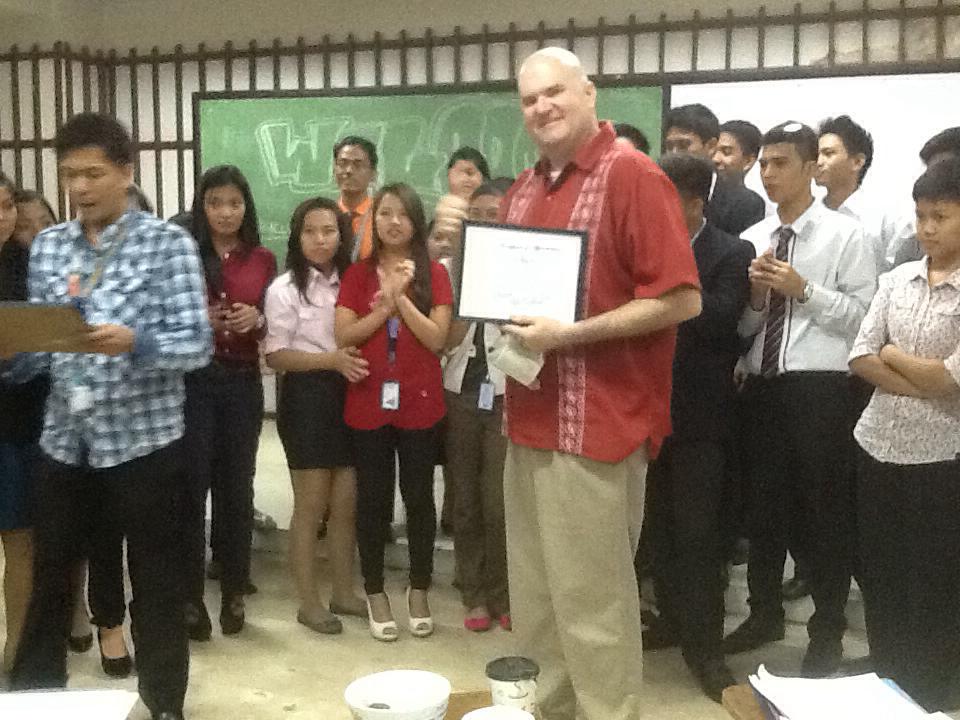
Anyway, El asked me to be part of a panel of judges for the class as they gave group presentations based on marketing plans that they developed. The plan was based on a project they had been working on for a while which is to set up an operate as a small business. It’s a great way to train future entrepreneurs and would be marketing majors and it made me feel a little like Simon Cowell.

I was honored to be one of three judges and we spent about two hours as the five groups of 5-10 students each presented their plans. And the best part was all of the 5 groups had set up food sales businesses and had samples. It was a lot of fun and the food was masarp (Tagalog for delicious).

As each group presented their plan I gave them feedback mostly on how did they validate their assumptions, did they collect any data, did they survey, how social media could play into their plans, etc. In all cases, I stressed the importance of showing data and visualizing it in ways that could be more impressive to potential investors.

I hope my feedback and advice helped them fine tune their marketing strategies and I would love to see them again when they are ready for OJT “on the job training” for their college internship requirements.

It was a lot like the TV show SharkTank but with great snacks! 🙂

How I Use Logic As An Analyst

Here is a follow up to the student I am helping with her class assignment on Logic… She asked me how I apply logic as an analyst with an example and here is what I came up with.

How I Use Logic As An Analyst

According to Webster’s Dictionary, logic is “the science or art of exact reasoning” and analyst is “someone who is skilled at analyzing data”. The two definitions are where I start when how I think back to the application of logic during my career as an analyst.

To solve business problems you need data. You need to identify the right data, analyze it and communicate your results. In all three aspects of analysis work you need to employ logic.

Basil Rathbone as Sherlock Holmes

When you are given a business problem to solve, say how to determine a market for a new project or trying to figure the cause behind a slowdown in production, you need to start with data. What data you get, how you get it and where you get it from is all driven by a combination of your business experience and logic.

Logic helps you eliminate data that useful to the problem at hand. One time when I was looking for data on current remittance flows to China, a logic driven approach would be to start looking at Chinese economic websites. Which I did using the science of logic.

Once I got some data sources on remittances from the US to China, I then used logic in my analysis. Is the data current? Is the source reliable? Is it relevant? Logic dictated that I not use sources that were more than a year old, where not from government sources and where directly providing data on remittances to China.

In my analysis I saw several patterns, most remittances where going to only two provinces. That is logical when you research to see that most immigrants to the US come from these two provinces.

And when I was ready to communicate my results, my choice on which application to use, what tone to use in my language and what visuals to use were all driven by my knowledge of the audience.

Since this was for a senior manager, well-versed in remittance patterns and very comfortable with big data speak, I just cut and past some charts from Excel into an e-mail and gave him 2-3 bullet points about the patterns I saw and noted my source. It was logical that he didn’t need a lot of explanation or easy to see analysis given his pedigree.

If this had been for a more general audience of say fresh grads who have never looked at this kind of data before, it would be logical to use PowerPoint, supply several descriptive notations and some easy to digest visuals that show remittance trends.

Trying to provide students with a report designed for senior managers is illogical for someone like myself with a lot of business analysis experience.

In the end, it is my opinion that few career paths call for a more consistent application of logic then does that of an analyst.

Analytics Leadership – DMAIPH specializes in arming the Data-Driven Leader with the tools and techniques they need to build and empower an analytics centric organization. Analytics leadership requires a mastery of not just analytics skill, but also of nurturing an analytics culture. We have guided thousands of Filipino professionals to become better analytics leaders. Contact DMAIPH now at analytics@dmaiph.com or connect with me directly to discuss a uniquely tailored strategy to ensure you are the top of your game when it comes to Analytics Leadership.

Analytics > Based on the Principles of Logic

One of my trainees recently asked me for some help with an assignment she had in her philosophy class. Now I am such a Star Trek fan aka Trekie, that of course the first thing that comes to mind in the character Spock.

I imagine that is anyone ever took a formal survey of analysts and analytics professionals, most would list Spock high on their list of “cool characters.” The use of logic to solve problems is a key plot point in several episodes and movies. Anyway, I digress…

The assignment is to look at the paperwork in a business and determine how logic and logical principles are applied. I look at logic as being used primarily in two different facets of paperwork.

1. to set priorities… using deductive reasoning to decide what priority is more important and which one to work on first. This is something that is hard to teach and a common interview question. Trying to determine if a person knows how to establish priorities tells you a lot about how logical they think.

2. to establish procedures… logic is used to set up a process like an assembly line or a pipeline where things are done in a routine that is most logical. Being efficient and optimizing a process require a lot of logic in the design and implantation of the process.

So for paperwork… the paperwork that gets done first is the highest priority like payroll… logic dictates that paying employees is the most important and logic helps you set up a process for paperwork… like if a form needs three signatures, you would use logic to set the order of whose signature you get first, second and third

When you have a problem with a process or too many priorities to accomplish all, you use logic to help you solve the problem.

Analytics, or the discipline of using data to drive decision-making in a business, is closely related. Logic is used to identify the data you need, logic is required to interpret the analysis and logic is needed to determine how bet to communicate your findings.

When you look at any business (or government, organization, structure, etc.), you need to employ logic to make that business run and paperwork is a big, big part of the resulting of using logic. Forms, reports, summaries, etc… they are all receptacles of logic that are used to keep things moving.

So when asked why I do what I do when it comes to the paperwork in my business, I am going to tell you because its logical to do it that way. Or as Spock might say, “Logic dictates how and why we use paperwork.”

General Analytics – Analytics is the application of using data and analysis to discover patterns in data. DMAIPH specializes in empowering and enabling leaders, managers, professionals and students with a mastery of analytics fundamentals. Contact DMAIPH now at analytics@dmaiph.com or connect with me directly to find out what we can do to help you acquire the analytics mastery you and your organization need to be successful in today’s data-driven global marketplace.

Revisiting the “Services Shift”

The world is currently witnessing a fundamental reorganization in the way services are delivered to customers. This is what is behind the movement to outsource. It’s a lot more than just saving money by shipping jobs overseas. Harvard Business Professor Robert E. Kennedy, call this the “Services Shift”. The globalization of services, in which different tasks are being carried out by different individuals in different locations, is about gaining access to the best combination of talent, resources and markets.

I bring this up because I recently blogged about Medical Transcription work being done in the Philippines. I came across a blog sharing some of the opportunities for nursing graduates in the Philippines to consider a career as an MT for a BPO company. The blog was not the most well written one, but it captured the sense of optimism for those looking for work in a way that perhaps before they had not considered. That really appealed to me so I used it in my blog.

I expected to get some negative reaction, because MT work is one of the areas of employment in the US that has been significantly impacted by the outsourcing of work overseas. MT work is not easy, and those that do it wherever they are employed requires a lot of skill, training and diligence. I see that with the team I’ve been working here in the Philippines. However, in my efforts to share that good story, I ended up also upsetting some hard-working Americans who have seen MT opportunities go abroad. And that made me think of this book the “Services Shift”.

Kennedy quotes several factors that are at play when industries are “outsourced”, they are:
* Technological Innovations like easy access to the internet and stored data.
* Emerging Market Growth in traditionally closed markets
* Global Macroeconomic Liberalization of government polices toward trade
* The Corporate Imperative to both reduce costs and improve quality
* The Convergence of a Global Business Culture based on the English language and American business models.

Given these factors, its easy to see how countries like India and the Philippines have taken advantage of situation and offered MT services as an outsourcing option. To that end I am working with a Philippines based company that is offering it MT and Coding services to companies in the U.S. I have made the choice to build my business on being part of the “Services Shift” and I am looking for like-minded people who see the opportunity to collaborate and find ways to take advantage of their experience and use it in a global partnership.

Just Do It… the best motto ever!!!!

From My recent Facebook status update “10 Days…. Two Hotels, Five Malls, Seven Business Proposals, Three Worship Services (including one in Tagalog), Added Two More Speaking Engagements, Interviewed Five, In the middle of two data projects, Kicked off a two month social media project, Blogged Everyday, Added 100’s of LinkedIn Connections, and I’m Just Getting Started!”

You see a lot of inspirational quotes out there, as people try and find the energy to get up everyday and go about their lives. Personally, the Nike one is the best ever. Its so simple, but so powerful. It is equal parts inspiration, motivation and achievement.

Why? Because its the key to success. All of the strategies, self-help books, business plans, meetings with experts, etc… none of them mean as much as just getting out there and doing things!!!!

If anyone were to ever ask me what is the secret to my drive? What’s behind my passion? That’s the answer… Just Do It!

th

Social Media Analytics… It’s not just a marketing tool

Most people I talk too think of Social Media Analytics in terms of a marketing tool. How many Likes, Shares, Follows, etc are my posts getting. Some take it a bit further to look at engagement factors as well. And a very few use it to measure the Return On Investment when it comes to the cost benefits of doing social media marketing.

All of the big social media sites like Facebook, LinkedIn, Twitter, etc. have built in Analytics tools to help businesses see the impact of their social media efforts in theses terms.

But who is using social media to listen to their customers? Again many have someone responsible for monitoring sites to address customer complaints. Some have teams that do this 24/7 and try to spin every negative post into a positive. And a few actually are proactive in engaging customers via social media by anticipating needs.

And who is using social media to keep track of their competitors? Again some do follow them. And a few actually track competitor behavior and use their findings in setting strategy.

And only a few layer their social media Analytics on top of demographics. LinkedIn and Facebook have built in demographics right there with their Analytics available to users.

So I guess the question is are you getting the most out of social media?

Is Analytics more an art or is it more a science? 3 of 3

data1Recently, a friend of mine replied to a post asking me for more details about how I would analyze and mitigate risk in a business…. “the details are a little thin. As a former professor of business decision science, I would like to read more about the model building tools and techniques of how you do it.”

My reply was “That’s a great question Chris. As a blogger I try to not go into too much detail in these posts as most of my audience is relatively unfamiliar with concepts like Big Data, Business Intelligence Applications and Predictive Analytics. That said, I can think of a couple of ways to reply to your comment. I often say that Analytics is as much an art as it is a science. So, I will craft two blog response one for the artists and one for the scientists.” And then I will conclude with my own unique approach to analytics.

So how do I make decisions? And more importantly to respond to Chris, how do I empower other to make more data-driven decisions? There are three parts to the answer to these questions.

Let’s start with my background as an educator. Originally my plan was to teach history that’s what my BA is in. I’ve always been drawn to history as to me it’s all about understanding relationships between people in the past that affect the world we live in today. I also obtained a Master’s Degree in Education to teach at the college level, because I not only wanted to be able to teach the subject matter, but understand how people learn. So the first questions I always ask in any situation is who is the audience and what is the best way for them to relate to the outcome. Ultimately, its understanding the context of who, why, when, why and how is involved in the decision-making.

The next factor is my own insatiable quest for knowledge of all kinds. As I kid I used to read encyclopedias and memorize baseball statistics. I am always reading. I read anything and everything and I am often read 3-4 books at the same time. When I want to kill time, I go to Wikipedia and just start reading about stuff that interests me. So after being an avid reader for 40+ years, being very strong at research throughout my academic career and having spent 15 years doing research and analysis for Wells Fargo, I know how to find data. Knowing where to find the data you need to make decisions is something I am very, very good at. And not just random data, but finding data that I know will provide the information needed for analysis and ultimately decision-making.

The final part is using the tools available to analyze and present the data. The science and the art of analytics. I apply everything I have learned both working as an analyst and being an educator to connect the dots. To help a person or a business get from A to B and decide whether the should go to C or D. I have a working knowledge of so many tools and methodologies, and if I need to work with one I am not familiar with I learn it.

My approach to decision-making is similar whether it be for huge corporate clients or small business. It means understanding the whole data process, understanding how decisions are made in that business and what kind of tools will best serve the decision makers. So my answer to Chris, I assess my client/audience/student to see what solution will best help them use the data they have around them to make good business decisions. In the end, its all about making data-driven decisions and I have my own unique way of showing you how.