Just Do It… the best motto ever!!!!

From My recent Facebook status update “10 Days…. Two Hotels, Five Malls, Seven Business Proposals, Three Worship Services (including one in Tagalog), Added Two More Speaking Engagements, Interviewed Five, In the middle of two data projects, Kicked off a two month social media project, Blogged Everyday, Added 100’s of LinkedIn Connections, and I’m Just Getting Started!”

You see a lot of inspirational quotes out there, as people try and find the energy to get up everyday and go about their lives. Personally, the Nike one is the best ever. Its so simple, but so powerful. It is equal parts inspiration, motivation and achievement.

Why? Because its the key to success. All of the strategies, self-help books, business plans, meetings with experts, etc… none of them mean as much as just getting out there and doing things!!!!

If anyone were to ever ask me what is the secret to my drive? What’s behind my passion? That’s the answer… Just Do It!

th

Social Media Analytics… It’s not just a marketing tool

Most people I talk too think of Social Media Analytics in terms of a marketing tool. How many Likes, Shares, Follows, etc are my posts getting. Some take it a bit further to look at engagement factors as well. And a very few use it to measure the Return On Investment when it comes to the cost benefits of doing social media marketing.

All of the big social media sites like Facebook, LinkedIn, Twitter, etc. have built in Analytics tools to help businesses see the impact of their social media efforts in theses terms.

But who is using social media to listen to their customers? Again many have someone responsible for monitoring sites to address customer complaints. Some have teams that do this 24/7 and try to spin every negative post into a positive. And a few actually are proactive in engaging customers via social media by anticipating needs.

And who is using social media to keep track of their competitors? Again some do follow them. And a few actually track competitor behavior and use their findings in setting strategy.

And only a few layer their social media Analytics on top of demographics. LinkedIn and Facebook have built in demographics right there with their Analytics available to users.

So I guess the question is are you getting the most out of social media?

DMAI 2.0 > Recruiting the top analytical minds in the Philippines

420

DMAI aka Decision-Making, Analytics & Intelligence, is a Philippines based company offering cutting edge of analytics solutions for both domestic and international clients.

DMAI is launching several initiatives and are looking for top analytical talent to join of rapidly growing team. Everyone on the DMAI team should have a natural curiosity and willing to take the initiative.

In addition, we look for the several general requirements across all positions. They include:
• Above Average English
• Strong Internet Research Skills
• A Positive Attitude
• A Willingness to go Above and Beyond

We are currently recruiting for the following positions:
1. Data Analyst
2. Analytics Project Manager
3. Administrative Assistant
4. Social Media Analyst

The Data Analyst position requires above average experience with MS Excel. Analysts should be very comfortable with pivot tables, using charts & graphs, and managing 100,000+ rows of data. Analysts also need to have experience taking data and analysis and building PowerPoint decks that give client actionable insights and recommendations. Experience with joining data sources and writing queries using SQL is also a must.

The Analytics Project Manager position requires excellent MS Excel and PowerPoint skills. The PM also needs to have a background with analytics. This position is expected to already have extensive PM experience and be well versed in Project Management methodology and comfortable managing projects with stakeholder located in different countries. Excellent English and Communication skills are a must.

The Administrative Assistant position requires previous experience with recruiting and with general office administration. The AA will support the DMAI Executive team and travel to various meetings and events to provide administrative support to training and speaking engagement event. The AA should also have some experience with HR functions like payroll, SSS and benefits. Excellent English and the ability to multitask on the go are must have skills.

The Social Media Analyst position requires a special person who is equal parts blogger/social media power user/seo analyst. Experience managing social media sites and pages is required. The SMA must have outstanding written English skills and able to write engaging content. The SMA must also have a passion for analytics and be a user of social media analytics tools.

Currently we are only looking for candidates located in Metro Manila, but may consider candidates living in the provinces in the near future.
To express your interest in any of the open positions, please send your most up to date resume to analytics@dmaiph.com

This is cutting edge analytics for support of clients abroad and you will get the chance to work with me, one of the leading analytics minds in the Philippines. If you are interested in learning more, please let me know immediately as we hope to have the team in place within a month or so.

We offer very competitive compensation based on experience and have a lucrative bonus plan as well.

To learn more about DMAI, follow us at any of the social media sites listed below:
> Facebook >>> https://www.facebook.com/dmaiph
> YouTube >>> http://youtu.be/blx8IuHsmCA
> LinkedIn >>> http://ph.linkedin.com/pub/dan-meyer/4/771/675
> WordPress >>> https://dmaiph.wordpress.com/
>Twitter >>> https://twitter.com/BPOElite1

Thanks for your consideration. Please send me your most updated resume if you would like to be part of this amazing team.
Sincerely,

Dan Meyer
President & Founder
DMAI

An Inside Look At Analytics In Action > U.S. Census Data

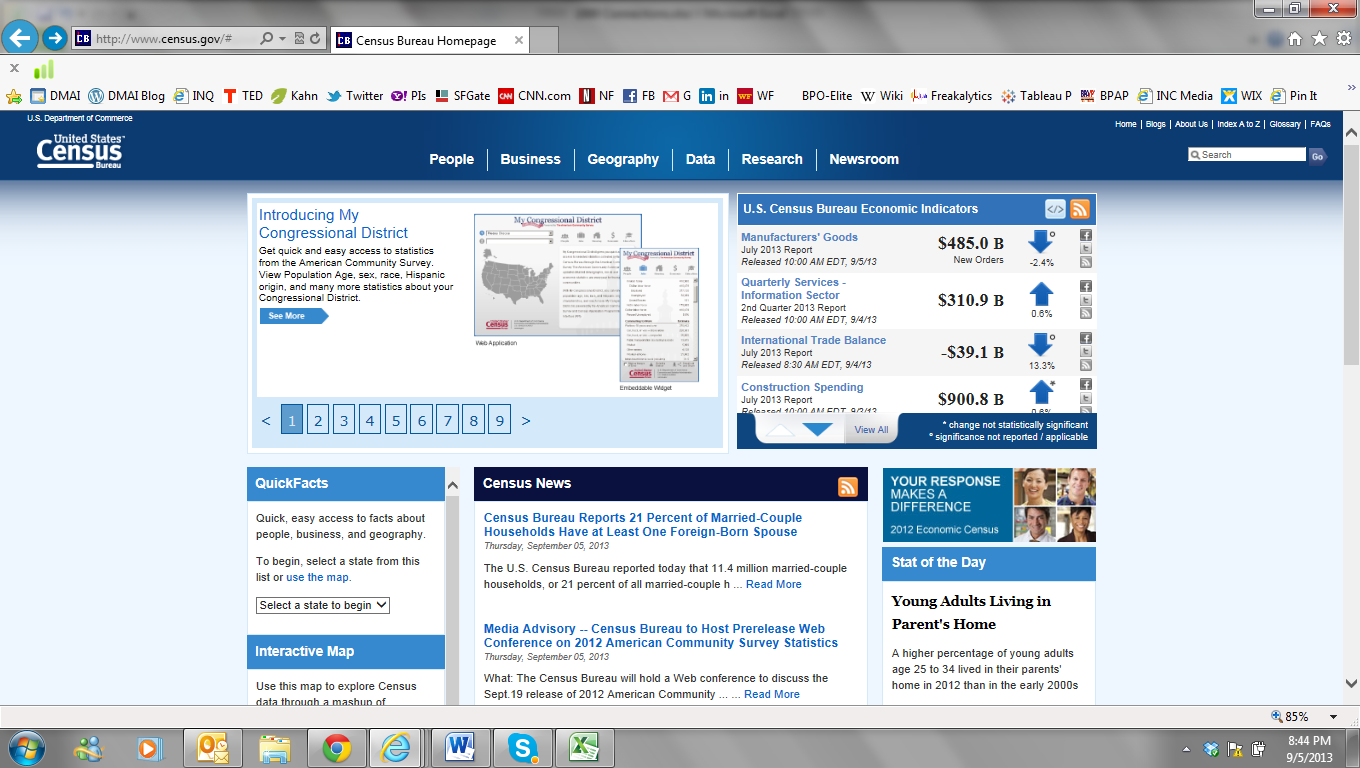
US CensusIf you are working with American clients or customers, one of the most useful tools any analyst can master is the U.S. Census Data. http://www.census.gov

It is #1 source for current population data and the latest Economic Indicators and is culled from the nationwide census conducted in the US every ten years. The last collection was in 2010. However, the US Census Bureau also collects data from smaller sample sizes every year.

When I was with Wells Fargo, I used census data extensively to help us understand the demographics of targeted markets. I have also used data from the site for building competitive profiles for BPO Elite and DMAI clients.

When you go to the site (www.census.gov), it can be a little overwhelming due to the massive amount of data collected and made available. There are some videos, webinars, in class trainings and lots of learning tools available to master how to make the best use of the data.

For now though, lets focus on one particular demographic data point that I will explain how to find and use. I have a client who wants to know % of households in certain Zip Codes around the Dallas, Texas are that have at least one person over 65-year-old in that household.

Step One is knowing where to go. In this case, we will choose the data menu and then American Fact Finder. As you can see if you view the site… the choices can be quite intimidating to those not used to this site. Type in Dallas County, Texas and you will get access to all kinds of demographic data. In this case we will look at the 2010 US Census. You can see that 8.8% of the population is 65 and over.

For the sake of this blog I wont bore you with details, but then we take that data and we look at it at the zip code level. And then we can see what parts of Dallas County are “older” than others. This will help out client target his marketing efforts since his product is geared towards customers 65+

So if you have a business where you need demographic data for the US, this is the place to go. DMAI is happy to help you find ways to unlock this incredible source of data and empower your business with more analytics intelligence!

Is Analytics more an art or is it more a science? 3 of 3

data1Recently, a friend of mine replied to a post asking me for more details about how I would analyze and mitigate risk in a business…. “the details are a little thin. As a former professor of business decision science, I would like to read more about the model building tools and techniques of how you do it.”

My reply was “That’s a great question Chris. As a blogger I try to not go into too much detail in these posts as most of my audience is relatively unfamiliar with concepts like Big Data, Business Intelligence Applications and Predictive Analytics. That said, I can think of a couple of ways to reply to your comment. I often say that Analytics is as much an art as it is a science. So, I will craft two blog response one for the artists and one for the scientists.” And then I will conclude with my own unique approach to analytics.

So how do I make decisions? And more importantly to respond to Chris, how do I empower other to make more data-driven decisions? There are three parts to the answer to these questions.

Let’s start with my background as an educator. Originally my plan was to teach history that’s what my BA is in. I’ve always been drawn to history as to me it’s all about understanding relationships between people in the past that affect the world we live in today. I also obtained a Master’s Degree in Education to teach at the college level, because I not only wanted to be able to teach the subject matter, but understand how people learn. So the first questions I always ask in any situation is who is the audience and what is the best way for them to relate to the outcome. Ultimately, its understanding the context of who, why, when, why and how is involved in the decision-making.

The next factor is my own insatiable quest for knowledge of all kinds. As I kid I used to read encyclopedias and memorize baseball statistics. I am always reading. I read anything and everything and I am often read 3-4 books at the same time. When I want to kill time, I go to Wikipedia and just start reading about stuff that interests me. So after being an avid reader for 40+ years, being very strong at research throughout my academic career and having spent 15 years doing research and analysis for Wells Fargo, I know how to find data. Knowing where to find the data you need to make decisions is something I am very, very good at. And not just random data, but finding data that I know will provide the information needed for analysis and ultimately decision-making.

The final part is using the tools available to analyze and present the data. The science and the art of analytics. I apply everything I have learned both working as an analyst and being an educator to connect the dots. To help a person or a business get from A to B and decide whether the should go to C or D. I have a working knowledge of so many tools and methodologies, and if I need to work with one I am not familiar with I learn it.

My approach to decision-making is similar whether it be for huge corporate clients or small business. It means understanding the whole data process, understanding how decisions are made in that business and what kind of tools will best serve the decision makers. So my answer to Chris, I assess my client/audience/student to see what solution will best help them use the data they have around them to make good business decisions. In the end, its all about making data-driven decisions and I have my own unique way of showing you how.

Is Analytics more an art or is it more a science? 2 of 3

gapminder-data-visualization-psfk1 - CopyRecently, a friend of mine replied to a post asking me for more details about how I would analyze and mitigate risk in a business…. “the details are a little thin. As a former professor of business decision science, I would like to read more about the model building tools and techniques of how you do it.”

My reply was “That’s a great question Chris. As a blogger I try to not go into too much detail in these posts as most of my audience is relatively unfamiliar with concepts like Big Data, Business Intelligence Applications and Predictive Analytics. That said, I can think of a couple of ways to reply to your comment. I often say that Analytics is as much an art as it is a science. So, I will craft two blog response one for the artists and one for the scientists.” And then I will conclude with my own unique approach to analytics.

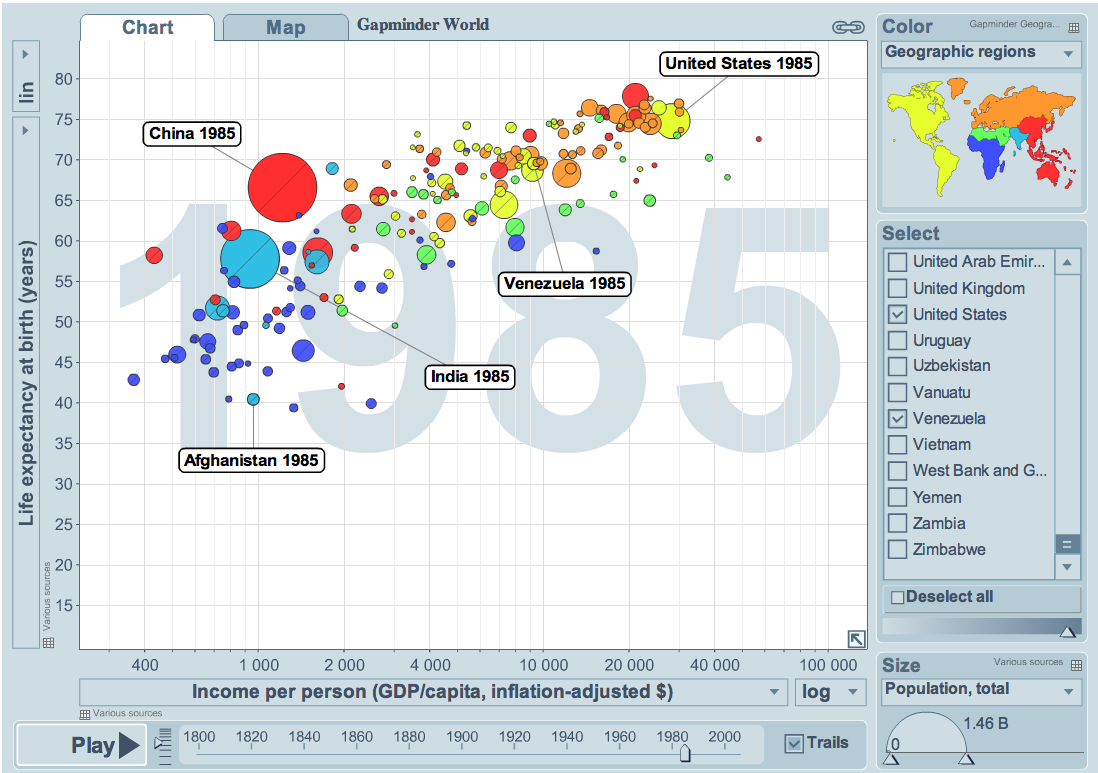
So yesterday we covered the science side, today lets look at the art side. They say a picture is worth 1000 words, well I agree and would take things further and say a good pie chart is worth 10000 rows of data. 🙂

Analytics as an art form is a more appealing to the average person, because most people don’t like math. They are afraid of having to use excel and rows and rows of data confuses them. This is why we have analytics, so people who do like math, numbers and excel can figure things out for the majority who don’t.

One of the big buzzwords going around right now is storytelling. Businesses need to engage customers in the way people are engaged by a good story. Marketing team are charged with connecting with an audience in the same way a great film maker or author does. And to do this, marketers have to be very good at getting their data and analytics to a point where it can tell that story.

Data visualization is one of the most powerful skills an analyst can use. Whether it be by using charts and graphs in excel, an info graphic or a business intelligence tool like Tableau that creates data visualizations; analysts can now be artists as much as scientists.

So what does this have to do with my friend Chris’s question about business decision science. It used to be that most decision were made after a long process of drafting requirements for the IT team, a long development cycle and static reporting put into place. However, that’s old school. Now good leaders and decision-makers access data themselves and do a lot of their analysis by playing around with the data.

Knowing what data to pull, how to analyze it for patterns and trends and putting into a format where it can be used by decision makers is still the same, what’s different if the ability to get it to tell a story to the audience. My all time favorite master of data visualization is Dr. Hans Rosling, If you don’t know who he is, check out his site http://www.gapminder.org

Watching him in action is the best way to see why I think that analytics is more of an art then a science. You can have all the data in the world, and you can have great analytics talent working with it using cutting edge technology. But if you can’t use that data to influence your audience in powerful ways, then you are missing the boat.

Sharing a friend’s article – The War for Talent Rages in SE Asia!

http://www.sunstar.com.ph/cebu/business/2013/08/27/toral-digital-recruitment-insights-300020

My friend Janette recently wrote, “THE war for talent is real. Companies need to start treating people they recruit similar to responding to customer inquiries or complaints online. The slowness in responding to applicants can be the difference between hiring a highly qualified applicant now or taking only what is left in the market.”

This is one of the points I emphasize in my Recruitment Analytics trainings classes. There are so many ways that a good recruiter can make a difference, but I think the most important is engaging their candidates in a timely manner. If you work with good recruiters, you see that they manage their candidate pipelines very well… they never let them feel like they are in the dark and the recruiters create an atmosphere of approachability.

In short they follow-up often. And the digital world allows us to do this so much easier than ever before.

Janette adds, “Companies should level up and embrace digital at the same level as marketing uses it to reach out to prospects and customers.” They can do this by using the following tools:
> Use websites as a tool not only to attract customers but also prospective employees.
> Use social networking tools to build their digital influence and make themselves accessible online.
> Foster an open communication culture using the various modes of communication we have available.

As one of my best friends and colleagues at BPO Elite, Rachelle explains to me… in the end the most important thing is to find the right person for the right position. To do this you will see good recruiters embracing new technologies and take full advantage of the digital resources available to them.

And of course the best thing about using these digital resources is that they are chock full of analytics. LinkedIn, Bullhorn, Indeed, Facebook, Twitter, etc. all offer free analytics tools embedded in the applications that allow you to see who is seeing and following you. For a recruiter, it’s an amazingly powerful way to stay engaged with their candidates because they can see patterns and trends in who they interact with.

For more info on what Janette is up to, you can follow her at https://www.facebook.com/digientrepreneur

Is Analytics more an art or is it more a science? 1 of 3

PrintRecently, a friend of mine replied to a post asking me for more details about how I would analyze and mitigate risk in a business…. “the details are a little thin. As a former professor of business decision science, I would like to read more about the model building tools and techniques of how you do it.”

My reply was “That’s a great question Chris. As a blogger I try to not go into too much detail in these posts as most of my audience is relatively unfamiliar with concepts like Big Data, Business Intelligence Applications and Predictive Analytics. That said, I can think of a couple of ways to reply to your comment. I often say that Analytics is as much an art as it is a science. So, I will craft two blog response one for the artists and one for the scientists.” And then I will conclude with my own unique approach to analytics.

So let’s tackle the science angle first. In corporate and academic circles, analytics is looked at primarily as a science. You have millions of pieces of data, you take that data and you analyze it and then you use the analysis in your decision-making. There is a lot of science in this approach.

I often say that in the past two days we have created more data than we created in the entire history of human existence up to the past few years. This is big data… it’s mostly unstructured and its challenging to manage. It takes an understanding of how data is collected, stored, accessed and disseminated. This is why analytics usually starts with the IT team. They manage the databases that do all these things. SO as a scientist, you need to have a lab… in most cases this is a database or data warehouse. How easy is it to identify, inventory and integrate data in your business? Does you lab contain all the raw materials you need for your experiments?

Once you have your data, you need tools to analyze it, to look for patterns and discover new opportunities or to identify risks. There are many instruments you can use like a scientist uses a microscope. Excel is the most common, but there is an ever-growing number of analytics tools that you can use to glean more intelligence from your business. Some of the tools are very complicated and require a lot of training, other are free and can be learned in a matter of hours. SO as a scientist, you need to use the right tool at the right time to get just the analysis you need. What kind of tools are you using for analysis? What kind of tools are you using for reporting and sharing information? If you are using excel to design Powerpoint Decks to share via email, then I have news for you…. you are headed towards joining the dinosaurs. 🙂

And the final part that to me is the most scientific… applying the tools. There many methodologies out there about decision-making. You are starting to see a lot more college and post-graduate course work in decision-making… this is what my friend Chris is talking about in his comment. Having the materials and the tools are no good if you don’t have tried and tested ways of using them so you can trust the results of your analysis. If you want to get into predictive analytics to try to guess right about sales trends or market direction, you need to have a lot of science on your side.

Most businesses struggle having the analytics in place to fully understand where they have been and where they are now. Getting into a science driven way to predict the future requires data, tools and methodologies that you traditionally only find in big companies that invest in well-trained and/or educated professionals. When you have that then you can really benefit from the science side of analytics.

However, are you just as well versed on the art side of the equation? And what if your business doesn’t have the capability of investing in the same things the big boys use? How can you maximize the art side of things? Let’s talk about that in our next blog!

Learnings from a friend’s “Elements of a Losing Culture”

http://fortune100coach.wordpress.com/2013/08/26/elements-of-a-losing-culture/#comment-202

I just read my good friend and mentor Bjorn’s blog post and it made me think about how closely tied a business culture is to the analytics used in that business. Bjorn posted, “Success leaves clues and so does its opposite. Reality checks are important so we can tell where we are and properly assess what needs to be done. When we can’t seem to find the clues indicating a successful culture it’s time to look for its opposite.”

Let’s look at that comment from an analyst’s prospective. One of the clues I look for in a successful organization is an understanding of how decisions are made. Are they top down? Are the inclusive? And most importantly to me, how much data is analyzed prior to making decisions. For the most part great companies make great decisions and this feeds a successful and healthy culture. When decisions are made off the cuff, with little input from the ranks and without the benefit of good data… you get a recipe for a losing culture.

Bjorn mentions several other indicators of a Losing Culture. I want to add some data driven perspectives to them as well.

1. Lack of clear target, vision, etc. Having good metrics to monitor progress. Setting goals and then reporting and communicating them. There are key ways you can measure if a business has a healthy focus.

2. Lack of alignment. People don’t know how to compare themselves or even worse improve themselves. There is no sense of the big picture and little effort to work across business lines or help other teams. You need a lot of visualization of data and analysis to show how it all fits together. Dashboards and internal web sites, using visualizations like info graphics and data visuals can help people feel aligned and give them a sense of where they fit in.

3. Lack of authenticity. Know if your customers care. Knowing if your employees care about your customers and each other. Knowing if you stack up well with the competition. Knowing what about your business causes others pain and what causes satisfaction. Using surveys, focus groups and other tools to gather feedback will help your business be authentic to your customers and your employees. You cant really have loyal and engaged customers if you don’t come across to them as authentic.

To learn more about Bjorn and his consulting business, you can follow him here: http://fortune100coach.wordpress.com/

Big Data and Analytics: How to avoid going the way of the Dinosaur!

jurassic_parkhttp://www.linkedin.com/today/post/article/20130822181033-251829763-big-data-blurring-risk-and-uncertainty

“More than 99% of all species that have ever existed are now extinct. The causes of species extinction include the predictable — predator-prey relationships, for example — to the unpredictable, such as an asteroid collision. Similarly, 90% of Fortune 500 companies since 1955 no longer exist. Businesses, like species, face perils that range from identifiable risks to true uncertainty or unknowns. Uncertainties pose unknowable and hence unmanageable threats. Risks, however, can be explicitly accepted, avoided, or transferred. Organizations that are fully exploiting big data are actively uncovering and converting uncertainty into known risk as well as addressing and exploiting competitive vulnerabilities.”

The following three big-data analytics keys are critical to supporting a proper understanding of risk versus uncertainty — and ultimately leveraging risk for competitive advantage.

1. Healthy Analytics Culture. The first key to using big data analytics to survive is empowering business owners and leaders with the ability to use data to drive decision-making. There is so much data to analyze, so using cutting edge analytics tools and employing curious and proactive analytical professionals help maintain a healthy culture.

2. Segmenting Risks. The second key is know how to identify and classify risk. When you come across a risk in your business you have to assign the right team or person to investigate the risk. To understand if it should be accepted, avoided or somehow transferred. Accepting risks means you have to monitor it and make sure its controllable. Avoided risks require changes in strategy or process, often needing people to lead a new way to do things. Transferring the risk means you need to trade-off things or hiring someone else to take the risk from you. Big Data analytics allow you to investigate, assess and segment risks.

3. Accept, Avoid or Transfer Risks. Once you have decided how to segment risk, then you need to take action. You need to set up a mitigation strategy, you need to monitor the risk and you be capable of re-segmenting the risk if it changes.

Businesses that can access their big data, that can analysis it and that use it to drive decision-making will survive. Ones that do not will go out of business, be acquired or just go the way of the dinosaurs.