13 Months in the Philippines – Lesson 2 – June 2012 – Training is My Passion

522Pasay City, Metro Manila, Philippines

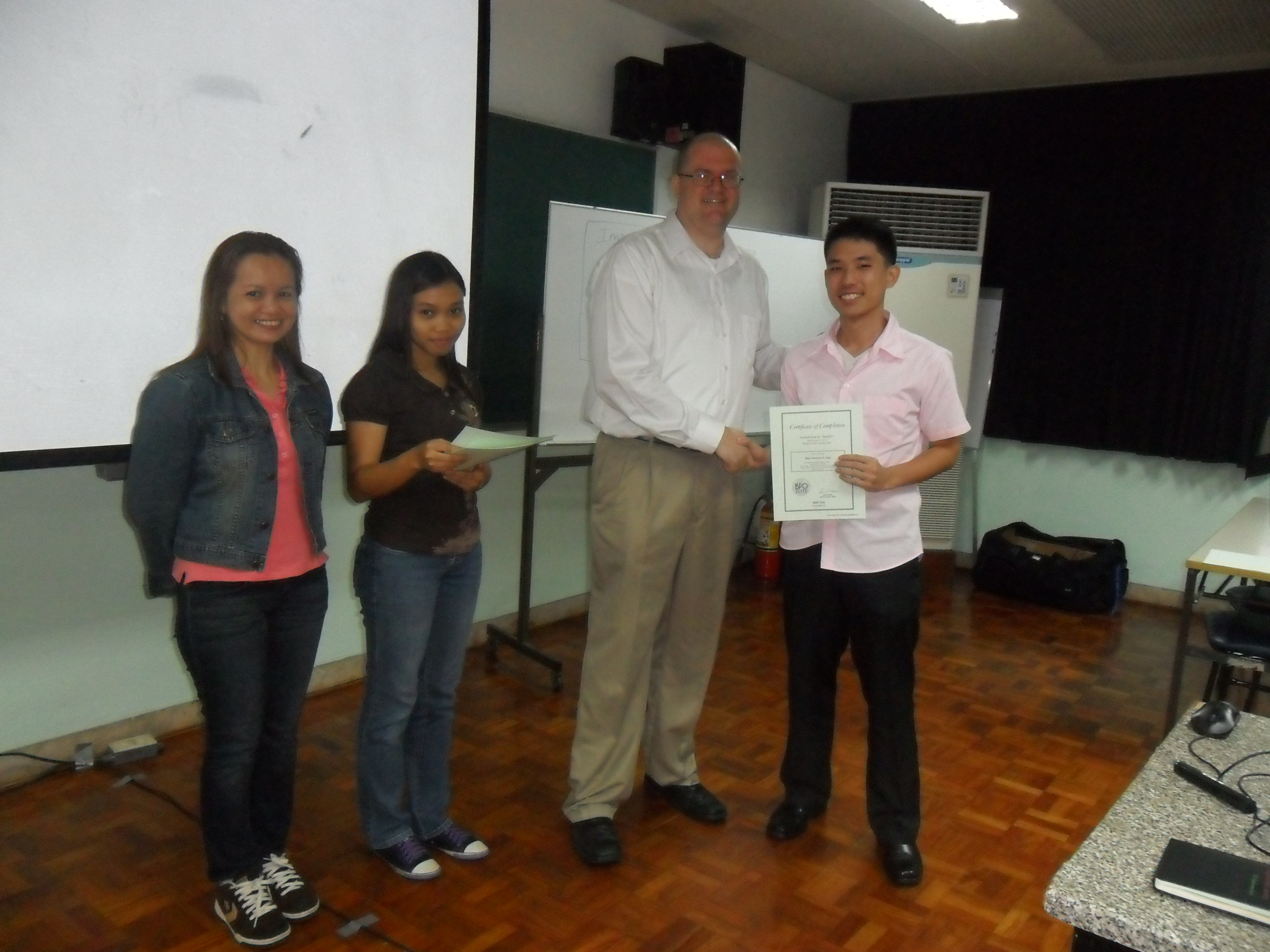
I did a trial run of the Introduction to Analytics training back in December 2011 with some interns and business partners, which helped me prepare a two-day training class. I launched the two-day class with the target of fresh grads in late May 2012, and I conducted several of the classes over the course of the next six months. It was in June however that I really figured out that I was an amazing trainer and that I could enchant an audience by talking about analytics.

I have always liked being in front of an audience and being empowered to talk about things I am passionate about it. I get a huge rush of adrenaline that can last for several hours. This calling originally led me to traditional classroom teaching but after several misadventures post graduate school, I took the job with Wells Fargo to pay the bills. Fifteen years later I left Wells to do training full time. In the interim I did a lot of ad-hoc and informal training in various way at Wells although I never had trainer in the title.

Per Wikipedia, a Trainer is a person who educates employees of companies on specific topics of workplace importance. While a teacher is simply who provide schooling for pupils and students. I have found that I am exactly in the middle. And there are very, very few people who can train like a teacher. People who can provide hands on, useful content in a short time frame, but deliver it in way that has the empowering effect of taking an actual academic style class are worth their weight in gold. These are the great trainers or favorite instructors who end up becoming speaker and lectures. They have both the ability to train on skill and teach on knowledge. This is what I learned about myself last June.

From an analytics standpoint, I learned a lot about how to construct a training program. Budget, Recruitment, Venue Management, Staffing, Marketing, etc. I learned a lifetime worth of lessons in a few months. I was able to look at each of these topics and find data to compare what I was doing to other benchmarks. Am I efficient, am I cost-effective, am I marketable. Lots and lots of data to bring into my analysis of how to grow my business.

Analytics Tool > Microsoft Excel > http://office.microsoft.com/en-us/excel/

Analytics Concept > Big Data > http://en.wikipedia.org/wiki/Big_data

YouTube Resource > http://www.youtube.com/watch?v=jhjuyH4RTrM&feature=share&list=PL7EC252B253873D5D

My Analytics Story – My passion is solving problems by bringing together the best talent, cutting edge technology and tried and true methodologies. DMAIPH is all about empowering people towards better Decision-Making through the use Analytics and business Intelligence. This is what I do best. Contact DMAIPH now at analytics@dmaiph.com or connect with me directly for a free consultation about getting more analytics into your career and your business.

13 Months in the Philippines – Lesson One – Finding the Right People

Lesson 1 – May 2012 – Finding the Right People

Makati, Metro Manila, Philippines

I took a couple of trips to the Philippines in early 2012 to lay the ground work before committing 100% to moving there lock, stock and barrel. When I was there, one of the things I did was set up some interviews for my first BPO Elite employee.

elite-strategy-hi-res-21.jpg

Now don’t get me wrong, I ended up with an amazing employee who would become one of my best friends. But the process itself had some serious flaws. Let me break them down. And even though I have extensive experience in recruitment and hiring, I made many of the same mistakes in the process that most managers make. They put it on themselves to do it all, they are the only ones in on the decision-making, and they don’t really look at the available data to help them.

When recruiting. I found out the true power of LinkedIn. I networked with a couple dozen candidates, and narrowed it down to six to interview based on e-mail conversations before I left the US. When I arrived, I set up phone screenings with the six and ended up then conducting two final interviews. Pretty standard stuff and thanks to LinkedIn, all the candidates where qualified to be my very first employee, a recruitment specialist. However, I did all this myself. And even though I have partners and an assistant back in the US, I took it on myself. That’s lesson #1, you cant always do everything yourself. It takes up a lot of time and it makes others think you don’t need or want your help. Next time I do this, I need to delegate and be more inclusive.

The next thing I did wrong was that I didn’t have one of my partners interview with me. I based my decisions on my gut. Now as an analyst, I am kicking myself about this, but as a first time business owner… its a very common mistake. There is tons of data that shows that candidates hired after interviews with more then one person as much as a 100% chance to stick around longer than those interviewed solely by one person.

540

The final lesson that comes to mind is that I didn’t do a very good job of understanding the data available when it comes up to the recruitment industry in the Philippines. After being there a while and gathering data and insights, I over paid, I over promised and I over recruited. I hired two, at way more than the market price and I gave them pretty favorable terms. All things that more research would have uncovered.

So In the end it worked out, I got a great candidate who stuck with me thru thick and thin. I just wish I would have hired me the analysts to do the prep work for me the business owner. Hehe!

Analytics Tool > LinkedIn > http://www.linkedin.com

Analytics Concept > Marketing Analytics > http://en.wikipedia.org/wiki/Marketing_analytics#Data_and_analytics

YouTube Resource > http://www.youtube.com/watch?v=6jDjeNJrN14&feature=share&list=PL7EC252B253873D5D

My Analytics Story – My passion is solving problems by bringing together the best talent, cutting edge technology and tried and true methodologies. DMAIPH is all about empowering people towards better Decision-Making through the use Analytics and business Intelligence. This is what I do best. Contact DMAIPH now at analytics@dmaiph.com or connect with me directly for a free consultation about getting more analytics into your career and your business. 


13 Months in the Philippines

Updated 12/10/16…

I wrote this 4.5 years ago. As my 5 year plan to become a name brand in analytics in the Philippines comes to a close, I thought it a good time to select on the lessons of my first year. So I will repost these lessons from what seems like a lifetime a goal to see what I have truly learned from my adventures. 

After having a month of vacation, I been able to do a lot of reflecting on my 13 Months in the Philippines. My plan is to share with you some of the life lessons I learned from the experience. I had an amazing time, getting to live my professional dream and impacting hundreds of people. I also learned as many important lessons in my personal life as well. And since its an analytics blog, I will also include some analytics insights as well.

Introduction
Lesson 1 – May 2012 – Finding the Right People
Lesson 2 – June 2012 – Training is My Passion
Lesson 3 – July 2012 – Growing the Business
Lesson 4 – August 2012 – Mother Nature Strikes
Lesson 5 – September 2012 – Cracks in the Pavement
Lesson 6 – October 2012 – You Cant Go Home Again
Lesson 7 – November 2012 – Flying Solo
Lesson 8 – December 2012 – Holidays in the Philippines
Lesson 9 – January 2013 – New Beginnings
Lesson 10 – February 2013 – The Future is Bright
Lesson 11 – March 2013 – Missed Opportunities
Lesson 12 – April 2013 – The Wheels Come Off
Lesson 13 – May 2012 – Exit Plans
Epilogue

At the bottom of each blog post you will see links to various analytics tools, concepts and YouTube videos to help add more color to my experiences.

Hope you like it enough to follow along!

My Analytics Story – My passion is solving problems by bringing together the best talent, cutting edge technology and tried and true methodologies. DMAIPH is all about empowering people towards better Decision-Making through the use Analytics and business Intelligence. This is what I do best. Contact DMAIPH now at analytics@dmaiph.com or connect with me directly for a free consultation about getting more analytics into your career and your business. 

For Every Ten Analyst Postings, There Are Only Two Qaulified Candidates

http://www.cnbc.com/id/100792215

Wow! That was a pretty mind-boggling stat when I cam across it. So of all the analyst postings out there, only 20% will be filled with quality candidates. The problem is even more acute because of the diversity of needs. No two companies build business analyst or data analysts positions the same. And the combination of skills and experience make it almost impossible for fresh graduates to apply. I’ve seen data suggesting that there are only about 20,000-30,000 people out there working right now in the U.S. who would be considered top data analysts. Yet there are 100,000 job postings right now on indeed.com for analysts here in the U.S. I also previously published research on analytics in the Philippines showing a 33% year over year growth in the need for analysts on jobstreet.com.ph

However, there are a lot analytics professionals out there looking for work. How is this possible? Well, when you look deeply into the job descriptions, you see the complexity of the requirements. The mix of technical skills, soft skills and specific experience are pretty rate combinations. It is almost like managers are throwing together a wish list of the perfect candidate without any real thought on what the chances are of actually finding someone like that. Then to make the problem worse, they pass the requirements to HR who then take a checklist approach to recruitment and can’t find many if any candidates who match all the requirements. Its quite amazing actually. But not a good kind of amazing.

Back to Basics – Part 2: Analytics Lead To Data-Driven Decision Making

540Of all the lessons I have learned this past year, one that definitely rings truest is that people who use data in their decision-making always come out on top. Having spent 15 years in an amazingly successful company, it became obvious to me that almost everything being done in the bank has a lot of planning and thought behind it. And much more often than not the planning was both strategically and tactically guided by mountains of data. When I left Wells, there are 30-40 analytics postings on any given day, I just looked recently and there were 120 job postings requiring analytics skills.

Now having spent close to two years working with a wide range of other businesses as a consultant, its clear to me that few businesses have the same will to use data in decision-making. It takes a lot of foresight, tons of planning, and huge amounts of discipline to really get a handle on the data in your business, and very few smaller business are able to develop an analytics culture.

That the 2nd reason behind founding BPO Elite. I identified that the talent gap growing quickly when it comes to analytics training (the first) and I also identified the lack of strong analytics cultures in most businesses (the second). So we set up BPO Elite to train and place talent with these companies in dire need to better analytics.

I am helping a friend prepare a new product he is going to launch for his consulting business. On the surface it seems like a great idea with a decent sized market that should fairly easily make a decent revenue stream. But what does the data say? How big is the market really? What is the ideal price to make the product profitable? How best to market it to the target demographic? Most business leaders take a few hours to conduct actual research and then dive in and start spending money on marketing and product development. And this is where so many go wrong. They never looked deep enough to find the data to answer these questions with a more scientific certainty. So that is where I come in.

Empowering small businesses to make more data-driven decisions is where it all started!

One Year Later, It’s time to Get Back to the Basics – Part 1

As most of you know, I moved here one year ago from the United States. I left behind a 15 year career as an analyst with Wells Fargo to set up a business here in the Philippines to train analysts. Over the past year, my path has diverged and expanded to encompass several different analytics solutions including social media outsourcing, recruitment analytics training for corporate HR professionals and speaking engagements at schools promoting analytics careers in the IT-BPO industry. I have trained close to 200 people from a large cross section of schools and companies.

This morning I started thinking though about why I came here in the first place. Are there more analyst jobs out there then their is talent available for them? When I first started looking at the demand side, I analyzed things like looking at postings in job street with the term analyst in them… I got back over 1000 postings. A year later I do the same thing, but am now getting back 1300 postings.

My analysis has always been that there are several factors which make a training program like I have developed not only necessary, but imperative.

First off there is not a lot of analytics related education being taught at the college level. You see it in some programs at some schools, but overall higher education is not producing analytics talent ready to fill the jobs.

Secondly, there is such a dichotomy of skills required for the job postings… soft or people skills like communication and cross-department project work combined with the technical skills in specific programming languages or experience with certain types of analytics tools. It is very hard to find people who can balance the art and science of analytics and no one here is training people on both… its all one or the other.

The third reason why a training program like mine is important is the job requirements are getting increasingly complex in both quantity and quality. Traditional methods of recruiting don’t work well for analyst positions because most recruiters are focused almost exclusively in the technical skills and not of the soft skills. It is very hard to assess someone for curiosity or the ability to conceptualize big data schemes in a way that can be explained both to techie developers and people skill focused managers. To make things more challenging, few companies are trying to retain and train up analytics talent within, they instead turn to recruiters to pirate or poach talent from somewhere else.

The need for training approaches that are innovative and effective is growing much, much faster than most people are able to grasp. The massively overwhelming amount of data we have to analyze in our businesses each and very day is mind numbing.

A couple of analytics solutions for Real Estate? Pretty cool stuff!

http://www.prweb.com/releases/2013/4/prweb10634977.htm

http://www.zdnet.com/manhattan-software-unveils-big-data-analytics-for-real-estate-7000015291/

Trying to bring an analytics approach to real estate sales is something that is starting to pick up steam in the U.S. How long until someone here in the Philippines figures this out? Hmmm…. sounds like an intriguing opportunity!

🙂

Data Engineer? Data Scientist? I love all the new terms for data nerds

Here is an infograph on Data Engineers, something one of my trainees came up with at the direction of my assistant.

15_Alvin_Data_Engineer

I love it! So much information wrapped into an eye catching visual. I’m proud of you Alvin. This is really good stuff! Anyone looking for top-notch analytic talent who gets both big data (the science)  and data visualization (the art), look no further. We have them here at DMAI!


How Marketing Legend Guy Kawasaki Manages His Social Media Presence

http://blog.hubspot.com/how-guy-kawasaki-manages-social-media?utm_source=buffer&utm_medium=facebook&utm_campaign=Buffer&utm_content=buffer68edc

For those following me, you know I am Guy’s number one fan, so I was in heaven when I cam e across this post. I’m doing a lot of this, but need to amp things up a little to get closer to where I want to be…. which is the Analytics Expert of the Philippines!!!

Two Interesting Articles Related to the Analytics Talent Gap

http://www.hispanicbusiness.com/2013/5/1/as_big_data_becomes_big_business.html

http://sloanreview.mit.edu/article/predicted-to-perform-how-to-hire-analytic-talent

Several key bullet points:

  • People who wield computers to analyze large amounts of digital information are  in high demand.420
  • Businesses today control massive and growing streams of information that flow  from cash registers, patient records, smartphones, warehouses, the sensors in  your Nikes, databases, Facebook and good old-fashioned loyalty cards.
  • The challenge is finding people who can put it all together and make better  strategy. Everyone from the Central Intelligence Agency to Gander Mountain is on  the hunt.
  • “I would challenge you to describe to me an organization of any size in any  industry or not-for-profit setting that will not be leveraging this,” said Isaac  Cheifetz, a headhunter working to find the Mayo Clinic a head of information  management and analytics. “Name one. I can’t.”
  • Businesses have the data to keep sale racks thin, streamline shipping and get  more people to click ads. What they need are better analysts. It’s a new kind of  job, and it’s coming to your workplace if it’s not already there.
  • The McKinsey Institute predicted in 2011 that a big-data boom would create up to  190,000 new deep-analytics positions in the United States, and demand for 1.5  million data-savvy managers.
  • Fifty-five percent of big data analytics projects are abandoned.
  • The most significant challenge with analytics projects, according to the survey? Finding talent. Most (80%) of the respondents said that the top two reasons analytics projects fail are that managers lack the right expertise in-house to “connect the dots” around data to form appropriate insights, and that projects lack business context around data.
  • “A popular approach is to hire for skills,” said Roberts. “You’re going to have a lot of failures if you just say ‘I need SPSS, R, SAS’ or some other skill. Business and technology are evolving so fast now. You need someone [who] is compelled to learn and keep up with what is new. So, it’s the curiosity to learn the skill that is the fingerprint. Not the skill itself.”
  • Creativity and curiosity, she says, are far more important than established skills.
  • Another misstep is not recognizing the difference between candidates being curious or just detail-oriented — both very different attributes. The way to determine the difference? Asking questions that get at curiosity.
  • Finally, HR managers should be aware that analytical professionals are just that — analytical. As a general rule, they are not likely to be charismatic and may not present well in an interview.

These bullet points are very similar to the section of my Introduction to Analytics PowerPoint about who are analysts and why we need more of them!