The Tension of Now > Do More Now, Do More Later

http://sethgodin.typepad.com/seths_blog/2015/06/the-tension-of-now.html

Sharing Seth’s latest blog…

The tension of now

Later is the easiest way to relieve the tension that accompanies now.

But later rarely leads to the action we seek and the change we need.

When you encounter the tension of now, caused by the urgency of action, veer toward more tension, not less now.

This is one of those things we know logically, but people are generally illogical so they go against it.

Most people will delay dealing with problems, hoping the problems will iust go away… which rarely happens.

They then end up spending extra time on energy on the bigger problem and have no time for dealing with new problems.

The wise man deals with problems now and frees himself up to handle new problems tomorrow.

Common sense can he in such short supply because of the general fear of tension.

1075177_10151826941667425_1417094118_n

Why We Need Business Analysts! > The Philippines Is Quickly Becoming A Hub For Analytics

Most business leaders know that they need more analytics based decision making in their operations, however few have figured out how to obtain it as analytics software or engaging high priced consultants doesn’t suffice.

Businesses are challenged with endless streams of data of immense volume, variety and velocity coming from global marketplaces and from a multitude of social media platforms that didn’t exist until recently.

Per CHED, Business analytics is essentially about:

  • providing better insights;
  • particularly from extensive use of operational data stored in transactional systems;
  • statistical and quantitative analyses;
  • explanatory and predictive modeling;
  • facts-based management;
  • to drive decision-making for optimal results

Dictionary.com defines insight as “an instance of apprehending the true nature of a thing, especially through intuitive understanding.” Business Analytics allows a business to get the cause of something, to find an explanation or a reason that something has happened.

BA is also very useful to understand who, where, why, how and in what way customers interact with the business. BA lets us know who the customers are based on demographic breakdowns like age, sex, education level, etc. BA tells us how much of what product is bought, where the product is bought from, how often it is bought. And BA brings us insights into why the product was bought.

MSP24321b65h584fd76h9i00006996g957h01de5g6

Business analytics has long been used to understand things like which sales person is the most successful or which market is the most profitable by looking at the operational data stored in the transactional systems of that business.

Just about every business has at least some basic way of calculating profit, validating inventory and measuring success. These transactional data points are generally housed in a data storage system that can be accessed to view reports. This is the core of business analytics.

BA gets a lot more insightful when business decision-makers have the ability to look at statistical and quantitative analysis of that data. Often this is not only done by the decision-makers, but by analysts who can dedicate more time to discovering, investigating and analyzing the data.

Businesses that are able to employ even more advanced analytics by using data models. In the hands of a good analyst, models allow one to quickly and easily adjust the analysis based on using different variables. Building models is especially important when working with large data sets or what’s called Big Data. Models also let analysts not only look backwards at what has happened, but allows analysts to look into the future.

When you look at any successful business, odds are that they have solid business analytics in place. The leadership team is generally provided with reports that allow a fact-based management of the business. As opposed to businesses that are run based on intuition or gut feel, businesses that invest in analytics generally make better decisions.

In the hypercompetitive global market of today, even the smallest and most simple businesses need some level of business analytics to be able to make smart choices to optimize results and be successful.

Five Tips To Make A Great Dashboard > DMAI Analysts Master These Skills

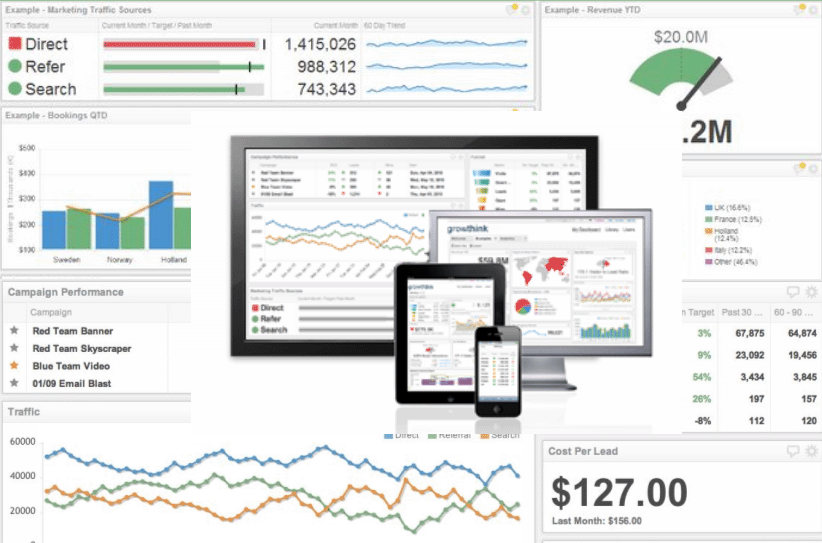
A business dashboard allows decision-makers to better manage their business, and thus improve sales and profits. Here are five tips to make a successful business dashboard:

1) Personalize. Tailor your dashboard to the role of the user, designing it around metrics specific to the individual. Accommodate your users no matter where they are located.

2) Self-sufficient. Dashboards should guide business users to relevant insight without help from IT. Dashboards should be intuitive and provide simple access to business data using menu filters and drill-down functions. Also, users should have access to FAQs, help ­files, how-to videos, and an online user community so they can feel con­fident when using their dashboard.

3) Interactive. Dashboards are not a static experience. Users should be able to apply filters and adjust values on a chart, for example, to plan for various scenarios. They should also be able to write-back to the data source if permitted. Drill-down capabilities are particularly useful because users can delve into charts to get further details with just one click. Interactive dashboards keep users engaged and focused.

4) Dynamic. Static dashboards rely on historical data, neglect your organization’s present performance and set you up for failure, warns Forrester Research. Successful dashboards are dynamic and reflect the real-time changes of your business’ performance. They also offer ad-hoc capability so users can manipulate variables for further analysis and drill-down functionality so users can find root causes.

5) Accessible. Dashboards should be accessible from any device so users can view their data anywhere, anytime. Mobile dashboards are easy to deploy if your BI system supports web apps, which can be developed once and deployed anywhere – on any PC, smartphone, or tablets.

The bottom line is that dashboards should be analytical tools, not just pretty pictures. The ultimate measure of dashboard success is adoption. When users come to see their dashboards as indispensable, you know you’ve done well as a dashboard designer.

DMAI specializes in designing business dashboards, training staff to use them effectively and in providing staff who can build, manage and enhance business dashboards

Growthink_Dashboard_Hero_w_Background_PSD_0

Five Uses For Business Dashboards > DMAI Can Build You One Or Provide You Support To Build Your Own

Research from Aberdeen Group shows the average company that uses business dashboards enjoys triple the revenue growth and double the profit growth of companies that don’t.

Why?

Because with the right dashboard:

  • Businesses make more intelligent business decisions
  • Managers have complete, real-time visibility into their organization
  • Leaders manage their business more effectively

5 Key Benefits of Business Dashboards

Business Dashboard gives business executives numerous benefits including the following:

  1. Visibility: An executive dashboard provides great visibility and insight. Decision-makers know exactly what’s going on in all aspects of their business, allowing to see connections and correlations.
  2. Continuous Improvement: One of Peter Drucker’s most famous quotes is, “if you can’t measure it, you can’t improve it.” Dashboards allow leaders to measure performance throughout their organization and thus improve it.
  3. Time Savings: Many executives spend countless hours logging into business systems and running reports. Conversely, the right dashboard always shows managers the latest results from each report they need. This saves precious hours each month.
  4. Plan vs. Performance: Many executive spend time creating a business plan for their organization to follow. However, that’s just the first piece to success. The second is making sure their company is performing to the plan’s expectations. Dashboards can automatically show progress towards goals from the business plan versus actual, real-time results.
  5. Employee Performance: When employees know their performance is being judged in a dashboard, and can see their results, they innately start to improve their work.

DMAI specializes in designing business dashboards, training staff to use them effectively and in providing staff who can build, manage and enhance business dashboards

3.8.2.

Finding The Right Data To Help A Business Is The Key To Being A Great Analyst

Knowing where to go to find the data you need is one of the most important keys to being a successful analyst.

There are three basic areas where you can go to find data:

  1. Private Company Databases and sources
  2. Public Databases and sources
  3. The Internet

Each company treats its data a little different, but you can expect them to store their data in data bases that fall into the following couple of categories:

  1. Proprietary Databases. All of the data used for analysis is kept in databases that are built and maintained by an internal IT team. They may use heavily personalized commercial software.
  2. Off the Shelf Databases. Most data is housed in a commercial database solution like Oracle, Teradata, MS Access, etc. where IT team often work in partnership with the database manufacturer.
  3. External Databases. The company does not have its own IT team and receives its data from external resources. Usually analysis is conducted via a connection to the data through the vendor.

In addition to using internal data sources, you may also find yourself surfing the web to find data for your analysis.

A lot of time it takes a combination of internal business data and things from the web to give you an overall picture.

In my experience there are three places I generally go to in search of publicly available data on the internet. I generally find what I need from either:

  1. As a general starting point for just about anything you can begin with a Wikipedia search.
  2. Google Search. To pull together press releases, news articles, images, and other pieces of data that are not statistically driven, Google is your best bet.
  3. Government Databases. The are billions upon billions of datasets out there on just about every kind of public data in terms of demographics, government spending, monetary flows and many, many other type of data.

So when you look to provide a well-rounded and detailed analysis of any business problem, the first step is always knowing where to go to get your data.

10406025_10152524531307425_1404103117_n

Looking More Closely At The CHED Memorandum on Business Analytics

Looking closer at the course description for the Fundamentals of Business Analytics course published by CHED in 2013. Amazing how closely it matches to the Intro to Analytics training i have been doing since 2012 when I founded BPO Elite.

The course provides students with an overview of the current trends in business analytics that drives today’s businesses. The course will provide understanding on data management techniques that can help and organization to achieve its business goals and address operational challenges.

Learning Outcomes:

  1. Define business requirements.
  2. Verify correctness of the contents of the data architecture.
  3. Describe where to look for data in an organization and create required reports.
  4. Understand data management concepts and criticality of data availability in order to make reliable business decisions.
  5. Demonstrate understanding of business intelligence including the importance of data gathering, data storing, data analyzing and accessing data.
  6. Understanding the functions and data access constraints of various departments within an organization and identify reports that are crucial for intelligent decision-making
  7. Work on various analytics tools available in the market for various business functions.
  8. Participate actively in business discussions with various departments and create common reports or specific/unique reports with regard to predictive and prescriptive analytics.

I think the biggest areas that I can add to my approach and highlight in my book is the reporting piece. How to create a report and make it a living document is something a lot harder then most people think.

the-five-parts-of-me

Analytics Education – Facilitating a mastery of the fundamentals of analytics is what DMAIPH does best. As a key parnter of the Data Science Philippines Meetup Group, DMAIPH champions the use of using data. All across the world, companies are scrambling to hire analytics talent to optimize the big data they have in their businesses. We can empower students and their instructors with the knowledge they need to prepare for careers in analytics. Contact DMAIPH now at analytics@dmaiph.com or connect with me directly so we can set a guest lecturer date, On-the-Job Training experience or other analytics education solution specifically tailored to your needs.

SWOT > Great Tool For Analysts To Know

One of the reasons I love working with students is often something that is old to me and to many analysts, is actually new to them. SO getting to explain SWOT to students, or in this case having a student share with me their understanding of SWOT is pretty cool.

SWOT can be very helpful in general consulting and also in process optimization projects that many analysts find themselves assigned to.

How the SWOT ANALYSIS helps the business

One of the best way of evaluating a business unit opportunities is conducting the SWOT Analysis. Using a SWOT Analysis in your business, you can provide a necessary tools and information to establish your goals and objectives. And it will measure the progress of the business. The Strengths’ and the Weakness and the Weaknesses will be the inside Factors; the Opportunities and Threats will serve as the exterior factors.

Evaluating the Strengths

Evaluating what does the company do well, does the company has strong sense of purpose and the culture to support that purpose and is the company strong in its market. It could be your marketing expertise, or your excellent customer service. It’s important to try to evaluate your strengths in terms of how they compare to those of your competitors.

Recognize the Weaknesses

Recognizing the weaknesses will aid the decision-making process designed to improve you’re company. Don’t just make a list of mistakes that have been made but instead learned from what happened. Be prepared to hear things you may not like, but which, ultimately, may be extremely helpful. Business weaknesses can include accessibility of product, higher prices than other competitors and poor quality of products and services. By this you can minimize your weaknesses.

Look for the Opportunities

In this section you can identify what are the new opportunities for your business and interesting trends which you can take advantage of.  Example of opportunities includes potential new uses of products or services, social factors and the use of marketing or promotional techniques to market the business.

Be ready for the Threats

Threats to your business can be also as weaknesses and can be adversely affect your business but it can be a short- term circumstances that can be resolved immediately. For external Threat it could be new legislation or a new competitor in your market and for internal threats could include the company’s skill or staff shortage.

analytics_robo_people

The 3 V’s of Big Data: Volume, Velocity, & Variety

The value of big data isn’t in the amount of data it can process, but in the insight that big data analytics can yield. Big data has value because it can assimilate vast amounts of different types of data. The three V’s – volume, velocity, variety – are wbrainhat give big data its value, and what powers these three V’s is more and better data.

Source: im-techsolutions.com

Analytics is all about looking for patterns in data that give you actionable insights.

IBM’s SMART Approach to Analytics

Came across this 5 point methodology for applying analytics in a business… very similar to the 3 I’s that I use in my training. I’ll start using both going forward.

S=Start with Strategy
What problems do you need big data to help you solve? If you’re running a business you might think it’s as simple as “How do I increase my profits?” But a question like that is inevitably going to lead you to more questions.
How do you generate more sales? How do you increase visitors to your site or store? How do you make your customers happier?

In this first step you need to be clear about your strategic objectives as well as the key strategic questions you want to have an answer to. You need to have this nailed down before you worry about collecting your first kilobyte of data.

M = Measure metrics and data
Once you know what data you need to answer your most strategic business questions, you can work out how you are going to capture it. Everything we do, online and, increasingly, in the real world, is capable of being recorded and stored. If we visit a website, records are kept of how long we browse for and where we head off to next. GPS systems in our phones as well as CCTV surveillance keep track of our physical movements.

Of course much of it is (hopefully) anonymized. Big data collection isn’t about tracking individuals, it’s about tracking the masses, so patterns can be spotted giving clues to overall trends. This part of the process involves designing the actual systems that will collect what your strategy tells you is needed.

A = Apply analytics
Increasingly, we are finding that the sort of data which contains really valuable insights is very messy. The slightly more technical term we use for this is that it is unstructured data. The sort of neat and tidy data you get when, for example, you ask someone to fill in a form giving you their age, height, weight and data of birth, is structured. The sort of messy, disjoined data you get when you analyze the contents of an email exchange or CCTV recording is unstructured.

The hidden value in this unstructured data is where most big data divers are finding the real sunken treasures. If you’re a business, being able to spot trends affecting your industry before your competitors is what will give you your edge. In order to implement this part of the process you will need to get to grips with the ever-growing range of tools and methods becoming available for making sense of messy, complex data sets.

R = Report results
The most insightful insight ever is useless if you can’t explain what it means to the key decision-makers in your business. Presenting the information necessary to drive change in a clear and digestible format is as vital as any other step of the operation. This part of the process has analogies to storytelling. There will be a beginning, a middle and an end, detailing why you need the insights, what you did to find them, and how they will result in everyone living happily ever after.

If you use data visualization and narratives to tell that story in a focused and interesting way, it’s far more likely people will understand what you are trying to do, and be as motivated as you are yourself about implementing data-driven change.

T = Transform your business
Change—specifically positive change—is the ultimate aim. Transformations you make to your products, service, marketing strategies or internal processes, guided by insights from your Smart Big Data analysis, is the catalyst which will drive that change.
cropped-dmai-fb-cover-photo1.jpg

Limiting You Core Values To Just 3

https://www.linkedin.com/pulse/you-have-more-than-3-core-values-think-again-dave-kerpen?trk=tod-home-art-list-small_2

For DMAIPH, I have infused 3 core values into everything we do. They come from having seen companies succeed and seeing companies fail. The ones who succeed have the in common. Here they are:

Partnership

Integrity

Teamwork

For my the core valued of any business starts with the partnerships is has with its industry. For public trainings its all about having a robust network. Being able to get new business, mine existing business, and bringing back old business all comes out of strong partnerships.

Integrity is also super important. Being honest and doing the right thing. Have an identity that makes one thing of likability and trustworthiness. When you have that you take care of your customers, your employees are satisfied and engaged, and you ability to partner gets much easier.

And the third value is teamwork. Teamwork is based on trust. And trust comes from integrity amount partners. Work partnerships, between employer and employee and between each employee with their peers all lead to a more vibrant teamwork.

DMAIPH stands for strong partnerships among analytics providers and consumers, for being know for our rock solid integrity, and for engaged and empowered team we have.

What are your 3 Core Values?

If you cant recite them of the top of your head, then you probably have too many.

DMAI - Logo_ver2-02-01

Analytics Leadership – DMAIPH specializes in arming the Data-Driven Leader with the tools and techniques they need to build and empower an analytics centric organization. Analytics leadership requires a mastery of not just analytics skill, but also of nurturing an analytics culture. We have guided thousands of Filipino professionals to become better analytics leaders. Contact DMAIPH now at analytics@dmaiph.com or connect with me directly to discuss a uniquely tailored strategy to ensure you are the top of your game when it comes to Analytics Leadership.