What To Do When Employees Don’t Succeed?

http://www.recruiter.com/i/4-positive-alternatives-to-firing-staff/?utm_content=buffer888a9&utm_medium=social&utm_source=linkedin.com&utm_campaign=buffer

Came across this interesting article on LinkedIn, about what to do instead of firing an employee. It caught my attention as the BPO Industry in the Philippines continues to grapple with attrition rates that are way to high.

In short, the problem is that with a perceived deep talent pool to tap, BPOs have put little effort into retention policies instead being quick on the trigger thinking they can easily find a better employee. This mindset is not only self-destructive but also badly out of line with available data. As it gets harder and harder to recruit quality employees, many times the answer is pour more money into recruiting or more money into incentives, but almost no one is putting more money into training and coaching.

When you can step out of the industry for a minute and look at the patterns its pretty mind-boggling that such a booming and vibrant industry is so short-sighted.

So, with that back drop in mind, I found this article a good one to help me and my management team put some pauses in place and do a little more due diligence before coming to the decision to give up on someone.

The 4 bullet points listed are all very good ones to chew on:
1. Employ Self-Assessments to go hand in hand with KPI data points
2. Setting clear and achievable goals to mark success
3. Targeted coaching and training
4. And redeployment to positions with a better chance for success

I’ve added these discussion topics to my next management meeting agenda and will build in additional check points within our assessment process. All in all a good read indeed!

HR & Recruitment Analytics – The recruitment and retention of top talent is the biggest challenge facing just about every organization. DMAIPH is a leading expert in empowering HR & Recruitment teams with analytics techniques to optimize their talent acquisition and management processes. Contact DMAIPH now at analytics@dmaiph.com or connect with me directly to learn how to get more analytics in your HR & Recruitment process so you can rise to the top in the ever quickening demand for top talent.

Reflection Time > The Journey Of A Lifetime

As I sit here in the lounge awaiting my fight back to the US… for the 10th time in the past two plus year, I am enjoying the time to reflect on this journey.

1960033_10152334044802022_1470432615_n chili

In the past two years I have gone form working for one of the most stable companies in the world to seeing one start-up crash and burn in a very expensive thud and a second go from riches to rags to riches again. The lessons I have learned about how to set up a business are countless. The sleepless nights trying to figure out what to do tomorrow to inch towards success are countless. But I would not have traded this for anything. Its been the chance to really live my life to the fullest.

From training analysts to work in outsourcing to consulting with outsourcing companies to being an outsourcing company ourselves, DMAI’s journey and mine are closely entwined. I started with 1 employee who shared my passion and vision as we trained close to 200 people in the use of analytics. And that soon grew to a half dozen analysts on staff and from there to 16 and from there to 30+ and by the end of April we should be over 40. Add to that the hundreds of students I have spoken to about analyst careers and I have directly be involved in empowering and inspiring close to 1000 people in the past two years. That’s living the dream.

As with just about any start up story, our successes have come with great cost. Not everyone who started with us is here to enjoy the current success. Lots of money was spent. Lots of opportunities were missed. Lots of dreams did not catch fire as we had hoped. But now, as I reflect on our success and my own personal growth on this journey… I can honestly say… it was all worth it in the end.

No Matter How Much Training We Do, Will It Ever Be Enough?

http://blogs.wsj.com/searealtime/2014/03/13/poverty-is-stubborn-foe-in-philippines/

I came across this recent blog post from the Wall Street Journal and it matches a lot of my own observations about the economic realities of the Philippines. Having spent most of the past 2+ years here in the Philippines I have seen my own perceptions of the country’s amazing economic growth evolve from one of unbridled enthusiasm to one of more moderate expectations.

Just to go back a few years, I was at Wells Fargo and heavily involved in both remittances to the Philippines and outsourcing to the Philippines. I saw a lot of data about all time high remittance inflows at the same time we saw a huge shift as the Philippines passed India to become the call center capital of the world. Coupled with my visits to the Philippines, it seemed to be a perfect time to come here and set up a business.

So I came here, set up the business, started doing training and have been able to help quite a few Filipinos find there way towards analytics focused jobs. I’ve also been able to employ many as well. However, as time has gone by, I have also seen that my efforts (as well as so many well-meaning others) come up short in really making a difference. If you add up all the OFWs and all the BPO Employees that are driving more spending and more growth, its still not enough to move the Philippines out of the grasp of massive and disabling poverty.

1969361_436875143110396_1289407291_n

As the article points out, training is a key missing effort that despite many best efforts is still falling short. The talent gap between the job requirements and the available workers keeps growing faster then all the training and shifts in education can keep pace with.

When I read articles like this, I find myself wishing I could do more and I will keep doing as much as I can, but to be honest I have started to feel that people like me are just too few and far between to really make a difference. Don’t get me wrong, I still love what I do and am passionate to keep doing it… but I am a little less spirited and a little more cautious now then I was at the start of this journey.

I guess that’s my new found wisdom talking…

Five Trends I Shared With A Class Of Future Analysts

Just wanted to share my perspective on what I see as being five trends that future analysts here in the Philippines can jump on to help them get ahead of the competition as they look for their first job.

1966784_10152250706706628_1752784040_n

1. Finding Unstructured Data on the Internet
Most Data is Unstructured, meaning it’s not easily accessible and stored in an internal database. This goes against the conventional approach to analytics where you write a query to pull data from a big data warehouse and dump it into an analytics tool. For most analysts, trying to find unstructured data and then capture it and use it in decision-making is not easy.

2. Self Service Business Intelligence Tools
Business intelligence (BI) refers to computer-based techniques used in identifying, extracting, and analyzing business data, such as sales revenue, market opportunity or product performance. Self-service ones are easy to learn, sit on a desktop and have more power to do great analytics then a team of 10 IT Engineers did 5 years ago. My favorite BI tool is Tableau. Check it our at http://www.tableausoftware.com

3. Competitor Intelligence
Per Wikipedia, competitive intelligence is the action of defining, gathering, analyzing, and distributing intelligence about products, customers, competitors and any aspect of the environment needed to support executives and managers in making strategic decisions for an organization.Every successful business conducts competitor intelligence and uses this process in various ways. Some examples for a fast food chain might include:
> Pricing
> Product and Service Offerings
> Targeted Demographic Marketing
> Marketing Promotions
> Location Renovations and Expansions

4. Data Visualization
The main goal of data visualization is to communicate information clearly and effectively through graphical means. They say a picture is worth a thousand words. A good pie chart is worth 10,000 rows of data stored in a database. I often say what separates a good analyst form a great analysts, is the ability to easily communicate their findings in a way that makes it easy to exercise good decision-making.

5. Business Dashboards
Wikipedia’s definition of a business dashboard: “An easy to read, often single page, real-time user interface, showing a graphical presentation of the current status (snapshot) and historical trends of an organization’s Key Performance Indicators (KPIs) to enable instantaneous and informed decisions to be made at a glance.” That’s a mouthful, but if you are able to deliver all of these items in a single view, you are worth your weight in gold to an analytics savvy organization.

To learn more about analytics, DMAI and careers as an analyst in the Philippines, follow this blog and you will keep yourself on the cutting edge of all things analytics!

Convergys eyes 6,000 new hires this year… But From Where?

A recent ABS-CBN headline touts how one of the biggest BPOs in the Philippines is planning to increase their staff by about 15%. And they are not alone, in the past few months I have seen a lot of the bigger players (including IBM and Google) make public announcements about staffing up here in the Philippines. But a lot of people are asking where will they come from?

Based on research being produced and/or complied by IBPAP, we are seeing a widening of the talent gap between the number of seats available and the number of quality candidates to fulfill them. The Philippines is about to graduate hundreds of thousands of college students, yet so few of them will be ready to step right into a call center job. The government has made huge strides in partnering with the industry leader and higher education to create courses that will help fuel the demand, but its not nearly enough.

And to make things even more interesting, we are seeing a lot of mergers between bigger players (Convergys just acquired Stream) as they try to consolidate to offer more services to bigger clients abroad. So the big fish are eating well. However, the same cannot be said for a lot of the smaller BPOs.. most set up by Filipinos with the idea of capitalizing on the call center boom. But they are for the most part struggling as they either can’t find accounts or enough staff to fill the client requirements. The competition has never been more fierce when it comes to finding good people.

So where does that leave the industry? Is the pool big enough to supply the big fish like Convergys with 6K more employees? 2014, will be an important year in the evolution of the BPO industry in the Philippines.

539735_206746759470775_461235919_n

As for DMAI? We continue to grow quickly as we have a mostly work from home team that is almost completely made up of former call center agents who have walked away from higher pay for better work life balance. Is this the wave of the future? I think so!

How To Build A Competitive Landscape for Your Marketing Strategy

In preparation for my talk next week at CSB, I wanted to share with you one of the simplest parts of a well-rounded analytics solution.. which is to take account for the competition. I talk about this a lot because it’s often one of the most overlooked.

So, lets say we work for an events management company and we are going to set up a training workshop on business analytics. We need to provide our marketing team with some data to help them in their efforts. To help ensure the program will be a success, there are several data points about the competition we can source to see how we stack up in comparison.

First let us look at pricing. How much are we going to charge for the workshop? We need to make money, so first of all we need to account for expenses and determine an ideal profit margin and then set a target ticket price. That’s simple. However are there other workshops out there that offer similar content for a lower price? Or can we raise our ticket price to be more in line with the market?

To get the data we need to survey the marketplace and gather the intel and put in a simple excel file just to see where our desired price points compares. It may take a few hours of calls, web searches and online inquires, but it all pretty much public data and easy to get.

Second, we can look at format. How long is our workshop? How many speakers? Will there be a panel of experts? We can gather these data points at the same time we capture pricing data, so let’s just add a few more columns to the excel file. This way we can see with some certainty about the number of competitors we have and how our workshop will measure up.

MSP24321b65h584fd76h9i00006996g957h01de5g6

To give a different type of dimension to our landscape, let’s look at reputation. So let’s add one more set up columns to capture year established, number of public training offerings a month and number of cities/provinces used. And then add a final column for general notes. The idea here is we are going to add analysis to how credible a competitor they are. We can see who has been around awhile and who is new to the game, who has a narrow scope and who is everywhere. This way we look at more than just raw numbers.

SO, you take your spreadsheet, you fill it out and then you add a row for our own company and then we can see where we rank in each of the categories (columns). It’s not a 100% scientific, but it will give us a good idea of where we stand in the grand scheme of analytics training options out there.

Based on this analysis we can help the marketing team by showing our relative value to attendees as compared to other options. We can distinguish what it is about our format that gives us an edge. And we can advise marketing on what parts of our credibility we want to promote.

For example, a tagline marketing can use based on our data could be something like Join DMAI, the Philippines most well established name in Analytics, for an innovative approach analytics training next month at a very affordable price.

There you go! 🙂

Analytics In Action: How DMAIPH Uses Data to Drive Decision-Making

Awhile back, I was a guest speaker for a business analytics class at the College of St. Benilde. I had been asked to talk about how DMAIPH uses analytics in our business.

When it comes to sizing up an analytics project, I tend to use a methodology I learned from a couple Stanford professors several years ago. It is pretty simple concept that is applicable across all kinds of projects; (1) identify the data you will need, (2) bring it in to your analysis tools, aka inventory it, (3) and then integrate it into a larger story or context.

I tend to use MS Excel for the majority of my analysis, but when I need to build a map, or prototype a business dashboard or need some high-powered visuals to present my data, I use Tableau Public. In the past I have used a wide range of analytics tools, but they are always specific to a certain type of data I needed to access.

One of my favorite infographics

I am going to show three examples of how we use analytics:

  •  How we built and maintain a competitive landscape looking at the current trends in analytics here in the Philippines. Who is using what, what they are doing and where the talent is coming from.
  • How we built and update a demographic profile based on resume and LinkedIn data for the various types of analyst jobs we are currently employing.
  • And, how we built a business dashboard using Google Drive for the management team to use when looking at who on the team to coach and what to coach them on. It’s a simple way to share KPIs.

In all three cases I will explain how we identified the data we needed, how we inventory it so we can look at historical trends as well as a current snapshot and how we integrate these analytics solutions into our business strategy. It should be a pretty good presentation followed by some great Q+A! 

jobspicture2

Analytics Training – DMAIPH offers a wide range of analytics centric training solutions for professionals and students via public, in-house, on-site, and academic settings. We tailor each training event to meet the unique needs of the audience. If you need empowerment and skills enhancement to optimize the use of analytics in your organization, we are here to help. Contact DMAIPH now at analytics@dmaiph.com or connect with me directly to set up a free consultation to learn which of our DMAIPH analytics training solutions is best for you.

Outsourcing Tip > Make NASA Jealous! Ensure You Have A Smooth Launch Of Your Outsourcing Efforts

The final area that I have seen countless outsourcing efforts fall short is in having a smooth launch. You have put so much time into sizing the opportunity, negotiating the contract, finding the right people, acquiring the technology you need and building a technique playbook, but you aren’t done yet. You still need to roll it out.

When it comes to outsourcing, there is one thing I have never, ever seen. And that is a full delivery of services, exactly as required on target and without any glitches.

Here are a few keys to ensuring that you go live and avert as many potential disasters as possible.
• First of all, have a risk minded person involved. Someone who is great at looking at something and then coming up with a laundry list of things that can go wrong. And then most importantly, have them in charge of eliminating or mitigating the risks.
• Second, have your processes, the workflow, escalation procedures, and other important documents in writing for the team. No battle plan survives first contact unscathed, but the battle will go much better with one.
• Third, brief everyone. Have a pre-kick off meeting, do a walk through, run lots of tests. Do whatever you can to mimic production so that people get used to having to make decisions just like they will when things are live.
• And finally, hapollo11ave a plan to celebrate. Let everyone know what awaits them if they pull everything off. Give them an extra reason to go an extra step. Everyone wants to be part of a winning team enjoying the celebration of a new start.
That is just a few ideas of what you can do to ensure your launch go as smooth a NASA’s putting a man on the moon!

Analytics Outsourcing – DMAIPH has successful set up Filipino analytics teams for over a dozen U.S. based businesses. Offering both virtual and office based teams that specialize in problem solving using data, new technology and analytics techniques is our strength. Finding and empowering analytics talent is increasingly challenging, but we have it down to a science. Contact DMAIPH now at analytics@dmaiph.com or connect with me directly to learn more about how to set up an analytics-centric team in the Philippines.


Outsourcing Tip > The Three T’s: Talent, Technology and Technique

I’ve been part of dozens of BPO team set ups and have directly implemented five this past year or so. In ALL five cases, we have had challenges because we didn’t have the right talent at launch, we didn’t have our technology lined up correctly and we didn’t have techniques in place to ensure a smooth transition of work and an optimal business flow.

Finding good talent here in the Philippines can be a difficult. I’ve blogged about this quite often, the skills gap is a major concern for the long-term success of outsourcing to the Philippines. There are so many good people with the right work ethic and the desire to learn, but so few of them are trained in a way that makes them day one ready to go in a call center environment. Making sure you have correctly identified the skills you need, allocating the appropriate recruiting resources, and building a pipeline to replenish loses and fuel expansion, is so much harder than it sounds.

In regards to technology, there are so many ways to connect clients, customers and operations here in the Philippines. The Cloud allows all sorts of processes to be easily shifted to remote staff and the culture in the Philippines is very tech driven, it’s a great match.

The challenge is sometimes the technology needed is not as easy to introduce as expected and telecommunications and online access very greatly across the country and the workforce. Having a tried and test technological solution and being prepared to deal with the connectivity issues will help assure a much smoother transition of work from abroad.

275

Most call center operations I have worked with don’t have a clear concept of what they want the day-to-day to look like. The lift and shift approach where you just take a process from overseas and apply it here never works without adjustments. Many times you can find more optimal ways of doing things when you set up because you are able to look at the process end to end. Taking advantage of fully understandings the process being outsourced, documenting it and training on it with a clear plan are all keys to success.

So in conclusion, often what people assume would be the easy parts turn out to be the hardest when it comes to the talent, technology and technique needed to se up a successful outsourcing operation. DMAIPH specializes in helping call centers bring more data to their decision-making and ensure a more optimal approach.

Analytics Outsourcing – DMAIPH has successful set up Filipino analytics teams for over a dozen U.S. based businesses. Offering both virtual and office based teams that specialize in problem solving using data, new technology and analytics techniques is our strength. Finding and empowering analytics talent is increasingly challenging, but we have it down to a science. Contact DMAIPH now at analytics@dmaiph.com or connect with me directly to learn more about how to set up an analytics-centric team in the Philippines.

Ten Things I Noticed While Walking Along EDSA

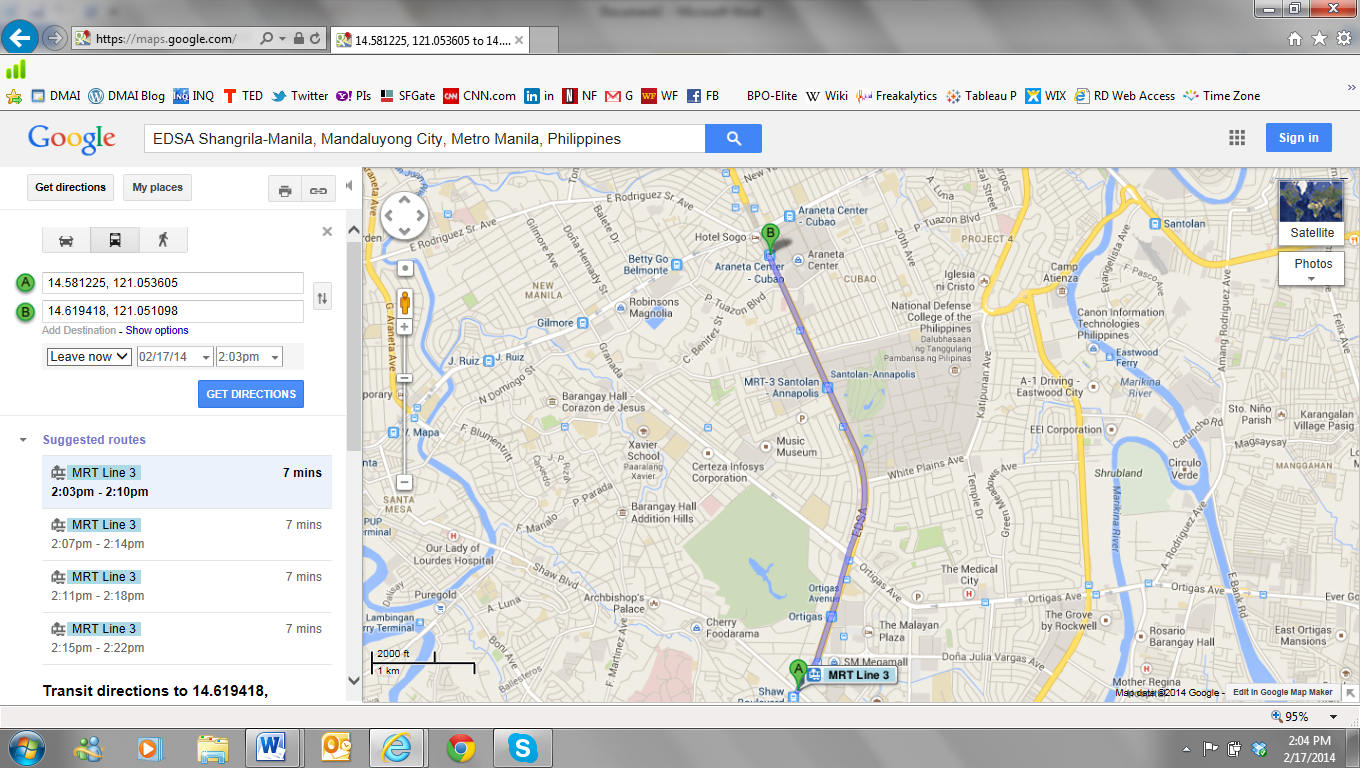
The other day I was at a meeting at the Mall at EDSA Shangri-La and it hadn’t occurred to me that it’s Valentine’s Day. Being that I’m Iglesia Ni Cristo (Church of Christ), we don’t really celebrate it, so don’t flame me for not being a romantic.

Anyway, as my assistant and I left the mall, it became obvious to me that getting back to Cubao was going to be a challenge. So after looking at the taxi queue and the bus line queue we decided to walk the two blocks down EDSA to Megamall to see if it was any better. It wasn’t. So then I decided why not just walk back to Cubao. It shouldn’t take more than an hour or two, so and it would be good exercise.

So on that long walk, actually a couple of kilometers, that actually took just under two hours, I had a lot of time to reflect on things. Here are ten things that occurred to me during the walk.

1. Its not actually a bad walk, with the exception of a few tight squeezes at the MRT stations and in front of Mega Mall, it was pretty wide open side walk most of the way.

2. Don’t Go to the Malls on a Holiday. The malls in the Philippines always get crowded on Friday nights, but a Friday Night Valentine’s Day… takes the cake for the busiest I have ever seen.

3. The MRT is way to overcrowded. We didn’t even try taking the MRT (Manila’s light rail network) because you can see by the passing trains people were crammed in like sardines. Whatever happened to the plans to modernize the now 20+ year old rail service?

4. Nice Restaurants are so overpriced. 4,000 PHP ($100) for a steak dinner. When you compare prices between the US and the Philippines, fine dining is one area way out of whack. So many places to eat at EDSA Shang, so few offer a nice meal for a good price.

5. There are not enough Taxis when you need them. If you spend time in Manila, you know the drill. During off hours, taxi drivers fight over you, but during rush hours you have to fight for them. Its one of the greatest variations in ebb and flow business I have ever see. I’d argue even worse than Manhattan.

6. Robinson Galleria has the worst Taxi Queue in Metro Manila. Green Hills and EDSA Shang Mall are close runners-up, but the taxi queue at Robinson Galleria is the slowest moving one I have ever stood in.

7. There are too many buses. Even when they are crowded to the brim with people and offering the cheapest way to get up and down the EDSA for most people, there are too many buses. The biggest cause of traffic congestion are buses who cut in and out of lane, stop in the middle of the road and all in all are driven by want to be Hollywood stunt drivers.

8. Too Many Ways to Waste Money. When you walk down ESDA, besides the dozen malls, you also see countless showrooms for high-end cars, you see a lot of business whose cliental can only by the wealthy. If you have money there are so many ways to waste in EDSA, while the masses ride by in a crammed bus or are stuffed away on the MRT. Its one of the worst visualizations of the rich-poor divide in the Philippines.

9. There are more condos being built than anything else. Its mind-boggling that they boom keeps booming. When you try to do the math in your head, how many condo have been built and how many multitudes of more are under construction and then you take into account the number of OFWs, Call Center Agents and people with enough money to invest, there are still more vacant or going to be vacant condo units then there are buyers. Talk about a bubble that has to burst.

edsa

And 10. Mary Me, Oliva is the talk of the town. Up and down EDSA there are a series of bill boards with the message “Olivia, will you marry me 21414.” The speculation is rampant about what the heck they mean. But whatever the origin, its one of those things that has every one buzzing about it.