The Philippines is Going Beast Mode! 1 of 3

ASEAN Economies

Sharing my thoughts on some great Bloomberg visuals my good friend Justin Calderon used in a recent story he put together.
http://investvine.com/charts-outlining-the-philippines-economic-trajectory/

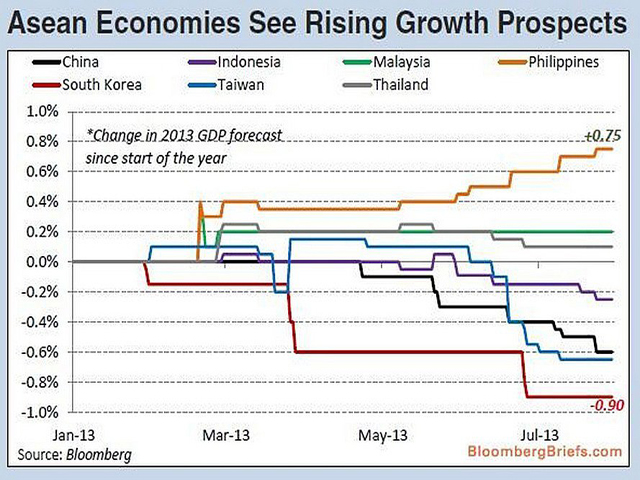
Beast Mode is an American Football term for a player who singlehandedly dominates a game. This is the first of three visuals I will breakdown and comment on.

Over the past couple of years I have been talking a lot about how the economy of the Philippines is quickening. The overall trajectory for the economy is rocketing ahead for several reasons including geography, history, political climate, and demographics. There are dozens of stories published all the time about why, how, and what this means for both the Filipino people, for the ASEAN countries and for the global marketplace. There is so much economic data out there, its like an analytics playground.

One of the most significant and often used economic data points is GDP (Gross Domestic Product). GDP is of course is the market value of all officially recognized final goods and services produced within a country in a given period of time. Thanks Wikipedia for that definition.

As you can see the Philippines is the only economy of the seven countries being measured that is not only trending upward, but the trend is accelerating. If we were looking at mid season performance of a sports player being compared to other players in it’s division… we’d be saying the Philippines is in Beast Mode. Check out the YouTube video below and imagine #24 is the Philippines economy right now.

Sharing Some of My Favorite LinkedIn Groups about the Philippines

Here are some of my favorite LinkedIn Groups that relate to living in and running a business in the Philippines. I try to follow the discussions and actively post comments and new discussion several times a week. LinkedIn is an amazing tool to stay current on things important to you and your business.

Philippines Call Center Professionals – lots of good info about current trends and issues
http://www.linkedin.com/groups?home=&gid=2130497&trk=anet_ug_hm

EXPAT PHILIPPINES – a great place to network and learn how to deal with common challenges
http://www.linkedin.HR Philippines com/groups?home=&gid=1483687&trk=anet_ug_hm

HR Philippines – an excellent source for recruitment and HR trends and hot button topics
http://www.linkedin.com/groups?home=&gid=992347&trk=anet_ug_hm

Filipino Professionals for 1stWorldPhilippines.com Movement – The name Says it all!
http://www.linkedin.com/groups?home=&gid=21601&trk=anet_ug_hm

The Philippines Sourcing Council – A good combination of contributors
http://www.linkedin.com/groups?home=&gid=96615&trk=anet_ug_hm

Philippine Society for Learning and Performance – A great group of professional opinions
http://www.linkedin.com/groups?home=&gid=3897230&trk=anet_ug_hm

Why the Philippines? Q+A

539735_206746759470775_461235919_nRecently I received a LinkedIn message regarding my blog series about my 13 months living and setting up a business in the Philippines. The message contained some pretty good questions so I thought the best way to answer it would be to share the conversation with you.

Q: I’m always curious to hear why people have chosen the Philippines over other countries to start a business in?

A: From my perspective, the Philippines is a truly phenomenal place to be right now. I ask everyone is there any country today in a better position to make such significant and long lasting positive changes in the very fabric of the country? Being the home of some many overseas workers and their remittances, being the call center capital of the world, be positioned close to some of the biggest markets in the world and blessed with a unique connection to the United States are just some of the reasons. Its on the verge of something truly special. You can feel it where you are there. So for professional reasons that’s why I decided to move there and set up a business. There are even more personal reasons why I love the Philippines, but that’s a different question.

Q: Even given some of the press around about the difficulties with traffic, weather, corruption?

A: They are all significant challenges that can indeed hinder growth. However, I think the Philippines is being forced to evolve as a nation by some key demographics that make its growth unavoidable. The average being 23, the level of English taught and used, the culture of embracing work either coming from or going to the rest of the world. The traffic is a nightmare in Manila, but you are seeing a lot of growth in the provinces as a result. The weather is a problem, but the county is big enough and the important economic drivers are diverse enough to weather major calamities. Corruption is a huge problem, but its getting better. It is being addressed at all level of society and progress is being made. I survived getting stuck in traffic on EDSA, caught in flood waters up to my waste and forced to pay a fixer to get some things done faster and none these things lesson my confidence in the Philippines.

Q: From a business perspective, I see a growing trend in being able to provide customized types of products and services. Are niche businesses offering customized products and services viable?

A: When I compare the challenges of setting up a small business and taking your product/service to the market, its 10x easier than it is in the U.S. There challenges are very different. In the Philippines your success will depend on who you know and how your business identity is perceived. You have to but a lot more effort into making connections and making sure everyone is happy and engaged. There is a lot of bureaucracy that goes with setting up a business there so it’s key to have the right connections to smooth things out.

Q: I am looking to recruit some people to do some web design work. Is it better to look for established workers or go with college age students.

A: I tend to go with younger, less proven talent in most cases. This goes against conventional wisdom in the Philippines. I have noticed that in general Filipinos place a higher value on certifications and accomplishments than most. And the school systems push out a lot of graduates with similar training and skills sets. Conformity and coloring within the lines is expected for most white collar jobs. The more time spent in this rigid system the harder it is to find someone who thinks outside the box. So going with the whole I prefer to train a blank slate versus having to untrain someone who is already programmed. However, the flipside is they will probably need more supervision and direction then someone with experience.

Q: I would love to hear more about which things you would do differently second time around.

A: To quote one of the most quoted saying of all time… “I shall return!” And when I do I will make these three significant changes in my approach. (1) I will be more hands on with the people I hire. I will not micromanage like many do, but I will be more active in empowering and teaching successful work habits to the people on my team. (2) I will be more frugal in my expenses. I overspent a lot on things because I was charged foreigner prices. Having a Filipino negotiate things for you is key. (3) I will live more like a Filipino and less like a foreigner. By the time I left I took Jeepneys and Buses more often than taxis. I was eating more Filipino food from small vendors and avoiding high priced meals at chains in the mall. Things like that go a long way in both making you fit in a little more and saving you a lot of money.

I am always happy to share my insights and experiences. I hope that helps!

3 Great Tips for Blog Writing!

Sharing this really useful article from a blog I follow…

http://www.joeseeber.com/how-to-write-articles-for-blogs/

How To Write Articles For Blogs

A big mistake that most bloggers make when writing articles is having big blocks of text, Aka, massive paragraphs.

Having big blocks of text, aka massive paragraphs, makes it hard for the reader to read and it discourages people from reading your content.

Because here’s the deal…

When viewers see massive paragraphs, they tend to feel overwhelmed with the amount of information they will have to consume… and most of the time people will choose to not read it all or just skim through the article…

…rather than investing the time to actually read it.

And on top of that, with massive blocks of text, people will make the decision right then and there whether to read your article, just by looking at the structure of the post.

Just take a look with how my article is set up… is this starting to make sense?

Have you ever looked at someone else’s blog post and just by the way it looked… it made you make a conscious decision not to read it?

Think about it.

Size 14 Font Is The New 12.

see link to continue: How To Write Articles For Blogs

http://www.joeseeber.com/how-to-write-articles-for-blogs/

Analytics Tool for Sales #3 – Customer Insights

143The third area that most business people undervalue in importance is gathering actionable insights from their customers. Aside from general conversations and dealing with irate or upset customers, how much knowledge are you actually gleaning from them. Do you survey them? Do you have a loyalty program? Do you do AB testing before making changes? These are just a few ways to build up data points you can use to gauge customer satisfaction, understand customer pain points and unearth new niches to exploit.

This is one of the things that Wells Fargo does exceptionally well. During my time with the bank, I was involved with a number of surveys and focus groups to give us some soft data to go with mountains of hard data we culled from internal and external sources. Far too often decisions are made without really listening to the customer… think about the misfires Nextflix had a few years ago. It could have easily been avoided with better intelligence on customer sentiment and a better understanding of what they value. Netflix antagonized their extremely loyal customer based and then made matter worse by mishandling customer feedback.

Beyond just conducting the survey, there are many sure fire ways to construct the survey to assure you get actionable data from the exercise. Just asking questions will only get you so far. You need to be able to construct the questions to give you useful answers that you can use to drive decision-making.

With free survey tools like Surveymonekey, and the ability to easily gather data online via social media, there is really no excuse for a company to have blind spots with their customer base. If you need help setting up, delivering and/or analyzing a customer survey, DMAI has extensive experience with this business intelligence tool.

Analytics Tool for Sales #2 – Competitor Landscape

IMG_1833Another blind spot for a lot of business leaders is knowing their competition. Most have some sense of where they stack up on price and know what the competition offers, but few put any real data and analysis behind it. They make a lot of business decisions based on personal observations and historical knowledge. Very few mystery shop or put together a competitor landscape.

Per Wikipedia, competitiveness pertains to the ability and performance of a firm, sub-sector or country to sell and supply goods and services in a given market, in relation to the ability and performance of other firms, sub-sectors or countries in the same market. You take data points on the various aspects of products and services and you visualize them to see where you rank. Based on your ranking and the variances between competitors you can have a more focused business strategy and make more data-driven decisions.

Competitive data can be gathered off the internet, by phone and in person mystery shopping and surveying your own customers. Its a very powerful piece of information to know what your own customers are buying from your competition and why. When I was at Wells Fargo, I build a competitive landscape of all the primary money transfers business and monthly updated the management team with our rankings and trends. We would often use this information to adjust pricing and launch new marketing initiatives.

Do you know who your competitors are, where they are better than you and how you stack up in your own customers minds? DMAI offers a suite of business intelligence solutions to small and medium sized business including building and maintaining a competitor landscape for your business.

Analytics Tool for Sales #1 – Demographic Profiles

philippines-outsourcing-teamOne thing that amazes me is the lack of knowledge most sales people have about their current, former and potential customers. Who are they? Where do they come from? What do they look like? What are there habits? What appeals to them? These kinds of questions are often answered by personal observation. Most business owners and leaders don’t take the time to understand the demographic data of their market and miss key opportunities all the time.

According to Wikipedia, A demographic or demographic profile is a term used in marketing and broadcasting, to describe a demographic grouping or a market segment. This typically involves age bands (as teenagers do not wish to purchase denture fixant), social class bands (as the rich may want different products than middle and lower classes and may be willing to pay more) and gender (partially because different physical attributes require different hygiene and clothing products, and partially because of the male/female mindsets).

In short, every business owner and leader should have demographic data at their fingertips so they can analyze which customers are the most profitable and what they look like. Then its a matter of developing marketing schemes to attract more of them using the underlying data. Know your market and the markets around you.

There are numerous sources of free, publically available data available online. The US Census Bureau has one of the most detail collections of demographic data ever collected. As do other US Government Entities like the Bureau of Labor Statistics and the Central Intelligence Agency. There are also numerous organizations that supply global data like the United Nations, the World Bank and the International Monetary Fund. Many countries also publish valuable data on their websites like Central Banks and Government Statistics Offices. The Philippines in particular has some pretty solid data available to use for demographic profiling.

DMAI specializes is building demographics profiles based on your customer data and the public data about the markets your operate in. Stop guessing and minimize lost opportunities by working with DMAI to get your the demographic data you need to make more data-driven decisions.

13 Months in the Philippines – Lesson 13 – May 2013 – Exit Plans

Lipa City, Batangas, Philippines

At the end of April, I set a line in the sand. If we couldn’t line up enough co-marketed trainings and consulting gigs by the middle of the month, I would pull up stakes and head back to the US for a while. As the days went on we had several set backs as a key marketing partner decided to cancel the four training dates we had set up in May and a couple of potential consulting clients decided to wait on our training. In looking at expenses as well as several pressing personal issues it became pretty clear by the middle of the month that it was time for another change.

In looking at the amount of money we would need to keep things going versus the short-term revenue options the analytics suggested taking a pause and trying again once we have more capital. A lot of companies use data and analysis to look at where they’ve been, but not as many use analytics to help predict behavior. I think any solid predictive analytics exercise would suggest that there is a lot of money to still be made doing what we started. The market is there. The need is there. The raw talent is there. It’s just a matter of a better plan with more dedicated partners.

At about the same time, my partners also decided to officially disband BPO Elite. It has kind of just hung our there as an empty shell since October. I occasionally used the name and identity for people who new me as the man behind BPO Elite before I launched DMAI. It was a pretty sobering day to say the least when two years of work came to an end. However, it severed its purpose. It opened up doors, it allowed me to have the time of my life and it helped a lot of trainees achieve their dreams of finding jobs.

So after 13 months, I got on a plane and headed back to the United States a man who will never have to say he didn’t go all in for the sake of chasing his dream.

Little did I know, the labor and hard work of these past 13 months laid a foundation that would soon led to some amazing opportunities to come back and try it all again.

Analytics Tool > Business Intelligence Applications > http://www.gatner.com

Analytics Concept > Predictive Analytics > http://en.wikipedia.org/wiki/Predictive_analytics

YouTube Resource > http://www.youtube.com/watch?v=BjznLJcgSFI&feature=share&list=PL8D46F50D27222FD4

My Analytics Story – My passion is solving problems by bringing together the best talent, cutting edge technology and tried and true methodologies. DMAIPH is all about empowering people towards better Decision-Making through the use Analytics and business Intelligence. This is what I do best. Contact DMAIPH now at analytics@dmaiph.com or connect with me directly for a free consultation about getting more analytics into your career and your business.

13 Months in the Philippines – Lesson 12 – April 2013 – The Wheels Come Off

Picture1Quezon City, Metro Manila, Philippines

April 2012, was a tough month. The challenge with filling training classes continued. We had three staff members depart for other opportunities. I ended a six-month engagement with my top client. It was time to switch gears again. We needed to pivot towards doing more outsourcing and consulting and less training.

One good things to come out of April, was the Social Media Analytics Workshop we held for a group of trainees for one of our clients. We discovered some pretty good talent and were able to put together a good team of analysts with a large range of analytics skills and social media savvy. There are a plethora of social media analytics tools built-in to just about every significant social media site. We also learned that the Philippines is the most social media driven country in the world. There is a higher percentage of Filipinos are online and actively using social media that with any other country.

I also continued to blog almost daily as I had learned from a good friend, is the key to monetizing your online business. You need fresh content that is relevant and engaging. You have that and you feed it to your audience on a regular basis, you can then start making a profit off it. Blogging about analytics is a key tool for analysts that’s often overlooked. Most analysts stay embedded in their silo. They focus on the data at hand and they master how to identify, inventory and integrate it. They accumulate a wealth of experience and knowledge and many are blogging about it.

However, in this case it was too little too late. Due to a series of personal and professional challenges it was time to think about what to do if revenue didn’t pick up quickly.

Analytics Tool > Analytics Blog > http://www.wordpress.com

Analytics Concept > Social Media Analytics > http://en.wikipedia.org/wiki/Social_analytics

YouTube Video > http://www.youtube.com/watch?v=JQYOmQRhzhM&feature=share&list=PL8D46F50D27222FD4

My Analytics Story – My passion is solving problems by bringing together the best talent, cutting edge technology and tried and true methodologies. DMAIPH is all about empowering people towards better Decision-Making through the use Analytics and business Intelligence. This is what I do best. Contact DMAIPH now at analytics@dmaiph.com or connect with me directly for a free consultation about getting more analytics into your career and your business.