DMAIPH HR Analytics Strategy Lead

HR Analytics Strategy Lead

DMAIPH is an international analytics firm with offices in both the U.S. and the Philippines that specializes in providing analytics themed training, consulting and outsourcing to its clients.

DMAIPH also conducts analytics training classes facilitated by our President & Founder, Daniel Meyer. Mr. Meyer is an author, public speaker and one of the most sought after analytics experts in the Philippines. Over the past 5 years, Mr. Meyer has trained 1,000s of Filipinos on a variety of analytics topics. We are currently building out a marketing and analytics team to grow the training business line.

We currently employee over 60 employees here in the Philippines who are assigned to providing customer service, email support and graphic design work for a U.S. based client. This account is a mature account, having been established in 2013. This specific role will work directly with the marketing and analytics teams of DMAIPH and support the broader HR efforts for the other DMAIPH lines of business.

The role of the HR Analytics Strategy Lead has four primary functions;

  • 25% HR Generalist (Comp/Ben, Contracts, Recruitment, etc)
  • 25% HR Analytics Technical Trainer
  • 25% HR Analytics Projects
  • 25% HR Analytics Resource Speaker

Job Requirements:

  • At least 3 years of of HR work experience.
  • Experience in the BPO industry is a plus.
  • Four-year degree holder in an HR, related course preferred, but any undergraduate experience is acceptable.
  • Intermediate MS Excel skills.
  • A strong interest in analytics; using data to driven decision-making.
  • Experience with corporate training, public speaking and/or classroom teaching strongly preferred.
  • An Above average level of English proficiency.
  • A pleasant attitude and professional appearance.
  • A curious mind. Successful candidates will be able to demonstrate how they enjoy solving problems and looking for innovative solutions.

Job Duties:

HR Generalist (25%) – serving as an HR Generalist (Recruitment, Compensation & Benefits, and Employee Engagement) for a team of 10-15 marketing and analytics employees. Will also work with HR staff from DMAIPH business partners responsible for other DMAIPH teams.

HR Analytics Technical Trainer (25%) – will work alongside other DMAIPH trainers to deliver content specifically designed for HR Analytics training activities. Initially working with content already developed, over time the lead may develop their own content under the guidance of senior DMAIPH staff.

HR Analytics Projects (25%) – will work on ad hoc and ongoing analytics projects aligned with industry and academic needs to massively upskill HR staff. Will conduct research, prepare reports and deliver findings to DMAIPH management and key business partners.

HR Analytics Resource Speaker (25%) – will be assigned speaking roles at various academic and industry events where as needed. Content will be provided. Over time will become a spokesperson and champion for furthering the use of HR analytics in the Philippines.

Please note that we are not expecting successful candidates to already have work experience in all of these areas. There will be a large amount of training, coaching and mentoring to get the Talent Management Analyst up to speed. Above all else we are looking for someone who is curious, who is flexible and who can take initiative.

Compensation:

  • Starting salary depends on experience, but the position base is targeted at 30,000 PHP a month.
  • After probationary period, health benefits and paid leave will be made available (probation can last between 1 to 6 months).
  • Additional performance based incentives can be achieved for filling training classes and meeting HR metrics goals.
  • Up to P2,500 in tax-free allowances.
  • Possible 5-10% performance bonus upon normalization.
  • Complete 40 hours of work. This is a full-time job commitment.
  • Annual performance evaluation and compensation increases.
  • Standard employee benefits as mandated by Philippine law.
  • Company lap top and mobile phone may also be provided.

Location:

This position is primary office based, but will be able to work remotely a significant % of the time once past probationary status. There will be a need to go into the field to attend job fairs, DMAIPH training events and occasional conference and workshops. There may also be a need to report to our Ortigas office for meetings and trainings. During the onboarding and probationary period, the HR Analytics Strategy Lead may be required to come into the office regularly until they are fully up to speed.

Interested applicants please send your resume and contact details directly to me at danmeyer@dmaiph.com

April 18 – Ortigas – Industry-Academe

Industry – Academe Data Science and Analytics Conference 2018

April 18, 2018
University of Asia and Pacific, Pearl Drive, Ortigas Center, Pasig City

The Analytics Association of the Philippines in partnership with DMAIPH and UA&P is proud to present the Industry – Academe Data Science and Analytics Conference 2018.

With the theme “Bridging the Industry-Academe Analytics Gap through the APEC Data Science and Analytics Competencies”, the conference aims to help academic institutions craft and deliver Analytics programs that are relevant, applied and experience-building for the students and to help the industry gain access to graduates ready for analytics jobs.

One of the highlights of the event is the dialogue between the industry and the academe where we will work to bridge the gap between the current syllabi and the Recommended APEC Data Science and Analytics Competencies developed through Project DARE (Data Analytics Raising Employment), an initiative led by the United States Department of Labor under APEC’s Human Resources Development Working Group and endorsed by the APEC Business Advisory Council.

Why Focus on APEC’s Data Science and Analytics Competencies?

Jobs requiring a familiarity with data analysis are forecasted to dramatically rise, resulting in a massive shortage of qualified employees. According to reports, some economies face a shortage of up to 1.5 million data analytics-enabled managers and analysts, costing billions of dollars in lost revenue annually. There is an urgent need to ensure that the future workforce is equipped with data analytics competencies to secure the jobs of tomorrow and move with ease in the labor market.

This is where Project DARE comes in. Project DARE aims to facilitate development of a data analytics-enabled workforce across the APEC region to effectively support sustainable economic growth and prosperity in the Asia-Pacific region. To do so, Project DARE developed a set of Recommended APEC Data Analytics Competencies which will be a resource to academic institutions and governments to align curricula, courses and programs so APEC economies are equipped to educate its workforce with the data analytics skills needed by employers in a data-driven future.

How was the Recommended Data Analytics Competencies Developed?

The Recommended APEC Data Analytics Competencies was developed through a public-private partnership with input from over 40 Advisory Group members comprised of distinguished business and higher education leaders who oversee data science and analytics needs for their organization and data science inter-disciplinary initiatives and curriculum. The Advisory Group was led by the private sector partner co- chairs, global skills and knowledge company Wiley and the Business Higher Education Forum (BHEF), with technical support by the EDISON (Education for Data Intensive Science to Open New Science Frontiers) Project. AAP’s Founding Members, Mr. Karlo Panti, Dr. Breda Quismorio, Mr. Sherwin Pelayo, Mr. Dan Meyer and Dr. Eugene Rex Jalao.


DMAI - Logo_ver2-02-01

Analytics Education – Facilitating a mastery of the fundamentals of analytics is what DMAIPH does best. As a key parnter of the Asia Pacific Economic Cooperation’s Project DARE initative, DMAIPH champions the use of using data. All across the world, companies are scrambling to hire analytics talent to optimize the big data they have in their businesses. We can empower students and their instructors with the knowledge they need to prepare for careers in data science and analytics. Contact DMAIPH now at analytics@dmaiph.com or connect with me directly so we can set a guest lecturer date, On-the-Job Training experience or other analytics education solution specifically tailored to your needs.

How Do We Make Globalization Work For Every Filipino? We Need To Massively Upskill!

In the Philippines we see many pros and cons of Globalization first hand.

The BPO Industry and the OFW culture has given millions of Filipinos access to jobs that provide higher salaries and economic opportunities that they might now have been able to find locally.

However, these two economic trends have also caused a brain drain, where any of the best and the brightest of the Filipino workforce is not engaged in helping better the Philippines directly.

It’s a double edged sword, but I for one think up until now the pros have been worth the cons and we have seen a growing middle class in the Philippines that didn’t exist 20 years ago.

However, the Philippines still remains on the whole a fairly poverty stricken country. Wealth distribution is a major problem. Many economic indicators show the Philippines economy being one of the shining stars of Asia, but on the streets of Manila the average Filipino is not really seeing the benefits of this growth. Still, its indisputable that for millions of Filipinos Globalization has been a benefit in raising their economic quality of life.

In addition, most of the jobs that OFWs and BPO workers take on are jobs that hard, manual process intensive, and do not require tech skills which cannot easily be replaced by A.I.  There is little doubt that most of new jobs being created today require tech skills that most of the current work force does not have. The ability of the education system in the Philippines to prepare the next generation workforce with tech skills is also not where it could be.

Answers to these challenges will come with investing a lot more in upskill training and curriculum redesign to provide Filipinos with 21st Century Skills. And that is why I founded DMAIPH and am part of the AAP.

profile pic5

Analytics Leadership – DMAIPH is a founding member of the Analytics Association of the Philippines (AAP.PH) and specializes in arming the Data-Driven Leader with the tools and techniques they need to build and empower an analytics centric organization.

Analytics leadership requires a mastery of not just analytics skill, but also of nurturing an analytics culture. We have guided thousands of Filipino professionals to become better analytics leaders. Contact DMAIPH now at analytics@dmaiph.com or connect with me directly to discuss a uniquely tailored strategy to ensure you are the top of your game when it comes to Analytics Leadership. #AAPMoonshot #DataRockPinas

The 4 “Sets” of HR Analytics

Disruption is now the new normal. Cutting edge HR Managers utilize data-driven techniques like; capability analytics, competency acquisition analytics, capacity analytics, employee churn analytics, corporate culture analytics, recruitment channel analytics, leadership analytics and employee performance analytics.

New technologies like social networks, applicant tracking systems, business dashboards and business intelligence applications are fundamentally changing the entire talent management process from sourcing to placement to retirement.

These new technologies are enabling HR Managers with vast amounts of big data and providing truly actionable insights which allows a deeper understand of what’s working and what’s not working when it comes to our talent strategy.

That said, many HR teams here in the Philippines are still stuck doing basic management reporting using descriptive analytics with Microsoft Excel.

If you break down HR Analytics into four types sets: data sets, tool sets, skill sets and mind sets, you can determine where barriers exist in your business. These barriers are almost always either a lack of training or a problem with company culture.

cropped-25158225_1294902127321894_6189827007539627681_n.jpg

HR & Recruitment Analytics – The recruitment and retention of top talent is the biggest challenge facing just about every organization. You really have to Think Through The Box to come up with winning solutions to effectively attract, retain and manage talent in the Philippines today.

DMAIPH is a leading expert in empowering HR & Recruitment teams with analytics techniques to optimize their talent acquisition and management processes. Contact DMAIPH now at analytics@dmaiph.com or connect with me directly to learn how to get more analytics in your HR & Recruitment process so you can rise to the top in the ever quickening demand for top talent.


Hunting For Those Missing Elements – Massive Analytics Upskilling

One of the best things about bringing new people on board is that you tend to get pretty insightful feedback.

Let me show you why I really value a fresh pair of eyes as I try and lead my team of analysts in our advocacy to conduct massive upskill training in the Philippines.

Thanks to Ludz Pridas, a new business analyst on the AAP Analytics Team, for creating most of the content below.

On one hand it’s refreshing to know that all of these observations are things we are actively working on. On the other, it can be little frustrating that we haven’t worked them all out yet to a point where the whole team see the big picture.

So that is my first missing element I need to focus on, upping the level of internal communication. Not easy with a team that works virtually a lot. We use Trello, that helps. We have monthly strategy meetings, but probably need to have them a little more frequently.

Another “missing element for us to do a massive training is the opportunity for advancement, a llack of advances towards other training”… the ecosystems is very fragmented. As the number of training options and academic programs focused on analytics grows, so does the difficulty for someone looking to upskill.

Unification of the ecosystem is a top priority of the AAP as we set up partnership agreements with various other organizations. Advocating for standards built around the APEC Data Science & Analytics Core Competencies Map helps. But we need to do a lot of networking and storytelling to build a successful framework for someone to easily determine which upskill option is the right one for them.

We also have to both make things simpler and add more complexity. It is even harder to pull this off then it sounds. Most people looking for analytics training are pretty new to many of the concepts used by cutting edge analytics teams. And a lot of people needing the training simply aren’t numbers people. So we need to keep things fairly layman.

At the same time we need to use the framework to help people easily level up and progress. That cant all be done in person. So online tools will be essential, and there are a lot in the works. Also additional resources for self-guided learning need to be developed and shared.

And the final point that Ludz pointed out to me is “the lack of trainers to teach analytics, to guide the audience beyond our standard 2 days of fundamentals. It’s just not enough to learn all the stuff about analytics quickly.”

Yes, that is why we are gonna do a run of the Train the Trainer in Bacolod in Feb and are working to set up a fun of Train the HR Trainer early in 2018, and another run of Train the Trainer in Davao in April. A large part of my time this coming year will be spent growing the numbers of experts.

By my calculations, to train 500,000 Filipinos by the end of 2022, we will need about 10,000 experts to conduct various types of training.

As I said at the top, these are things we know. We just need to get better at talking about them to a point where everyone involved gets it. That’s who advocacies from one man shouting in the wilderness, to a society of learners working together to optimize the use of data across the county.

Interested in helping the AAP achieved our analytics moonshot? I hope so because it gonna take all of us.

AAP Logo Option Vertical

Analytics Leadership – DMAIPH is a founding member of the Analytics Association of the Philippines (AAP.PH) and specializes in arming the Data-Driven Leader with the tools and techniques they need to build and empower an analytics centric organization. Analytics leadership requires a mastery of not just analytics skill, but also of nurturing an analytics culture. We have guided thousands of Filipino professionals to become better analytics leaders.

Contact DMAIPH now at analytics@dmaiph.com or connect with me directly to discuss a uniquely tailored strategy to ensure you are the top of your game when it comes to Analytics Leadership.


The AAP Analytics Internship Matching Program

Innovating the Data Science & Analytics Internship Experience in the Philippines.

The Analytics Association of the Philippines will offer a Data Science and Analytics Internship matching program for Filipino students and employers. The AAP will serve as a conduit and catalyst bridging theory and application to ensure value to the company as well.

Our program has been developed to address 3 current challenges facing students and employers when it comes to data science and analytics themed internships:

  • students are often given menial tasks that do not apply knowledge / learned theory
  • mechanisms do not address disconnect between areas of interest and areas of need
  • companies are not able to effectively identify parts of the value chain that can be assigned to interns while causing no substantial risk to the business’ operations

By enrolling in the AAP DSA Internship Matching Program, students will be matched with employers that provide opportunities to learn and practice DSA skills that are in high demand in the workforce. Students can also be fast tracked for employment post-graduation by their match in a more continuous process.

By enrolling in the AAP DSA Internship Matching Program, employers will be matched with students that are committed to learning DSA skills that can add value to the employer’s business as well as provide a more seamless path to career placement.

Employers will also be encouraged to take a more active role in providing, business cases, data sets and resource speakers for the programs the students they are matched with come from. By being more involved with their students before and after the internship, the bridge between academia and industry will be optimized.

To this end we have developed the following process that will kick off on January 15,2018:

  • Students apply for OJT matching with AAP
  • Employers apply for OJT matching with AAP
  • AAP Matches students and employers based on profiles
  • AAP conducts orientation for students and employers
  • AAP provides online resources to both students and employers

The AAP will assess partner schools and their respective tracks and courses that could work on analytics (end-to-end of value chain) The AAP will also define areas of expertise of each program based on the APEC DSA Competencies and the AAP DSA Framework. Students will be interviewed and vetted.

Additionally, the AAP will provide a matrix of industry partners and corresponding needs (with parts of the value chain, doesn’t have to be siloed, can cover multiple parts)

As for the employer, they will:

  • Define problems/needs (could be something students can work on parallel to an existing team effort)
  • Define final output (paper/study, running program, a presentation, proposal, working product, solution)

As for the schools, they will:

  • Provide 1-2 professors to assist in mentorship
  • Conduct processing of internship experience to give feedback to AAP

Overall our goal is to offer a unique value proposition by facilitating internships with a view of work as an end-to-end process that involves deep-diving into a specific problem or project of the company. The companies enrolled in our program get real value out of internships besides serving as a marketing tool.

With our network of industry partners, prestigious academic institutions and analytics thoughts leaders, the AAP is well positioned to facilitate significant change in the way analysts and data scientists are born.

Our Analytics Internship Matching Program will go a long way in providing tomorrow’s workforce with in demand skills that employers covet, which in turn will allow the Philippines to be a world leader in analytics talent.

Most of the credit for the content of this post goes to Mel Awit, the AAP Analytics Manager. 

AAP Logo Option Vertical

DMAIPH is a founding member of the Analytics Association of the Philippines (AAP.PH) and specializes in arming the Data-Driven Leader with the tools and techniques they need to build and empower an analytics centric organization. Analytics leadership requires a mastery of not just analytics skill, but also of nurturing an analytics culture. We have guided thousands of Filipino professionals to become better analytics leaders. Contact DMAIPH now at analytics@dmaiph.com or connect with me directly to discuss a uniquely tailored strategy to ensure you are the top of your game when it comes to Analytics Leadership.


Upskilling 500,000 Will Require 1,000 Trainers… Where To Start?

So when I start talking about the AAP Analytics Moonshot of up skill training 500,000 Filipinos in Data Science and Analytics skills over the next 5 years, one of the central questions I face is who will do the training?

Well, that’s easy. People who are right now doing analytics everyday. The hard part is getting the ready to be trainers. To know how to present material, assess if the material is being understood, handling questions and managing the training environment are not things a lot of professional analysts are used to doing.

So we basically take the Fundamentals of Analytics, and we turn the course into a train the trainer exercise, where we apply teaching methods and training skills to the 1,000 DSA experts. Then they can go forth and conduct trainings on a scale that gets us to the 500,000 goal.

So what is the Fundamentals of Analytics? Well, its a method I developed to teach fresh grads and young professionals the basics of business analytics in a short period of time.

The course material, when combined with case studies and hands on exercises, can take some quite unfamiliar with analytics and get them to shift their mindset to thinking data first.

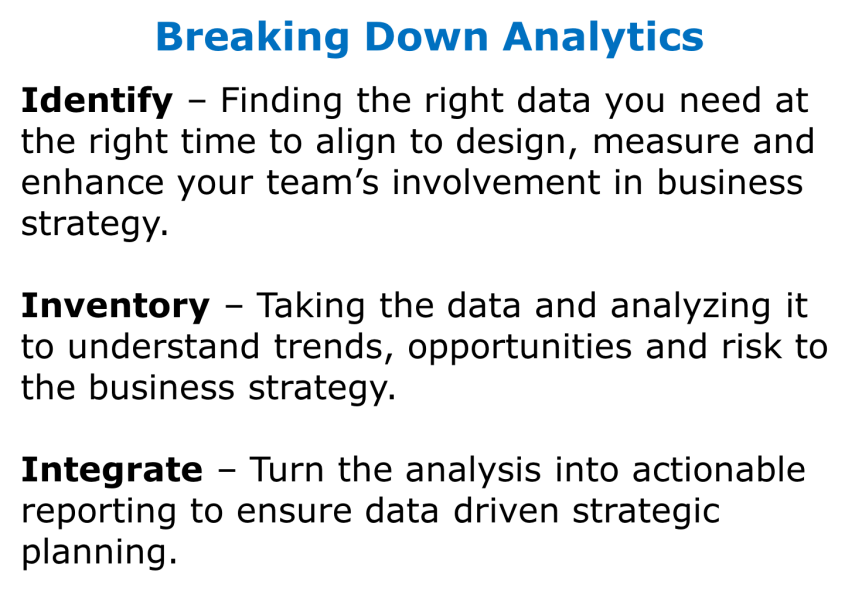
I call my method, Getting IT: The 3 I’s and the 3 T’s of Analytics.

Getting IT Picture1

I borrow the concept of the 3 I’s from a book called the Accidental Analyst. 

Getting IT Picture2

To train someone to be an analyst you need to make them aware of how to find the right data, how to analyze it and how to share it. The 3 I’s.

For analytics to work, you have to have a combination of good talent, technology and technique.

It’s really that simple.

As you discuss any analytics case study or approach any hands on exercise using real data, you plan the 3 I’s and you assess how to use the 3 T’s.

Now take someone who is already an analyst and get them to be able to explain this concept, have them draw from their own experience and their own set of skills, and you have the recipe for a moonshot.

AAP Logo Option Vertical 5

Analytics Leadership – DMAIPH is a founding member of the Analytics Association of the Philippines (AAP.PH) and specializes in arming the Data-Driven Leader with the tools and techniques they need to build and empower an analytics centric organization. Analytics leadership requires a mastery of not just analytics skill, but also of nurturing an analytics culture. We have guided thousands of Filipino professionals to become better analytics leaders.

Contact DMAIPH now at analytics@dmaiph.com or connect with me directly to discuss a uniquely tailored strategy to ensure you are the top of your game when it comes to Analytics Leadership.

I Need Analytics Training. Where Do I Start?

If you put yourself in the mind of the typical Filipino professional looking for analytics training, it is not easy to figure out where to start.

The ecosystem is not very unified, with a hodge podge of public training solutions available and only dozen or so schools offering analytics.

To someone who is relatively new to using big data to solve business problems, it can all seem very nosebleed inducing as well. Data science, predictive analytics and machine learning can all sound complicated and expensive.

So where do I start? That is a very common question I get asked when I talk about analytics in the Philippines.

The answer comes in three parts. First we need a framework to set certain standards and definitions of what a Data Science and Analytics enabled professional should know.

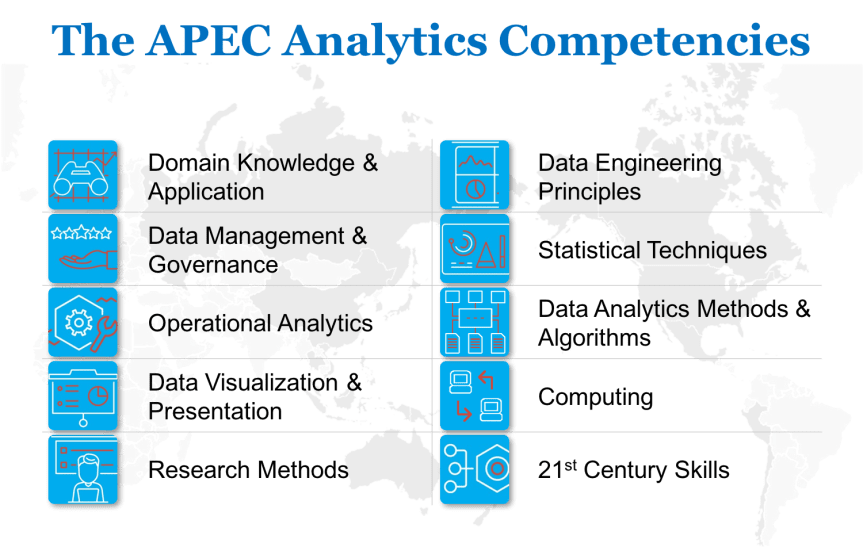
We base that on the set of 10 DSA competencies as defined by APEC’s Project DARE,

Eco_Picture1

(Props to my fellow AAP board member Sherwin Pelayo for the awesome images)

Since few people need to know everything about everything, it is best to figure out which competencies you want to focus on first.

Once you have an idea of where to start, then the next step is determine what kinds of job skills match the competencies you are looking to develop.

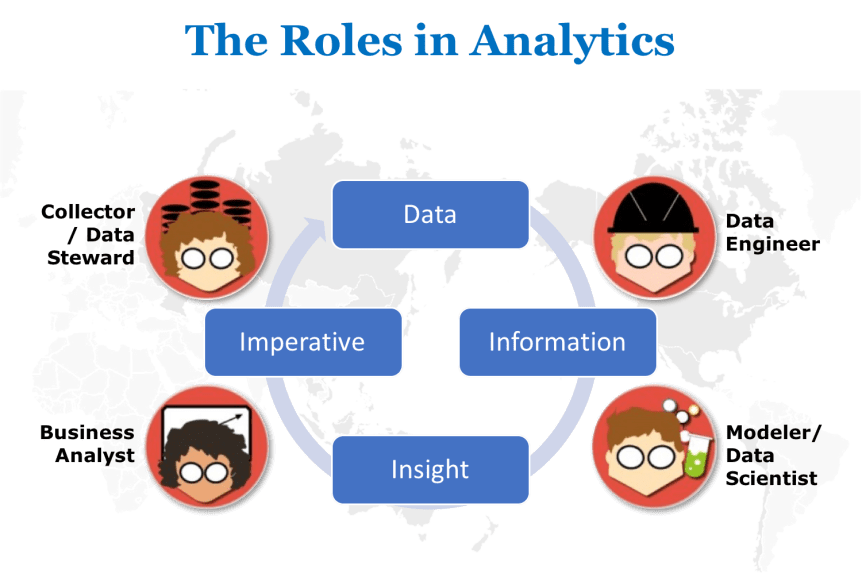
This can be done by determining where in the data life cycle you are looking have an impact,

Eco_Picture2.png

Once you have a firm idea of the skills you want to build and where they fit into the analytics life cycle of your business, then it is a matter of planning out how to level up.

This is where the AAP has take APEC’s competency list  and broken then out across the various job functions along the analytics life cycle by level of skills required.

Eco_Picture3

This allows us the ability to determine where we are in terms of analytics maturity and design the appropriate plan to level up.

And that will lead you to one of the AAP member companies for the appropriate type of corporate training or to one of the AAP member schools for the right higher education solutions.

AAP Logo Option Vertical

And that is how you can get a better idea of what type of analytics training is best for you and your business to get started with.

Analytics Leadership – DMAIPH is a founding member of the Analytics Association of the Philippines (AAP.PH) and specializes in arming the Data-Driven Leader with the tools and techniques they need to build and empower an analytics centric organization. Analytics leadership requires a mastery of not just analytics skill, but also of nurturing an analytics culture. We have guided thousands of Filipino professionals to become better analytics leaders.

Contact DMAIPH now at analytics@dmaiph.com or connect with me directly to discuss a uniquely tailored strategy to ensure you are the top of your game when it comes to Analytics Leadership.


My Big Data Initiatives for 2018

As 2018 comes to a close, I plan on spending the last few weeks of the year thinking about what comes next.

Priority #1 is expanding the advocacy for more data-driven decision-making in the Philippines.

There are two components to this effort; talking about analytics to as many Filipinos as possible and continuing to hit the road and spread the advocacy to as many provinces as possible.

Priority #2 is something new.

After six years of being pretty much 100% focused on analytics in the Philippines, I will be spending some of my time back in the United States. I will be volunteering time to help educate and empower the electorate to make more data-driven decisions when it comes to exercising their vote.

My call to action for 2018 will center around three #hashtags:

#DataRockPinas

#AAPMoonshot

#BetterBringData

More to come.

Analytics Leadership – DMAIPH is a founding member of the Analytics Association of the Philippines (AAP.PH) and specializes in arming the Data-Driven Leader with the tools and techniques they need to build and empower an analytics centric organization. Analytics leadership requires a mastery of not just analytics skill, but also of nurturing an analytics culture. We have guided thousands of Filipino professionals to become better analytics leaders.

Contact DMAIPH now at analytics@dmaiph.com or connect with me directly to discuss a uniquely tailored strategy to ensure you are the top of your game when it comes to Analytics Leadership.


#DataRockPinas: Uplifting Big Data Believers and Converting Analytics Skeptics

I have been talking about analytics here in the Philippines for almost 7 years.

In that time I have come across two types of attitudes towards analytics: Believers and Skeptics.

Believers understand there is value in business data that needs to be unlocked, analyzed and put into action.

These are unfortunately, in the minority of the people I talk with.

Skeptics come in many forms.

Some are skeptics because they just don’t like math. Data to them means nose bleed by numbers.

Some skeptics have a negative opinion about analytics because they got burned in the past by some high-priced consultant or technology that didn’t deliver as promised.

Others are skeptical because they got to where they are in their career or with their business because they have good instincts and trust their gut over a bunch of spreadsheets.

However, the largest population of skeptics are people who just don’t know much about analytics. They have worked in their jobs and have run their business in manual process driven environments that don’t have a culture of using data.

When it comes to delivering analytics training, it’s easy to focus on the believers. They generally come to us looking for trainings, or they see our marketing and make a quick mental decision that they need it.

Over the past several years I say the percentage of believers here in the Philippines has probably doubled from about 20% of the working population to closer to 40% of the working population.

Acceptance of analytics and the use of data has come along way. Success stories like Waze, Grab and Uber… the proliferation of smartphones, and the boom in call centers are some of the reasons for this.

Working with that 40% brings people like me a lot of business. And it is fun to work with people open minded to the use of data.

Still, its still less than half.

So to really make a difference, to grow the advocacy, we need to start converting skeptics into believers.

This requires taking concepts that are hard and breaking them down into layman’s turns.

This requites lots of real world case studies and examples that the average Juan can relate to.

And this requires constantly looking for opportunities to raise awareness.

#DataRockPinas is about all of the above.

We have pockets of believers scattered across the Philippines who are hungry for analytics training to help them in their careers and with their businesses.

We also have large segments of the population who need to be exposed to the concepts of Big Data, Analytics and Data Science in ways that get their attention.

And this is what the DMAIPH andA AP are going to do… work with both the believers and convert the skeptics.

AAP Logo Option Vertical 5

Analytics Leadership – DMAIPH is a founding member of the Analytics Association of the Philippines (AAP.PH) and specializes in arming the Data-Driven Leader with the tools and techniques they need to build and empower an analytics centric organization. Analytics leadership requires a mastery of not just analytics skill, but also of nurturing an analytics culture. We have guided thousands of Filipino professionals to become better analytics leaders.

Contact DMAIPH now at analytics@dmaiph.com or connect with me directly to discuss a uniquely tailored strategy to ensure you are the top of your game when it comes to Analytics Leadership.