Data Analytics to the Rescue

I am a big fan of super hero movies.

One of the reasons why is that in many ways I consider myself to be somewhat of a super hero.

According to Webster’s Dictionary, a super hero is “a figure endowed with extraordinary or superhuman powers which are used for fighting evil.”

IMG_6912

In my world, evil is analogous to ignorance… or the lack of information needed to make good decisions.

I live to fight this fight.

My extraordinary gifts are being blessed with a keen analytical mind and the ability to empower others to unleash their analytical abilities.

Analytics was not my career choice, but my innate curiosity and passion for answering questions put me in a position to become an analytics expert.

I have all the training and skills an educator needs, but instead of teaching in the classroom I train out in the business world.

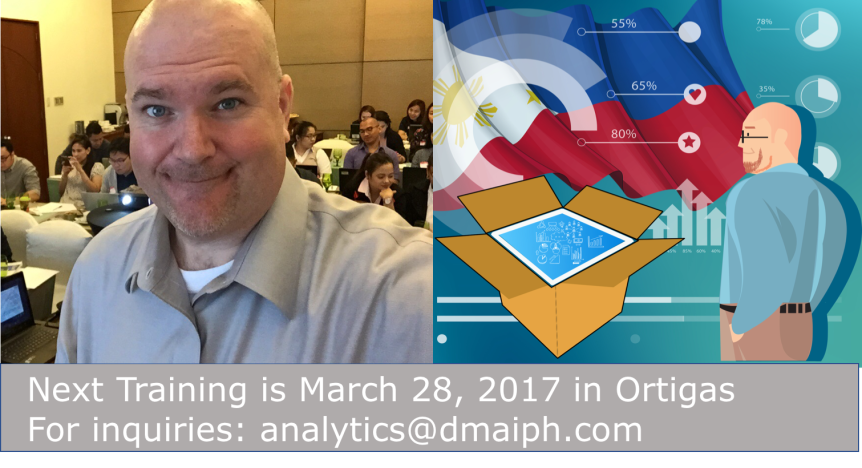
On February, 21, 2017 I will be hosting a training on Data Analytics. E-mail us at analytics@dmaiph.com to register or get more info.

This will be so awesome.

I get to do what I do best.

And I get to do it in my adopted homeland.

I get to use my gifts to help Filipino professional unlock the curiosity buried inside them and use that to help empower more data-driven decisions in their organization.

#IamDMAIPH

Analytics Training – DMAIPH offers a wide range of analytics centric training solutions for professionals and students via public, in-house, on-site, and academic settings. We tailor each training event to meet the unique needs of the audience. If you need empowerment and skills enhancement to optimize the use of analytics in your organization, we are here to help. Contact DMAIPH now at analytics@dmaiph.com or connect with me directly to set up a free consultation on which of our DMAIPH analytics training solutions is best for you.

Learn How to Turn Your Data Into Insightful and Actionable Analysis

Data Analytics Seminar

February 21,2017

9:00am- 5:00pm

Discovery Suites, ADB Drive, Ortigas Center

Objectives

  •  We will start with a basic overview of analytics, current trends in the field and how analytics is being used here in the Philippines.
  • Through a couple of hands on exercises, we will practice finding data, analyzing it and reporting our findings.
  • We will go in depth understand several key components of analytics including business intelligence, competitive landscaping, data visualization and business dashboards.
  • We conclude the day by taking an assessment of each of our own business and starting to develop strategies to enhance the analytics culture in our business.
  • Learn more about Big Data and Data Warehousing

Key Topics

  1. What is Data Analytics?
  2. Overview of Data Analytics in the Philippines
  3. Self- assessment of your own Analytics
  4. Finding Data, Mining and Presenting Data
  5. Internet Research Tips
  6. Management Reporting
  7. Reporting Using Excel
  8. Big Data and Data Warehousing
  9. Discussion about Descriptive, Predictive and Prescriptive Analytics
  10. Business Intelligence and Business Dashboards
  11. Using Data Analytics to Drive Decisions

At the end of this course you will learn:

  • How to do public data mining
  • How to provide data for Business Intelligence
  • How to build better reports in Excel
  • How to manage data for a business dashboard

Requirements: At least basic knowledge of Microsoft Excel

Who should attend?

People who make countless decisions every day!

  • Managers
  • Supervisors
    • Business Owners / Leaders
  • Team Leads
    • Accountants
    • Analysts
    • Students Enrolled In Related Courses of Study
  • Human Resources and Recruiting

This innovative and one of a kind workshop will provide you with easy to implement strategies to increase your effectiveness in decision- making.

While most people have an idea of what analytics is: data, analysis, metrics, and business intelligence are just the start… it is an abstract concept that is difficult to summarize in a sentence or two. Most business leaders know that they need more analytics based decision making in their operations, however few have figured out how to obtain it as analytics software or engaging high priced consultants doesn’t suffice.

This is where we come in. Daniel Meyer spent 15 years as an analyst with Wells Fargo Bank in the US, has combined that practical experience with his educational background; has a master’s degree in education, and developed an innovative training approach to analytics. DMAIPH specializes in a variety of analytics training solutions including ones designed for call center managers, recruiters, HR professionals, fresh grads, and analysts.

Learning Investment  IMG_7203

Exclusive Offer!! 

P 5,800.00 + VAT

This offer includes:

An Analytics Book especially designed for Filipino Professional

(Pay the full amount on or before January 20, 2017)

Group Rate (Minimum of 5)

P5,400.00

 Regular Rate: 

P 6,600.00 + Vat

(starting January 21, 2017)

All rates includes: Training Modules, AM/PM Snacks, Lunch and Certificate of Completion.

Registration 

Kindly email us your Name, Company, Job Title and Phone Number. With the Subject: Data Analytics Seminar 

info@sonicanalytics.com | analytics@dmaiph.com

You may contact us at (0917)799-2827 | (02) 959-8017

Terms and Conditions

  1. Seminar Registration shall be carried out via Sonic Analytics’ Website or the link provided by Sonic Analytics or DMAIPH, by entering the necessary information into the relevant online application form.
  2. After registration, the following will be e-mailed to the registrants: A) Confirmation email; and  B) the Invoice
  3. Contract for the seminar shall be deemed to be completed upon the receipt of the confirmation email. If a registrant’s application cannot be accepted due to lack of vacancies or for any other reasons, he/she will be informed immediately
  4. Cancellation by the delegate will be subject to cancellation charges as follows: More than 15 days prior to commencement of the course: No penalty.6 to 14 days prior to commencement of the course: 25% of course fee.5 days  prior to commencement of the course: 100% of course fee.Failure to attend course without prior notice being given: 100% of course fee.

Sonic Analytics and DMAIPH reserves the right to cancel or reschedule a Public Course and in these situations every effort will be made to accommodate delegates on an alternative course or refund payment in full.

  • Payment of the full course fee is required within 7 days of receipt of invoice. Failed to do so, the reservation shall be forfeited
  • The course fee covers training, venue, training materials, am/pm snacks, lunch and certificate of completion.
  • All stated fees are exclusive of VAT

Mode of Payment

  • DMAI accepts Cash and Cheque only
  • You may deposit the amount on our BPI Account:
  • Account Name: DMAIPH DATA ANALYTICS
  • Account Number: 3553-3662-74

About the Speaker 

Daniel Meyer

Analytics Expert and Author

-President and Founder of DMAIPH and Sonic Analytics

-15 years of experience in the banking industry.

-Masters’ in Education

-5 years college teaching experience

-Published an Analytics Book titled “Putting Your Data to Work”

Having spent 15 years as an analyst in Wells Fargo Bank, Mr. Meyer gets analytics. With the combination of his practical experience and his educational background; Mr. Meyer has developed a unique and innovative training approach to analytics.

P600.00+ Shipping Fee

Putting Your Data to Work by Mr. Daniel Meyer is designed to be an analytics guidebook for the Filipino Professional. The primary aim of the book is to acquaint everyday professionals with a working knowledge of the key concepts of analytics. Whether you are an analyst, do analysis in your job or manage someone who does analysis, this book will help you get started with using more data in your decision-making.

To avail the book or get a free short version of the book, kindly email us your details:

Name, Company, Job Title, Full Address (for shipping) and Phone Number

For inquiries please call us at (02) 959-8017 and (0917) 799-2827

analytics@dmaiph.com | info@sonicanalytics.com

Testimonials 

“I really learned a lot especially in terms of how to maximize the wealth of talent-related information that we have in PMFTC. I am pleased to inform you that I am downloading tableau as i type this message. I am also currently outlining a report that i want to present to my boss by Monday. I am also thinking about ways to improve our team’s regular reporting to HR Managers, being that none of the HR Business Partners seems to read the weekly report that we publish. I am looking at making it more like an infographic rather than just a collection of pivot tables that it is today. I can go on and on about the things that i want do to with everything I learned today. Thanks again for today’s learning-filled session.”

-Patricia

PMFTC

“The training was informative. Learning the fundamentals of recruitment analytics will really help me in providing quality work to the team”

-Raine

Convergys

“Dan’s pretty good. Can’t wait to do something more practical in forms of the application of training lessons.”

-George

Accenture

15442108_1022250554587054_3902952314714042475_n

Analytics Training – DMAIPH offers a wide range of analytics centric training solutions for professionals and students via public, in-house, on-site, and academic settings. We tailor each training event to meet the unique needs of the audience. If you need empowerment and skills enhancement to optimize the use of analytics in your organization, we are here to help. Contact DMAIPH now at analytics@dmaiph.com or connect with me directly to set up a free consultation on which of our DMAIPH analytics training solutions is best for you.


10 Points Where There is a Need for a Data Science Consultancy

My good friend Albert Gavino recently posted about why there is such a strong need right now for data science consultancies.

Bert is a data scientist in the truest sense of the word. So when he listed 10 reasons, which I think are spot on, I asked him if I could share. The 10 reasons are:

  1. Some (if not most) companies want to get into it, but are not sure if they need it.
  2. They need direction on how to do it.
  3. They need information on how much to invest in data science infrastructure
  4. They need people with skill sets to be able to implement data science
  5. Some are biased towards proprietary software while some like the open source guys like Apache.
  6. CEOs think it’s all about big data
  7. Data Science is continually evolving so don’t ask me about AI and deep learning….it’s still transforming things
  8. How much does it cost to consult for a data science? pretty high because we all know demand and supply in this industry
  9. Recruiters confuse programming languages and tools such as R, Python, SPSS, SAS, matlab, spark, scala, hadoop, hive, mahout (there are just too many out there they would get lost)
  10. There is a gap in our Academic Curriculum where they just teach electives such as Business Analytics which does lack a lot of information to the needs of the industry.

talas

So if the point is not already clear, there is a growing difference between the haves and the have nots when it comes to analytics and data science.

If you want to be with the have and leave all the have nots behind, you have to invest in a good analytics solution, a data science team and some technology to help you handle your big data.

1966784_10152250706706628_1752784040_n

If you want to learn more, please look for my friend Albert Gavino or connect with me. Also, Talas Data Consultancy will be hosting a Data Science Conference on November 26, 2016. I will be there meeting and greeting analysts, data scientists and people interested in how to use data to drive better decision-making.

Analytics Culture – The key to using analytics in a business is like a secret sauce. It is a unique combination of analytics talent, technology and technique that are brought together to enrich and empower an organization. A successful analytics culture is not easy to create, but DMAIPH can show you how. Contact DMAIPH now at analytics@dmaiph.com or connect with me directly so we can build a strategic plan to turn your company into analytics driven success story.

Let Your Data Tell You When It’s Time To Say Goodbye – Habitual Tardiness

Came across this blog post the other day and it inspired me to write about how use analytics to know when to let go of troublesome employees.

The first type I’ll blog about is ones who are habitually tardy.

“Handling employees who are constantly tardy for work is one of the difficulties of being a manager — no matter the industry. Simply firing them isn’t always the best policy when you consider the effort spent trying to hire their replacement. On the other hand, if your organization thrives on teamwork, having one team member not pulling their weight is bad for office morale.” Wise words form the blog I read.

The best way to deal with tardy employees is to look at the various data points that are generated by their behavior.  This allows you to be unbiased in your decision-making when it’s time to say goodbye. The 5 data points I suggest you focus on are:

  1. Total Down Time. What % of their shift did they miss plus what time it takes for them to get ready to work (logging in, opening systems, etc.) plus any time out of production you use to counsel them. Take this number and compare it to someone who comes in early, is ready to go when the clock starts and you never have to pull out of production to give warnings too. You will see a surprising difference of how much less time habitually late employees are contributing for the same pay
  2. Distance To Work. Look at how far they have to travel every day to get to the office. I am betting its further than most. There is generally a strong correlation between schedule adherence and distance to work. Not always, but a high % of the time.
  3. Difficulty of Commute. Look at the commute they have every day. How much time do they spend in traffic? Do they have to switch transportation modes? Is their route full of unpredictable impediments? It’s likely that challenges in their commute also have something to do with their consistent tardiness.
  4. Quality Scores. Again, as a general rule, employees who have trouble getting to work on time also have lower than average quality scores.
  5. Primary Production Metrics. Likewise, you generally see lower production metrics from employees who don’t start their shift ready to go.

“When simply walking by their desk to acknowledge a late arrival doesn’t stop the issue, it is probably time for a one-on-one meeting with a frank discussion.” Use this one-on-one time to review these metrics. Share with the employee some insights into why they might be late so often as well as how it effects the business.

It’s my experience that when you show them the data, it generally has a much more profound impact then just talking about things in a general sense. The power of your total down time is the highest on the team. You have the longest and most challenging commute. Your QA scores and production metrics are in the bottom 25% of the entire team. All of these can either be more motivating to the employee or they can provide a good reality check.

Time-to-say-goodbye-300x225

“Being proactive as a manager while showing you understand and even relate to their personal situation might enhance that employee’s performance over the long haul. It is vital you take the steps to get to the bottom of the issue before contemplating further discipline.” Using these data points in your verbal, written and final warnings add much more weight to your counseling. And when/if they finally hit the 3rd strike, you have a lot more data-based rationale behind your final decision. See the original article here:

How long until You Give Up on an Employee Who Keeps Showing Up Late?

If you need help in coming up with a way to build more analytics in your schedule adherence and discipline process, just let me know. I am happy to help.

HR & Recruitment Analytics – The recruitment and retention of top talent is the biggest challenge facing just about every organization. DMAIPH is a leading expert in empowering HR & Recruitment teams with analytics techniques to optimize their talent acquisition and management processes.  Contact DMAIPH now at analytics@dmaiph.com or connect with me directly to learn how to get more analytics in your HR & Recruitment process so you can rise to the top in the ever quickening demand for top talent.

Using Analytics To Validate A Candidates Primary Motivation For Work

I am often asked how to better use analytics in recruitment. Besides the fairly obvious ways like analyzing your pipeline for trends or looking at candidate demographics, I sometimes suggest coming up with a way to correlate candidate answers to items in their resume.

For example, what motivates the candidate to work. The question can be asked a number of ways. Here in the Philippines, it is pretty standard to ask a candidate why do they want to work. This is a different question then the more universal why did you apply for this job question.

The rationale for the question is generally to learn more about the candidate as it applies to commitment and work ethic. Common answers are I need to help meet my family’s financial needs, support my children, pay for a younger sibling’s education. The problem I with this question is that it set’s up a situation where the interviewer can feel sympathetic to the candidate.

As a counter to this, I train my team to look for a few queues in the resume to help validate the genuineness of the candidate’s answer. In short to do some analysis, and record some data for future analysis.

Most resumes here have a biodata section that includes things like parent’s occupation. This is a good place to probe more if the reply to the what is your primary motivation to work is family financial needs. You should also notate this and start compiling data on each candidate response that can then be used down the road in looking at their success as an employee if hired. You can also get a sense for what types of people are being attracted to apply for open jobs. Both can be very valuable insights when building some predictive analytics into candidate screening.

You can also look for employment gaps. If they are working to serve an overarching financial hardship, then there should not be significant gaps in their work experience and/or job hopping. This is a great insight into dependability and work ethic. Make sure to capture this data as well.

You can also ask them specifically how working will meet their primary motivation. Do they have specific costs and amounts at hand, or is the answer more general or even vague? Have they really thought through the cost versus their compensation? Probe to see if they have done analysis themselves on their own needs.

4.6

SO you get the idea, one simple questions with a short reply can actually lead you to much deeper analysis both during the interview and when looking at trending over time.

Ideally, every question you ask is something you can use to generate data. Every answer they give should be validated against the data in their application or resume. And here you create and capture more data.

In the end you will amass a wealth of information on candidates that you can analyze to look for patterns showing you who to hire and who not too. It can also help you determine that if you do hire them, what kind of employee will they become. Adding some simple analytics at the front end opens things up to a whole new level of data-driven decisions making in your talent acquisition process.

If you need a little help in adding or enhancing analytics in your recruitment process, let me know. Happy to help!

HR & Recruitment Analytics – The recruitment and retention of top talent is the biggest challenge facing just about every organization. DMAIPH is a leading expert in empowering HR & Recruitment teams with analytics techniques to optimize their talent acquisition and management processes.

Contact DMAIPH now at analytics@dmaiph.com or connect with me directly to learn how to get more analytics in your HR & Recruitment process so you can rise to the top in the ever quickening demand for top talent.

Why Analytics Projects Fail – #13: Over Reliance on External Help

The final reason I will articulate in this series of why analytics projects fail is an over reliance on external help. Historically the over reliance would happen when a team is “too busy” to learn the ins and outs of the analytics software they using.

An example would no one internally has the training to maintain or update the software themselves. Any fixes, patches or enhancements have to be done with the help of someone not on the company payroll. This has obvious limitations like not being top priority or made to wait longer the necessary, as well the potential slowdown caused be internal review and QA processes. Not having someone on the insides trained to handle external products is a major risk to an analytics project.

Another examples is when internal analyst don’t have the initiative to own the software. Meaning they just do the minimums, never really learn all the things the software can do and do not offer any new idea of solutions. Being totally dependent on a vendor to keep you up to date on all the new possibilities for use of the software is extremely short sighted. This often causes going the long way on a project instead of knowing about short cuts.

20141203193138-5-tech-tool-help-compete-with-big-guys

A third example is that your team is not empowered to work independently and their schedule is dictated by the availability of the vendor. Important deadlines might be missed or extended because the vendor resource is not available when you need them.

Regardless of the impact, relying too heavily on your analytics software vendor leaves open the risk of what if the external expert leaves. I have seen this happen a number of times, where analytics projects were halted or even cancelled because the expert was outside the company and left the project. The most common outcome of losing your expert is that things stop working and you have to either use workarounds or start over.

The key lesson here, if you are an analyst working with externally supported software, it behooves you to become the expert on it. This will mitigate any the risk of being over reliant on the vendor. It will also assure you of having more control of maintaining, fixing and upgrading your own analytics process yourself, which makes you more valuable to the organization you work for.

Analysts who know why things fail, are proactive, find solutions and become analytics champions are the ones you want to measured by. In the end, the best way to make sure your analytics projects don’t fail is to be awesome at what you do.

Analytics Culture – The key to using analytics in a business is like a secret sauce. It is a unique combination of analytics talent, technology and technique that are brought together to enrich and empower an organization. A successful analytics culture is not easy to create, but DMAIPH can show you how. Contact DMAIPH now at analytics@dmaiph.com or connect with me directly so we can build a strategic plan to turn your company into analytics driven success story.

Why Analytics Projects Fail – #12: New Technology

Occasionally one of the problems that can doom an analytics project is a new technology that emerges and makes the project obsolete before it is even implemented. This happened to me once when we were using an older and heavily modified version of Business Objects and then we got access to Tableau.

At the time, the flexibility of Tableau made our Business Objects business dashboard obsolete before we even completed the design phase of the project. The data visualization and the ease of use of Tableau Desktop at that time was miles ahead of anything our IT team could build around Business Objects. As a result, countless hours and dollars were lost, but in the end at least the business requirements we had established could be done by end users in Tableau.

Another example of how a new technology might impact your project is when a new version of the database you are using comes out. One that requires some much QA and/or testing to meet internal guidelines, that when it is finally approved it is hardly useful any more.  This can often be the case with big companies that have long vetting processes to use new version of software. You’d be surprised how many Fortune 500 companies are still running internal version of Windows XP because using 8 or 10 has not been approved yet.

Modifications done in house to off the shelf solutions can also make new versions incompatible. I have seen this happen with both Cisco and Teradata databases, where internal development of data flows and data structures to be so rigid, it was impossible to use updated versions of the same databases.

You can also come across situations where developers and IT teams are ordered to use something else because changes in a vendor relationships or a new strategy from the CTO.  In the end you have to adapt and either sacrifice, lose, or give up on what you have put into the project so far.

540

As the number of data collection and storage options grow, the complexity of data models surge and the types of business intelligence solutions increase, the likelihood of a big analytics projects being impacted by new technology. A good analyst has to stay up to date on what’s hot and new, in order to not advocate the use of something that is on its way to being a dinosaur.

To help me stay current, I follow several blogs and belong to a dozen analytics themed LinkedIn groups. I also try and attend at least one big industry conference a year as an attendee as well.  And finally I read a lot. I end up going through 3-4 analytics themed books a month. If you are facing a situation where you are worried your project might fall victim to a new technology, let’s talk about it. I can help you figure out a solution to keep you and your project on the cutting edge.

The key to using analytics in a business is like a secret sauce. It is a unique combination of analytics talent, technology and technique that are brought together to enrich and empower an organization. A successful analytics culture is not easy to create, but DMAIPH can show you how. Contact DMAIPH now at analytics@dmaiph.com or connect with me directly so we can build a strategic plan to turn your company into analytics driven success story.

Analytics Culture – The key to using analytics in a business is like a secret sauce. It is a unique combination of analytics talent, technology and technique that are brought together to enrich and empower an organization. A successful analytics culture is not easy to create, but DMAIPH can show you how. Contact DMAIPH now at analytics@dmaiph.com or connect with me directly so we can build a strategic plan to turn your company into analytics driven success story.

Why Analytics Projects Fail – #11: No End User Participation

One the most overlooked and under appreciated parts of assuring a successful analytics implementation is getting the participation of end users. End users being defined as the consumers of either the data, the analysis and/or the reports that come out of the project.

I can tell you countless horror stories about stacks of reports that go unread, email summaries that are never opened and business dashboards that are rarely clicked on. In most cases, all because the end user was not involved in the project or its development process.

One example of this is when the ones who need the reports are not asked what they need in the report.  This is more common than you might think. Requirements, no matter how well thought out, will always overlook something someone needs. Another reason is not finding out how the end users want it to look. They often are omitted from the design phase and just left to use it. Worse it’s possible that what is delivered in not even compatible with other things they do. This leads to failure by not being useful, a complete waste of time and resources, especially yours.

TPS-Report

The best way to assure end user use is to have them involved at the earliest stages of the project. If you are selecting the project team or have influence on the team makeup, make sure you get an end user who can speak for that audience. It might be more than one person.

Another way is to keep the end-users informed and allow for feedback. Finding ways to work feedback into your project is another place you would be surprised by how often it is not done.

And finally make sure you build in a testing period before your project goes into production. In some cases this might include the feedback phase, but in big projects there is often a need for end user testing. If you don’t shepherd this effort, who will?

If you are no sure how to go about involving the end users and/or are not sure of who all the end users might be, then you should really answer those questions as early as possible. No one wants to see their hard earned work just end up in the trash bin because it does not fit the need it was designed for.

The key to using analytics in a business is like a secret sauce. It is a unique combination of analytics talent, technology and technique that are brought together to enrich and empower an organization. A successful analytics culture is not easy to create, but DMAIPH can show you how. Contact DMAIPH now at analytics@dmaiph.com or connect with me directly so we can build a strategic plan to turn your company into analytics driven success story.

Analytics Culture – The key to using analytics in a business is like a secret sauce that fuels Data-Driven Decison-Making. It is a unique combination of analytics talent, technology and technique that are brought together to enrich and empower an organization.

A successful analytics culture is not easy to create, but DMAIPH can show you how. Contact DMAIPH now at analytics@dmaiph.com or connect with me directly so we can build a strategic plan to turn your company into analytics driven success story.

Why Analytics Projects Fail – #10: Key People Leave

One of the toughest analytics challenges to fix is when key people leave. This reason is another people problem, but with a technology bent. Depending on the importance of the person(s) who leaves, you can experience anything from a minor hiccup to a total meltdown of your project.

One example of this is when the one who built the database leaves. Often they take their unique knowledge of the data structure with them.  Another example is when the systems architect who knows the ins and outs of where the data flows departs. This can make it difficult to track down errors and bugs. Lastly,  the database admin who wrote the code might be the one who quits, taking with them all their coding work. I can even be worse if they leave on bad terms and take a key piece of your development work with them or even destroy it.

In general, the best outcome you can hope for is to is build workarounds that allow you to keep the project going, however sometimes you are better off just starting over or worst case you just live with what you have. So step one is seeing where you are in the process and then determining what it would take to replace that person.

If you are able to continue, then you need to start doing a better job of documenting and making sure information is shared so this won’t happen again. I learned this lesson early in my career. Learn all you can about all aspects of the data environment and document them. A lot of times a clear understanding and documentation will be required by management to assure funding and resources.

4.6

If you have to stop the project until you can find a replacement, then you should also learn, document and share everything so that the new person can pick things up as soon as possible.

In this case, the new person will likely be dependent on you to learn the ropes so use that opportunity to change your culture to be more open.

A final point to add, make sure you understand why the person left.

If there are things you can do to make sure the same thing does not happen again then it is on you to do just that. If it is a cultural thing, then you can be a catalyst for change. If its a compensation thing, then you can help define the expected scope of work and help in the compensation planning. If they left because of a personality conflict, then you can help find someone who will fit in better. Analysts have so much power to shape conversations. Use it.

Analytics Culture – The key to using analytics in a business is like a secret sauce that fuels Data-Driven Decison-Making. It is a unique combination of analytics talent, technology and technique that are brought together to enrich and empower an organization.

A successful analytics culture is not easy to create, but DMAIPH can show you how. Contact DMAIPH now at analytics@dmaiph.com or connect with me directly so we can build a strategic plan to turn your company into analytics driven success story.

Why Analytics Projects Fail – #9: Bad Data

In my experience, most of the time analytics projects fail its generally traceable back to a purely human problem. However, sometimes you see things fall apart because of technology, the misuse of technology and/or just bad technology. This is the case when projects fail because of bad data.

There are a lot of ways bad data can happen.

One common way you end up with bad data, is the data was not captured correctly. Perhaps the data was manually input with lots of error. Or maybe your data is not consistently collected so it has gaps. Knowing what exactly goes into capturing your data and being able to understand how it is collected is extremely important.

zurich_image_april_10-323x353

Another cause of bad data is that you are not getting all the data or you are getting data that has been altered. A lot of times when data passes from the collection point to you, it might be being truncated, or blended, filtered or converted. Lots of databases are structured for optimal data storage, not usage. A lot of database admins who don’t really know the data will add data flow shortcuts. Or maybe the fall under the datakeepers category and partition or cut out some of the data you need.

Bad data also comes in the form of old and out of date data. When you are making decision on data that just not recent enough, it can lead to a lot of problems. Keeping data fresh is something some companies just don’t value. If that’s the case, you will likely see your analytics initiatives come up with analysis that points you in the wrong direction.

In all three of these examples, one solution I suggest to mitigate the chance you have bad data is to build a data map. Learn about every point in a data flow that touches your data. Talk to the ones in charge of each touch point to make sure your data is not being impacted in any way that can result in bad data. Even if you cannot fix the problem, understanding it can help you set more realistic expectations of what your analytics project can achieve.

I have found using Visio to build data flow visuals is the best way to explore, document, and report how the data being used in my projects is being impacted by the environment it lives in. Knowing Visio is a valuable skill for an analyst. If you don’t use it, I promise you that once you do you’ll be sending me a thank you.

may18

Analytics Culture – The key to using analytics in a business is like a secret sauce that fuels Data-Driven Decison-Making. It is a unique combination of analytics talent, technology and technique that are brought together to enrich and empower an organization.

A successful analytics culture is not easy to create, but DMAIPH can show you how. Contact DMAIPH now at analytics@dmaiph.com or connect with me directly so we can build a strategic plan to turn your company into analytics driven success story.