Mixing Technique With Empowered Curiousity

Last year I spent some time helping a couple of schools build more analytics centric training into their psychology curriculums. The goal being to help prepare future HR managers and analysts to be ready to deal with real world analytics challenges.

Over the next few blogs, I will share several of the topics I listed in these curriculums that are equally balanced in both the technical and intellectual aspects of HR analytics.

It is a common misconception that HR analytics is all about using tools and techniques to generate reports and share information to management in a way that makes the business more successful. This concept will not generally work because the analysts are not empowered to question, explore and discover new opportunities or to understand hidden risks. All they are expected to do is report things faster and with more flash.

Some of the topics typically taught in your basic HR and/or Recruitment Analytics class include:

  • Stages of HR Analytics
  • HR Metrics – Calibration and Measurement
  • Statistical Analysis Tools like DCOVA (define, collect, organize, visualize and analyze)
  • Enhancing HRIS (Human Resources Information Systems)
  • Optimizing MS Excel for HR Analytics
  • Business Intelligence Tools for HR Teams
  • Predictive Analytics Methods and Models
  • Big Data Analytics for HR Teams

Each topic can be its own training module if you have the time to sit in a class and approach the use of HR analytics academically. The problem is few of us can spare the time.
522

My solution is a mixture of self-education, internal team building dynamics and an empowerment based model of analytics training that will not just make your team better at building reports, but will unlock their minds and free their curiosity allowing them to get outside the box and discover things you can’t even imagine.

No one wants a team of drones who just follow steps in a technique or use a technology to do just exactly what it was designed to do. To really have an HR Analytics team that make a difference, you need a team that thinks differently. If you are serious about building this kind of culture in your business, then I can show you how.

Analytics Culture – The key to using analytics in a business is like a secret sauce. It is a unique combination of analytics talent, technology and technique that are brought together to enrich and empower an organization. A successful analytics culture is not easy to create, but DMAIPH can show you how. Contact DMAIPH now at analytics@dmaiph.com or connect with me directly so we can build a strategic plan to turn your company into analytics driven success story.
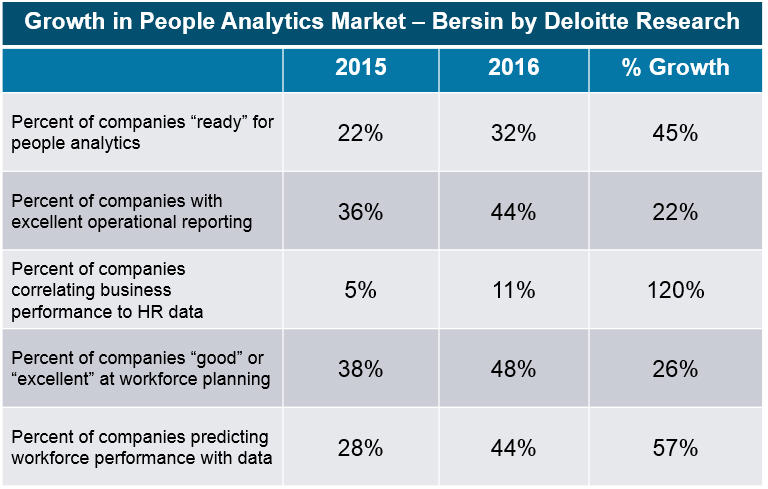
Explosive Growth In People Analytics

https://www.jibe.com/ddr/telling-the-story-of-a-data-driven-future-for-talent-acquisition/

Came across this really interesting table about the explosive growth in HR Analytics.

data-driven-human-resources

(Source:  Deloitte Human Capital Trends 2015 and 2016, 3,300 and 7,100 respondents, respectively) 

The blogger who shared this, Mike Roberts, stated “With advancements in technology, as well as more awareness of the power of data, this is starting to change. Since 2014, we’ve seen an incredible transformation in the way talent acquisition professionals view data. And research from leading analyst firms has been backing that up.”

This is exactly why I have been doing HR & Recruitment Analytics training classess. There is a growing number of options out there, so make sure you get the bang for you buck you are hoping for.

IMG_6912

Connect with me if you want to know more about my approach to using data to drive decision-making in HR and Recruitment. I have recently published a book, Putting Your Data to Work, that can be your guidebook to how to get more people analytics in your HR and Recruitment processes.

HR & Recruitment Analytics – The recruitment and retention of top talent is the biggest challenge facing just about every organization. You really have to Think Through The Box to come up with winning solutions to effectively attract, retain and manage talent in the Philippines today. DMAIPH is a leading expert in empowering HR & Recruitment teams with analytics techniques to optimize their talent acquisition and management processes. Contact DMAIPH now at analytics@dmaiph.com or connect with me directly to learn how to get more analytics in your HR & Recruitment process so you can rise to the top in the ever quickening demand for top talent.


Analytic Techniques to Make Data Driven HR Decisions

On June 22, 2016, in Ortigas, I will be partnering with my good friends at Ariva Events Management to facilitate a workshop on HR Recruitment Analytics.

We are expecting about 100 participants to come and learn more about how to use analytics to empower more data-driven decision-making in their organizations.

Analytics is now commonly being used across all industries, but being able to use the right analytic techniques to harness the power of big data is not so common.

Topics covered in the training include:

  • What is Recruitment Analytics?
  • Self-Assessment of your Recruitment Analytics
  • Analytic Techniques for Finding the Right Data at the Right Time
  • Applicant Tracking Systems & Social Media
  • Big Data and Recruiting Analytic Strategies
  • Business Intelligence, Data Visualization & Business   Dashboards Technologies
  • Building Meaningful HR Recruitment Techniques

New technologies like social networks, applicant tracking systems and business intelligence applications are fundamentally changing the entire recruitment process from sourcing to placement.

IMG_1224

A standard definition of HR Recruitment analytics is simply the metrics and analysis that relates to recruiting in a business.

However, we all know its actually a lot more challenging in practice.

The pressure to deliver results has never been greater.

HR and Recruitment managers are now more than ever required to demonstrate the return on investment their efforts are contributing to the bottom line.

So as the day progresses we will use hands of exercises based on real business cases to come up with solutions to the data challenges around us.

We will also look at several of the biggest trends in HR Recruitment Analytics. Sixmonths into 2016, there are the ones I have identified as the most common:

  1. Millennial Job-Hoppers
  2. Fresh Grad Skills Mismatch
  3. Selling Compelling Brands
  4. Focus Shift on Retention
  5. Social Media is not the magic solution
  6. Go Mobile or Go Dinosaur
  7. Big Data will make life better
  8. Analytics solutions that actually work

Don’t fall behind the competition. Recruiting for top talent in the Philippines is one of the hardest jobs on the planet right now. If your team is not armed with the best analytic techniques it will only get harder to stay a head in the game.

Let me know if you are interested in attending and I will connect you with my business partners at Ariva.


Finding The Time To Talk About Analytics Strategies

One of the biggest frustrations I hear from people when we are talking about how empower more data-driven decision-making in an organization is that no one has enough free time to get serious about analytics.

When facing this kind of challenge, a short presentation full of useful data can be used to start the ball rolling. When people say they are too busy then they are often actually saying I have too many things to keep track of and I am not as organized as I should/could be.

There are indeed times when there is more work than can be done in 40 hours a week, but that is actually not the case in most situations. Most corporate cultures reward those with the “I’m so busy I don’t have time to waste on reports” badge of honor.

To counter this you need to do some research into what are the potential time and cost savings that come from fixing the reports and getting better data to decision-makers. It wont take long to find a lot of numbers to use in your business case after a quick Google search. LinkedIn is also a good place to find lots of supporting documentation.

Once you have that info, you can add it to your own assumptions about what KPIs are not being used or what KPIs are missing from current reporting or which KPIs are miss reporting. This can all be turned into a short, compelling case for others taking the time to talk about broader reporting across the organization.

11756770_934770113231654_1677809504_o

To really add some punch to your argument, ask one of the too busy people to give  you a few minutes of time to ask them what more they want/need out of their reports. Hardly anyone is truly happy with the reports they get. Gain a few allies in your crusade.

Most people think that using analytics effectively is all about the technology, but the real secret to success is getting the people on board and on the same page. True analytics centric cultures are based on engagement and that engagement needs a facilitator.

Once you have your story and a few key advocates it will be a lot easier to get closer to the data-driven decision-making you are looking for.  If you need help polishing your story or advice on how to get the engagement of a really tough “I’m too busy” co-worker, let me know. I’m sure I can lend a hand.

Analytics Culture – The key to using analytics in a business is like a secret sauce. It is a unique combination of analytics talent, technology and technique that are brought together to enrich and empower an organization. A successful analytics culture is not easy to create, but DMAIPH can show you how. Contact DMAIPH now at analytics@dmaiph.com or connect with me directly so we can build a strategic plan to turn your company into analytics driven success story.

Conversation About the Reporting Mess

The other day I was hanging out with some friends who work for a company I used to work for and they were talking about challenges they were having with some reports. As I listened, images started filling my mind of the challenges so many companies face. Not having a good data strategy within a business is a killer to both productivity and morale, opens up a company to extra risk and blinds people to opportunities.

The first problem I suggested they tackle is validating their current Key Performance Indicators (KPIs). They need to analyze what is currently being reported to find out what is not useful to the business in making educated decisions.

The second problem is that the people who “own” the data don’t like sharing.  The place where I’d start with this challenges is mapping out the data flow. It would be really powerful to illustrate the different touch points within the flow and most importantly where things get stuck. Then it’s a matter of explaining the big picture to those who might be causing slowdowns.

The third problem is that everyone is too busy to sit down and figure out how to fix things. To solve this challenge, we will need to get everyone on the same page and agree to a common data strategy. This will not be a one and done meeting, but a series of conversations.

So to solve this, my friends need to start with asking questions about what do people really need. In many cases I would expect the answer is no. This is where knowing the architecture comes in handy, so you know where the data lives that is currently missing. After this it’s a matter of storytelling and influencing the “owners” of the data to understand how access to key data would generate more powerful KPIs which would allow everyone to get on the same page.

10592010_10152674958362425_1982237172_n

It sounds pretty easy and it should be. The ultimate challenge is really getting people to all agree on how to use the data. In some cases, it might take senior management support to get everyone to play nice. And my friends will need data to support their argument on how thing can be better and put some numbers behind their vision of a stronger data-driven culture.

This is where I come in. When inside politics and no one has time to lead the charge, an outside consultant might be the best solution. An expert in not just identifying the challenges and sharing findings, but someone who can actually help facilitate cultural change. People who are equally skilled in both the technical world of analytics and the social world of team building are pretty rare birds.

If you are in a situation like my friends, then I’m ready to help you like I helped them.

Analytics Consulting – DMAIPH specializes in a variety of analytics consulting solutions designed to empower analysts, managers and leaders with the tools needed for more data-driven decision-making. We have helped dozens of companies get more analytics in their business. Contact DMAIPH now at analytics@dmaiph.com or connect with me directly so we can tailor an analytics solution made just for your unique requirements.

Data Analytics Training on Nov 22

Just sharing some details on an upcoming training I’ll be delivering.

This innovative and one of a kind workshop will provide you with easy to
implement strategies to increase your effectiveness in decision- making.

Objectives
– We will start with a basic overview of analytics, current trends in
the field and how analytics is being used here in the Philippines.
– Through a couple of hands on exercises, we will practice finding data,
analyzing it and reporting our findings.
– We will go in depth understand several key components of analytics
including business intelligence, competitive landscaping, data
visualization and business dashboards.
– We conclude the day by taking an assessment of each of our own
business and starting to develop strategies to enhance the analytics
culture in our business.
– Learn more about Big Data and Data Warehousing

Key Topics:
– What is Data Analytics?
– Overview of Data Analytcs in the Philippines
– Self- Assessment of your own analytics
– Finding Data (Mining and Presenting the Data)
– Big Data and Data Warehousing
– Discussion about Descriptive, Predictive and Prescriptive Analytics
– Business Intelligence and Business Dashboards
– Using Data Analytics to Drive Decisions
– Enchant your audience

Group Exercises will focus on mining data from public data sources, working on a marketing strategy based on business analytics and building a business dashboard prototype.

In today’s global marketplace, businesses are challenged with endless streams of data of immense volume, variety and velocity coming from around the world. Having people on your team who can use the data in your business to drive more data based decisions in no longer an added value. It is a fundamental cornerstone of success.

522

SEMINAR FEE

PHP 6,000/regular participant inclusive of VAT, training materials
(workbook), am/pm snacks, lunch and certificate of completion

*Group DISCOUNT (Minimum of 5):*

PHP 4,800/ participant inclusive of VAT, training materials (workbook),
am/pm snacks, lunch and certificate of completion.

To register, please call 09177992827 or send an email to info@sonicanalytics.com

Analytics Training – DMAIPH and our partners at Sonic Analytics offer a wide range of analytics centric training solutions for professionals and students via public, in-house, on-site, and academic settings. We tailor each training event to meet the unique needs of the audience. If you need empowerment and skills enhancement to optimize the use of analytics in your organization, we are here to help. Contact DMAIPH now at analytics@dmaiph.com or connect with me directly to set up a free consultation on which of our DMAIPH analytics training solutions is best for you.

Q15: What is a business dashboard and how is it used in a business?

Much like a driver uses a car’s dashboard to make lots of decisions before and during a trip, a business dashboard helps a business decision-maker to plan for his business.

Wikipedia’s definition of a business dashboard is quite long. A business dashboard is  “An easy to read, often single page, real-time user interface, showing a graphical presentation of the current status (snapshot) and historical trends of an organization’s Key Performance Indicators (KPIs) to enable instantaneous and informed decisions to be made at a glance.”

That is a mouthful. But lets break it down to help us understand how a business can use dashboards to make better decisions.

  • Single Page – You need to be able to see everything you need to know at a glance. If you need to scroll or click to get data it really lessens that power of the dashboard.
  • Real Time – If the data isn’t current, then you really are limited to being able to take action. With technology today, not having a way to feed real time data in your dashboard is pretty old school. Plus this can help you set up some useful predictive models that feed into the dashboard.
  • Graphical Presentation – People pick up data much quicker from visual queues like charts and graphs then they do a table full of numbers. There are a lot of great visualization tools out there to add a lot of both style and substance to analyzing business data.
  • Current Status – Besides being furnished with real time data, you should be able to look at where things stand right now. Like how a speedometer keeps you within the speed limit, real time status can help you know where to focus your energy most.
  • Historical Trends – The priority is real time, current status all in one view. That said, having the ability to switch to historical trends is also something to look for in an awesome dashboard.
  • KPIs – One of the keys to getting the most bang for your buck with a dashboard is to make sure you are feeding the right KPIs into it. The audience will gravitate to what is most important to them and if its not available at first glance they wont use the dashboard. So knowing the business well enough to know the key KPIs for the power users is super important.
  • Make Decisions – The bottom line is that if a dashboard improves the speed and the accuracy in which decisions are made then its working. Companies with really good analytics cultures use dashboards at staff meetings and conference calls and have pretty much killed the use of power point for most discussions.

When you walk into a company and you see business dashboards on the wall monitor and/or on desktops you are in the kind of place we should all be. The technology is there, its more a matter of culture to make it useful.

3.8.2

Hope that helps shed some light on how business dashboards can help a business. They just give you much more relevant and useful data summarized and offered in easy to use and understand bites.

My team is very adept at setting up business dashboards using Tableau Public. Let me know if you’d like to know more.

The 3 Parts of Me: BPO Elite, DMAIPH and Sonic Analytics

A little about me. I oversee three small companies that specialize in analytics. I am not actively trying to sell you my services, but do hope that if you ever have a need for tailor made analytics solutions, you remember me.

BPO Elite is a consulting business that matches up companies in the U.S. with talent in the Philippines to do a variety of basic analytics and back office work. We DO NOT deal with companies looking just to send jobs overseas, focusing only on partners who need to add flexibility and depth to the talent pool. We have helped over a dozen companies find the right solution for their business to date.

DMAIPH is a company designed to deliver analytics training and support to colleges and universities looking to add more analytics centric courses and materials to their curriculum. To date, I have consulted with over a dozen of the top schools in the Philippines as well as working with student interns from UC Berkley, San Diego State and Diablo Valley College. My interns have helped a number of small business with basic analytics projects. I also blog about my love for analytics and how I teach it.

Sonic Analytics is a training business that focuses on corporate trainings in analytics related topics. Based on my experience as a senior analytics consultant with Wells Fargo Bank and in teaching analytics to college students in both the U.S. and the Philippines, I have come up with a very effective way to help professionals get a better handle on the analytics culture in their business. I have delivered trainings to thousands of people over the past few years, helping them learn how to make more data-driven decisions.

IMG_1224

Each company represents one of the key components of my dream to bring better analytics to as many businesses as possible.


Q4: Can you please describe the current state of analytics in the Philippines? – Part 2

So the last blog post gave us the history. Now let’s cast an eye on the future.

Over the past year or so I have started to see a significant effort from data science and analytics professionals come together to address some of the challenges outlined in my last blog post.

In short, the way higher education and the government has approached the need for analytics talent is simply to little to late to meet the needs of many businesses.

Everything they are doing helps, but in the end the world is desperately looking at the Philippines to do with analytics what it did with customer service. To become a center of capable, long-term and affordable talent.

With taking customer service calls, it was a natural fit given that most Filipino college graduates have a foundation in English. With analytics and data science it has not been so easy. While many Filipino have the underlying course work in coding, database management, computer science, etc… they are not getting enough exposure to data-driven decision making, business intelligence tools,  and more advanced things like machine learning, prescriptive analytics and blending big data from diverse data sources.

I don’t want to sound too pessimistic, things are moving quickly but it is generally the multinationals driving things forward. They have the clients, they have the need and so they go out and find people and train them. That’s why 3 years ago hardly anyone in the private sector was offering analytics training, now you see more and more options all the time. They are generally expensive and narrow in focus, but they are opening up huge opportunities for data loving Filipinos to get into upwardly mobile and financially rewarding careers.

I belong to a couple of newly founded organizations of data scientists and analysts who meet on a regular basis to share knowledge, support each other’s ideas and build a community with the goal of using data to helping both the Filipino to fill these open jobs and for the Philippines to begin to use more data in decision-making so we can solve the big issue problems important to all of us.

It’s a pretty exciting time.

10256713_275221292688289_6652823653462957603_o

So where next?

Given that the Philippines is one of the youngest countries in terms of average age on the plant and the youth are incredibly communal and very tech savvy, I have found great success in training batch of Filipino fresh graduates in basic analytics. Of the 200 or so trainees I have personally trained, most of them now have jobs with analyst in their title.

I have also seen a lot of talent quickly go from novice to expert using applications and doing coding in relatively short periods of training. In many respects the approach to analytics is more vocational then academic allowing for quicker training.

Beyond these strength, you can expect more partnerships between the government, higher education and big business to offer training and career pathing.  The success of the BPO industry is really the driving force to add employees who can do the tasks of an analyst. The huge surge in job postings demonstrates this quickening trend.

Finally, the reason I see a bright future for analysts and data scientists in the Philippines is the simple fact that Filipinos gravitate to under filled career paths, they push themselves to get the skills to fill those jobs.  You see it in the Middle East oil fields, in sailors and seamen in just about every ship at sea, you see it with overseas workers across the planet, and you saw it happen with call centers.

And that is exactly why I set up my business in the Philippines. Here are some of the analytics solutions we offer:

The Fundamental of Business Analytics – Business Analytics is the application of talent, technology and technique on business data for the purpose of extracting insights and discovering opportunities. DMAIPH specializes in empowering organizations, schools, and businesses with a mastery of the fundamentals of business analytics.

HR & Recruitment Analytics – The recruitment and retention of top talent is the biggest challenge facing just about every organization. You really have to Think Through The Box to come up with winning solutions to effectively attract, retain and manage talent in the Philippines today. DMAIPH is a leading expert in empowering HR & Recruitment teams with analytics techniques to optimize their talent acquisition and management processes.

Contact DMAIPH now at analytics@dmaiph.com or connect with me directly to learn how to get more analytics in your Business or your HR & Recruitment process so you can rise to the top in the ever quickening demand for top talent.

Q4: Can you please describe the current state of analytics in the Philippines? – Part 1

Let me tackle this question in two parts. The history major in me demands we look at how we got to where we are now before we talk too much about where we are going.

To start, both the appreciation for and the use of analytics has grown tremendously over the past few years. When I first started thinking about setting up a business in the Philippines back in 2011, hardly anyone knew much about analytics. Big banks, large call centers, multinational corporations and only the top schools were even talking the concept.

It was a challenge to fill my initial training classes due to lack of general awareness. Even at industry events and conferences it was rare to hear much about the idea of using data to drive business decisions.

Doing a search on the top job board in the Philippines back in 2012 for the jobs with analyst in the title netted about 1,000 job postings on any given day.  The average salary was some here around 30,000 PHP a month. It was a challenge to find good talent and those who could do analytics were all gainfully employed.

It wasn’t until 2013 that I stated seeing other analytics training options and those were just ones being done by IBM to meet the CHED (Commission on Higher Education) requiring the implementation of a six class elective tract in business analytics. The was accompanied by the launching of Analytica, and IBM backed effort to push the Philippines towards being more a viable option for analytics outsourcing.

At this time a job search for analyst would bring back about 1,500 jobs. Salaries were starting to rise for analysts as well with the market average getting closer to 50,000 PHP.  Still not a lot of public training or analytics centric organizations around then.

About the same time I started getting invited to schools on a regular basis to lecture about analytics to IT, CompSci and Management students. For the most part they had no idea of the career opportunities out there for those with analytics talent. I consulted with several schools on how to implement the CHED memo and how to prepare their students for analytics careers.

In 2014, an analyst job search was yielding closer 2,000 open jobs. The average salary climbed north of 50,000 Pesos for an experience analyst. I did a lot more trainings, being able to routinely fill a class of people hungry to learn more about analytics and how it could help them in their jobs.

The most in demand analytics skills up to this point where many centered on management reporting, production analysis and workforce management. Most analysts used some kind on proprietary database to store data and did just about all their analysis in Excel.

By 2015, analytics was finally in the mainstream.  Job posting now routinely called for specific skills sets in programming languages and business intelligence tools. Multiple organizations made up of analytics professionals started coming together. The number of jobs open hit 2,500 on any given day and salaries for really good analysts hit 70,000 PHP a year.  By this time, many outsourcing companies focused on setting up team of analysts to offer analytics as an outsourcing option.  Big data jobs and even data scientist positions started showing up in large numbers.


So here, we are now in early 2016. The sky is the limit when it comes to Filipinos with analytics talent being able to enjoy good career growth and make substantial salaries. The schools are now starting to churn out talent with analytics careers in mind. Things look great on the supply side of analytics talent and the market growth opportunity for businesses offering analytics is huge.

An additional complexity in the analytics world is the vast number of tools out there to gather, store, analyze and present data. Although IBM is by far the biggest player in training people, they are not the universal solution when it comes to the methodologies and technologies people use every day.

The biggest challenge today is that the demand for analytic talent dwarves the actual current and near term talent supply. The global need for not just analysts, but also data scientists has quickened to a point where catching up for the Philippines seems almost impossible.

hrcloudblog-967x380

HR & Recruitment Analytics is the application of talent, technology and technique on business data for the purpose of extracting insights and discovering opportunities. DMAIPH specializes in empowering organizations, schools, and businesses with a mastery of the fundamentals of business analytics.

The recruitment and retention of top talent is the biggest challenge facing just about every organization. You really have to Think Through The Box to come up with winning solutions to effectively attract, retain and manage talent in the Philippines today. DMAIPH is a leading expert in empowering HR & Recruitment teams with analytics techniques to optimize their talent acquisition and management processes.

Contact DMAIPH now at analytics@dmaiph.com or connect with me directly to learn how to get more analytics in your HR & Recruitment process so you can rise to the top in the ever quickening demand for top talent.