Explosive Growth In People Analytics

https://www.jibe.com/ddr/telling-the-story-of-a-data-driven-future-for-talent-acquisition/

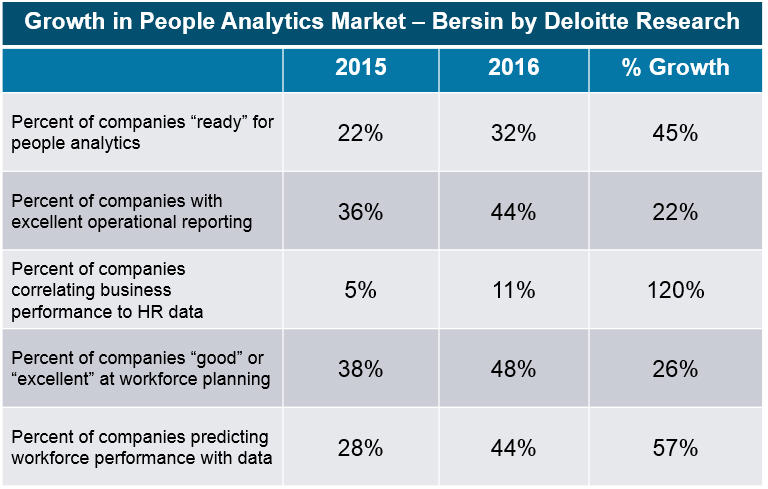
Came across this really interesting table about the explosive growth in HR Analytics.

data-driven-human-resources

(Source:  Deloitte Human Capital Trends 2015 and 2016, 3,300 and 7,100 respondents, respectively) 

The blogger who shared this, Mike Roberts, stated “With advancements in technology, as well as more awareness of the power of data, this is starting to change. Since 2014, we’ve seen an incredible transformation in the way talent acquisition professionals view data. And research from leading analyst firms has been backing that up.”

This is exactly why I have been doing HR & Recruitment Analytics training classess. There is a growing number of options out there, so make sure you get the bang for you buck you are hoping for.

IMG_6912

Connect with me if you want to know more about my approach to using data to drive decision-making in HR and Recruitment. I have recently published a book, Putting Your Data to Work, that can be your guidebook to how to get more people analytics in your HR and Recruitment processes.

HR & Recruitment Analytics – The recruitment and retention of top talent is the biggest challenge facing just about every organization. You really have to Think Through The Box to come up with winning solutions to effectively attract, retain and manage talent in the Philippines today. DMAIPH is a leading expert in empowering HR & Recruitment teams with analytics techniques to optimize their talent acquisition and management processes. Contact DMAIPH now at analytics@dmaiph.com or connect with me directly to learn how to get more analytics in your HR & Recruitment process so you can rise to the top in the ever quickening demand for top talent.


HR Recruitment Analytic Techniques

Every recruiting organization is looking for a way to better understand what’s working and what’s not working in their recruiting strategy. By using meaningful HR Recruitment Analytics techniques, your recruitment efforts can be greatly enhanced.

With real-time recruitment metrics & reporting, we can finally know what’s happening in our pipelines and what channels provide us with most qualified candidates.

New technologies like social networks, applicant tracking systems and business intelligence applications are fundamentally changing the entire recruitment process from sourcing to placement.

The pressure to deliver results has never been greater. HR and Recruitment managers are now more than ever required to demonstrate the return on investment their efforts are contributing to the bottom line.

Building analytics centric teams and using techniques taught in this training session will empower more data-driven decision making. This will result in both process efficiency and better return in investment in the recruitment process.

A few months ago, I facilitated a training class on HR Recruitment Analytic Techniques.

The Learning Session Objectives from the training were:

1. To learn analytics techniques that will allow quicker, deeper and more impactful analysis of HR Recruitment Big Data.
2. To be exposed to cutting edge technology being used in other companies to build HR Recruitment business dashboards and design more powerful reports.
3. To assess the current state of analytics in your HR Recruitment process and build a strategy to empower the greater use of analytics in your organization.

The Key Benefits from Attending this Learning Session were:

1.Develop analytic techniques that you can use to improve decision-making and improve the bottom line.
2. Explore analytics tools like business dashboards and data visualization to improve reporting.
3. Build a strategy to move your organization from current state to ideal state when it comes to the use of analytics.

Topics covered in the training included:

  • What is Recruitment Analytics?
  • Self-Assessment of your Recruitment Analytics
  • Analytic Techniques for Finding the Right Data at the Right Time
  • Applicant Tracking Systems & Social Media
  • Big Data and Recruiting Analytic Strategies
  • Business Intelligence, Data Visualization & Business Dashboards Technologies
  • Building Meaningful HR Recruitment Techniques

img_7502

Overall it was a great training class with lots of great discussion. Given that the recruitment and retention of top talent is the biggest challenge facing just about every organization. more conversations are needed.

DMAIPH is a leading expert in empowering HR & Recruitment teams with analytics techniques to optimize their talent acquisition and management processes. Contact DMAIPH now at analytics@dmaiph.com or connect with me directly to learn how to get more analytics in your HR & Recruitment process so you can rise to the top in the ever quickening demand for top talent.


Follow Up to Q17: HR Analytics Trends

As a follow up to my last blog, I wanted to share a few more points about HR and Recruitment analytics then time allowed for. So here’s what I left out.

First we are seeing a massive replacement of licensed, traditional HRMS systems taking place. Many large companies either have, our or are looking into replacing the core HR applications. Most where built internally, just store structured data, are difficult to pull data from unless you can write code and are not integrated with other data structures.

The replacements are often vendor managed, cloud based, data storage solutions with end user interfaces that simply finding and analyzing data and often automate much of the reporting. And they can be updated in hours versus minutes, versus the old platforms that could take weeks if not months to update.

540

These new platforms are able to provide almost limitless data points, have built in business dashboards and are starting to offer powerful predictive analytics models. The days of many of the old school CRMs and ATSs we are using to manage people data are truly numbered.

Another trend worth mentioning is the efforts cutting edge teams are putting into both candidate and employee engagement. Attempts to “gamify” various part of the employee lifecycle to make data gathering, analysis and sharing more eventful is increasingly common. Its common knowledge that ways to attract and keep the attention of millennials is significantly different then it is for baby boomers or Gen Xers.

Dr. Sullivan mentioned that “we are seeing the traditional annual engagement survey is going the way of the dinosaur (slowly however) and a new breed of pulse tools, feedback apps, and anonymous social networking tools has arrived.” It has never been more important to look at not just the enterprise wide health of a company, but that of small communities within the enterprise.

Metrics that measure how engaged an employee once a year is are no longer enough. We can use things like sentiment analysis, text analytics and social media data scrapping to uncover things we would never see in a survey where everyone is pressured to give top scores.

And we really have to get beyond historical data and descriptive analytics to look at current and predictive metrics. We need to quickly know when and why metrics are headed in the wrong direction and measure the impact of our solutions. And this goes for not just current employees, but future ones as well. Candidate satisfaction with the hiring process is often an over looked metric.

We also now have the data and the tools to run predictive models on how, when and why someone may be looking to leave the company. This creates another whole area of HR analytics to look at.

Dr. Sullivan added that “we are seeing tools to predict flight risk, assess high potential job candidates, even find toxic employee behavior – are all in the market today.  While many are not highly proven yet, they all work to a degree, providing great value to any company.”

Now we have, three more trends to consider when it comes to analytics in HR & Recruitment:

  1. Replacement of old internal HR systems with new vendor managed tools
  2. The evolution of employee engagement tools
  3. Predictive analytics modeling

If you are curious about how to get more than just the most basic descriptive analytics out of your business data, then let us sit down and talk about. Finding solutions to replace your old HR systems with more employee engagement options and predictive analytics is not as hard or as expensive as it was a few years ago. Let me show you how getting back on the cutting edge  with your data can be done.

HR & Recruitment Analytics – The recruitment and retention of top talent is the biggest challenge facing just about every organization. DMAIPH is a leading expert in empowering HR & Recruitment teams with analytics techniques to optimize their talent acquisition and management processes. Contact DMAIPH now at analytics@dmaiph.com or connect with me directly to learn how to get more analytics in your HR & Recruitment process so you can rise to the top in the ever quickening demand for top talent.

Q17: What are some best practices and technologies used in HR & Recruitment Analytics?

HR and Recruiting Professionals have embraced analytics. It took a while, but the increased need for data and analytics tools –The ability to collect, process and analyze “big data” has become paramount to the people side of the business. In order to gain a competitive edge in the increasingly chaotic global workplace, those who use analytics to gain data-driven insights into recruitment, compensation and other performance centric trends are the ones on the cutting edge.

“In my opinion, 95% of all the work that is done on recruiting metrics ends up being a waste of time, because the work focuses on creating historical tactical metrics never actually used to improve recruiting performance,” says Dr. John Sullivan, an ERE blogger and recruiting metrics expert. He says there are 3 reasons why there are failures and wasted time when it comes to metrics:

  1. Recruiting metrics omit any “big-picture” business impacts
  2. Current recruiting metrics are 100% descriptive and only offer guesses on what is and what will happen.
  3. Once collected, the metrics are reported to “barley interested eyes” who then assign things to a committee whose time spent results in very little measurable impact.

If you are still focused on time to fill and cost per hire, you really are quickly becoming a dinosaur. In addition, the idea of trying bringing in new people while working towards retaining top talent are generally not assigned to the same people. The disconnect between recruiting good people and retaining the good people who have been recruited is a killer to many companies. Both the material and cultural cost of replacing a bad hire isn’t generally looked at.

There are lots of blind spots to what is happening not just internally, but also externally.  Knowing who you are competing against for the same talent and what makes your offer to sign or stay stand out from the crows. None of these points can be analyzed with old school metrics terms and methods.

Dr. Sullivan also recommends six strategic categories of metrics that will help your in not just recruitment but in many other HR initiatives like retention and employee engagement:

  • The positive performance increase added by more productive hires
  • The failure rate of new hires and the damage done by weak hires
  • The losses created by a weak hiring process
  • The opportunity costs of “missed” landable top talent
  • The cost of using excessive hiring manager hours

img_7526

If you are looking at metrics like these, and sharing your findings not just with the recruitment team, but the boarder HR team, you can come up with big picture strategies to deal challenges much more effectively. In my own experience, a few other noteworthy trends in HR and Recruitment Analytics to consider include:

  • Disruptive Technology. Giving tools and information to managers and employees directly allows action to happen much quicker and be much more localized in impact. Success means giving the power to the end users so that HR can do more to oversee and manage big picture metrics.
  • Once A Year Is Not Enough. Annual reviews and employee surveys are too old school. Using analytics to gain insights can now be done 24/7. This can really have positive changes on employee engagement without the drawn out and too formal process made uniform to all.
  • Outsource Stuff. In successful companies, many tasks are outsourced to vendors who can do a lot more specialized things then in house generalist staff can do. Its just to much to ask a few people to stay on top of all the things important to the people you rely on. You have to pick and choose what you can keep and what you can outsource.
  • Mobile Apps. Designing apps for mobile first use is the way to go. We too often rely on old school thinking and take web-only or web-first tools and repurpose them for mobile. Times have changed. Mobile first is the way to connect with todays candidates and employees.
  • Look For It On YouTube. Video based learning, recorded by localized subject matter experts is on the cutting edge. The bonuses of learning from someone who is doing it versus traditional corporate trainers and enterprise world eLearning modules is another key to success.
  • Out Of The Box Analytics Tools. Behind the fire wall HR applications are being replaced or augmented by vendor based analytics tools that are more dynamic and expandable. Many can set on top of or replace current tools that are being used to gather, store, analyze and report data. The days when everything has to be designed, developed and maintained by an internal IT team is also going the way of the dodo bird.

So there you have it… becoming an HR and Recruitment Analytics ninja is going to take a lot of new thinking and a lot of letting go of how it worked in the past. Everyone agrees recruiting has never been harder, retention is getting more challenging and the future of finding and retaining talent is looking like a nightmare on the horizon.

If you need some guidance with how to being your HR and/or Recruitment team into the information age, I’m happy to help. One of my favorite things to do is get in a room with HR and Recruitment staff and talk about how to bring the team form the past to the future when it comes to analytics.  Just ask me how.

HR & Recruitment Analytics – The recruitment and retention of top talent is the biggest challenge facing just about every organization. DMAIPH is a leading expert in empowering HR & Recruitment teams with analytics techniques to optimize their talent acquisition and management processes. Contact DMAIPH now at analytics@dmaiph.com or connect with me directly to learn how to get more analytics in your HR & Recruitment process so you can rise to the top in the ever quickening demand for top talent.
Probing For Curiosity

Finding a good assessment to measure curiosity is something I am always looking for. Lots of ways to try and find it, but a true penchent towards curiosity can still be elusive during the hiring process.

Lot’s of probing questions like, asking candidates to explain how they solve problems and what they do when they come across something unexpected is a good start.

Taking personality tests like the MBTI and its ilk is another way.

Giving them a quick research assignment with fairly vague directions and open ended results can also help too.

Reading for fun is also another good indicator.

IMG_1310

Whatever it is you do, make sure its something you are probing for.

Of all the data points in HR & Recruitment Analytics, that is the one I care most about.

HR & Recruitment Analytics – The recruitment and retention of top talent is the biggest challenge facing just about every organization. DMAIPH is a leading expert in empowering HR & Recruitment teams with analytics techniques to optimize their talent acquisition and management processes. Contact DMAIPH now at analytics@dmaiph.com or connect with me directly to learn how to get more analytics in your HR & Recruitment process so you can rise to the top in the ever quickening demand for top talent.

Infusing HR Analytics into Organizational Behavior and Human Resource Management Classes

One of the things I have been working on is helping a top school here in the Philippines develop a strategy to infuse more HR Analytics into their Organizational Behavior and Human Resource Management Classes.

This effort is a precursor to a class specifically on HR Analytics, which is to the best of my knowledge, the first ever here in the Philippines.

So as I put more thought into the syllabus of each class, it occurred to me that a good way to approach analytics is to introduce it slowly over the length of the 3 classes, which follow in a natural progression.

Starting with the OB class, we can focus on how to identify data in an organization that will be useful to a HR team to measure things over time. To help really get at causality of human behavior on a wide scale, you need to have the data to understand context.

In the HR Management class, we will spend more time working on the inventory part of analytics, which is to bring the data into an analysis and reporting structure that helps us discover patterns and trends based on that data.

Then the HR Analytics class, we will then proceed on how to integrate the data and the analysis into tool like a business dashboard.

At a high level, the students will gain an appreciation for the wealth of data HR can access in an organization and how the analysis and reporting of this data can lead to more data-driven decision making.

Its great to have an understanding of why people leave a job, and to have good reporting on attrition patterns, but you also need to have the ability to enable strategic action based on data and not just observation or simple metrics.

That is what our students will be able to do that will separate them from other Psychology grads entering the workforce. They will be ready day one to be HR Analysts who can bring a much needed data centric skills set to a very people driven discipline.

If you are a school administrator or professor and need to get more analytics in your course work so your students are better prepared for the analytics centric jobs, connect with me. I can show you how. I even have a textbook you can use. My new book Putting Your Data to Work is ideal for the nascent analytics learner.

9b9b0d_9e1b0bda82a944ed9d8845fb26bc2b7b-png_256


Analytics Education – Facilitating a mastery of the fundamentals of analytics is what DMAIPH does best.

All across the world, companies are scrambling to hire analytics talent to optimize the big data they have in their businesses. We can empower students and their instructors with the knowledge they need to prepare for careers in analytics.

Contact DMAIPH now at analytics@dmaiph.com or connect with me directly so we can set a guest lecturer date, On-the-Job Training experience or other analytics education solution specifically tailored to your needs.


The Average Keeps Getting Lower And I Refuse To Tolerate This – Updated

Updated on 10/27/16

http://sethgodin.typepad.com/seths_blog/2015/08/the-average.html

The average

 Everything you do is either going to raise your average or lower it.

 The next hire.

 The quality of the chickpeas you serve.

 The service experience on register 4.

 Each interaction is a choice. A choice to raise your average or lower it.

 Progress is almost always a series of choices, an inexorable move toward mediocrity, or its opposite.

I can totally relate to this. We are a society more and more inclined to settling for the average, and are even ok with it when the average trends lower.

One place I see it happening more than most is in talent management. The demand so far outweighs the supply of good talent; we keep lowering the bar.

Frist it was 4 year degree required. Then it was some college. Now its high school grad.

In just a few years we have gone from a high bar to also most no bar.

Same day hiring. No interview required. No test or assessment. Just how up and get a job.

I hate this.

This new reality taking hold across the Philippines  is deeply concerning to me.

It is unacceptable to me to be involved with anything that is just average, and I just get crazy when I see people doing things to lower the average on purpose.

There is another way.

If you have good analytics, you can be better at setting a realistic bar and not just going lower to meet requirements.

No more mediocrity. No more playing to the average and definitely purposely lowering the average.

I just refuse to tolerate it anymore!

Let me show you how to use the data in your business to turn things around.

Stop the insanity of fueling high turnover and low employee engagement that is lowering the quality of service to a dangerous place.

Who is with me?

If you are, the you will might enjoy reading my new book, Putting Your Data to Work. I can help you use your data.

HR & Recruitment Analytics – The recruitment and retention of top talent is the biggest challenge facing just about every organization. DMAIPH is a leading expert in empowering HR & Recruitment teams with analytics techniques to optimize their talent acquisition and management processes. Contact DMAIPH now at analytics@dmaiph.com or connect with me directly to learn how to get more analytics in your HR & Recruitment process so you can rise to the top in the ever quickening demand for top talent.

Building An Employee Engagement Road Map

My good friend and BPO colleague, Martin Conboy’s most recent blog is pretty awesome and well timed for my leadership meeting on Monday.

http://theoutsourcing-guide.com/strong-employee-engagement-exceptional-customer-experience/

Here are a few of his key points:

“Employee engagement is a workplace methodology designed to ensure that employees are committed to their organization’s goals and values, inspired to contribute to organizational success, and are able at the same time to enhance their own sense of well being.”

When I think about all the places I have worked over the years from scooping ice cream, filing library books, teaching, customer service, business analytics to setting up call centers, I often reflect on the cultural lessons I gained from those experiences.

As Martin says, engagement is a direct result of the methods  used to drive a business… its how people are bossed, managed and/or lead. That impacts how people feel about and treat each other. Most people generally look at their job as just a job, but they look at their co workers as friends or even family.

When companies are able to get people to think of their job with the same level of interest they think of their co-workers, then you have an indicator of engaged employees, That is far from the only one, but its an easy to see indicator.  They go to lunch together, but do they work together to solve problems for the customer?

“Creating exceptional customer experiences and engagement requires understanding and mapping the customer’s journey. Likewise employee engagement is dependent on creating exceptional experiences based on understanding and mapping the employee’s journey.”

Mapping the journey… from pre-hire, to job offer, to onboardinng, to training, to production, to coaching, to mentoring, to career development. Is it all mapped out? If not its hard to have good employee engagement. Are there leaders within the organization that help others read the map? If not then most employees are going to get lost. The journey will not likely be a success without the map and people who know how to both read the map and teach others how to read it.

Thanks Martin for the inspiration.

HR & Recruitment Analytics – The recruitment and retention of top talent is the biggest challenge facing just about every organization. DMAIPH is a leading expert in empowering HR & Recruitment teams with analytics techniques to optimize their talent acquisition and management processes. Contact DMAIPH now at analytics@dmaiph.com or connect with me directly to learn how to get more analytics in your HR & Recruitment process so you can rise to the top in the ever quickening demand for top talent.

One Step Ahead In The Talent War Across Call Centers In Manila

https://www.recruiter.com/i/5-tips-on-cultivating-your-talent-pipeline/

Came across this interesting article on LinkedIn. I’m always curious about that people are saying about how to have success with recruiting, because its perhaps the top challenges in my industry.

Recruiting good call center agents in Manila has got to be one of the hardest requirements to fill anywhere on the globe right now. Awhile back I came up with a formula for what makes up a good call center agent, and not the just the surface skills, but he core competencies. Here is what I see:

  • Conversational English (20%) – Conversations follow rules of etiquette because conversations are social interactions, and therefore depend on social convention.
  • Customer Service (20%) – Customer service is a series of activities designed to enhance the level of customer satisfaction – that is, the feeling that a product or service has met the customer expectation.
  • Technical Training (20%) – Instruction to help agents use the systems and personal computers on which they are dependent to get their daily work done.
  • Product Knowledge (20%) – An understanding of a good or service that might include having acquired information about its application, function, features, use and support requirements.
  • Work Ethics (20%) – A strong work ethic is vital to a company achieving its goals. An example of someone with work ethic is a person who gets to work on time every day and always works long days to get the job done.

Of these, the hardest to teach is the fifth one, work ethic. So to me 5 ways to look for strong work ethic in a candidate are similar to the ones listed in the LinkedIn article. They are:

  1. Recruiting at events is more the just showing our brand, but our story out there. It’s a crowded field and we are just one, small voice. But it’s a enchanting story that get people excited about working with us.
  2. We too lean on Referrals for a high % of our new hires. There is nothing better than an endorsement for the job from someone doing the job.
  3. Internships/OJT/Trainees let us see how they work and letting them see what its like to work with my team. Great way to make sure it’s a good fit from both ends.
  4. Looking locally at schools and outside the industry places like retail and service jobs to attract new talent to the industry. The industry is full of job hoppers and money chasers, so going for them is not a good option.
  5. Staying in touch by sending newsletters, inviting to trainings, text blasts is important to us. Staying top of mind and keep telling our story.

So there you, go that’s how we are helping companies stay ahead of the game when it comes to the talent war going on in the call center industry in the Philippines right now.

RA_Mar28_8

I am currently working on a book dedicated to helping HR & Recruitment professionals in the Philippines. The book should be ready by early 2017. In the meantime, you can check out my latest work, Putting Your Data to Work, for an overview of how to get started with analytics in your business. Connect with me and I will show you how to get a copy of my fast selling analytics guidebook.

HR & Recruitment Analytics – The recruitment and retention of top talent is the biggest challenge facing just about every organization. DMAIPH is a leading expert in empowering HR & Recruitment teams with analytics techniques to optimize their talent acquisition and management processes. Contact DMAIPH now at analytics@dmaiph.com or connect with me directly to learn how to get more analytics in your HR & Recruitment process so you can rise to the top in the ever quickening demand for top talent.

Talented Philippines! A Really Helpful Resource For BPO Professionals

http://www.talentedphilippines.com/

Came across this new book and just ordered it. Im pretty excited about it.

In a nutshell… Talented Philippines answers critical questions for multinational corporations currently operating in, expanding or establishing operations in the Philippines.

Some of the key questions tackled in the book:

What are the critical business issues for multinationals in the Philippines?

What are the key talent management implications?

How have the Philippine’s best organizations addressed those challenges?

talented philippines

Talented Philippines was created to address the critical business and HR issues impacting the Philippines today as the country continues to transform. Based on the responses of more than 650 business and HR practitioners at the forefront of HR innovation, thought leadership and implementation in the country, the book explores the people management priorities across small, medium and large enterprises operating in the Philippines. Combined with numerous case studies that highlight the experiences of leading organizations and insight from a wide cross-section of public and private sector enterprises, Talented Philippines offers global best practices for multinational companies looking to leverage the great promise of this flourishing nation and its talented workforce.

This is well timed as the last year has seen a quickening of the talent war in the Philippines as the issue of a skills mismatch between job seekers and employers has really come to a head. It is a must read for anyone involved in the BPO industry in the Philippines.

However, there is one thing that based on what I see so far, is missing form this book. The fact that no matter how awesome a company’s HR practitioners are… they are still trying to find talent when it is truly lacking in a natural state. As a companion piece to this book, would be solid advice on how, when, where and why to invest more in training… especially pre-hire training and training geared towards internal advancement.

No matter how great an HR team is, they still have to get the right people in the door to apply and that seems to be the issue… because even in country of 90 million there is just not enough Filipinos with the skill sets and/or aptitude for a BPO career right now. The demand will only be met if the supply is given more training, more preparation and more data to make good career decisions.

Dr. Data_Analytics in the Philippines
If you like this book, you will probably enjoy my new book as well. Putting Your Data to Work is a guidebook designed to help Filipinos get started with building a good analytics culture in their business. Connect with me if you are interested in purchasing a copy for only 600 PHP.

HR & Recruitment Analytics – The recruitment and retention of top talent is the biggest challenge facing just about every organization. DMAIPH is a leading expert in empowering HR & Recruitment teams with analytics techniques to optimize their talent acquisition and management processes. Contact DMAIPH now at analytics@dmaiph.com or connect with me directly to learn how to get more analytics in your HR & Recruitment process so you can rise to the top in the ever quickening demand for top talent.