Guest Blog: How Does HR Use Social Media? (Infographic)

http://www.socialtalent.co/blog/how-does-hr-use-social-media-infographic

Home » Blog » How Does HR Use Social Media? (Infographic)

How Does HR Use Social Media? (Infographic)

social-media-2013-survey

Posted by Siofra Pratt, December 19th 2013

Over the past year we’ve heard all about how recruiters use social media to bolster their sourcing efforts, now it’s HR’s turn! – See more at: http://www.socialtalent.co/blog/how-does-hr-use-social-media-infographic#sthash.XybotY5m.dpuf

Philippines Analytics Outlook 2014 (2 of 4): Top Skills in Demand

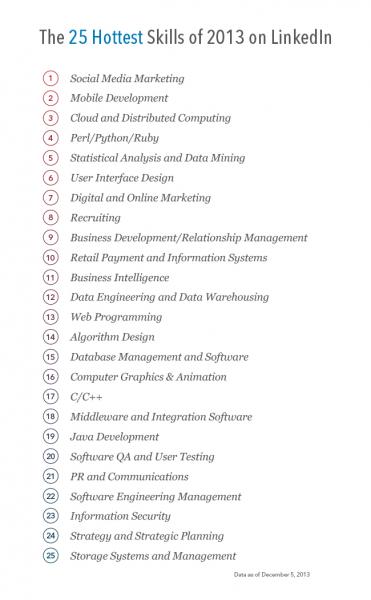
LinkedIn recently came out with the 25 hottest skills from 2013 based on their 259+ million member profiles. As you can see below, this list of skills in demand is dominated by technology skills. Business growth and development also tops the chart, showing growth in next year’s forecast. http://itstaffing.matrixresources.com/opportunities/tech-trends/top-25-skills-linkedin-2013

LI-25-Hottest-Skills-Ranking-List-Final

So what does this mean for us in 2014 and for us going to school or working and doing business in the Philippines?

•Technology skills are highly valued. It’s almost 2014. This shouldn’t come as a big surprise, but if it isn’t already painfully clear why Science, Technology, Engineering, and Math (STEM) education is a top priority for many of the world’s governments, now you know. However in the Philippines, we are still producing more nurses and accountants then we are analysts. So training classes like our are going to be in an ever increasing demand.

•We live in a data-driven world. Cloud and distributed computing (#3), data mining (#5), and data engineering (#12) being highly ranked on our list paints a picture of a world overwhelmed with information, with businesses scrambling to store, retrieve, and make sense of it all. HP and IBM know this and are pushing training into the schools. BPAP knows this has partnered with a number of schools. But in the next 3-5 years its still going to be primarily people like DMAI up training folks to plug the gaps. This gets back to the consistent increase in jobstreet postings for analytics talent.. up 33% from a year ago.

•Businesses are looking to grow. Recruiting (#8), business development (#9), and strategic planning (#24) are all skills that help businesses hire more employees and find new sources of revenue. Expectations of 20% growth in the BPO industry in the Philippines is being lead by “up the value chain” type jobs and many of them require the analytics and data interpretation skills we specialize in.

So, with 2014 fast approaching, its time to think about how to get more training in analytics or how to get more trained analysts in your business. These are high demand, limited supply needs that will only get more extreme in the next few years.

Follow our blog to find out when the next DMAI analytics training is coming.

A Really Big Data Creation Project

About a week ago I got a random e-mail from a strategic research company based in India asking me if I could help them find some information on the domestic remittance market in the Philippines. They specialize ins preparing research for various financial and banking segments and are looking to put together a paper on this topic. From my experience with Wells Fargo and having set up a business in the Philippines, I’ve managed to make a lot of connections that would undoubtedly help find them some of the data they need.

MSP24321b65h584fd76h9i00006996g957h01de5g6

First off though, I told them up front… there is no where you are just going to find the data they are looking for in one or two places. Most of the data on this topics is going to be unstructured… and what is available is going to be with a narrow focus and incomplete.

And this is something I am very good at… creating data. Taking a diverse collection of sources and using them to create a landscape of information. Data creation definitely falls more into the art side of analytics, because it’s all about networking and connecting the dots and taking educated guesses… not a lot of hard science!

This kind of analytics is very hard because most analysts are only comfortable working with data that’s been validated, is housed with a structured architecture and can be easily queried. They like playing with big data when it’s in a defined sandbox. The data needed for this project is scattered all over the place and in many cases hasn’t even been sourced yet.

So looking at some of the requirements; (1) domestic remittance transaction counts and peso volumes, (2) top remittance corridors, (3) major players in the market, and (4) channel used for transfers… its pretty clear we’ll need to lean on the Central Bank, and several other financial services providers to get data. We also need some demographics on the people doing the transfers and look at recent trends… and in addition, the client wants to include bill payments. It’s an extremely ambitious project.

Stay tuned to see how it ends up.

The Mission of the DMAI Family of Companies: Creating More Analysts

I just wanted to share this blog post from the World Bank as it addresses exactly what we at DMAIPH have been saying and are trying to address; the need for more high end skills training in the Philippines.

12072012489

8 of 12 from this training batch found jobs with BPO companies within a couple weeks of completing the two day Introduction to Analytics training!

http://blogs.worldbank.org/eastasiapacific/node/3096
======================================

The Philippines faces an enormous jobs challenge. Good jobs—meaning jobs that raise real wages or bring people out of poverty—needed to be provided to 3 million unemployed and 7 million underemployed Filipinos—that is those who do not get enough pay and are looking for more work—as of 2012.

In addition, good jobs need to be provided to around 1.15 million Filipinos who will enter the labor force every year from 2013 to 2016. That is a total of 14.6 million jobs that need to be created through 2016.

Did you know that every year in the last decade, only 1 out of every 4 new jobseeker gets a good job? Of the 500,000 college graduates every year, roughly half or only 240,000 are absorbed in the formal sector such as business process outsourcing (BPO) industry (52,000), manufacturing (20,000), and other industries such as finance and real estate.

Around 200,000 new job seekers find work abroad, and around 60,000 will join the ranks of the unemployed, go back to school, or rely on financial support from family for the time being.

This still leaves 600,000 new jobseekers who have no choice but to work in the low-skill and low-pay informal sector in rural and urban areas.

Higher growth can provide more Filipino workers with good jobs. With sustained GDP growth of 7 percent per year and the removal of constraints in fast growing sectors (e.g., addressing skills shortages so that the BPO industry can accelerate its annual growth from 20 to 30 percent), the formal sector will be able to provide good jobs to around 2 million people in the next 4 years – that is double the current figure.

Even so, the majority of Filipino workers will still be left out. By 2016, around 12.4 million Filipinos would still be unemployed, underemployed, or would have to work or create work for themselves in the low pay informal sector such as selling goods in sari-sari stores (small retail stores) and peddling on the streets, and driving tricycles and pedicabs.

Addressing this jobs challenge requires meeting a dual challenge: expanding formal sector employment even faster, while rapidly raising the incomes of those informally employed.

To create good jobs for the 12.4 million, a comprehensive package of reform is needed to create a business environment that is conducive for the private sector to create jobs and increase human capital. Reforms that will secure property rights, open the economy to more competition, simplify business regulations, and increase investments in health, education, and infrastructure are needed.

But will the private sector have the incentive to invest and create jobs for the 12.4 million Filipinos who are left out of the fast growing formal sector?

What do you think is key to creating more and better jobs in the country? Creating jobs for millions is a daunting task, but perhaps we can agree to start somewhere.

call_center

Analytics Training – DMAIPH offers a wide range of analytics centric training solutions for professionals and students via public, in-house, on-site, and academic settings. We tailor each training event to meet the unique needs of the audience.

If you need empowerment and skills enhancement to optimize the use of analytics in your organization, we are here to help. Contact DMAIPH now at analytics@dmaiph.com or connect with me directly to set up a free consultation to learn which of our DMAIPH analytics training solutions is best for you. 

Marketing to Your Competition… Face Palm!

I get e-mails like this all the time…

================================================
Dan,
I was doing some research on BPO Elite, and based on your previous interest, I was inspired to reach out to you for your guidance.
How much of the information within your data is locked away, hidden, and inaccessible in the moments you need visibility to it the most? Are you facing any challenges surrounding accurate forecasting? What would it mean to you to have everyone at every level of the organization, working from a single version of the truth?
We are helping organizations reduce the time to access relevant data by 95%. Is “good enough” really good enough moving forward to a new year in 2014?
With end of year promotions beginning now, the purpose of my note is to determine if this is an area of interest for your team and also the best person to speak with about achieving powerful business analytics and beautiful dashboard reporting.
Thank you for your time and feedback Dan.
===============================================

Insert Face Palm image > facepalm

So if you spend 10 seconds on any of my social media sites, its pretty clear that I am all about analytics! So in effect they are asking me to outsource what we do for a living to them?

I find this quite comical.

I imagine the person who sent this email is either going off a list or just spamming and hoping to get lucky. Because when you market to you competition you want to at least come off as you know you are marketing to your competition.

Recruitment Analytics… where both demand and need is greatest

Who’s left? > Reblog from one of my blogging heroes, Seth Godin.
http://sethgodin.typepad.com/seths_blog/2013/11/whos-left.html

This is EXACTLY why I have been able to run several successful recruitment analytics seminars in the past year. So many HR and Recruitment teams still approach sourcing talent like this…

“The classified section of the Sunday New York Times used to be more than twenty or thirty pages long. Now it’s down to one.

Part of this is due to the lack of new jobs in the post-industrial economy, but mostly it’s due to job listings moving online. I was fascinated to see some of the jobs in last week’s paper, and confess befuddlement at the thinking of those that ran them.

Here’s one, from Amazon, for a level II programmer in their New York office. Just a mailing address, no online method for contacting or applying. They’re using the newspaper to search for programmers unable to apply online, perhaps the best place to find this sort of programmer, but really, do they want them?

Or the ad from Paul, Weiss, a prestigious big law firm in New York. It’s the biggest ad on the page, and goes into a long, long list of requirements for the job–Magna Cum Laude from a famous law school, more than three years with one of their competitors, etc. Which high-powered New York lawyers are reading the last single page of newspaper classifieds?

And my favorite, an equally long ad for Deloitte that instructs the applicant to go to a website and enter a 15-digit code, including several “1”s, some “I”s and a bunch of letters and numbers. Almost unreadable in the paper, and hard to transcribe. More than a billion combinations… why not just enter NYT1124?

Lots of time and money being spent chasing the wrong people with the wrong ads.

My point, and I do have one, is that if your HR department is run by policies that were established a decade ago, worth a new look. And if you are serious, truly serious, that talent is your competitive advantage, please understand that the way you look for and sort that talent is the highest-leverage way you’ve got to increase what you end up with.”

HR & Recruitment Analytics – The recruitment and retention of top talent is the biggest challenge facing just about every organization. You really have to Think Through The Box to come up with winning solutions to effectively attract, retain and manage talent in the Philippines today.

DMAIPH is a leading expert in empowering HR & Recruitment teams with analytics techniques to optimize their talent acquisition and management processes. Contact DMAIPH now at analytics@dmaiph.com or connect with me directly to learn how to get more analytics in your HR & Recruitment process so you can rise to the top in the ever quickening demand for top talent.

Philippines Analytics Outlook 2014 (1 of 4): My Assessment

049As 2014 is on the near horizon, I have been asked by more than a few people what I think the next year looks like in terms of analytics and its evolution as both a service and a career path. Now more than ever, I think it’s the time to really up our game in both terms of training talent and providing analytics solutions.

Here is why:

• BPAP and some of the big analytics companies like IBM and HP are moving quickly to infuse more analytics focused content into the higher education system. DMAI continues to get more requests to be involved with turning students onto BPO and analytics careers than I can address myself.
• The demand for analysts still far outweighs supply and the talent gap will quicken throughout the year. If you type in analyst in jobstreet.com.ph you will see about 1500 jobs posting on any given day. That’s a 33% jump from where the demand was less that two years ago.
• More companies are looking to the Philippines as place to start-up analytics teams. I’ve had conversations with about a dozen companies on the past six months asking me how to go about it.
• The biggest demand is for Fresh Grads and Undergrads who have the critical thinking skills and decision-making confidence needed for analytics. SO that’s is where DMAI will focus in the first half of 2014
• The SMEs (small and medium-sized entrepreneurs) are starting to see the need for analysts but don’t have access to the talent available. If fresh grads are once again our priority, SME needs is right behind it.

So in the coming months you will see DMAI strive to do the following:

1. Continue to add more positions with DMAI to meet the demand of overseas clients. We plan to grow from 12 to 20 analysts by the end of January alone.
2. Conduct more trainings, including the one we are doing as a charitable effort to support the people directly impacted by the recent typhoon.
3. Present at more schools and professional events to continue to sound the call to action.

If you are interested in joining our team as we charge ahead towards our goal of being THE name brand in analytics in the Philippines, please send me us your resume to analytics@dmaiph.com.

If you’d like to learn more about how our analytics talent and solutions can help your business, please email me directly at danmeyer@dmaiph.com

About Me… something I threw together for a client proposal

20130911-104637.jpg

Dan Meyer established BPO Elite LLC, in the United States in 2010 and with the intention of setting up an analytics training and consulting business in 2012. After a 15 year career as a senior analyst with Wells Fargo Bank, Dan moved to Manila in May 2012 and immediately set up BPO Analytics Elite Inc.

During the next several months Dan trained over 75 fresh grads in the concepts of analytics and 2/3 were quickly able to find jobs as analysts in the BPO industry. BPO Elite was also hired as a consultant for a number of companies here in the Philippines.

In January 2013, Dan spun off some of his efforts into a new company, DMAI – Decision Making, Analytics and Intelligence. DMAI focuses on professional analytics training, management consulting and outsourcing. Dan has conducted several public trainings in 2013, training over 50 professionals for a wide range of top companies.

In recent months, DMAI has also taken on additional consulting clients here in the Philippines as well as begun to provide outsourcing services for six overseas clients. Dan also continues to empower students and young professionals via speaking engagements across Metro Manila.

Dan conducted seven sessions of the two-day, An Introduction to Analytics for Fresh Grads and Young Professionals between May and November 2012. In all he instructed over 75 trainees who he then helped find work as analysts. Over 2/3 found work as analysts in the BPO industry within a few months with various companies including Accenture, Citibank, Genpact, Emerson, Sencor, and GL Advisor

So far in 2013, Dan has also conducted six analytics and decision-making themed public trainings for professionals. Mainly targeting HR and Recruitment professionals, these interactive one day workshops have been attended by over 100 trainees. Some of the companies represented include McDonalds, Price Waterhouse Coopers, Manulife, iRemit, Lexmark, DestucheBank and Sitel.

Dan has also conducted in-house analytics trainings for the management team and staff of several companies here in the Philippines including Microtel, Kalibrr, and Medexcel Global Solutions.

Dan has worked as a consultant on a range of analytics themed projects for a variety of BPO companies here in the Philippines including GL Advisor (staff recruitment), Jumbo Shipping (outsourcing jobs from Holland), Microtel (setting up an HR and manpower business), Genpact (training junior staff on career opportunities as an analyst) and Medexcel (social media marketing campaigns).

Dan has set up several outsourcing analytics projects of various sizes and capabilities with companies from overseas including Dimedius (a Houston based healthcare consulting business, currently providing market research and demographics analysis), Kass Consulting Group (a Boston-based outsourcing firm, provided internet research on current trends and facts in outsourcing), ZoneApps (a Boston-based mobile application developer, provided content management for their mobile app), ArtFact (a Boston-based online auction house, managing a virtual team of eight social media analysts and customer service reps), IQR (an India based analytics outsourcing company, sub-contracted to provide data analysis and client presentations) and StatMarin (a San Francisco based analytics outsourcing company, sub-contracted to provide marketing campaign analysis)

Speaking Engagements
August 2012 – HR and Recruitment Summit in Quezon City
February 2013 – St. Benilde IT Summit at College of St. Benilde
September 2013 – Innovation Bootcamp at St. Scholastica College
October 2013 – Startup Challenge at College of St. Benilde

In addition, Dan volunteers to go to schools to talk about careers in the BPO industry as part of his membership in BPAP. To date Dan has spoken at a number of schools including CSB, PUP, and UMak.

Dan has appeared as a featured guest on a number of local media outlets around Metro Manila to talk about analytics, the BPO Industry and decision-making for SMEs. Some of the outlets include GNN, DZBB and the Armed Forces Radio.

Analyzing Social Media Campaigns

I have been working on a project for six week now and have enough data to do some analysis. The campaign is a social media one where a client asked me to help connect her company with more potential clients. Given budget and time constraints, my suggestion was to use LinkedIn to market her services to a wide audience of potential referrers, partners and clients.

I’m using a methodology I learned a while back with Wells Fargo>
1. Plan
2. Execute
3. Measure
4. Analyze
5. Optimize

social media1

The client came back with some goals, which at the time seemed reasonable. Connect with 50 potential clients a week, of which we should be able to convert 3 or so to active leads. This was going to be a 10 hour a week commitment on my part.

So I built a LinkedIn ID and started networking. I created a new one as opposed to using my existing one as I didn’t want to confuse my connections to think I was now working for a different company. I didn’t have a lot of predicting if evidence that this strategy, our goals or the process were sound… they just made sense.

After six weeks I can see where we have misfired in a couple of places. Early on it became clear that getting connected with actual people who would be clients would be a challenge because (1) they are in a different industry than most of my natural connections and (2) there is not a high % of these people on LinkedIn. So I focused more on referrals early on and it got some good buzz going but no hot leads.

Two weeks in I started switching connecting with more existing businesses who do similar things so the we could look for partnerships. This actually lead to a lot of discussion among some LinkedIn groups and several email conversations, but again no real deals in the works.

The past two weeks I have now switched tactics again to hone in on potential clients. After four weeks of building up my network, I have a number of practitioners who might be clients, but I am finding our offer a hard sell. What we offer is not something that is an easy sell by any means and trying to drum up business via an e-mail to a new connection on LinkedIn in akin to needle hunting in hay stacks.

So with two weeks left in the campaign, I am going to modify my tactics again to mainly revisit old leads and trying to re-engage ones that didn’t go hot right away but still have potential.

In the end I will have half of what I promised I would deliver… 200 new connections who know about the company and our product and have the potential to refer, partner or buy. But the other half of the goal… 24 new hot leads that ideally would lead to a few buyers still looks elusive.

Any thoughts or suggestions?

Am I The Simon Cowell of Analytics?

Last week I had the pleasure to help out a good friend who teaches at the University of Makati. He teaches a marketing elective class to high school students who are in the new 11th grade. FYI for those not familiar the Philippines is in the process of instituting two additional years to the education system here so its on par with the US and many of the countries in having a K-12 program.

1371465_602647766443892_566956799_n

Anyway, El asked me to be part of a panel of judges for the class as they gave group presentations based on marketing plans that they developed. The plan was based on a project they had been working on for a while which is to set up an operate as a small business. It’s a great way to train future entrepreneurs and would be marketing majors and it made me feel a little like Simon Cowell.

I was honored to be one of three judges and we spent about two hours as the five groups of 5-10 students each presented their plans. And the best part was all of the 5 groups had set up food sales businesses and had samples. It was a lot of fun and the food was masarp (Tagalog for delicious).

As each group presented their plan I gave them feedback mostly on how did they validate their assumptions, did they collect any data, did they survey, how social media could play into their plans, etc. In all cases, I stressed the importance of showing data and visualizing it in ways that could be more impressive to potential investors.

I hope my feedback and advice helped them fine tune their marketing strategies and I would love to see them again when they are ready for OJT “on the job training” for their college internship requirements.

It was a lot like the TV show SharkTank but with great snacks! 🙂