Q4: Can you please describe the current state of analytics in the Philippines? – Part 2

So the last blog post gave us the history. Now let’s cast an eye on the future.

Over the past year or so I have started to see a significant effort from data science and analytics professionals come together to address some of the challenges outlined in my last blog post.

In short, the way higher education and the government has approached the need for analytics talent is simply to little to late to meet the needs of many businesses.

Everything they are doing helps, but in the end the world is desperately looking at the Philippines to do with analytics what it did with customer service. To become a center of capable, long-term and affordable talent.

With taking customer service calls, it was a natural fit given that most Filipino college graduates have a foundation in English. With analytics and data science it has not been so easy. While many Filipino have the underlying course work in coding, database management, computer science, etc… they are not getting enough exposure to data-driven decision making, business intelligence tools,  and more advanced things like machine learning, prescriptive analytics and blending big data from diverse data sources.

I don’t want to sound too pessimistic, things are moving quickly but it is generally the multinationals driving things forward. They have the clients, they have the need and so they go out and find people and train them. That’s why 3 years ago hardly anyone in the private sector was offering analytics training, now you see more and more options all the time. They are generally expensive and narrow in focus, but they are opening up huge opportunities for data loving Filipinos to get into upwardly mobile and financially rewarding careers.

I belong to a couple of newly founded organizations of data scientists and analysts who meet on a regular basis to share knowledge, support each other’s ideas and build a community with the goal of using data to helping both the Filipino to fill these open jobs and for the Philippines to begin to use more data in decision-making so we can solve the big issue problems important to all of us.

It’s a pretty exciting time.
10256713_275221292688289_6652823653462957603_o

So where next?

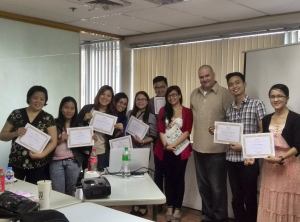
Given that the Philippines is one of the youngest countries in terms of average age on the plant and the youth are incredibly communal and very tech savvy, I have found great success in training batch of Filipino fresh graduates in basic analytics. Of the 200 or so trainees I have personally trained, most of them now have jobs with analyst in their title.

I have also seen a lot of talent quickly go from novice to expert using applications and doing coding in relatively short periods of training. In many respects the approach to analytics is more vocational then academic allowing for quicker training.

Beyond these strength, you can expect more partnerships between the government, higher education and big business to offer training and career pathing.  The success of the BPO industry is really the driving force to add employees who can do the tasks of an analyst. The huge surge in job postings demonstrates this quickening trend.

Finally, the reason I see a bright future for analysts and data scientists in the Philippines is the simple fact that Filipinos gravitate to under filled career paths, they push themselves to get the skills to fill those jobs.  You see it in the Middle East oil fields, in sailors and seamen in just about every ship at sea, you see it with overseas workers across the planet, and you saw it happen with call centers.

And that is exactly why I set up my business in the Philippines. Here are some of the analytics solutions we offer:

The Fundamental of Business Analytics – Business Analytics is the application of talent, technology and technique on business data for the purpose of extracting insights and discovering opportunities. DMAIPH specializes in empowering organizations, schools, and businesses with a mastery of the fundamentals of business analytics.

HR & Recruitment Analytics – The recruitment and retention of top talent is the biggest challenge facing just about every organization. You really have to Think Through The Box to come up with winning solutions to effectively attract, retain and manage talent in the Philippines today. DMAIPH is a leading expert in empowering HR & Recruitment teams with analytics techniques to optimize their talent acquisition and management processes.

Contact DMAIPH now at analytics@dmaiph.com or connect with me directly to learn how to get more analytics in your Business or your HR & Recruitment process so you can rise to the top in the ever quickening demand for top talent.

Probing For Curiosity

Finding a good assessment to measure curiosity is something I am always looking for. Lots of ways to try and find it, but a true penchent towards curiosity can still be elusive during the hiring process.

Lot’s of probing questions like, asking candidates to explain how they solve problems and what they do when they come across something unexpected is a good start.

Taking personality tests like the MBTI and its ilk is another way.

Giving them a quick research assignment with fairly vague directions and open ended results can also help too.

Reading for fun is also another good indicator.

IMG_1310

Whatever it is you do, make sure its something you are probing for.

Of all the data points in HR & Recruitment Analytics, that is the one I care most about.

HR & Recruitment Analytics – The recruitment and retention of top talent is the biggest challenge facing just about every organization. DMAIPH is a leading expert in empowering HR & Recruitment teams with analytics techniques to optimize their talent acquisition and management processes. Contact DMAIPH now at analytics@dmaiph.com or connect with me directly to learn how to get more analytics in your HR & Recruitment process so you can rise to the top in the ever quickening demand for top talent.

Infusing HR Analytics into Organizational Behavior and Human Resource Management Classes

One of the things I have been working on is helping a top school here in the Philippines develop a strategy to infuse more HR Analytics into their Organizational Behavior and Human Resource Management Classes.

This effort is a precursor to a class specifically on HR Analytics, which is to the best of my knowledge, the first ever here in the Philippines.

So as I put more thought into the syllabus of each class, it occurred to me that a good way to approach analytics is to introduce it slowly over the length of the 3 classes, which follow in a natural progression.

Starting with the OB class, we can focus on how to identify data in an organization that will be useful to a HR team to measure things over time. To help really get at causality of human behavior on a wide scale, you need to have the data to understand context.

In the HR Management class, we will spend more time working on the inventory part of analytics, which is to bring the data into an analysis and reporting structure that helps us discover patterns and trends based on that data.

Then the HR Analytics class, we will then proceed on how to integrate the data and the analysis into tool like a business dashboard.

At a high level, the students will gain an appreciation for the wealth of data HR can access in an organization and how the analysis and reporting of this data can lead to more data-driven decision making.

Its great to have an understanding of why people leave a job, and to have good reporting on attrition patterns, but you also need to have the ability to enable strategic action based on data and not just observation or simple metrics.

That is what our students will be able to do that will separate them from other Psychology grads entering the workforce. They will be ready day one to be HR Analysts who can bring a much needed data centric skills set to a very people driven discipline.

If you are a school administrator or professor and need to get more analytics in your course work so your students are better prepared for the analytics centric jobs, connect with me. I can show you how. I even have a textbook you can use. My new book Putting Your Data to Work is ideal for the nascent analytics learner.

9b9b0d_9e1b0bda82a944ed9d8845fb26bc2b7b-png_256


Analytics Education – Facilitating a mastery of the fundamentals of analytics is what DMAIPH does best.

All across the world, companies are scrambling to hire analytics talent to optimize the big data they have in their businesses. We can empower students and their instructors with the knowledge they need to prepare for careers in analytics.

Contact DMAIPH now at analytics@dmaiph.com or connect with me directly so we can set a guest lecturer date, On-the-Job Training experience or other analytics education solution specifically tailored to your needs.


The Challenge Ahead

How do we get better? That’s what is on my mind every day. Most people get up every day and go to work. They have family obligations to meet so they take a job that helps them meet these obligations. However, most people don’t find job that add much more value to their lives then a pay check.

Sometimes we get lucky and find a good place to work. Where we are valued as not just a worker, but a person. Where we are allowed to have more work/life balance then we might have in other places of employment. This is a special place to be. Its not what 90% of the global workforce face every day.

  • So what happens when we find that awesome company to be a part of? In some cases we are empowered to be innovative and to help be part of the success of the company as keep it moving forward. For people who feel this sense of positive energy, work is actually pretty fun most days.
  • However, in some cases we find that even though the company is good to us and we like working there, we find things start to feel routine. We have challenges every day that are either not fun to fix or when we fix it, no one seems to notice. This eats away at our positive feelings about our company.
  • And then we have a third group of people who for whatever reason are in the wrong place at the wrong time. They have challenges in their lives that prevent them from being at work every day. And often when they are at work they don’t feel very engaged. They have a low sense of satisfaction that makes each day on the job more work than its seems worth.

707022c7-f35e-4427-91c0-653a382a3689-medium

So as DMAIPH grows from a company of a half dozen to one of several dozen, how do we keep people trained? How do we make sure we keep as many team members as possible in the first category of engaged and empowered workers?

These is no simple answer. For some more money, for others more responsibility and for others more job variety.  There is no magic solution. It takes a lot of effort from not just the leaders but also from the employees who want to keep enjoying their work and like to work every day for the same company.

The answer of course is analytics. We need to know exactly what they need to stay engaged and to stay with us.

That is what I think about every day. That is THE big challenge ahead. And so should you.

Join us on Feb 21, 2017 in Ortigas to find out what metrics you need to interpret and access the data you have in your business that will tell you exactly what to do to keep attrition low and satisfaction high.

Analytics Leadership – DMAIPH specializes in arming the Data-Driven Leader with the tools and techniques they need to build and empower an analytics centric organization. Analytics leadership requires a mastery of not just analytics skill, but also of nurturing an analytics culture. We have guided thousands of Filipino professionals to become better analytics leaders. Contact DMAIPH now at analytics@dmaiph.com or connect with me directly to discuss a uniquely tailored strategy to ensure you are the top of your game when it comes to Analytics Leadership.

IBM’s Six Ways To Use Analytics To Manage A Workforce

http://www.forbes.com/sites/ibm/2015/04/06/6-ways-to-use-analytics-to-better-manage-a-workforce/

Interesting article about how to use more analytics in areas that are traditionally data rich, but not a focus of most enterprise analytics solutions.

Right now in the BPO industry in the Philippines, two of the bullet points really got me thinking.

Using analytics in HR to predict if and when employees might leave is a pretty cool concept. Their is plenty of historical data to look at resignation and termination patterns and segment the data in various buckets to see if any meaningful patterns jump out.

This goes hand in hand with higher employee expectations for work life balance and having a strong sense of community within the work place.

Both are things that might require a lot of unstructured analytics as well… although it blurs employee privacy issues, Facebook and Twitter can be an excellent place to glean insights into employee mood and their intentions.

I am curious to see how deep analytics can go into looking at data and trying to predict employee loyalty and stickiness.

The recruitment and retention of top talent is the biggest challenge facing just about every organization. DMAIPH is a leading expert in empowering HR & Recruitment teams with analytics techniques to optimize their talent acquisition and management processes.

jobspicture2

DMAIPH also specializes in arming the Data-Driven Leader with the tools and techniques they need to build and empower an analytics centric organization. Analytics leadership requires a mastery of not just analytics skill, but also of nurturing an analytics culture. We have guided thousands of Filipino professionals to become better analytics leaders. Contact DMAIPH now at analytics@dmaiph.com or connect with me directly to discuss a uniquely tailored strategy to ensure you are the top of your game when it comes to Analytics Leadership.

The Secrets of Money Ball Recruiting

http://youtu.be/6MStL5QIyCw

“There are rich call centers, with big budgets and huge recruitment teams. There are poor call centers with small budgets and just a few people. Then there is 50 feet of crap. And there is us.”

I conducted a Recruitment Analytics Training yesterday and shared one of my methodologies. Based on the movie (and book) Moneyball, I talked about how to be successful you need to find undervalued candidates who other call centers have passed on.

“If we try and play like Convergys in here (with our recruitment efforts), we will lose to Convergys out there (on the streets looking for talent)”.

10421381_626225777522869_8061177028338978985_n

So we need to boil down the recruitment process to the one thing most important for our business in every single employee.

Some of my points:

  1. We spend too much time looking for trainable skills like Good English, Good Communicators and Good Interview Takers.
  2. We need to stop hiring job hoppers and people looking to move up without having paid their dues.
  3. The one skill set we cannot teach, that we need to start making our top priority… is dependability.
  4. Will they show up on time every day for work is the single biggest need we have.

So that’s the one personality trait we are placing at the top of our recruitment process. We need to probe and dig and research, to find out will they be someone who will show up for their shift everyday.

That’s our “get’s on base” metric like in MoneyBall.  We can’t help the customer if we are not at work ready to help the customer.

HR & Recruitment Analytics – The recruitment and retention of top talent is the biggest challenge facing just about every organization. DMAIPH is a leading expert in empowering HR & Recruitment teams with analytics techniques to optimize their talent acquisition and management processes. Contact DMAIPH now at analytics@dmaiph.com or connect with me directly to learn how to get more analytics in your HR & Recruitment process so you can rise to the top in the ever quickening demand for top talent.

Don’t Be A Recruitment Dinosaur, You Need To Be Thinking Mobile First

Per monster.com… As more consumers set aside laptops in favor of smartphones, iPads and other tablet computers, job seekers expect to be engaged with videos, job notifications and quick follow-up. Many experts say that recruiters must learn to adapt their recruitment strategy to these platforms.

Today’s mobile job seekers have different expectations and look for:

  • Instant updates about new jobs via their mobile devices
  • Immediate feedback to their job application
  • Recruiting videos to watch on their mobile devices
  • Engaging, interactive content from employers

Recent Facebook data for here in the Philippines shows that as much as 90% of job applicants will apply via mobile for the same job they would pass up if looking at the post via a laptop or desktop.

IMG_1310

And according to CareerBuilder’s 2013 Candidate Behavior Study, 65 percent of workers who search for jobs via mobile devices will leave a website if it isn’t mobile-friendly, and – possibly worse – 40 percent walk away with a more negative opinion of the company.

You have to think Mobile first if you want to attract 18-24 year old Filipinos for jobs in the BPO Industry.

HR & Recruitment Analytics – The recruitment and retention of top talent is the biggest challenge facing just about every organization. DMAIPH is a leading expert in empowering HR & Recruitment teams with analytics techniques to optimize their talent acquisition and management processes. Contact DMAIPH now at analytics@dmaiph.com or connect with me directly to learn how to get more analytics in your HR & Recruitment process so you can rise to the top in the ever quickening demand for top talent.
Recruitment Analytics: A Simple Classification System

How do you classify the applicants in your pipe line? There are hundreds of ways to separate resumes at the first point of contact by potential job fit. Most Applicant Tracking Tools have this built in and really smart ones will auto separate and classify based on keyword searches.

If you can afford an ATS or have veteran recruiters and/or an optimized process you are probably already doing this. But you would also be shocked to know how many companies are not doing this.

To get started just create 3-4 piles to put resumes in. Its as simple as this:

  • Pool A is for candidates who have most if not all of the qualifications you are looking for.
  • Pool B is for applicants who have some of the qualities.
  • Pool C is for applicants who really don’t have any of the things you are looking for and/or have some fatal flaws that you believe are incompatible with the job.
  • Pool D can be for resumes who currently don fit, but might in the future.

If you are just using Excel to track your applicant pipe line, it is easy to add a column for general classification. Through in some weighted scoring to rank within each category and you are actually doing better than a lot of small and medium sized companies.

tracking-analytics

Just as an example, In each pool, you can add a rank of High, Medium and Low. High being they should be ready to start day one, medium meaning the will need some training time if they are hired and low meaning they will need some extensive training.

It is really that simple. Starting adding structure to your recruiting so you can focus your time and energy on those who have the most potential to help you right now, but also keep track of those who might be able to help you down the road.

IMG_1310

If you don’t have a good ATS, then doing something like this will make a huge difference. You will soon be able to start making more strategic choices on who you spend your time, focus and money on.

HR & Recruitment Analytics – The recruitment and retention of top talent is the biggest challenge facing just about every organization. DMAIPH is a leading expert in empowering HR & Recruitment teams with analytics techniques to optimize their talent acquisition and management processes. Contact DMAIPH now at analytics@dmaiph.com or connect with me directly to learn how to get more analytics in your HR & Recruitment process so you can rise to the top in the ever quickening demand for top talent.
The Most Over Looked Metric In Recruiting

Which recruiting metric is most important to you?

This is something I am asked all the time and I generally go back to something I came across awhile ago. I have yet to find a better one…

“I am convinced that the most important metric and the only one I care to follow is; how long did the person I place stay with my client company? Are they still there, or did they leave? Were they promoted? Or were they Fired?”

Source: http://www.recruitingblogs.com/

10421381_626225777522869_8061177028338978985_n

So, the metric we should be interested in improving is that of the success and tenure of our placements. How long do they stay? How well liked are they? How well do they fit in with the rest of the team? Do they get promoted? This is the true test of “Added Value” which is why companies hire recruiters.

I have hired over 150 people over the past few years and many of the best ones are still going strong, so we must be doing something right. 🙂

If you need help in your recruiting process, DMAIPH can help! My expertise with recruitment analytics makes me uniquely qualified to help you measure your most important requirement metrics.

HR & Recruitment Analytics – The recruitment and retention of top talent is the biggest challenge facing just about every organization. DMAIPH is a leading expert in empowering HR & Recruitment teams with analytics techniques to optimize their talent acquisition and management processes. Contact DMAIPH now at analytics@dmaiph.com or connect with me directly to learn how to get more analytics in your HR & Recruitment process so you can rise to the top in the ever quickening demand for top talent.

What Exactly Are Recruitment Metrics?

A general definition of recruitment metrics is something like this, “standards of measurement that HR and Recruitment professionals use to identify, analyze and present important information regarding the hiring process.” Recruitment metrics are extremely important in both assessing the effectiveness of the recruitment process and in looking at the ROI (return on investment).

Traditionally recruitment metrics focus on two areas; cost per hire and time to hire. They are both looking primarily at only the impact to hire someone.

However, those metrics generally do not include a multitude of important data points that decision-makers need to know. For example things like candidate satisfaction and hiring manager satisfaction can help determine wholes in a process.

You can also use recruitment metrics to optimize the hiring process looking at things like distance to work, difficult of commute, and demographic data on what schools and courses provide the best employees.

Another are you can draw psychometric data from for your metrics would be on things like work ethic, career decision-making and employee loyalty to see who is successful in your company so you can find more like them.

The types of metrics you can use in your recruitment process are practically limitless.

Based on a recent survey I saw on LinkedIn, If we use metrics correctly, they achieve the following additional benefits:

  • Advance the relationship between recruitment and the hiring managers — align the RIGHT objectives
  • Provide credibility to the recruitment department by displaying that they understand the overall business goals and objectives
  • Define what is important and expected of each recruiter
  • Drive consistency in delivery of recruitment services to the organization
  • Provide a platform to measure recruiter accountability and performance.

Does your recruitment process have actionable metrics that can drive data-driven decision-making?

If you are having trouble with your recruitment metric, connect with me and I’ll help you make sure you are measuring the recruitment metrics that are key to your business.

HR & Recruitment Analytics – The recruitment and retention of top talent is the biggest challenge facing just about every organization. DMAIPH is a leading expert in empowering HR & Recruitment teams with analytics techniques to optimize their talent acquisition and management processes. Contact DMAIPH now at analytics@dmaiph.com or connect with me directly to learn how to get more analytics in your HR & Recruitment process so you can rise to the top in the ever quickening demand for top talent.