The Five Stages of HR & Recruitment Analytics

I’ve seen a couple of articles recently espousing a set number of stages  in HR and/or Recruitment Analytics. Based on my knowledge, the 5 stages of analytics a people-centric department can experience are the following:

Stage 1 – The Data Dark Age – No analytics at all. Pipelines are either in MS Excel, a very old proprietary data based or maybe even on paper. Nothing is really analyzed, data quality is bad, and reports are pretty useless. Not collaboration exists between HR, Recruitment and other business lines.

Stage 2 – Living in Data Castles – Only a few people use analytics and most key management decisions are not made based on data, but on experience. Every department has data stored within its own data base. Its nearly impossible to share data due to poor data architecture. HR data is incomplete and the recruitment process does not have any dynamic reporting.

Stage 3 – The Flat Data Organization – Some people use some analytics to make some decisions, but its generally inconsistent across the organization. Data is generally historical and used tactically to understand simple patterns and effects. Some of the data castles have evolved to data explorers, venturing out to find and use new data sources, but many castles still remain in the organization. Generally HR and Recrutiment are using a people management and/or recruitment management software. Reports are useful and drive some decisions by management, but there is major room for improvement. Some data leads to buried treasure, but some leads you off the map… data quality is inconsistent.

Stage 4 – Civilized Data Flow – Most decision makers have access and generally use analytics. Several key team members have strong analyst backgrounds. Data is easily shared between teams. Most managers look at data before making a decision, and analysts have a say in business strategy based on their analysis. People are empowered to do their own discovery and analysis. The organization has answers  to questions about recruitment efforts and HR trends. Waste is controlled with effective people and recruitment management software.  Business dashboards are being used to convey a lot of information.

Stage 5 – Data Nirvana – Every team member from top down knows analytics, has access to the data they need and are empowered to take action on it. There are minimal hindrances to sharing data. It is hard to find a place like this but, when you do recruitment works like a well-oiled machine,  HR analytics are predictive and driving recruitment efforts. There is never a question management asks, that there is not a data driven explanation to answer with. Business dashboards are interactive and real time. Surprises are minimal and solutions come quick and founded on business data and insight. Open posts are filled quickly and people stick around because there needs are proactively being addressed.

So what phase is your organization in? Where do you want it to be? I can help you assess where you are and we can design steps to get your where you want to go.

11756770_934770113231654_1677809504_o


HR & Recruitment Analytics – The recruitment and retention of top talent is the biggest challenge facing just about every organization. DMAIPH is a leading expert in empowering HR & Recruitment teams with analytics techniques to optimize their talent acquisition and management processes.

Contact DMAIPH now at analytics@dmaiph.com or connect with me directly to learn how to get more analytics in your HR & Recruitment process so you can rise to the top in the ever quickening demand for top talent.
Mixing Technique With Empowered Curiousity

Last year I spent some time helping a couple of schools build more analytics centric training into their psychology curriculums. The goal being to help prepare future HR managers and analysts to be ready to deal with real world analytics challenges.

Over the next few blogs, I will share several of the topics I listed in these curriculums that are equally balanced in both the technical and intellectual aspects of HR analytics.

It is a common misconception that HR analytics is all about using tools and techniques to generate reports and share information to management in a way that makes the business more successful. This concept will not generally work because the analysts are not empowered to question, explore and discover new opportunities or to understand hidden risks. All they are expected to do is report things faster and with more flash.

Some of the topics typically taught in your basic HR and/or Recruitment Analytics class include:

  • Stages of HR Analytics
  • HR Metrics – Calibration and Measurement
  • Statistical Analysis Tools like DCOVA (define, collect, organize, visualize and analyze)
  • Enhancing HRIS (Human Resources Information Systems)
  • Optimizing MS Excel for HR Analytics
  • Business Intelligence Tools for HR Teams
  • Predictive Analytics Methods and Models
  • Big Data Analytics for HR Teams

Each topic can be its own training module if you have the time to sit in a class and approach the use of HR analytics academically. The problem is few of us can spare the time.

522

My solution is a mixture of self-education, internal team building dynamics and an empowerment based model of analytics training that will not just make your team better at building reports, but will unlock their minds and free their curiosity allowing them to get outside the box and discover things you can’t even imagine.

No one wants a team of drones who just follow steps in a technique or use a technology to do just exactly what it was designed to do. To really have an HR Analytics team that make a difference, you need a team that thinks differently. If you are serious about building this kind of culture in your business, then I can show you how.

Analytics Culture – The key to using analytics in a business is like a secret sauce. It is a unique combination of analytics talent, technology and technique that are brought together to enrich and empower an organization. A successful analytics culture is not easy to create, but DMAIPH can show you how. Contact DMAIPH now at analytics@dmaiph.com or connect with me directly so we can build a strategic plan to turn your company into analytics driven success story.

HR Analytics – Curiosity Trumps Technique

I came across an advertisement for an upcoming HR Analytics training a few days ago.

It’s a three-day class that goes pretty heavy into the technical side of HR Analytics. Like most analytics training classes being offered in the market right now there is a lot of emphasis how to gather data and report it. I am starting to see a little more emphasis in data visualization and building more dynamic reports, which is encouraging.

However, no matter what analytics tool you have, and how well your HR analysts are in using the technology, if your HR analysts aren’t empowered to really ask questions and unleash their curiosity on the people data they have access to, then you really won’t see a significant success when it comes to using data.

In addition, if your business is not ready to have an ongoing discussion about how to use the data to improve decision-making at all levels of the organization then you are not going to be successful either. You need an analytics centric culture to really benefit from all the amazing tools and techniques now available to HR teams.

10406025_10152524531307425_1404103117_n

When you look over the agenda of an HR Analytics training class and you don’t see anything about culture, empowerment, data-driven decision-making, or dynamic reporting using interactive tools… then it is highly unlikely you will benefit much from sending anyone to these types of trainings.

If you would prefer to send your team to a training where your HR analysts and managers will not just learn a few techniques and demo a few tools, but really get into what it means to be an HR analyst and how HR can be at the forefront of building an analytics centric culture, then I would be happy to include them in my next HR analytics training class.

HR & Recruitment Analytics – The recruitment and retention of top talent is the biggest challenge facing just about every organization. DMAIPH is a leading expert in empowering HR & Recruitment teams with analytics techniques to optimize their talent acquisition and management processes. Contact DMAIPH now at analytics@dmaiph.com or connect with me directly to learn how to get more analytics in your HR & Recruitment process so you can rise to the top in the ever quickening demand for top talent.

Explosive Growth In People Analytics

https://www.jibe.com/ddr/telling-the-story-of-a-data-driven-future-for-talent-acquisition/

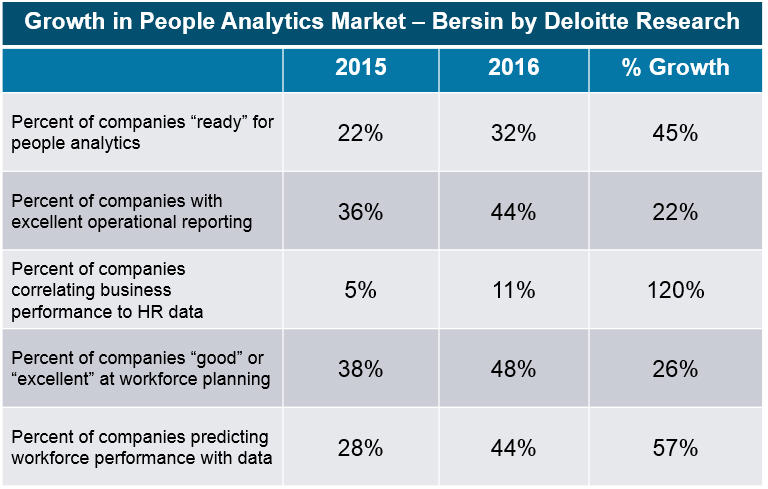
Came across this really interesting table about the explosive growth in HR Analytics.

data-driven-human-resources

(Source:  Deloitte Human Capital Trends 2015 and 2016, 3,300 and 7,100 respondents, respectively) 

The blogger who shared this, Mike Roberts, stated “With advancements in technology, as well as more awareness of the power of data, this is starting to change. Since 2014, we’ve seen an incredible transformation in the way talent acquisition professionals view data. And research from leading analyst firms has been backing that up.”

This is exactly why I have been doing HR & Recruitment Analytics training classess. There is a growing number of options out there, so make sure you get the bang for you buck you are hoping for.

IMG_6912

Connect with me if you want to know more about my approach to using data to drive decision-making in HR and Recruitment. I have recently published a book, Putting Your Data to Work, that can be your guidebook to how to get more people analytics in your HR and Recruitment processes.

HR & Recruitment Analytics – The recruitment and retention of top talent is the biggest challenge facing just about every organization. You really have to Think Through The Box to come up with winning solutions to effectively attract, retain and manage talent in the Philippines today. DMAIPH is a leading expert in empowering HR & Recruitment teams with analytics techniques to optimize their talent acquisition and management processes. Contact DMAIPH now at analytics@dmaiph.com or connect with me directly to learn how to get more analytics in your HR & Recruitment process so you can rise to the top in the ever quickening demand for top talent.
 

HR Recruitment Analytic Techniques

Every recruiting organization is looking for a way to better understand what’s working and what’s not working in their recruiting strategy. By using meaningful HR Recruitment Analytics techniques, your recruitment efforts can be greatly enhanced.

With real-time recruitment metrics & reporting, we can finally know what’s happening in our pipelines and what channels provide us with most qualified candidates.

New technologies like social networks, applicant tracking systems and business intelligence applications are fundamentally changing the entire recruitment process from sourcing to placement.

The pressure to deliver results has never been greater. HR and Recruitment managers are now more than ever required to demonstrate the return on investment their efforts are contributing to the bottom line.

Building analytics centric teams and using techniques taught in this training session will empower more data-driven decision making. This will result in both process efficiency and better return in investment in the recruitment process.

A few months ago, I facilitated a training class on HR Recruitment Analytic Techniques.

The Learning Session Objectives from the training were:

1. To learn analytics techniques that will allow quicker, deeper and more impactful analysis of HR Recruitment Big Data.
2. To be exposed to cutting edge technology being used in other companies to build HR Recruitment business dashboards and design more powerful reports.
3. To assess the current state of analytics in your HR Recruitment process and build a strategy to empower the greater use of analytics in your organization.

The Key Benefits from Attending this Learning Session were:

1.Develop analytic techniques that you can use to improve decision-making and improve the bottom line.
2. Explore analytics tools like business dashboards and data visualization to improve reporting.
3. Build a strategy to move your organization from current state to ideal state when it comes to the use of analytics.

Topics covered in the training included:

  • What is Recruitment Analytics?
  • Self-Assessment of your Recruitment Analytics
  • Analytic Techniques for Finding the Right Data at the Right Time
  • Applicant Tracking Systems & Social Media
  • Big Data and Recruiting Analytic Strategies
  • Business Intelligence, Data Visualization & Business Dashboards Technologies
  • Building Meaningful HR Recruitment Techniques

img_7502

Overall it was a great training class with lots of great discussion. Given that the recruitment and retention of top talent is the biggest challenge facing just about every organization. more conversations are needed.

DMAIPH is a leading expert in empowering HR & Recruitment teams with analytics techniques to optimize their talent acquisition and management processes. Contact DMAIPH now at analytics@dmaiph.com or connect with me directly to learn how to get more analytics in your HR & Recruitment process so you can rise to the top in the ever quickening demand for top talent.


Analytic Techniques to Make Data Driven HR Decisions

On June 22, 2016, in Ortigas, I will be partnering with my good friends at Ariva Events Management to facilitate a workshop on HR Recruitment Analytics.

We are expecting about 100 participants to come and learn more about how to use analytics to empower more data-driven decision-making in their organizations.

Analytics is now commonly being used across all industries, but being able to use the right analytic techniques to harness the power of big data is not so common.

Topics covered in the training include:

  • What is Recruitment Analytics?
  • Self-Assessment of your Recruitment Analytics
  • Analytic Techniques for Finding the Right Data at the Right Time
  • Applicant Tracking Systems & Social Media
  • Big Data and Recruiting Analytic Strategies
  • Business Intelligence, Data Visualization & Business   Dashboards Technologies
  • Building Meaningful HR Recruitment Techniques

New technologies like social networks, applicant tracking systems and business intelligence applications are fundamentally changing the entire recruitment process from sourcing to placement.

IMG_1224

A standard definition of HR Recruitment analytics is simply the metrics and analysis that relates to recruiting in a business.

However, we all know its actually a lot more challenging in practice.

The pressure to deliver results has never been greater.

HR and Recruitment managers are now more than ever required to demonstrate the return on investment their efforts are contributing to the bottom line.

So as the day progresses we will use hands of exercises based on real business cases to come up with solutions to the data challenges around us.

We will also look at several of the biggest trends in HR Recruitment Analytics. Sixmonths into 2016, there are the ones I have identified as the most common:

  1. Millennial Job-Hoppers
  2. Fresh Grad Skills Mismatch
  3. Selling Compelling Brands
  4. Focus Shift on Retention
  5. Social Media is not the magic solution
  6. Go Mobile or Go Dinosaur
  7. Big Data will make life better
  8. Analytics solutions that actually work

Don’t fall behind the competition. Recruiting for top talent in the Philippines is one of the hardest jobs on the planet right now. If your team is not armed with the best analytic techniques it will only get harder to stay a head in the game.

Let me know if you are interested in attending and I will connect you with my business partners at Ariva.


Follow Up to Q17: HR Analytics Trends

As a follow up to my last blog, I wanted to share a few more points about HR and Recruitment analytics then time allowed for. So here’s what I left out.

First we are seeing a massive replacement of licensed, traditional HRMS systems taking place. Many large companies either have, our or are looking into replacing the core HR applications. Most where built internally, just store structured data, are difficult to pull data from unless you can write code and are not integrated with other data structures.

The replacements are often vendor managed, cloud based, data storage solutions with end user interfaces that simply finding and analyzing data and often automate much of the reporting. And they can be updated in hours versus minutes, versus the old platforms that could take weeks if not months to update.

540

These new platforms are able to provide almost limitless data points, have built in business dashboards and are starting to offer powerful predictive analytics models. The days of many of the old school CRMs and ATSs we are using to manage people data are truly numbered.

Another trend worth mentioning is the efforts cutting edge teams are putting into both candidate and employee engagement. Attempts to “gamify” various part of the employee lifecycle to make data gathering, analysis and sharing more eventful is increasingly common. Its common knowledge that ways to attract and keep the attention of millennials is significantly different then it is for baby boomers or Gen Xers.

Dr. Sullivan mentioned that “we are seeing the traditional annual engagement survey is going the way of the dinosaur (slowly however) and a new breed of pulse tools, feedback apps, and anonymous social networking tools has arrived.” It has never been more important to look at not just the enterprise wide health of a company, but that of small communities within the enterprise.

Metrics that measure how engaged an employee once a year is are no longer enough. We can use things like sentiment analysis, text analytics and social media data scrapping to uncover things we would never see in a survey where everyone is pressured to give top scores.

And we really have to get beyond historical data and descriptive analytics to look at current and predictive metrics. We need to quickly know when and why metrics are headed in the wrong direction and measure the impact of our solutions. And this goes for not just current employees, but future ones as well. Candidate satisfaction with the hiring process is often an over looked metric.

We also now have the data and the tools to run predictive models on how, when and why someone may be looking to leave the company. This creates another whole area of HR analytics to look at.

Dr. Sullivan added that “we are seeing tools to predict flight risk, assess high potential job candidates, even find toxic employee behavior – are all in the market today.  While many are not highly proven yet, they all work to a degree, providing great value to any company.”

Now we have, three more trends to consider when it comes to analytics in HR & Recruitment:

  1. Replacement of old internal HR systems with new vendor managed tools
  2. The evolution of employee engagement tools
  3. Predictive analytics modeling

If you are curious about how to get more than just the most basic descriptive analytics out of your business data, then let us sit down and talk about. Finding solutions to replace your old HR systems with more employee engagement options and predictive analytics is not as hard or as expensive as it was a few years ago. Let me show you how getting back on the cutting edge  with your data can be done.

HR & Recruitment Analytics – The recruitment and retention of top talent is the biggest challenge facing just about every organization. DMAIPH is a leading expert in empowering HR & Recruitment teams with analytics techniques to optimize their talent acquisition and management processes. Contact DMAIPH now at analytics@dmaiph.com or connect with me directly to learn how to get more analytics in your HR & Recruitment process so you can rise to the top in the ever quickening demand for top talent.

Q17: What are some best practices and technologies used in HR & Recruitment Analytics?

HR and Recruiting Professionals have embraced analytics. It took a while, but the increased need for data and analytics tools –The ability to collect, process and analyze “big data” has become paramount to the people side of the business. In order to gain a competitive edge in the increasingly chaotic global workplace, those who use analytics to gain data-driven insights into recruitment, compensation and other performance centric trends are the ones on the cutting edge.

“In my opinion, 95% of all the work that is done on recruiting metrics ends up being a waste of time, because the work focuses on creating historical tactical metrics never actually used to improve recruiting performance,” says Dr. John Sullivan, an ERE blogger and recruiting metrics expert. He says there are 3 reasons why there are failures and wasted time when it comes to metrics:

  1. Recruiting metrics omit any “big-picture” business impacts
  2. Current recruiting metrics are 100% descriptive and only offer guesses on what is and what will happen.
  3. Once collected, the metrics are reported to “barley interested eyes” who then assign things to a committee whose time spent results in very little measurable impact.

If you are still focused on time to fill and cost per hire, you really are quickly becoming a dinosaur. In addition, the idea of trying bringing in new people while working towards retaining top talent are generally not assigned to the same people. The disconnect between recruiting good people and retaining the good people who have been recruited is a killer to many companies. Both the material and cultural cost of replacing a bad hire isn’t generally looked at.

There are lots of blind spots to what is happening not just internally, but also externally.  Knowing who you are competing against for the same talent and what makes your offer to sign or stay stand out from the crows. None of these points can be analyzed with old school metrics terms and methods.

Dr. Sullivan also recommends six strategic categories of metrics that will help your in not just recruitment but in many other HR initiatives like retention and employee engagement:

  • The positive performance increase added by more productive hires
  • The failure rate of new hires and the damage done by weak hires
  • The losses created by a weak hiring process
  • The opportunity costs of “missed” landable top talent
  • The cost of using excessive hiring manager hours

img_7526

If you are looking at metrics like these, and sharing your findings not just with the recruitment team, but the boarder HR team, you can come up with big picture strategies to deal challenges much more effectively. In my own experience, a few other noteworthy trends in HR and Recruitment Analytics to consider include:

  • Disruptive Technology. Giving tools and information to managers and employees directly allows action to happen much quicker and be much more localized in impact. Success means giving the power to the end users so that HR can do more to oversee and manage big picture metrics.
  • Once A Year Is Not Enough. Annual reviews and employee surveys are too old school. Using analytics to gain insights can now be done 24/7. This can really have positive changes on employee engagement without the drawn out and too formal process made uniform to all.
  • Outsource Stuff. In successful companies, many tasks are outsourced to vendors who can do a lot more specialized things then in house generalist staff can do. Its just to much to ask a few people to stay on top of all the things important to the people you rely on. You have to pick and choose what you can keep and what you can outsource.
  • Mobile Apps. Designing apps for mobile first use is the way to go. We too often rely on old school thinking and take web-only or web-first tools and repurpose them for mobile. Times have changed. Mobile first is the way to connect with todays candidates and employees.
  • Look For It On YouTube. Video based learning, recorded by localized subject matter experts is on the cutting edge. The bonuses of learning from someone who is doing it versus traditional corporate trainers and enterprise world eLearning modules is another key to success.
  • Out Of The Box Analytics Tools. Behind the fire wall HR applications are being replaced or augmented by vendor based analytics tools that are more dynamic and expandable. Many can set on top of or replace current tools that are being used to gather, store, analyze and report data. The days when everything has to be designed, developed and maintained by an internal IT team is also going the way of the dodo bird.

So there you have it… becoming an HR and Recruitment Analytics ninja is going to take a lot of new thinking and a lot of letting go of how it worked in the past. Everyone agrees recruiting has never been harder, retention is getting more challenging and the future of finding and retaining talent is looking like a nightmare on the horizon.

If you need some guidance with how to being your HR and/or Recruitment team into the information age, I’m happy to help. One of my favorite things to do is get in a room with HR and Recruitment staff and talk about how to bring the team form the past to the future when it comes to analytics.  Just ask me how.

HR & Recruitment Analytics – The recruitment and retention of top talent is the biggest challenge facing just about every organization. DMAIPH is a leading expert in empowering HR & Recruitment teams with analytics techniques to optimize their talent acquisition and management processes. Contact DMAIPH now at analytics@dmaiph.com or connect with me directly to learn how to get more analytics in your HR & Recruitment process so you can rise to the top in the ever quickening demand for top talent.

Q4: Can you please describe the current state of analytics in the Philippines? – Part 2

So the last blog post gave us the history. Now let’s cast an eye on the future.

Over the past year or so I have started to see a significant effort from data science and analytics professionals come together to address some of the challenges outlined in my last blog post.

In short, the way higher education and the government has approached the need for analytics talent is simply to little to late to meet the needs of many businesses.

Everything they are doing helps, but in the end the world is desperately looking at the Philippines to do with analytics what it did with customer service. To become a center of capable, long-term and affordable talent.

With taking customer service calls, it was a natural fit given that most Filipino college graduates have a foundation in English. With analytics and data science it has not been so easy. While many Filipino have the underlying course work in coding, database management, computer science, etc… they are not getting enough exposure to data-driven decision making, business intelligence tools,  and more advanced things like machine learning, prescriptive analytics and blending big data from diverse data sources.

I don’t want to sound too pessimistic, things are moving quickly but it is generally the multinationals driving things forward. They have the clients, they have the need and so they go out and find people and train them. That’s why 3 years ago hardly anyone in the private sector was offering analytics training, now you see more and more options all the time. They are generally expensive and narrow in focus, but they are opening up huge opportunities for data loving Filipinos to get into upwardly mobile and financially rewarding careers.

I belong to a couple of newly founded organizations of data scientists and analysts who meet on a regular basis to share knowledge, support each other’s ideas and build a community with the goal of using data to helping both the Filipino to fill these open jobs and for the Philippines to begin to use more data in decision-making so we can solve the big issue problems important to all of us.

It’s a pretty exciting time.

10256713_275221292688289_6652823653462957603_o

So where next?

Given that the Philippines is one of the youngest countries in terms of average age on the plant and the youth are incredibly communal and very tech savvy, I have found great success in training batch of Filipino fresh graduates in basic analytics. Of the 200 or so trainees I have personally trained, most of them now have jobs with analyst in their title.

I have also seen a lot of talent quickly go from novice to expert using applications and doing coding in relatively short periods of training. In many respects the approach to analytics is more vocational then academic allowing for quicker training.

Beyond these strength, you can expect more partnerships between the government, higher education and big business to offer training and career pathing.  The success of the BPO industry is really the driving force to add employees who can do the tasks of an analyst. The huge surge in job postings demonstrates this quickening trend.

Finally, the reason I see a bright future for analysts and data scientists in the Philippines is the simple fact that Filipinos gravitate to under filled career paths, they push themselves to get the skills to fill those jobs.  You see it in the Middle East oil fields, in sailors and seamen in just about every ship at sea, you see it with overseas workers across the planet, and you saw it happen with call centers.

And that is exactly why I set up my business in the Philippines. Here are some of the analytics solutions we offer:

The Fundamental of Business Analytics – Business Analytics is the application of talent, technology and technique on business data for the purpose of extracting insights and discovering opportunities. DMAIPH specializes in empowering organizations, schools, and businesses with a mastery of the fundamentals of business analytics.

HR & Recruitment Analytics – The recruitment and retention of top talent is the biggest challenge facing just about every organization. You really have to Think Through The Box to come up with winning solutions to effectively attract, retain and manage talent in the Philippines today. DMAIPH is a leading expert in empowering HR & Recruitment teams with analytics techniques to optimize their talent acquisition and management processes.

Contact DMAIPH now at analytics@dmaiph.com or connect with me directly to learn how to get more analytics in your Business or your HR & Recruitment process so you can rise to the top in the ever quickening demand for top talent.

Infusing HR Analytics into Organizational Behavior and Human Resource Management Classes

One of the things I have been working on is helping a top school here in the Philippines develop a strategy to infuse more HR Analytics into their Organizational Behavior and Human Resource Management Classes.

This effort is a precursor to a class specifically on HR Analytics, which is to the best of my knowledge, the first ever here in the Philippines.

So as I put more thought into the syllabus of each class, it occurred to me that a good way to approach analytics is to introduce it slowly over the length of the 3 classes, which follow in a natural progression.

Starting with the OB class, we can focus on how to identify data in an organization that will be useful to a HR team to measure things over time. To help really get at causality of human behavior on a wide scale, you need to have the data to understand context.

In the HR Management class, we will spend more time working on the inventory part of analytics, which is to bring the data into an analysis and reporting structure that helps us discover patterns and trends based on that data.

Then the HR Analytics class, we will then proceed on how to integrate the data and the analysis into tool like a business dashboard.

At a high level, the students will gain an appreciation for the wealth of data HR can access in an organization and how the analysis and reporting of this data can lead to more data-driven decision making.

Its great to have an understanding of why people leave a job, and to have good reporting on attrition patterns, but you also need to have the ability to enable strategic action based on data and not just observation or simple metrics.

That is what our students will be able to do that will separate them from other Psychology grads entering the workforce. They will be ready day one to be HR Analysts who can bring a much needed data centric skills set to a very people driven discipline.

If you are a school administrator or professor and need to get more analytics in your course work so your students are better prepared for the analytics centric jobs, connect with me. I can show you how. I even have a textbook you can use. My new book Putting Your Data to Work is ideal for the nascent analytics learner.

9b9b0d_9e1b0bda82a944ed9d8845fb26bc2b7b-png_256


Analytics Education – Facilitating a mastery of the fundamentals of analytics is what DMAIPH does best.

All across the world, companies are scrambling to hire analytics talent to optimize the big data they have in their businesses. We can empower students and their instructors with the knowledge they need to prepare for careers in analytics.

Contact DMAIPH now at analytics@dmaiph.com or connect with me directly so we can set a guest lecturer date, On-the-Job Training experience or other analytics education solution specifically tailored to your needs.