20 Questions with Dan Meyer about the Fundamentals of Analytics.

Recently I was asked to put together an FAQ about analytics. Based on my experiences from training people how to better use analytics, these 20 questions are the ones I most commonly get asked.

  1. To start can you provide us with a basic overview of what is analytics?
  2. Can you tell us what makes you an analytics guru?
  3. What are some of the current trends in analytics?
  4. Can you please describe the current state of analytics in the Philippines?
  5. What are some basic strategies an analyst can use to find the right data at the right time?
  6. Can you provide some tips on how to manage data?
  7. What exactly is data science and why the rapid rise of data scientists?
  8. Here something a lot of us are wondering, what exactly is big data and how can we use it?
  9. Can you please describe the concepts of storing data in a data ware house?
  10. Please talk about how, when and why we use should descriptive analytics?
  11. Can you next describe how to best use predictive analytics?
  12. Next please explain when and how we can use prescriptive analytics?
  13. A lot of us want to know what is business intelligence and how does it add value to analytics?
  14. What is data visualization and how does it help drive better decision-making?
  15. What is a business dashboard and how is it used in a business?
  16. Can you tell us more about current trends and hot new tools in social media analytics?
  17. Many of us work in recruitment or HR. What are some best practices and technologies used in HR and recruiting?
  18. Can you please talk about recent developments in higher education on how to train more analysts?
  19. How would you describe your approach to teaching analytics?
  20. So in conclusion can you explain a little more about your own method for using data to drive better decision making?

Each day for the next several days, I will take each question and elaborate and share with you my own personal FAQ on the Fundamentals of Analytics.
coverpicture1

The Fundamentals of Business Analytics – Business Analytics is the application of talent, technology and technique on business data for the purpose of extrating inights and discovering opportuniites. DMAIPH specializes in empowering organizations, schools,  and busiensses with a mastery of the fundamentals of business analytics.  Contact DMAIPH now at analytics@dmaiph.com or connect with me directly to find out how you can strengthen your business analytics fundamentals.


How to Build Your Business Strategy

Business strategy is something that comes naturally to me. I’m good at anticipating challenges, at doing research to assess the risk and reward to multiple options and I love to use data to validate or refute initial findings.

Though easy for me, I have found that being successful with business strategy is not as natural for most business owners, senior managers and decision-makers.

IMG_1849

When I set up my first company, it was based on a year of research and lots of networking. When I launched my second business it was based not just on research and networking, but learning from the mistakes made the first time with financial planning and partner relationships. Now on my third business, having taken the best of everything that worked before and finding ways to mitigate the things that went wrong before.

Now, for most business leaders you can’t just hit the rest button every few years, but you should hit the reset button on your initial strategy. Adapt to changes in the market. Glean new insights on cutting edge technology. Stay on top of industry trends.

That’s the first key to business strategy. Understanding that it is a continual process that evolves. Many businesses fail because they don’t change with the times or because leaders just stick with what has always worked. That’s dinosaur thinking.

Any good business strategy has to adopt a continuous process improvement policy, using something Six Sigma or Lean to keep things form getting stale.

A good business strategy also seeks out new technologies that can disrupt both their business and their business marketplace. What was cutting edge and trendy six months ago most likely be as effective six months from now. Good Business intelligence tools that can do cool data visualizations and build business dashboards help us stay ahead of the game. I show a lot of people how to do this using Tableau Public, which is free and easy to learn.

The next key to business strategy is integrating customer insights into everything you do. If you don’t listen to your customers, if you can’t predict what they need, and if you have a strategy that puts profit before customer experience you will probably fail.

It amazes me when I see bad customer service, products that no longer meet customer needs being produced and unimaginative marketing campaigns. In this day and age, with access to our customers at unprecedented levels, there is no excuse for failing to get it right the first time.  We do a lot of surveying and engage using social media to stay connected.

The third key I include in my business strategy planning and consulting is understanding the competitive landscape. Knowing where we stack up in the marketplace, what are our strengths and weaknesses, what is hot and what is not… you need to put as much focus on what is happening outside the business as you need to know what’s happening inside.

Almost everyone I talk with about their competitors share with me one common feeling… I don’t really know what my competitors are doing. In fact a high percentage even struggle to identify who their key competitors are. We are active in industry organizations, online social media groups and attend competitors events to stay up to date.

Business strategy is a lot more than just business intelligence, customer insights, and competitive landscapes, but it is a good start. If you are able to add these to financial models and demographic data, you will have a well-rounded business strategy. And then its just a matter of keeping it fresh, resetting it every so often to make sure you don’t become a dinosaur.

Let me know if I can help. In the past few years I have helped companies of all shapes and sizes refine their business strategy using my keys to success.

Business Strategy with Analytics – Aligning a business strategy to drive an organization forward requires a robust analytics solution. Businesses who have good analytics tend to be much more profitable and efficient then ones that do not. DMAIPH has helped dozens of companies in both the U.S. and the Philippines with adding more data analysis in their business strategy. Contact DMAIPH now at analytics@dmaiph.com or connect with me directly to find out what we can do to help you align your business strategy with analytics.

The Philippines An Emerging Center For Analytics

There has been a lot discussion the past several months about the relative pros and cons of outsourcing analytics. The biggest perceived con are that an outsourced analyst might not have the necessary business knowledge to pose the right questions or to clearly identify threats and opportunities.

However, the reality is that with the global analytics talent gap expanding at a rapid pace, many business have no choice but to explore outsourcing options for some if not most of their analytics.

Having worked with several businesses who have successfully outsourced analytics projects and even whole teams to the Philippines, I can say that the pros far outweigh the cons. Here are a few of the pros that I can testify to:

1. Speed and Focus. Once optimized, detached team can often get more done and get it done faster as they are able to mono task.

2. Fresh Set of Eyes. Given enough time to get up to speed on things, an “outsider” to the business often can see the forest through the trees.

3. Scalability. The savings based on things like having a team that can be quickly grown or shrunk based on business need and access to labor pools with a lower cost ratio can often make a big difference when it comes to covering all the bases.

10406025_10152524531307425_1404103117_n

There are countless other reasons why business in the U.S. are increasing looking across the Pacific for analytics talent including an American style of English, an affinity for the American business practices and a firm commitment from higher education to produce analysts.

In fact, the number of academic courses and corporate training programs offering business analytics is growing rapidly here in the Philippines.

As key players in the BPO industry here in the Philippines look to meet many of the analytics needs of companies abroad, the pros will continue to outweigh the cons.

And that is exactly why I founded DMAI.

Give Me A Young, Hungry And Curious Person And I Will Teach Them How To…

Businesses want analysts who can dig into a question and not only get to the root cause but also come up with multiple solutions.. this is not something that generally is taught in schools.

Unleashing a young, hungry and curious mind on complex business challenges is not generally considered, as most companies tend to assign newbies to remedial task and assign tire, narrow thinking, veterans to handle the big stuff.

Companies that see past these challenges and can select talent, empower them and turn them lose with cutting edge analytics technology are the ones succeeding.

DMAI_ERINSHELLMAN_shemac101_092015 copy

Dont give me an excuse, give me a solution. Don’t come with just a problem, also come with a suggestion on how to fix it.

How many people do you have in your business that can do that?

All The Tools And All of The Talent but none of the Technique… Where Good Analytics Intentions Go Bad

I have seen so many examples of this. A majority of companies throw money at analytics in the form of buying new technology, but don’t spend a fraction as much on the people who need to make the technology work.

A good analyst using Excel is much more powerful then a mediocre analyst using a cutting edge BI tool. Without the innate curiosity, knowledge of the business and ability to communicate discoveries that come with a good analyst, your analytics plans will fall short no matter what the sales reps from the analytics companies promise you.

Now we have the 2016 Presidential Election results to analyze. Most predictive models had Clinton winning. Most of the polls had Clinton winning.

So where did the analytics go wrong? Well, its definitely not the technology. And I don’t think it was the talent.

In the coming days, I am pretty sure we will find it was the technique.

It was not getting deep enough data.

It was looking at the data and seeing what you expected to see.

Curiosity was lost.

Finding new perspectives to make sure we have the right data next time.

Hillary Clinton’s campaign will be a case study in where good analytics where not good enough.

Analytics Culture – The key to using analytics in a business is like a secret sauce. It is a unique combination of analytics talent, technology and technique that are brought together to enrich and empower an organization. A successful analytics culture is not easy to create, but DMAIPH can show you how. Contact DMAIPH now at analytics@dmaiph.com or connect with me directly so we can build a strategic plan to turn your company into analytics driven success story.


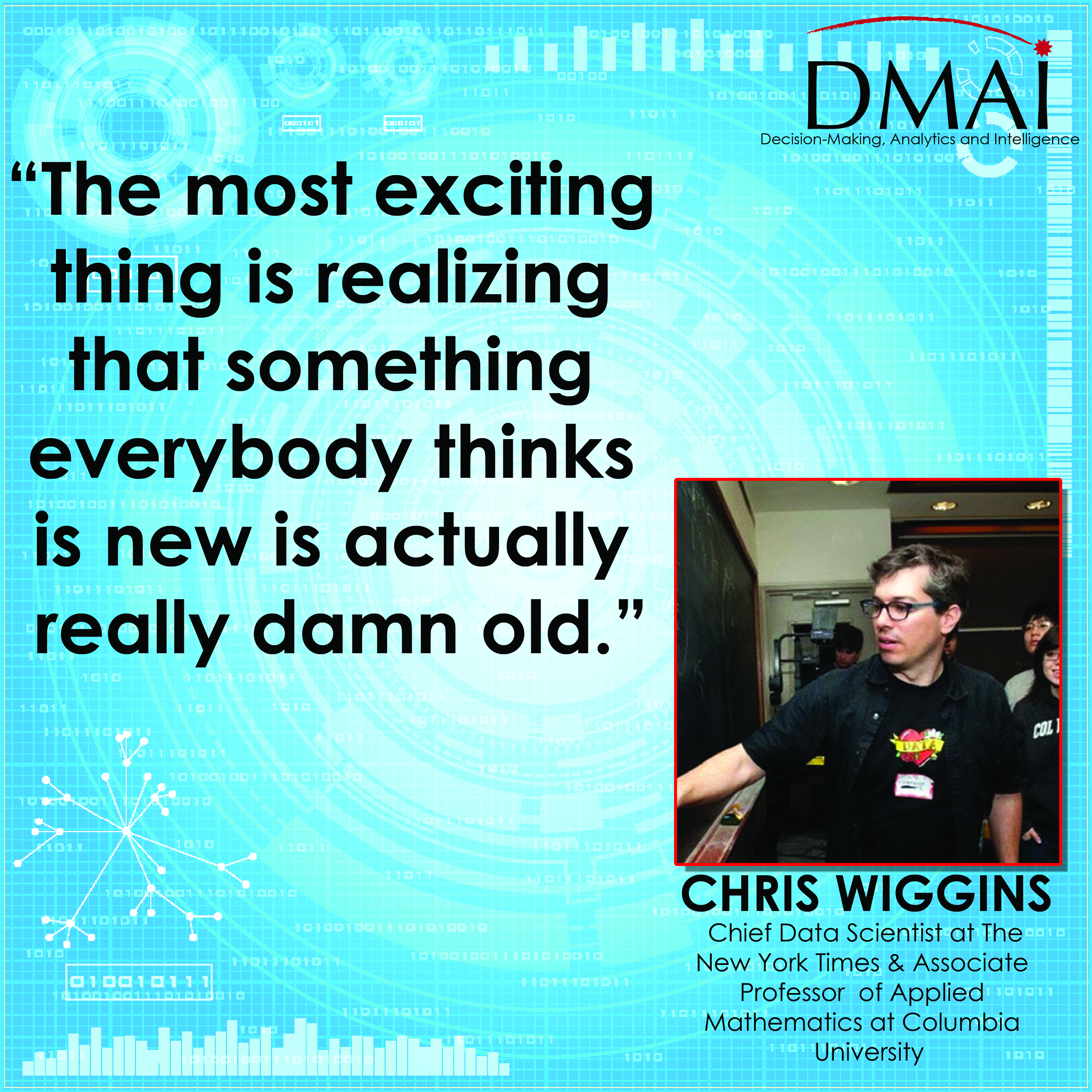
When What Is New Is Actually Old

I saw this quote and thought it was worth sharing… often I remind people that most problems have already been solved by someone else. One of the keys to being a good analyst is having a network that you can go to when you are stuck and ask around to see if anyone else has already figured it out.

Print

DMAI has been blessed with a very successful year so far in 2015 and is starting to look towards 2016 planning. Let’s see if there is some more opportunities out there for us to teach some people to rediscover things again using analytics!

Multitasking Is A Productivity Killer

Multitasking is a productivity Killer. Picked this up at a HR conference I was at last week. It was a theme during a couple of the presentations.

Multitasking as a competency is not the same as multitasking across projects and tasks during a day. That is good time management and the ability to prioritize what you work on.

The myth of multitasking, that you can do multiple things at the same time is a just that… a myth. Less than 10% of the world’s population is actually able to carry out two distinct tasks at the same time.

One of the speakers listed the Pros and Cons of multitasking:

  • Pros of Multitasking: Reduce Cost by having one person do the jobs of many people.
  • Cons of Multitasking: sense of being overburdened, stressed out, loss of focus, poor quality, high attrition, inflated sense of importance and value

As you can see not much comes from trying to force someone to do too much.

10592010_10152674958362425_1982237172_n

Back when I was an analyst with Wells Fargo, one of the keys to my success was that I didnt multitask when I had to focus on high priority projects. I would put my headphones on and block out the world. Often I would even close my Outlook and my browser. Giving 100% to a project for a few hours always led to a better finished product. And it feels awesome to have a sense of accomplishment.

I still do this. When Im focused in on a project I tell people I’m busy. I get away from distractions. And I focus in like a laser.

Multitasking is indeed a productivity killer and not falling prey to it is one of the reasons Im as successful today as I am.

The Average Keeps Getting Lower And I Refuse To Tolerate This – Updated

Updated on 10/27/16

http://sethgodin.typepad.com/seths_blog/2015/08/the-average.html

The average

 Everything you do is either going to raise your average or lower it.

 The next hire.

 The quality of the chickpeas you serve.

 The service experience on register 4.

 Each interaction is a choice. A choice to raise your average or lower it.

 Progress is almost always a series of choices, an inexorable move toward mediocrity, or its opposite.

I can totally relate to this. We are a society more and more inclined to settling for the average, and are even ok with it when the average trends lower.

One place I see it happening more than most is in talent management. The demand so far outweighs the supply of good talent; we keep lowering the bar.

Frist it was 4 year degree required. Then it was some college. Now its high school grad.

In just a few years we have gone from a high bar to also most no bar.

Same day hiring. No interview required. No test or assessment. Just how up and get a job.

I hate this.

This new reality taking hold across the Philippines  is deeply concerning to me.

It is unacceptable to me to be involved with anything that is just average, and I just get crazy when I see people doing things to lower the average on purpose.

There is another way.

If you have good analytics, you can be better at setting a realistic bar and not just going lower to meet requirements.

No more mediocrity. No more playing to the average and definitely purposely lowering the average.

I just refuse to tolerate it anymore!

Let me show you how to use the data in your business to turn things around.

Stop the insanity of fueling high turnover and low employee engagement that is lowering the quality of service to a dangerous place.

Who is with me?

If you are, the you will might enjoy reading my new book, Putting Your Data to Work. I can help you use your data.

HR & Recruitment Analytics – The recruitment and retention of top talent is the biggest challenge facing just about every organization. DMAIPH is a leading expert in empowering HR & Recruitment teams with analytics techniques to optimize their talent acquisition and management processes. Contact DMAIPH now at analytics@dmaiph.com or connect with me directly to learn how to get more analytics in your HR & Recruitment process so you can rise to the top in the ever quickening demand for top talent.

DMAI Data Science > Where Dreams and Demand Meet

Building a data science team tasked with helping other organizations build data science teams is equal parts dream and demand.

There is a quickly growing need for data science capabilities in the Philippines, but there are few ways for Filipinos to learn how to be data scientists. Almost over night it seems that people are posting job requirements for high powered analytics talent with very little idea of what data science is all about.

Business analytics is just now taking root in academia and being offered as a series of elective classes. Big data is just one class. Predictive and prescriptive analytics are also just one 3-5 month class. Its just not enough.

The big companies who are committed to building their own team are scrambling to find talent in the already hyper competitive BPO industry.

That’s the demand.

DMAI_GrowMoreDMAI_shemac081815 copy

Data science as a discipline is still quite new. In the U.S. and India you are starting to see a significant number of degree programs in analytics and data science. I learned a lot about data science before it even had a name. Analytics is deeply rooted at Wells Fargo and I benefited from being in the right place at the right time to get exposed to some pretty awesome analytics efforts.

This experience unlocked an opportunity to become one of top analytic minds in my adopted home, the Philippines. The opportunity of a life time really. Now I am at a point in the evolution of my business, DMAI, where I need to find 3 people like me to join me in my quest. My quest to help organizations in the Philippines set up data science teams.

I need a dream team. Like the Eath’s Mightiest Heroes the Avengers or the NBA Champion Golden State Warriors. the DMAI Data Science Team needs the best of the best who excel in complimenting each other.

We need a big data analyst strong man in the paint, we need a visionary data modeling expert who can create great data models and pass them off to the shooter of the team, the business analyst.

That’s the dream!

It’s time to join the right and be at the forefront of spreading data science across this great island nation so full of potential.

If you feel the call that I feel and are interested then connect with me on LinkedIn and/or send me you resume at danmeyer@dmaiph.com ,

What Is Data Science and Who are Data Scientists?

Per Wikipedia, Data Science is the extraction of knowledge from large volumes of data that are structured or unstructured, which is a continuation of the field data mining and predictive analytics, also known as knowledge discovery and data mining (KDD).

Does anyone know  a “data scientist”? Data scientists work with large data sets, analysis models, and technological solutions to help businesses drive more data-driven decisions. This is known as data science. Data scientists should have these six skill sets:

Tech Skills

  • Programmer
  • Statistician
  • Domain SME

People Skills

  • Artist
  • Client Facing
  • Communicator

As you can imagine, it is very difficult to find people who have expertise in all 6 skills sets.

DMAI Diagram_shemac101_081015 copy

The unique blend of skills required for a role on a data science team is being debated and almost everyone around the globe who is associated with Big Data, Analytics and Visualization has opinion on this topic.

DMAI has determined that the best lineup for our clients in the Philippines is a veteran business analyast, a big data analyst and a data modeling expert.

Ask me how you can get a data science team set up in your business.