Outsourcing Tip > Size the Opportunity! Not to be confused with Seizing the Opportunity.

When you have an opportunity to get involved with outsourcing, it always sounds like a good way to make some fast money.

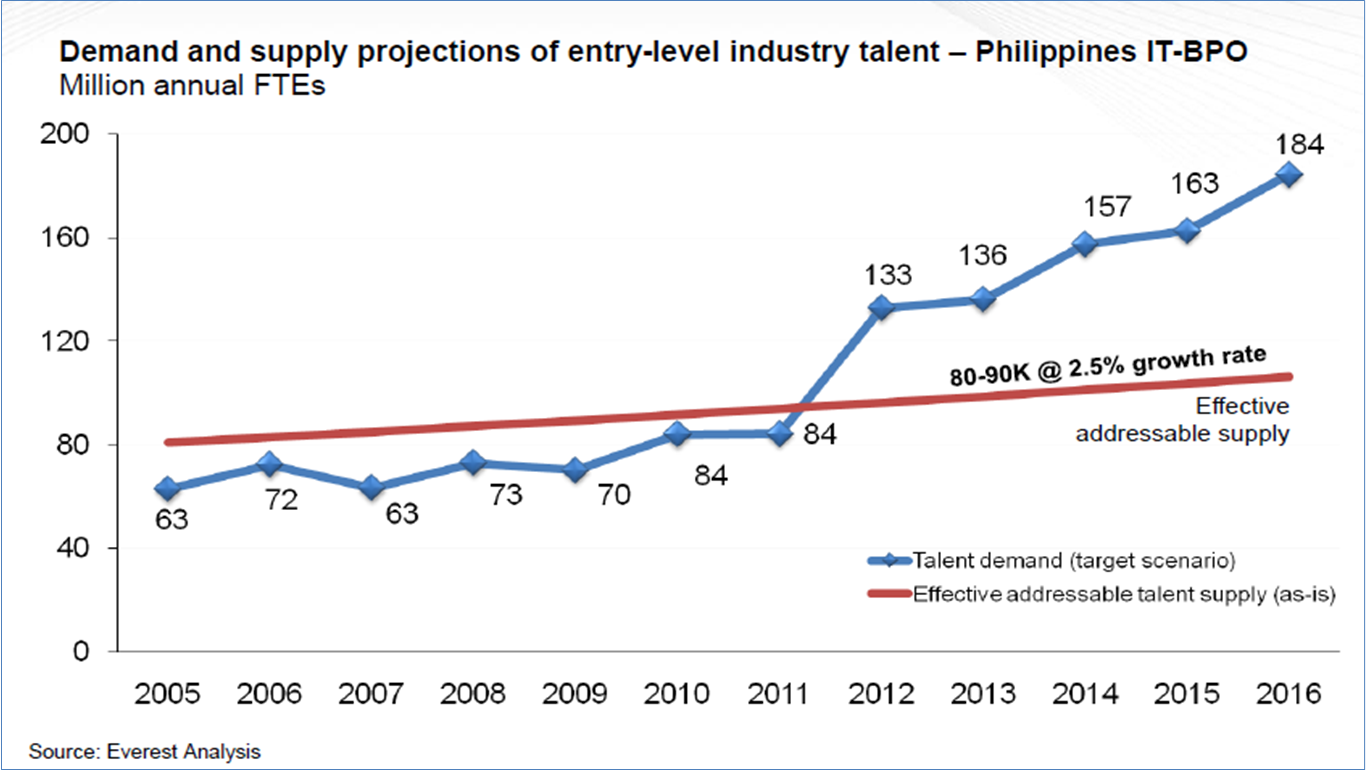
The news has been abuzz for a while now with mounds of data and statistics about the high-speed growth in the outsourcing industry, especially here in the Philippines. Just yesterday I saw a projection that BPOs in the Philippines are expecting to see a 15% growth in revenues in 2014.

Picture1

You couple that with the fact that everyone here knows someone who is making good money as a call center agent or investing in real estate that will be used by call centers, or have a friend in the US who knows someone who wants to save money by outsourcing. It’s one of those everyone is doing it, so why can’t I kinds of things.

This is all good, but there are just as many failures as there are success stories when it comes to small and medium-sized BPOs. Ones where someone had a client, or a building, or an idea but didn’t size it right and misjudged on cost, or talent or market and had to close their doors and lost money.

So when you have an outsourcing opportunity in front of you, whether it be as provider or a client, make sure you size it right. Here are a few things to think about:

  1. Does the client already have an existing business that they want to outsource? If so, fully understand all the requirements of that job as it is currently performed.
  2. Can you find the talent in the Philippines to provide just as good if not a little better service as currently is being provided? A common mistake is thinking that cutting both cost and the level of service will be a win-win.
  3. How scalable is this project? How can both ends be managed in a way that allows for uninterrupted growth? Often things start easy when it’s a pilot, but once you get into production a host of issues can pop up to derail growth and ultimately the partnership.
  4. How stable is the client? Are they a startup that has a great idea and is underfunded? Those are plentiful. Or are they an established business with a strategic plan that includes the fortitude to successfully outsource a key piece of its business? These are hard to find.

That is just a few things that come to mind when I think about sizing the opportunity. Having set up 5 teams in the past year to provide outsourcing services, I have learned a lot about making sure I get the sizing done right. Keeping a client happy is all about under promising and then over delivering when it comes to time, talent and cost.

Analytics Outsourcing – DMAIPH has successful set up Filipino analytics teams for over a dozen U.S. based businesses. Offering both virtual and office based teams that specialize in problem solving using data, new technology and analytics techniques is our strength. Finding and empowering analytics talent is increasingly challenging, but we have it down to a science. Contact DMAIPH now at analytics@dmaiph.com or connect with me directly to learn more about how to set up an analytics-centric team in the Philippines.

Being A Great Analyst > Key Attribute #1 > Know A Lot

Often you here people in business talk about how it’s more important to be either a master at one thing or a jack of all trades. When it comes to being a great analyst, you see many who are great because they have mastered their subject or a certain analytics tool. On the flip side you see many great analysts who seem to know a lot about a lot and are proficient across multiple subjects and/or can use many analytics tools. So which is better?

From both my experience and my personal perspective, analysts who know a lot about a lot are rarer and more valuable to a business. Based on both an accumulation of knowledge and the ability to work in various environments, analysts who are considered to jack of all trades kinds are in general great analysts.

IMG_6912 However, I have also found that most business actually find more value in master of certain type of analysis work or someone who is great at using a certain tool. Specialization is something that is on the surface very impressive as it shows discipline and competency in a certain subject. They know a lot about their area of expertise and are recognized as such.

Occasionally you can even come across analyst who are both knowledgeable about a lot and even more knowledgeable about a specific subject matter. Now that is a rare breed.

So, no matter what type of analyst you are or want to be, the bottom line is you need to constantly read and connect and expand your knowledge… you need to know a lot if you want to be great!

Analytics Culture – The key to using analytics in a business is like a secret sauce. It is a unique combination of analytics talent, technology and technique that are brought together to enrich and empower an organization. A successful analytics culture is not easy to create, but DMAIPH can show you how. Contact DMAIPH now at analytics@dmaiph.com or connect with me directly so we can build a strategic plan to turn your company into analytics driven success story.

Recruitment Analytics… where both demand and need is greatest

Who’s left? > Reblog from one of my blogging heroes, Seth Godin.
http://sethgodin.typepad.com/seths_blog/2013/11/whos-left.html

This is EXACTLY why I have been able to run several successful recruitment analytics seminars in the past year. So many HR and Recruitment teams still approach sourcing talent like this…

“The classified section of the Sunday New York Times used to be more than twenty or thirty pages long. Now it’s down to one.

Part of this is due to the lack of new jobs in the post-industrial economy, but mostly it’s due to job listings moving online. I was fascinated to see some of the jobs in last week’s paper, and confess befuddlement at the thinking of those that ran them.

Here’s one, from Amazon, for a level II programmer in their New York office. Just a mailing address, no online method for contacting or applying. They’re using the newspaper to search for programmers unable to apply online, perhaps the best place to find this sort of programmer, but really, do they want them?

Or the ad from Paul, Weiss, a prestigious big law firm in New York. It’s the biggest ad on the page, and goes into a long, long list of requirements for the job–Magna Cum Laude from a famous law school, more than three years with one of their competitors, etc. Which high-powered New York lawyers are reading the last single page of newspaper classifieds?

And my favorite, an equally long ad for Deloitte that instructs the applicant to go to a website and enter a 15-digit code, including several “1”s, some “I”s and a bunch of letters and numbers. Almost unreadable in the paper, and hard to transcribe. More than a billion combinations… why not just enter NYT1124?

Lots of time and money being spent chasing the wrong people with the wrong ads.

My point, and I do have one, is that if your HR department is run by policies that were established a decade ago, worth a new look. And if you are serious, truly serious, that talent is your competitive advantage, please understand that the way you look for and sort that talent is the highest-leverage way you’ve got to increase what you end up with.”

HR & Recruitment Analytics – The recruitment and retention of top talent is the biggest challenge facing just about every organization. You really have to Think Through The Box to come up with winning solutions to effectively attract, retain and manage talent in the Philippines today.

DMAIPH is a leading expert in empowering HR & Recruitment teams with analytics techniques to optimize their talent acquisition and management processes. Contact DMAIPH now at analytics@dmaiph.com or connect with me directly to learn how to get more analytics in your HR & Recruitment process so you can rise to the top in the ever quickening demand for top talent.

Analytics and Process Improvement

Had an interesting text conversation yesterday that I thought worth sharing as it brings up a good question… can you have process improvement without analytics?

I got a text randomly yesterday from a friend who is considering a new job as an analyst for a hospital.

flow

Friend: Hi Dan, I got a question on analytics. If I wanted to increase the utilization of rooms in a hospital, what kind of data should I be looking at?

Me: Do you want a well thought out plan or a quick and dirty answer?

Friend: I suppose quick and dirty.

Me: Length of patient stay. % of special needs patients. Physical dimensions of space to see if space is optimized. Understanding of patient process flow to see where wasted time is. Then put it all together to come up with some current metrics and then track against optimal case metrics.

Friend: What exactly do I need to be looking for if I go look at length of stay? What are optimal case metrics?

Me: To optimize usage, you need to gather data for key metrics as they currently are. And then project the same metrics is everything was working at its most efficient state. Length of stay is a key metric as you need to determine what is causing longer than expected patient stays. This will help you minimalism things causing wasted time. Analytics will identify waste and then you use metrics reporting to manage the waste. Make sense? This sounds like as much a process improvement project as it does analyst work doing some new metrics reporting. It could be a very interesting project with both short-term consulting on the process improvement and long-term need for an analyst to monitor the data via metrics reporting.

Friend: Yeah, you are making lots of sense. So, if I were trying to shorten length of stay, I would look at current length of stay per case. Then look for all the factors impacting length of stay, and then improve the process flow for the ones where its taking too long.

Dan: Something like this is how I would start.

Based on my experience, when you are presented with a business problem and asked to help solve it. It’s almost always an issue of a process that is inefficient or wasteful that is the root cause, but you need plenty of data to identify that. A good analyst is just as much a process improvement guru as they are a reporting expert.

IMG_6912

Analytics Consulting – As a founding member of Gloabl Chamber Manila, DMAIPH specializes in a variety of analytics consulting solutions designed to empower analysts, managers and leaders with the tools needed for more data-driven decision-making.

We have helped dozens of companies in both the U.S. and the Philippines, get more analytics in their business.

Contact DMAIPH now at analytics@dmaiph.com or connect with me directly so we can tailor an analytics solution made just for your unique requirements.

13 Months in the Philippines – Lesson One – Finding the Right People

Lesson 1 – May 2012 – Finding the Right People

Makati, Metro Manila, Philippines

I took a couple of trips to the Philippines in early 2012 to lay the ground work before committing 100% to moving there lock, stock and barrel. When I was there, one of the things I did was set up some interviews for my first BPO Elite employee.

elite-strategy-hi-res-21.jpg

Now don’t get me wrong, I ended up with an amazing employee who would become one of my best friends. But the process itself had some serious flaws. Let me break them down. And even though I have extensive experience in recruitment and hiring, I made many of the same mistakes in the process that most managers make. They put it on themselves to do it all, they are the only ones in on the decision-making, and they don’t really look at the available data to help them.

When recruiting. I found out the true power of LinkedIn. I networked with a couple dozen candidates, and narrowed it down to six to interview based on e-mail conversations before I left the US. When I arrived, I set up phone screenings with the six and ended up then conducting two final interviews. Pretty standard stuff and thanks to LinkedIn, all the candidates where qualified to be my very first employee, a recruitment specialist. However, I did all this myself. And even though I have partners and an assistant back in the US, I took it on myself. That’s lesson #1, you cant always do everything yourself. It takes up a lot of time and it makes others think you don’t need or want your help. Next time I do this, I need to delegate and be more inclusive.

The next thing I did wrong was that I didn’t have one of my partners interview with me. I based my decisions on my gut. Now as an analyst, I am kicking myself about this, but as a first time business owner… its a very common mistake. There is tons of data that shows that candidates hired after interviews with more then one person as much as a 100% chance to stick around longer than those interviewed solely by one person.

540

The final lesson that comes to mind is that I didn’t do a very good job of understanding the data available when it comes up to the recruitment industry in the Philippines. After being there a while and gathering data and insights, I over paid, I over promised and I over recruited. I hired two, at way more than the market price and I gave them pretty favorable terms. All things that more research would have uncovered.

So In the end it worked out, I got a great candidate who stuck with me thru thick and thin. I just wish I would have hired me the analysts to do the prep work for me the business owner. Hehe!

Analytics Tool > LinkedIn > http://www.linkedin.com

Analytics Concept > Marketing Analytics > http://en.wikipedia.org/wiki/Marketing_analytics#Data_and_analytics

YouTube Resource > http://www.youtube.com/watch?v=6jDjeNJrN14&feature=share&list=PL7EC252B253873D5D

My Analytics Story – My passion is solving problems by bringing together the best talent, cutting edge technology and tried and true methodologies. DMAIPH is all about empowering people towards better Decision-Making through the use Analytics and business Intelligence. This is what I do best. Contact DMAIPH now at analytics@dmaiph.com or connect with me directly for a free consultation about getting more analytics into your career and your business. 


The Current Analytics Talent Landscape in the Philippines – Updated

Updated on 10/26/16

Something I was working on for a potential client, that I thought interesting enough to share.

Here are some of the common characteristics of the three types of analytics talent you will find in the Philippines. Keep in mind that analytics is still a fairly very new concept in the Philippines, but I am convinced its primed for continued growth.

From my experience the analytics talent in the Philippines can be broken into three groups.

  1. Fresh Grads
  2. Entry Level Analysts
  3. Experienced Analysts

For the sake of comparison, I will speak mainly of analytics generalist positions like business analysts and operations analysts. More niche analytics jobs like financial analysts or quality analysts often come from different backgrounds then the bulk of the analytics talent I have worked with.

The first group of analysts are fresh grads. By and large they come from programs like IT, ComSci, Marketing, Business and other related courses. The ones with technical degrees all have some coding skills, know a few programming languages, are very comfortable with Excel and Access and have a general theoretical knowledge of databases, data warehouses and how big data is collected, stored and managed. Generally the business and marketing grads, have less technical skill, but are better prepared for the communication and data sharing side of analytics.

There are several thousand of these graduates entering the workforce every year, but a small % of them are really prepared for analyst careers. Several schools have launched Business Analytics elective tracts, but they are just getting started.

Most fresh grads with analytics talent find jobs in retail or in call centers, many as tech support or IT staff. The ones that do end up with the word analyst in the title are actually more like data encoders or just run reports.  They do very little actual analysis.

From this pool, the English and communications requirements of many analyst jobs screen out 75% of the applicants. Fresh grads who start in analyst roles make salaries of between 10-20,000 PHP a month.

The second group of analysts comes the way most people have become analysts… accidentally. They have very similar educational experiences to the fresh grad batch, but started as a CSR or IT or Tech Support and rose above their peers to take on more complex duties.

These analysts find ways to add value to their reports, or have a propensity to solve hard problems or have a tech skill that really stands out. They are promoted to entry level analyst jobs where they are generally used with business lines to do metrics and KPI reporting, assist with process improvement initiatives.

They start to become very skilled, but generally in only 1-2 applications. Their talent is very concentrated and they are not generally pushed to do more. Whether it be working with certain BI or analytics tools, CRMs or other applications, they become very proficient end users but rarely learn the concepts that allow them to move easily between companies. They generally make salaries of about 20-30,000 PHP a month.

However, that doesn’t stop them from hopping around quite a bit. The severe talent shortage for analysts in Metro Manila see a lot of analysts with 1-2 years under their belt get pirated and over a 5-6 year period you see they working for 3-4 companies, each time chasing more money. And rarely does this make them a better analysts as they have a lot of knowledge about a few things, but have not really mastered a competency in anything.

IMG_1310

The only training they receive is in-house training on new systems that is generally rolled out from abroad/above. This is one of the biggest difference between analysts in the US and India versus the Philippines. There is little investment in the analyst to grow. There is no encouragement to innovate they get bored pretty quickly which is why they are so susceptible to jump for a little more money.

Based on my observations, maybe 20% of this pool of thousands stick with the same company and rise up to be an experienced analyst in their original company. And you find the ones who stick are generally employed by US, Indian and European BPOs. They make about 25,000 and up PHP a month.

The final group, the more experience analysts are a rare breed. They have the skill similar to what you would expect from an Indian or US analysts with 5 years of experience. They have mastered a couple of disciplines (apps, systems, dbases, etc) and have carved out a good niche. They get paid at least 30-40,000 PHP a month and are firmly established with their employers.

They don’t hop for more money and they tend to be pretty loyal. The best way to pry them away is to offer them something new and different to play with. When you appeal to their curiosity, then they will consider hoping for more money. This is the play the HP, IBM, Google, Citibank, and others who have set up analytics teams are doing. They are trying to entice top talent with both money and new opportunity.

There is also a small, but growing number people in the Philippines who are at the level I was when I left Wells Fargo. Analytics Experts who can offer you a wide range of analytics solutions, understand how complex analytics works and are truly on the cutting edge. A lot of these analysts are now being classified as data scientists. The salaries for these positions can be 50,000 PHP or more a month.

Traditionally data scientist have advanced degrees in statistics, math or some other heavily technical field of study. They generally focus on building models and mining big data using advanced software. They have mastered several coding languages and use predictive and prescriptive modeling techniques. If I had to put a guess on this, there might be a couple thousand true data scientists in the Philippines right now. Hardly enough to go around.

In reality, many of the job postings across the Philippines for data scientists are actually looking for something different. The term is the current hot buzz word and many traditional analyst jobs are being mislabeled as data science jobs. It is very important when hiring someone who has data science in their background to make sure they really have the level of expertise you need.

Bottom line though, if you are looking for someone who is curious, adept at technology, loves solving problems and is data hungry, you can find them in the Philippines.

These thoughts are solely based on my observations and research; I would love to hear others either validate or counter any/all of my conclusions.

If you would like to know about the current state of analytics in the Philippines, please check out my new book, Putting Your Data to Work. The book serves as a guidebook for Filipino professionals to better understand how to get more data in their business. Connect with me and I’ll let you know how to get a copy.

Analytics in the Philippines – The Philippines is at the center of the action when it comes to solutions to the global need for analytics. Blessed with a solid foundation of young, educated and English speaking workforce, companies around the world are look for Filipino analytics talent to fill analytics positions. DMAIPH was set up to facilitate these solutions and bring the talent and the business together. Contact DMAIPH now at analytics@dmaiph.com or connect with me directly so we can help you take advantage of this unique global opportunity.


 

Simple Recruitment Analytics Exercise: Recruit your own Super Hero Team

Here is an example of simple exercise I sometimes include in my recruitment analytics trainings. It’s a good icebreaker/team builder that starts the conversation about how to measure the effectives ness of different roles in a recruitment process.

Situation: There is an asteroid about to hit the Earth. An evil super villain has  created a ray that is attracting the asteroid here.

You need to recruit a team of heroes to complete the following tasks

1.Stop the asteroid from hitting the earth.
2.Find the super villain and stop his ray.
3.Evacuate people from the impact zone in case you can’t stop it

Rules: You must pick 3 heroes and you must stay under budget on their “salaries”.

You can only spend 200 salary points total.

Superman –  150  JLA vs Avengers

the Hulk – 100

Batman – 75

Thor – 100

Wonder Woman – 75

Iron Man – 100

The Flash – 50

Captain America – 75

Green Lantern -50

Hawkeye – 25

Aquaman -25

Black Widow – 25

Hawkgirl – 25

Darna – 50

The discussion is always interesting and most teams come up with a different combination of heroes. Besides the lead in to recruiting, I also talk a lot about how when we recruit, we have to think about what appeals to our target demographic. Which in the case of most recruiting for the BPOs here in the Philippines means 18-24 year olds who like technology, games, super hero movies and anime. Trying to find creative ways to engage them and keep their attention is as big a challenge as any other one facing recruiters.
And for the record, the most common solution is just to hire Superman and save the rest of the money since he can handle all three tasks in a matter of seconds. 🙂
If your organization is struggling with recruiting and retaining talent like so many others are, then you need the equivalent of an analytics superhero to help you save the day.
HR & Recruitment Analytics – The recruitment and retention of top talent is the biggest challenge facing just about every organization. DMAIPH is a leading expert in empowering HR & Recruitment teams with analytics techniques to optimize their talent acquisition and management processes. Contact DMAIPH now at analytics@dmaiph.com or connect with me directly to learn how to get more analytics in your HR & Recruitment process so you can rise to the top in the ever quickening demand for top talent.