The Philippines is Going Beast Mode! 2 of 3

ASEAN Demographics

Sharing my thoughts on some great Bloomberg visuals my good friend Justin Calderon used in a recent story he put together.

http://investvine.com/charts-outlining-the-philippines-economic-trajectory/

Beast Mode is an American Football term for a player who singlehandedly dominates a game. This is the second of three visuals I will breakdown and comment on.

This slide tells me so much. Based on this I am convinced that its time to revamp my plans for training fresh grads in analytics. Look at how much younger the Philippines is then its neighbors! Combine this remarkable demographic datapoint with other factors like the investment being made in the BPO/Call Center industry, the education system geared to produce American style English, and the size of the talent pool.

When you do that you see what I see, an amazing opportunity to be in the middle of all the training, skill building and mentoring that will be needed to prepare this population boom for the jobs of the next 10-20 years.

In the previous post, it was noted how quickly the Philippines economy is accelerating and here you see a snapshot of the future. There are still so many potential detractors and possible hindrances ahead, so you have to pay them mind. However, its data points like that, backed up by analysis and on the ground intelligence that have me convinced its time to go back and jump in!

The Philippines is Going Beast Mode! 1 of 3

ASEAN Economies

Sharing my thoughts on some great Bloomberg visuals my good friend Justin Calderon used in a recent story he put together.
http://investvine.com/charts-outlining-the-philippines-economic-trajectory/

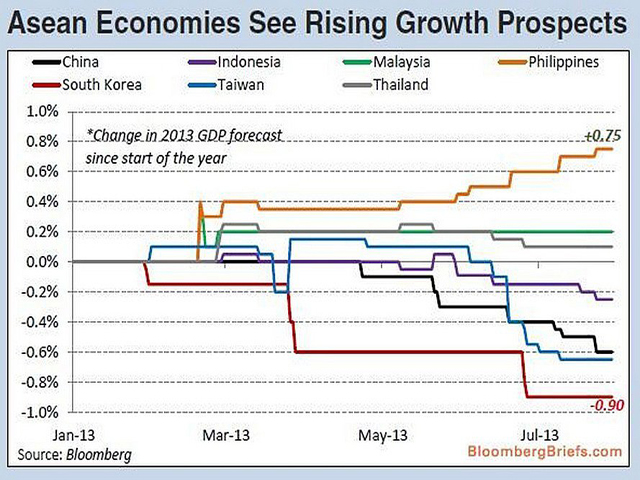
Beast Mode is an American Football term for a player who singlehandedly dominates a game. This is the first of three visuals I will breakdown and comment on.

Over the past couple of years I have been talking a lot about how the economy of the Philippines is quickening. The overall trajectory for the economy is rocketing ahead for several reasons including geography, history, political climate, and demographics. There are dozens of stories published all the time about why, how, and what this means for both the Filipino people, for the ASEAN countries and for the global marketplace. There is so much economic data out there, its like an analytics playground.

One of the most significant and often used economic data points is GDP (Gross Domestic Product). GDP is of course is the market value of all officially recognized final goods and services produced within a country in a given period of time. Thanks Wikipedia for that definition.

As you can see the Philippines is the only economy of the seven countries being measured that is not only trending upward, but the trend is accelerating. If we were looking at mid season performance of a sports player being compared to other players in it’s division… we’d be saying the Philippines is in Beast Mode. Check out the YouTube video below and imagine #24 is the Philippines economy right now.

Sharing Some of My Favorite LinkedIn Groups about the Philippines

Here are some of my favorite LinkedIn Groups that relate to living in and running a business in the Philippines. I try to follow the discussions and actively post comments and new discussion several times a week. LinkedIn is an amazing tool to stay current on things important to you and your business.

Philippines Call Center Professionals – lots of good info about current trends and issues
http://www.linkedin.com/groups?home=&gid=2130497&trk=anet_ug_hm

EXPAT PHILIPPINES – a great place to network and learn how to deal with common challenges
http://www.linkedin.HR Philippines com/groups?home=&gid=1483687&trk=anet_ug_hm

HR Philippines – an excellent source for recruitment and HR trends and hot button topics
http://www.linkedin.com/groups?home=&gid=992347&trk=anet_ug_hm

Filipino Professionals for 1stWorldPhilippines.com Movement – The name Says it all!
http://www.linkedin.com/groups?home=&gid=21601&trk=anet_ug_hm

The Philippines Sourcing Council – A good combination of contributors
http://www.linkedin.com/groups?home=&gid=96615&trk=anet_ug_hm

Philippine Society for Learning and Performance – A great group of professional opinions
http://www.linkedin.com/groups?home=&gid=3897230&trk=anet_ug_hm

13 Months in the Philippines- Lesson 4 – August 2012 – Mother Nature Strikes

IMG_1011Manila, Metro Manila, Philippines

In late July, 2012, the Philippines was pounded by several typhoons and monsoon rains. There was one period where it rained hard for four days straight non-stop. Before the storms, I was in full swing… setting up speaking engagements, attending job fairs, conducting trainings, and shopping for clients, but then the storms came and everything ground to a halt. At the time, after three months of non-stop working, it seemed like a nice respite.

For those of you who have never been in Manila during a flood, its pretty hard to describe with out it sounding dramatic. In short, the city floods almost every year for a number of reasons. The people are just used to it. Walking in water up to your waste and dealing with school and business closures… its now big thing to most residents of Manila. But for me it was a pretty overwhelming experience. After coming back from a field trip on the 3rd day of the heavy rains, my son was stranded at his school. And I was powerless to do much. We walked a couple of miles from Makati to Manila in heavy downpours to get to his school. There were no taxis or public transit, so we had quite an adventure getting back from Manila to Makati.

Anyway, because of the floods, I did have to cancel once training class. It was a full class of 15 and had a lot of people with call center experience. It would have been a very fun class.

After the floods, things changed pretty significantly and pretty rapidly. More on that in the next blog post. But August was kind of a lost month. I didn’t conduct any other trainings that month due to scheduling issues and for the first time I started to wonder if my plans were going to work.

As an analyst, this is where I had to do a better job looking at and listening to the data. We weren’t making a lot of money on the public trainings and we had only placed 3 of our initial 30+ trainees directly. The business model was not working as it was intended to. Our ROI was not good for job fairs, we were not getting clients to sign up with us directly and I hadn’t quite figured out the marketing yet. So based on all the info, a change in course had to be made. So by the end of August BPO Elite moved in an entirely new direction.

Analytics Tool > SuveryMonkey > http://www.surveymonkey.com

Analytics Concept > Customer Insights > http://en.wikipedia.org/wiki/Customer_insight

YouTube Video > http://www.youtube.com/watch?v=SS_IkObdTc0&feature=share&list=PL7EC252B253873D5D

My Analytics Story – My passion is solving problems by bringing together the best talent, cutting edge technology and tried and true methodologies. DMAIPH is all about empowering people towards better Decision-Making through the use Analytics and business Intelligence. This is what I do best. Contact DMAIPH now at analytics@dmaiph.com or connect with me directly for a free consultation about getting more analytics into your career and your business. 

13 Months in the Philippines

Updated 12/10/16…

I wrote this 4.5 years ago. As my 5 year plan to become a name brand in analytics in the Philippines comes to a close, I thought it a good time to select on the lessons of my first year. So I will repost these lessons from what seems like a lifetime a goal to see what I have truly learned from my adventures. 

After having a month of vacation, I been able to do a lot of reflecting on my 13 Months in the Philippines. My plan is to share with you some of the life lessons I learned from the experience. I had an amazing time, getting to live my professional dream and impacting hundreds of people. I also learned as many important lessons in my personal life as well. And since its an analytics blog, I will also include some analytics insights as well.

Introduction
Lesson 1 – May 2012 – Finding the Right People
Lesson 2 – June 2012 – Training is My Passion
Lesson 3 – July 2012 – Growing the Business
Lesson 4 – August 2012 – Mother Nature Strikes
Lesson 5 – September 2012 – Cracks in the Pavement
Lesson 6 – October 2012 – You Cant Go Home Again
Lesson 7 – November 2012 – Flying Solo
Lesson 8 – December 2012 – Holidays in the Philippines
Lesson 9 – January 2013 – New Beginnings
Lesson 10 – February 2013 – The Future is Bright
Lesson 11 – March 2013 – Missed Opportunities
Lesson 12 – April 2013 – The Wheels Come Off
Lesson 13 – May 2012 – Exit Plans
Epilogue

At the bottom of each blog post you will see links to various analytics tools, concepts and YouTube videos to help add more color to my experiences.

Hope you like it enough to follow along!

My Analytics Story – My passion is solving problems by bringing together the best talent, cutting edge technology and tried and true methodologies. DMAIPH is all about empowering people towards better Decision-Making through the use Analytics and business Intelligence. This is what I do best. Contact DMAIPH now at analytics@dmaiph.com or connect with me directly for a free consultation about getting more analytics into your career and your business. 

The Current Analytics Talent Landscape in the Philippines – Updated

Updated on 10/26/16

Something I was working on for a potential client, that I thought interesting enough to share.

Here are some of the common characteristics of the three types of analytics talent you will find in the Philippines. Keep in mind that analytics is still a fairly very new concept in the Philippines, but I am convinced its primed for continued growth.

From my experience the analytics talent in the Philippines can be broken into three groups.

  1. Fresh Grads
  2. Entry Level Analysts
  3. Experienced Analysts

For the sake of comparison, I will speak mainly of analytics generalist positions like business analysts and operations analysts. More niche analytics jobs like financial analysts or quality analysts often come from different backgrounds then the bulk of the analytics talent I have worked with.

The first group of analysts are fresh grads. By and large they come from programs like IT, ComSci, Marketing, Business and other related courses. The ones with technical degrees all have some coding skills, know a few programming languages, are very comfortable with Excel and Access and have a general theoretical knowledge of databases, data warehouses and how big data is collected, stored and managed. Generally the business and marketing grads, have less technical skill, but are better prepared for the communication and data sharing side of analytics.

There are several thousand of these graduates entering the workforce every year, but a small % of them are really prepared for analyst careers. Several schools have launched Business Analytics elective tracts, but they are just getting started.

Most fresh grads with analytics talent find jobs in retail or in call centers, many as tech support or IT staff. The ones that do end up with the word analyst in the title are actually more like data encoders or just run reports.  They do very little actual analysis.

From this pool, the English and communications requirements of many analyst jobs screen out 75% of the applicants. Fresh grads who start in analyst roles make salaries of between 10-20,000 PHP a month.

The second group of analysts comes the way most people have become analysts… accidentally. They have very similar educational experiences to the fresh grad batch, but started as a CSR or IT or Tech Support and rose above their peers to take on more complex duties.

These analysts find ways to add value to their reports, or have a propensity to solve hard problems or have a tech skill that really stands out. They are promoted to entry level analyst jobs where they are generally used with business lines to do metrics and KPI reporting, assist with process improvement initiatives.

They start to become very skilled, but generally in only 1-2 applications. Their talent is very concentrated and they are not generally pushed to do more. Whether it be working with certain BI or analytics tools, CRMs or other applications, they become very proficient end users but rarely learn the concepts that allow them to move easily between companies. They generally make salaries of about 20-30,000 PHP a month.

However, that doesn’t stop them from hopping around quite a bit. The severe talent shortage for analysts in Metro Manila see a lot of analysts with 1-2 years under their belt get pirated and over a 5-6 year period you see they working for 3-4 companies, each time chasing more money. And rarely does this make them a better analysts as they have a lot of knowledge about a few things, but have not really mastered a competency in anything.

IMG_1310

The only training they receive is in-house training on new systems that is generally rolled out from abroad/above. This is one of the biggest difference between analysts in the US and India versus the Philippines. There is little investment in the analyst to grow. There is no encouragement to innovate they get bored pretty quickly which is why they are so susceptible to jump for a little more money.

Based on my observations, maybe 20% of this pool of thousands stick with the same company and rise up to be an experienced analyst in their original company. And you find the ones who stick are generally employed by US, Indian and European BPOs. They make about 25,000 and up PHP a month.

The final group, the more experience analysts are a rare breed. They have the skill similar to what you would expect from an Indian or US analysts with 5 years of experience. They have mastered a couple of disciplines (apps, systems, dbases, etc) and have carved out a good niche. They get paid at least 30-40,000 PHP a month and are firmly established with their employers.

They don’t hop for more money and they tend to be pretty loyal. The best way to pry them away is to offer them something new and different to play with. When you appeal to their curiosity, then they will consider hoping for more money. This is the play the HP, IBM, Google, Citibank, and others who have set up analytics teams are doing. They are trying to entice top talent with both money and new opportunity.

There is also a small, but growing number people in the Philippines who are at the level I was when I left Wells Fargo. Analytics Experts who can offer you a wide range of analytics solutions, understand how complex analytics works and are truly on the cutting edge. A lot of these analysts are now being classified as data scientists. The salaries for these positions can be 50,000 PHP or more a month.

Traditionally data scientist have advanced degrees in statistics, math or some other heavily technical field of study. They generally focus on building models and mining big data using advanced software. They have mastered several coding languages and use predictive and prescriptive modeling techniques. If I had to put a guess on this, there might be a couple thousand true data scientists in the Philippines right now. Hardly enough to go around.

In reality, many of the job postings across the Philippines for data scientists are actually looking for something different. The term is the current hot buzz word and many traditional analyst jobs are being mislabeled as data science jobs. It is very important when hiring someone who has data science in their background to make sure they really have the level of expertise you need.

Bottom line though, if you are looking for someone who is curious, adept at technology, loves solving problems and is data hungry, you can find them in the Philippines.

These thoughts are solely based on my observations and research; I would love to hear others either validate or counter any/all of my conclusions.

If you would like to know about the current state of analytics in the Philippines, please check out my new book, Putting Your Data to Work. The book serves as a guidebook for Filipino professionals to better understand how to get more data in their business. Connect with me and I’ll let you know how to get a copy.

Analytics in the Philippines – The Philippines is at the center of the action when it comes to solutions to the global need for analytics. Blessed with a solid foundation of young, educated and English speaking workforce, companies around the world are look for Filipino analytics talent to fill analytics positions. DMAIPH was set up to facilitate these solutions and bring the talent and the business together. Contact DMAIPH now at analytics@dmaiph.com or connect with me directly so we can help you take advantage of this unique global opportunity.


 

Social Media in the Philippines

Picture1

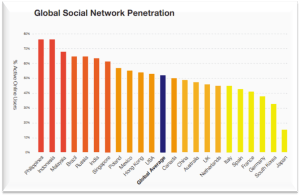
I use this in some of my training classes to demonstrate the opportunity social media presents for businesses here in the Philippines .

Some interesting bullet points about Social Media in the Philippines.

  • The Philippine is the leading country in the world that uses social media.
  • 95% of the Filipinos are using social media.
  • The average web user in the Philippines is just 23 years old, while almost 6 out of 10 social media users are below the age of 24.
  • Filipinos spent 21.5 hours per week.
  • 90% of them are using Facebook.

Source: http://www.techbullets.blogspot.com

Bloomberg chief says PH in an ‘enviable position’ = A strong tailwind for BPOs

http://business.inquirer.net/113137/bloomberg-chief-says-ph-in-an-enviable-position

There are a lot of factors behind the economic boom being enjoyed by the Philippines right now… and although controversial in some circles, I agree with Bloomberg that strong leadership is one of them. It would be pretty hard to have strong economic growth without political leadership’s influence.

As an interested  observer, I can say that love him or hate him, the President has done a great deal to change the global view of the Philippines. His leadership comes across very well in the media and plays well overseas.