Using Data Analytics to Assess Work Ethic

When you oversee the growth of a team from 6 to 100 employees in just over a year like I have, one of the biggest challenges you face is keeping up with recruitment requirements. When in rapid expansion mode, it is easy to lower standards and fall into a “just fill the seat” mentality. When this happens, high attrition generally follows.

One way to try and curb high attrition rates is to get better at measuring candidate work ethic. For most people assessing the work ethic of candidates is something that seems very subjective and not something that is east to apply metrics too. And in with that assumption, you are missing some very easy data points to capture and use in being more analytical in your recruitment process.  Let me highlight three data points to capture in the recruitment process that have a strong correlation to work ethic.

  • Timeliness
  • Resume Quality
  • Preparation for Interview

We all make note of these items during the process, and often include them in the overall evaluation of the candidate. But rarely is anyone capturing these items as data and using it to help measure work ethic and use it to predict work ethic once employed.

Timeliness is simple. Where they early, on-time, late, really late or a no show for any of the interviews in the process. If people are early or on-time it’s a positive and can show a general behavior once employed. On the other hand if a pattern of being late or not showing up is already evident before being hired, why would you expect that to change once they are part of your team?

IMG_6912

One thing that is common here in the Philippines is dramatic excuses for being late or missing interviews. If you are or ever have done recruiting here, I am sure you can rattle of a long list of excuses; family emergency, death of a loved one, getting sick, and stuck in traffic being the ones I hear the most. Its easy to dismiss the excuse as a valid reason to be late or not show, but time and time again when we hire people who started like this, they don’t stick around. Putting a weight behind timeliness is extremely important. Over time you can track the attendance patterns of people you hired with low timeliness scores and I guarantee you that you will see a strong correlation between the two.

Resume Quality is also something that generally has a direct reflection on the candidate’s level of professionalism. If you are expecting someone to treat your business with respect and hard work, yet their resume is out of date, incomplete and/or full of typos, once again you are fooling yourself. Im sure we all think at some point the resume is just a resume and bad candidates can have good resumes and vice versa. Well if you do think that, then don’t you owe it to yourself to start tracking data to validate that. When you find you are mistaken, and bad resumes general equal bad employees, you can thank me. Come up with simple scoring system. Like an English teacher would grade a paper. Grade the resume and add the data to both your decision-making and your data analysis.

One of the deal breakers for me when I interview is how prepared is the candidate. When I ask them how did the hear about the job, and they say a friend told me to apply I get concerned. My follow up being did you research the company before coming here. When they say I didn’t. Its pretty close to an automatic fail. If a friend told them about the job, but they didn’t do anything to learn about the company it’s a clear sign they are not taking this serious. So why would I expect them to take their job serious once they start. Again come up with a simple scoring system to indicate how did they hear about the job, what kind of research did they do about the company and how much knowledge do they come in with about the job they are applying for.

So there, you go. That’s how you can add some powerful analytics to your recruitment process. Come up with you own measurements for timeliness, resume quality and interview preparation. Use them along side the tests and assessments and interviews, to build a more complete candidate profile. All track these data points over time to compare to data once they are an employee like schedule adherence, productivity and quality of work. I promise you, you will see strong correlations between the pre hire and post hire data.

HR & Recruitment Analytics – The recruitment and retention of top talent is the biggest challenge facing just about every organization. DMAIPH is a leading expert in empowering HR & Recruitment teams with analytics techniques to optimize their talent acquisition and management processes. Contact DMAIPH now at analytics@dmaiph.com or connect with me directly to learn how to get more analytics in your HR & Recruitment process so you can rise to the top in the ever quickening demand for top talent.

 

Key Analytics Essentials For HR Success

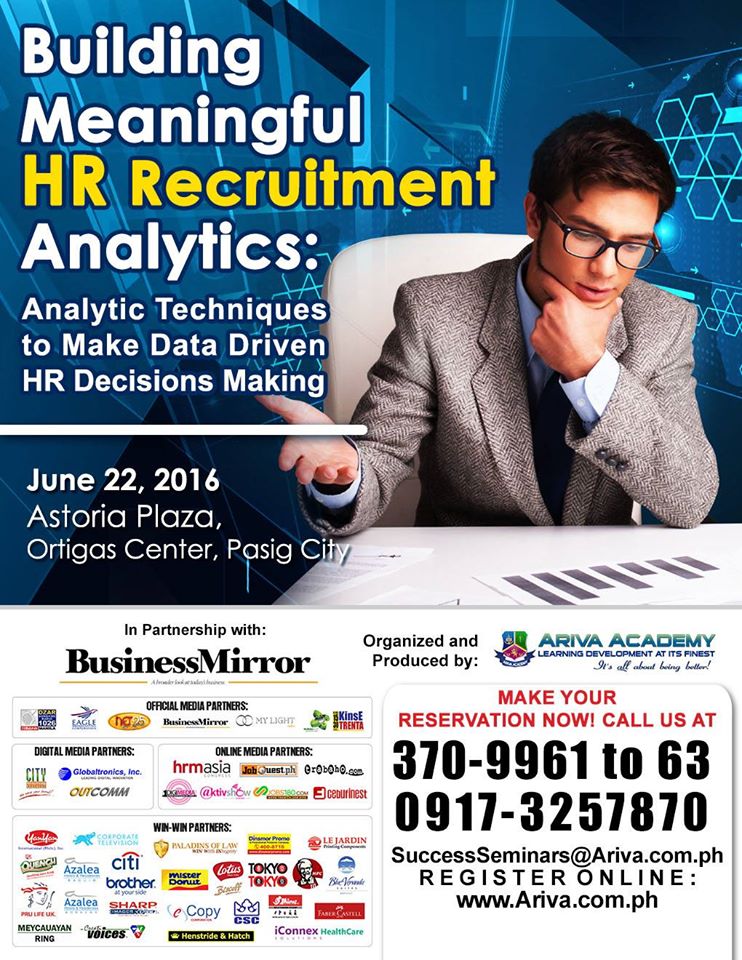
A few months back, I had the pleasure to be one of the resources speakers at the HR Congress. Put on my good friends at Ariva Events Management, the event was at the SMX Convention Center, Mall of Asia Complex, Pasay City, Philippines.

This HR Congress aimed to provide Industry Updates, Expert Insights, Good Practices and Experiences, and Practical Knowledge; generate thought-provoking and challenging discussions; and encourage professional networking and strategic partnership among stakeholders, if only to further the HR Agenda supportive of the organizational targets.

A primary goal was to cross-examine the major HR Trends quickly moving forward and impinging on the business in developing an effective ‘Employer of Choice’ branding. The Congress also shared how to develop employees to optimize their potentials; and build an emotionally-committed multi-generational team.

The Two-Day Event covered Six Essential Cores in People Management, each one with a tie into my favorite topic… analytics.

1. Strategic Human Resource Management (SHRM)
Overview of the business environment vis-à-vis the changing roles and functions of Human Resources in general. With so much data now available, its much easier for HR times to decide where to spend their time and focus. Without good HR analytics you might as well be fumbling around in the dark

2. Human Resources Information System (HRIS)
Overview of tools and appropriate support structures for administering HR-related information. This aims to impart knowledge and skills in managing information resources to support basic records management and people administration. A reality is that most of us are still using MS Excel to manage talent pipelines and HR data. So learning how to use more cutting edge technology is key to being successful in the Information Age.

3. Employee Selection
Methods of employee selection and concepts in forecasting and identifying competencies; an Interview Guide may be developed that will assist in spotting competencies to match people needs. There is so much competition out there right now. The supply is far outweighed when it comes to top talent. You need to turn lose your business data to help you attract, hire and retain while others deal with massive turnover and low employee engagement.

4. Performance and Rewards Management
Case studies and exercises, concepts in managing employee performance; pay and benefits Learners will be able to hone skills in performance planning, performance assessment, coaching and giving performance feedback. All this generates massive amounts of data that can be turned into valuable insights.

5. Employee Development
Skills in determining employee development needs; different training and development interventions; participants are expected to come up with an employee development plan. It is getting harder and harder to keep good people around. SO, you need to use your data and a good HR analytics solution to make sure you are giving your employees the exact opportunities they demand, before they jump ship.

6. Employee Relations and Well-Being
Equipping participants with the know-how in employee relations including basic labor laws and managing employee organizations. Employee well-being issues such as employee stress and burnout, smoking, and work-life balance will also be covered. This area is often very manual and rarely included in a good analytics solution. That doesn’t have to be the case.

SO, as you can see their in an analytics solution to just about any issue facing HR. In fact, the recruitment and retention of top talent is the biggest challenge facing just about every organization. DMAIPH is a leading expert in empowering HR & Recruitment teams with analytics techniques to optimize their talent acquisition and management processes. Contact DMAIPH now at analytics@dmaiph.com or connect with me directly to learn how to get more analytics in your HR & Recruitment process so you can rise to the top in the ever quickening demand for top talent.

You can also reach out to my key business partner, Ariva Events Management to request an in-house training featuring me as your resource speaker.

What ever you do, make sure you optimize your use of data and analytics in your HR decision-making processes. If you don’t your organization will face a much more challenging path then ones who do.


Let Your Data Tell You When It’s Time To Say Goodbye – Habitual Tardiness

Came across this blog post the other day and it inspired me to write about how use analytics to know when to let go of troublesome employees.

The first type I’ll blog about is ones who are habitually tardy.

“Handling employees who are constantly tardy for work is one of the difficulties of being a manager — no matter the industry. Simply firing them isn’t always the best policy when you consider the effort spent trying to hire their replacement. On the other hand, if your organization thrives on teamwork, having one team member not pulling their weight is bad for office morale.” Wise words form the blog I read.

The best way to deal with tardy employees is to look at the various data points that are generated by their behavior.  This allows you to be unbiased in your decision-making when it’s time to say goodbye. The 5 data points I suggest you focus on are:

  1. Total Down Time. What % of their shift did they miss plus what time it takes for them to get ready to work (logging in, opening systems, etc.) plus any time out of production you use to counsel them. Take this number and compare it to someone who comes in early, is ready to go when the clock starts and you never have to pull out of production to give warnings too. You will see a surprising difference of how much less time habitually late employees are contributing for the same pay
  2. Distance To Work. Look at how far they have to travel every day to get to the office. I am betting its further than most. There is generally a strong correlation between schedule adherence and distance to work. Not always, but a high % of the time.
  3. Difficulty of Commute. Look at the commute they have every day. How much time do they spend in traffic? Do they have to switch transportation modes? Is their route full of unpredictable impediments? It’s likely that challenges in their commute also have something to do with their consistent tardiness.
  4. Quality Scores. Again, as a general rule, employees who have trouble getting to work on time also have lower than average quality scores.
  5. Primary Production Metrics. Likewise, you generally see lower production metrics from employees who don’t start their shift ready to go.

“When simply walking by their desk to acknowledge a late arrival doesn’t stop the issue, it is probably time for a one-on-one meeting with a frank discussion.” Use this one-on-one time to review these metrics. Share with the employee some insights into why they might be late so often as well as how it effects the business.

It’s my experience that when you show them the data, it generally has a much more profound impact then just talking about things in a general sense. The power of your total down time is the highest on the team. You have the longest and most challenging commute. Your QA scores and production metrics are in the bottom 25% of the entire team. All of these can either be more motivating to the employee or they can provide a good reality check.

Time-to-say-goodbye-300x225

“Being proactive as a manager while showing you understand and even relate to their personal situation might enhance that employee’s performance over the long haul. It is vital you take the steps to get to the bottom of the issue before contemplating further discipline.” Using these data points in your verbal, written and final warnings add much more weight to your counseling. And when/if they finally hit the 3rd strike, you have a lot more data-based rationale behind your final decision. See the original article here:

How long until You Give Up on an Employee Who Keeps Showing Up Late?

If you need help in coming up with a way to build more analytics in your schedule adherence and discipline process, just let me know. I am happy to help.

HR & Recruitment Analytics – The recruitment and retention of top talent is the biggest challenge facing just about every organization. DMAIPH is a leading expert in empowering HR & Recruitment teams with analytics techniques to optimize their talent acquisition and management processes.  Contact DMAIPH now at analytics@dmaiph.com or connect with me directly to learn how to get more analytics in your HR & Recruitment process so you can rise to the top in the ever quickening demand for top talent.

Using Analytics To Validate A Candidates Primary Motivation For Work

I am often asked how to better use analytics in recruitment. Besides the fairly obvious ways like analyzing your pipeline for trends or looking at candidate demographics, I sometimes suggest coming up with a way to correlate candidate answers to items in their resume.

For example, what motivates the candidate to work. The question can be asked a number of ways. Here in the Philippines, it is pretty standard to ask a candidate why do they want to work. This is a different question then the more universal why did you apply for this job question.

The rationale for the question is generally to learn more about the candidate as it applies to commitment and work ethic. Common answers are I need to help meet my family’s financial needs, support my children, pay for a younger sibling’s education. The problem I with this question is that it set’s up a situation where the interviewer can feel sympathetic to the candidate.

As a counter to this, I train my team to look for a few queues in the resume to help validate the genuineness of the candidate’s answer. In short to do some analysis, and record some data for future analysis.

Most resumes here have a biodata section that includes things like parent’s occupation. This is a good place to probe more if the reply to the what is your primary motivation to work is family financial needs. You should also notate this and start compiling data on each candidate response that can then be used down the road in looking at their success as an employee if hired. You can also get a sense for what types of people are being attracted to apply for open jobs. Both can be very valuable insights when building some predictive analytics into candidate screening.

You can also look for employment gaps. If they are working to serve an overarching financial hardship, then there should not be significant gaps in their work experience and/or job hopping. This is a great insight into dependability and work ethic. Make sure to capture this data as well.

You can also ask them specifically how working will meet their primary motivation. Do they have specific costs and amounts at hand, or is the answer more general or even vague? Have they really thought through the cost versus their compensation? Probe to see if they have done analysis themselves on their own needs.

4.6

SO you get the idea, one simple questions with a short reply can actually lead you to much deeper analysis both during the interview and when looking at trending over time.

Ideally, every question you ask is something you can use to generate data. Every answer they give should be validated against the data in their application or resume. And here you create and capture more data.

In the end you will amass a wealth of information on candidates that you can analyze to look for patterns showing you who to hire and who not too. It can also help you determine that if you do hire them, what kind of employee will they become. Adding some simple analytics at the front end opens things up to a whole new level of data-driven decisions making in your talent acquisition process.

If you need a little help in adding or enhancing analytics in your recruitment process, let me know. Happy to help!

HR & Recruitment Analytics – The recruitment and retention of top talent is the biggest challenge facing just about every organization. DMAIPH is a leading expert in empowering HR & Recruitment teams with analytics techniques to optimize their talent acquisition and management processes.

Contact DMAIPH now at analytics@dmaiph.com or connect with me directly to learn how to get more analytics in your HR & Recruitment process so you can rise to the top in the ever quickening demand for top talent.

Looking for Unicorns – One Reason It Is So Hard To Find Good Analytics Talent

When I look at job requirements for analytics jobs I generally find myself thinking, is this person recruiting from the same talent pool the rest of us are? Or do they really believe that the narrowly focused and hyper specific skill set they are looking for don’t really exist.

Often I am asked by HR and Recruitment professionals here in the Philippines to help them figure out how to bring more analytics into their talent acquisition process. Before going to deep, I generally review job requirements to see how realistic the requirements are.

You would be surprised how often the people doing the hiring have no idea how hard it will be to find candidates, let alone if they even exist.

For example, a Data Analysts with an advanced degree in analytics, 5+ years related experience, with knowledge in a wide range of specific coding languages (SQL and R) and business intelligence applications (Tableau and IBM Cognos), and who also know how to perform advanced predictive modeling. And willing to work in an office (Eastwood in QC), that is hard to get to during commute hours for a total compensation package that is way below market rates (45,000 PHP).

That’s a real posting I just pulled off jobstreet.com

Good Luck with that.

05_a_q_winhoffer

Seriously, recruiters are often tasked to find analytics professionals that in reality are few and far between. There are no degree programs in analytics. You need to know what related course work will potentially make a good analyst like statistics or computer science. This broadens your talent pool when you know what schools have been producing graduates who have the foundation of analytics when they leave school.

Work experience is a tough one to gauge based on titles. I have seen far more “analysts” who are just doing basic reporting then I have true analysts with the ability to discover patterns in business data and turn them into actionable insights. You need to dig deeper to find out what data they were working with, what tools they used to analyze it and how they presented it to decision-makers.

Knowing certain coding languages is a plus, but given few businesses have the exact same data structures, it will take as much adaptability as experience to be successful in your job. Same with BI tools, just because you know how to refresh and share a business dashboard in Tableau doesn’t mean you know how to build a new one from scratch. Having experience is important as it lessens ramp up time. But don’t be fooled that it gaurantees success.

Analysts are in super high demand right now. Getting them to work like a traditional office worker lessens their ability to optimize your business. They need space to be curious, autonomy to discover and flexibility to put energy into projects that make a significant difference. 9 to 5 office hours, chained to a desk, following all the controls in place for a traditional office staff member is a waste of a beautiful mind.

And when it comes to pay. Six figures is not as farfetched as it might sound.  If you are able to do a real cost analysis of what the analyst will save the company and/or new revenue they can help generate, they really are priceless.

SO before posting that job requirement, do a little analytic yourself to make sure you are not hunting for a unicorn.

Let me know if you need helping recruiting analytics talent. I can help you attract their attention and assure they will be successful once you get them.

General Analytics – Analytics is the application of using data and analysis to discover patterns in data. DMAIPH specializes in empowering and enabling leaders, managers, professionals and students with a mastery of analytics fundamentals.

To this end we have parterned with Ariva Events Management/Ariva Academy to offer a wide range of analytics themed trainings across the Philippines. Our next learning event will be on March 31 in Ortigas. It is called Data-Driven Decision-Making for Owners, Managers and Leaders. Click here to find out more >>>

Contact DMAIPH now at analytics@dmaiph.com or connect with me directly to find out what we can do to help you acquire the analytics mastery you and your organization need to be successful in today’s data-driven global marketplace.


The Four Corners of Me – Provincial Edition

As I sit here looking out my window at the beautiful city Cagayaon de Oro, I am taking stock of what it means to be me.

CDO

It not even a beautiful picture as much as it is the fact that its not full of stuff.

When I am in Manila I try and balance what I call the Four Corners of Me, which are looking for new business opportunities, leading my current business ventures, creating analytics content and sharing my analytics expertise. At times it can be a lot to balance with the challenges that come with doing business in one of the most chaotic megalopolises on the planet.

At the intersection of the four corners are my mind, body, health and spirit. When those 4 corners effortlessly intersect, then then I can manage the four corners of my professional life. Given how the negative forces of Metro Manila like poverty, pollution, congestion, and corruption can sometimes sap my 4 inner corners, it can end up leaving my four outer corners out of whack.

Which makes this trip to CDO so well timed.

The conventional wisdom is that to set up a successful business in the Philippines you need to be in Manila. That’s where most of the players are, where the government is centralized and where most of the perceived best things are located. However, when you get out to the provinces, pretty much anywhere you will find expats who have bucked that trend and set up their own little business empires far away from the capital.

I have long thought I’d much more likely enjoy life if most of my time was spent in a provincial city close to the beach. I thought that in Iloilo, and in Bacolod. Now I can add CDO to that list of places I see myself in for a big part of the rest of my life. Business development can be done anywhere if you have your inner four corners lined up.

Managing my current businesses sure seems easier when my condo is two blocks from my office. But given I spent so much of my time outside Ortigas, and since I have a good management team in place, running things from the Visayans or Mindanao is not as farfetched as it used to be. We dabbled with having a team in Cebu and it worked well. So this is any easy one.

One of the beauties to what I do with most of my time, writing and blogging about analytics can be done from anywhere. Access to virtual resources and discussions about analytics in limitless. When I first set up shop in the Philippines in 2012, access to in person conversations about analytics pretty much required being in Manila. But not so much anymore. Having worked with schools in several provinces, the demand for good analytics contact is driving people to be much more open minded to where they find their solutions.

And finally, the training aspect. In many ways, the schools and businesses outside Metro Manila are more hungry for subject matter experts. The pressure to not only keep up, but show up things in the capital is quickening.

So, the dream of where the four corners of me is based in a province and not Manila is once again at the forefront. Thanks to the view outside my window for the inspiration to bring the dream back.

Flying at 30,000 Feet

I have spent a fair amount of time over the past 5 years travelling at 30,000 feet. The best part about my travels is the opportunity to experience cool things.

Since I first started laying the foundation for setting up a business in the Philippines, I have flown from San Francisco to Manila and back about 30 times. I am closing in on half a million miles with Philippine Airlines and have become quite comfortable taking the 11 to 13 hour flight. Flying never gets old for me. The excitement of takeoff and landing takes my back to my childhood every time. Flying a lot is cool.

With the explosive growth in Business Process Outsourcing industry over the past decade, I imagine there are quite a few businesspeople who have flown more often than me. Occasionally I bump into another call center owner or outsourcing professional and have had some memorable conversations about the state of the industry. Make me think I need to do more networking to meet more cool people.

45.png

I also use my travel time to read and write a lot. I make a point of every eastbound flight to pick up a business book, read it and then use my findings in future blogs or training presentations.  Of all the things I do, standing in front of a room of people to talk about analytics is my favorite. I meet a lot of people who are looking for help into how to get more analytics in their business. It is way cool to be able to turn them on to a new idea or approach to achieve that.

On pretty much every westbound flight I write a blog post while at the airport waiting for my flight. I like to reflect on my most recent time spent and share something that seemed inspirational at the time.

Flying to the Philippines always fills with me with anticipation of new adventures and as of now unseen opportunities ahead. My adopted home is such an amazing country, with off the charts promise as history propels the county forward.

Flying back to the U.S. always fills me with pride as I look forward to being back in the land of the free and the home of the brave.

When I fly at 30,000 feet across the Pacific I take the time to reflect on just who I am and why I have such a blessed life. I look forward to the next 30 trips with as much excitement as I did my first trip.

This just never gets old.

And that is super cool.

Why Analytics Projects Fail – #13: Over Reliance on External Help

The final reason I will articulate in this series of why analytics projects fail is an over reliance on external help. Historically the over reliance would happen when a team is “too busy” to learn the ins and outs of the analytics software they using.

An example would no one internally has the training to maintain or update the software themselves. Any fixes, patches or enhancements have to be done with the help of someone not on the company payroll. This has obvious limitations like not being top priority or made to wait longer the necessary, as well the potential slowdown caused be internal review and QA processes. Not having someone on the insides trained to handle external products is a major risk to an analytics project.

Another examples is when internal analyst don’t have the initiative to own the software. Meaning they just do the minimums, never really learn all the things the software can do and do not offer any new idea of solutions. Being totally dependent on a vendor to keep you up to date on all the new possibilities for use of the software is extremely short sighted. This often causes going the long way on a project instead of knowing about short cuts.

20141203193138-5-tech-tool-help-compete-with-big-guys

A third example is that your team is not empowered to work independently and their schedule is dictated by the availability of the vendor. Important deadlines might be missed or extended because the vendor resource is not available when you need them.

Regardless of the impact, relying too heavily on your analytics software vendor leaves open the risk of what if the external expert leaves. I have seen this happen a number of times, where analytics projects were halted or even cancelled because the expert was outside the company and left the project. The most common outcome of losing your expert is that things stop working and you have to either use workarounds or start over.

The key lesson here, if you are an analyst working with externally supported software, it behooves you to become the expert on it. This will mitigate any the risk of being over reliant on the vendor. It will also assure you of having more control of maintaining, fixing and upgrading your own analytics process yourself, which makes you more valuable to the organization you work for.

Analysts who know why things fail, are proactive, find solutions and become analytics champions are the ones you want to measured by. In the end, the best way to make sure your analytics projects don’t fail is to be awesome at what you do.

Analytics Culture – The key to using analytics in a business is like a secret sauce. It is a unique combination of analytics talent, technology and technique that are brought together to enrich and empower an organization. A successful analytics culture is not easy to create, but DMAIPH can show you how. Contact DMAIPH now at analytics@dmaiph.com or connect with me directly so we can build a strategic plan to turn your company into analytics driven success story.

Results Of My Quick Analytics Survey

As you may know, I have been working on a book about analytics and the data-driven cultures of companies who successfully use analytics. So, to help me in my research, I sent our a short survey to all 10,000 of my LinkedIn connections.

I asked just one question. “If the following business lines, which one is the business line in your organization that in your opinion best uses analytics when making key business decisions?”

  1. Sales & Business Development
  2. Marketing
  3. Operations
  4. Supply Chain/Inventory
  5. Legal, Risk & Compliance
  6. Customer Service
  7. Human Resources/Recruitment
  8. Strategic Planning
  9. No one really uses analytics in decision-making effectively.

Thanks to all of you who replied.

Now, I’ll share my results.

7% of my 10,000 Connections
Sales & Business Development – 20%
Marketing  – 17%
Operations  – 15%
Strategic Planning  – 14%
No One Uses Analytics Well  – 10%
Customer Service  – 9%
Human Resources/Recruitment – 7%
Supply Chain/Inventory – 4%
Legal, Risk & Compliance – 3%

To no surprise about a third of my connections indicated that Sales, Business Development and Marketing where the top users of analytics in their business. Using analytics to help track success in growing the business and making a profit is nothing new.

As expected, HR/Recruitment was not well represented. Given I will be conducting a training on Analytics Techniques for HR & Recruitment in a few weeks, this shows I’m spot on about the biggest need right now.

My U.S. Based LinkedIn Connections
Sales & Business Development – 18%
Marketing – 18%
Operations – 14%
No One Uses Analytics Well-  14%
Strategic Planning – 13%
Human Resources/Recruitment – 7%
Supply Chain/Inventory – 5%
Legal, Risk & Compliance – 5%
Customer Service – 5%

The most significant difference I saw when breaking our just U.S. based connections was that Customer Service was so low. Given how metrics rich most customer service environments are,  I suspect the low ranking was mainly due to the fact that nothing cutting edge or amazing is going on in this area for the most part.

I was also surprised to see that 14% of American respondents listed No One Uses Analytics well as the top answer. Still a lot of opportunity here in the U.S. for analytics coaching and training.

My Philippines Based LinkedIn Connections
Strategic Planning – 22%
Sales & Business Development – 19%
Marketing – 14%
Operations – 14%
Customer Service – 11%
No One Uses Analytics Well – 11%
Supply Chain/Inventory – 3%
Legal, Risk & Compliance – 3%
Human Resources/Recruitment – 3%

Given that a significant percentage of my LinkedIn connections work in HR and/or Recruitment in the Philippines, I was both surprised and intrigued by the fact that it scored lowest on the analytics survey.

So if you just happen to be in that 97%, then I have a great opportunity for you. I will be doing training in two weeks on this very topic

13350236_1069524879763933_7282179244107132925_o.jpg

Let me throw out a little disclaimer, this survey is really just for directional purposed and is far from the scientifically sound type of survey I would recommend in most situations. But my goal was to validate my  recent observation, that we still have  a long way to go before analytics has taken deep roots in HR and Recruitment in the Philippines.

Why Analytics Projects Fail – #12: New Technology

Occasionally one of the problems that can doom an analytics project is a new technology that emerges and makes the project obsolete before it is even implemented. This happened to me once when we were using an older and heavily modified version of Business Objects and then we got access to Tableau.

At the time, the flexibility of Tableau made our Business Objects business dashboard obsolete before we even completed the design phase of the project. The data visualization and the ease of use of Tableau Desktop at that time was miles ahead of anything our IT team could build around Business Objects. As a result, countless hours and dollars were lost, but in the end at least the business requirements we had established could be done by end users in Tableau.

Another example of how a new technology might impact your project is when a new version of the database you are using comes out. One that requires some much QA and/or testing to meet internal guidelines, that when it is finally approved it is hardly useful any more.  This can often be the case with big companies that have long vetting processes to use new version of software. You’d be surprised how many Fortune 500 companies are still running internal version of Windows XP because using 8 or 10 has not been approved yet.

Modifications done in house to off the shelf solutions can also make new versions incompatible. I have seen this happen with both Cisco and Teradata databases, where internal development of data flows and data structures to be so rigid, it was impossible to use updated versions of the same databases.

You can also come across situations where developers and IT teams are ordered to use something else because changes in a vendor relationships or a new strategy from the CTO.  In the end you have to adapt and either sacrifice, lose, or give up on what you have put into the project so far.

540

As the number of data collection and storage options grow, the complexity of data models surge and the types of business intelligence solutions increase, the likelihood of a big analytics projects being impacted by new technology. A good analyst has to stay up to date on what’s hot and new, in order to not advocate the use of something that is on its way to being a dinosaur.

To help me stay current, I follow several blogs and belong to a dozen analytics themed LinkedIn groups. I also try and attend at least one big industry conference a year as an attendee as well.  And finally I read a lot. I end up going through 3-4 analytics themed books a month. If you are facing a situation where you are worried your project might fall victim to a new technology, let’s talk about it. I can help you figure out a solution to keep you and your project on the cutting edge.

The key to using analytics in a business is like a secret sauce. It is a unique combination of analytics talent, technology and technique that are brought together to enrich and empower an organization. A successful analytics culture is not easy to create, but DMAIPH can show you how. Contact DMAIPH now at analytics@dmaiph.com or connect with me directly so we can build a strategic plan to turn your company into analytics driven success story.

Analytics Culture – The key to using analytics in a business is like a secret sauce. It is a unique combination of analytics talent, technology and technique that are brought together to enrich and empower an organization. A successful analytics culture is not easy to create, but DMAIPH can show you how. Contact DMAIPH now at analytics@dmaiph.com or connect with me directly so we can build a strategic plan to turn your company into analytics driven success story.