The Four P’s (Principles) of Marketing

I was recently asked how I apply the Four Principles of Marketing to my business.

The 4 P’s being Product, Place, Price and Promotion.

When I was with Wells Fargo, I spent a significant portion of my time working with marketing teams to help analyze market opportunity, assess market penetration, and to measure marketing campaign success.

I learned quite a bit about how to attach metrics to each of the 4 P’s to determine our strategy.

When it comes to product, the most common metric is sales. How many products have been sold and how much revenue that translate too is a cornerstone of any business plan.

It can be just important though to blend in analysis that is not reflected by internal data alone. Knowing how your product stacks up to the competition and what your customers are saying about your product are much more challenging data points to capture.

As for place, the general data point most business decision-makers start with is how much sales activity comes out of a location or geographic area.

IMG_6912

Place can also be reflected in marketing channel; in-store, direct, online, etc. Decision-makers tie this concept to market place and always look within that place to determine marketing plans.

I also like to add demographic data to place to help understand overall opportunity and trends in how the market place is evolving.

Price is much more than just what it costs to produce and sell a product. Marketing expense must also be counted in the amount ultimately charged for a product. Price usually contain several components that can be analyzed to make sure price covers expense and allows for profit.

Again, I look to competitor data to help assess if the price we are charging is optimal. As a rule, you don’t want to be too expensive or too cheap when your customers have a choice.

Finally, when looking at promotion, its more than just where you sell your product and what marketing materials your use. Using the right delivery channel and leveraging your company brand also factor into the equation and should have metrics attached to them.

So, as you can see, marketing is more than just counting products sold, finding a place to sell the product, setting a price and beginning a promotion. For a good marketing analytics strategy, that is just the beginning.

An effective marketing analytics approach should have at least 10-20 data points to more accurately capture the things you need to know like how big is your market, how competitive is your product, how deeply have you penetrated your market, and what delivery options are the most effective ways to promote your product.

The 4 P’s of Marketing can easily be built into a marketing analytics dashboard where you see your key performance indicators and make swift, decisive business decisions.

Since setting up my business about 5 years ago, I have helped dozens of businesses get a better handle on their 4 P’s using marketing analytics.

Let me show you how we can do the same for your business.

Business Strategy with Analytics – Aligning a business strategy to drive an organization forward requires a robust analytics solution. Businesses who have good analytics tend to be much more profitable and efficient then ones that do not. DMAIPH has helped dozens of companies in both the U.S. and the Philippines with adding more data analysis in their business strategy. Contact DMAIPH now at analytics@dmaiph.com or connect with me directly to find out what we can do to help you align your business strategy with analytics.

What % of Companies Can Both Afford Data Science Teams and Understand How to Use them?

Woke up this morning thinking about the future of analytics and data science in the Philippines.

I created this image to help visualize one of the biggest challenges. From my perspective the majority of companies out there don’t really understand data science and probably cant afford a traditional data science team.

who-can-afford-it

Best guess is ever 50% of companies operating in the Philippines aren’t yet at a place where data science is practical.

The smallest group are ones who both understand data science and know how to use it. These are the ones who are players in the data science consulting, training and outsourcing business.

Best guess its about 10% of the companies operating here and just about all of them are big corporations with lots of resources.

The next segment is the ones who do understand the value of data science, but don’t have the resources to compete for a the talent it takes to build a top data science team.

I’ll peg this at about 15%. But its  growing quickly. Awareness and adoption are actually ahead of the talent, as you see so many “data scientists” in name only out there filling open jobs right now.

That leaves the 25% of companies operating in the Philippines who have money and resources but just don’t know how to get started using data science and building a team. This is the target market of companies like mine.

DMAIPH has the capability to educate your managers and decision-makers on how to use data science to add value to the business. We can also train your team in the basics of data science to allow you to cultivate a data driven culture and promote from within to build a data science team. And we can also take some of the load off your shoulders in the terms doing some of the data science for you.

Analytics Consulting – DMAIPH specializes in a variety of analytics consulting solutions designed to empower analysts, managers and leaders with the tools needed for more data-driven decision-making. We have helped dozens of companies get more analytics in their business. Contact DMAIPH now at analytics@dmaiph.com or connect with me directly so we can tailor an analytics solution made just for your unique requirements.

Where’s the Analytics? The Analytics Challenges of Malls in Metro Manila

I spend a lot of time in malls when I’m in Metro Manila.

Business meetings at coffee shops.

Staff meetings at restaurants.

Getting exercise why walking to hit my FitBit goal.

I see a lot of movies.

And I am not alone.

Malls are where everyone goes. To beat the heat, to meet up with friends, to conduct business, and of course to shop and eat.

Given that I spend so much time in malls, I think a lot about the analytics that can take place behind the scenes.

Or in many cases, the apparent lack of analytics.

Now don’t get me wrong. I love the Philippines.

The heart and spirit of the Filipino people is the primary reason I set up a business here.

But I do sometimes wonder, how much better things could be in my adopted home if there was more widespread use of analytics in decision-making.

The malls are full of great examples of decisions that are pretty much done without much data analysis.

At least that is how it appears to me.

So in this series of blog posts I will discuss several topics that come to my mind when being in a mall in Metro Manila and how I would go about using analytics to investigate my observations.

Analytics in the Philippines – The Philippines is at the center of the action when it comes to solutions to the global need for analytics. Blessed with a solid foundation of young, educated and English speaking workforce, companies around the world are look for Filipino analytics talent to fill analytics positions. DMAIPH was set up to facilitate these solutions and bring the talent and the business together. Contact DMAIPH now at analytics@dmaiph.com or connect with me directly so we can help you take advantage of this unique global opportunity.

Big Data Analytics > The Art of Presenting Big Data


It has been my experience that presenting Big Data requires quite a bit of artistic ability.

I will be talk about the Art of Presenting Big Data among other topics at an event this coming February 21 in Ortigas.

For me there is a clear need to Apply a Process to Present Big Data Clearly
. This process has 3 parts.

  1. Selecting the Appropriate Presentation Format to Communicate Your Findings Effectively to Your Audience
  2. Mastering the Power of Enchantment
  3. Sharing Findings from Big Data to Drive Decisions Within Your Organization

Knowing How to Select the Appropriate Presentation Format to Communicate Your Findings Effectively to Your Audience is where we will stat.

To that end I have a checklist I use before every presentation I share involving Big Data:

  • Know Your Audience
  • Consider Time Constraints
  • How Will The Data Be Consumed?
  • Can The Data and Analysis Be Accessed?
  • Make it Interactive

DMAIPH offers a wide range of analytics centric training solutions for professionals and students via public, in-house, on-site, and academic settings. We tailor each training event to meet the unique needs of the audience. If you need empowerment and skills enhancement to optimize the use of analytics in your organization, we are here to help. Contact DMAIPH now at analytics@dmaiph.com or connect with me directly to set up a free consultation on which of our DMAIPH analytics training solutions is best for you.


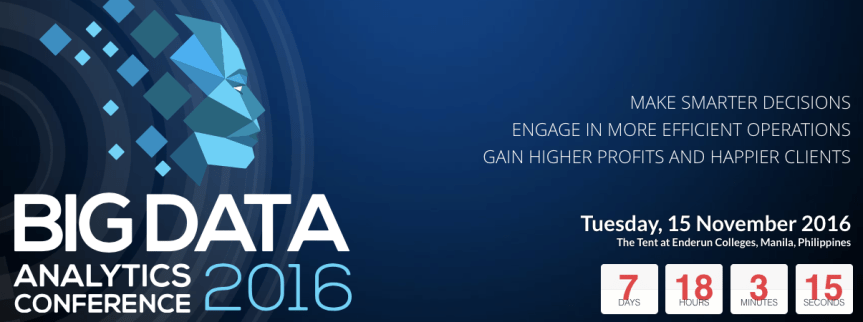
My Take Aways for the Big Data Conference 2016

Had a blast at the Big Data Conference at Enderun College yesterday. Lots of things to discuss in upcoming blogs, but here are a few takeaways that I notated.

There is a strong hunger for a national umbrella organization for analytics, big data and data science.

Engagement at the C-Level of Filipino companies outside the IT-BPO sector to eliminate the biggest adoption roadblock.

Restart of the Government, Industry and Academia collaboration on analytics needs to happen.

More hands on experiential learning for both students and faculty involving the industry.

Both traditional training and certification models as well as mentoring and self-guided training opportunities.

The speed and consistency of the internet is a huge threat.

img_0121

Advocacy for fixing culture before spending on costly technology and high priced talent.

Conversion of up to 70% of Customer Facing BPO Workers to doing analytics and data science as a hedge against automation and political decisions.

Im convinced that a lot of good can come out of the conference as the analytics and data  science industry is at about the same point the call center industry was 10 years ago.

However, given the global demand for data savvy talent and the exponential proliferation  of data, we need todo in 3-5 years what the BPO industry did in 10.

More to come!

News & Events- DMAIPH is a highly engaged leader, sponsor and participant in analytics events across the U.S. and the Philippines. As an Analytics Champion I write, blog, speak and lecture about analytics in a wide variety of forums. I authored several publications on analytics including my latest book, Putting Your Data to Work. Contact DMAIPH now at analytics@dmaiph.com or connect with me directly to learn more about where I will be talking about analytics next.

Philippines Analytics Review – 2016

There is no doubt that analytics is now a big deal in the Philippines.

Now that 2016 is in the books, I can proudly say I spent the better part of the past year helping Filipino get more analytics in their businesses.

My primary goal for the year has been meet, so let’s recap how that happened…

My involvement in empower Filipino companies, students and professionals to make data-driven decisions has renewed my passion for being a top name brand for analytics in the Philippines.

As I think back the Recruitment Analytics training that DMAIPH and Sonic Analytics put on early in the year, I think about how HR professionals are now actively looking to get more analytics in their business.

The simple fact is there are more white collar, professional staff jobs out there then there are qualified candidates. And its only getting worse. Recruitment Analytics is the only way to stay on the cutting edge.

This was even more evident when I spoke in front of close to 100 HR professionals at a workshop called HR & Recruitment Analytics Techniques put on by my good friends at Ariva Events Management.

We spent the day talking about how get IT when it comes to recruitment. The 3 I’s of analytics; identify, inventory and integrate data as well as the 3 T’s; talent, technology and technique needed to make sense to the data.

I once again joined Ariva for their annual Philippines HR Congress. One of the central themes of the conference attended by over 1000 HR professionals was Aligning HR Strategy with Analytics.

HR teams are sitting on a gold mine of insightful data, but in most cases have not been able to take advantage of it.

Big Data Analytics has come so fast and furious, that it takes a lot of effort to become analytics champions and try and move a company culture towards more data-driven decision-making. This was top of mind for all the attendees.

At the same time I have been doing speaking and public training, CHED has been training teachers on how to teach business analytics. Their efforts to explain the Fundamentals of Business Analytics to faculty and students will go a long way in making the Philippines a significant analytics hub.

I have been honored to have helped several schools in adding my two centavos to the discussion about analytics careers for fresh grads.

Another moment of great personal pride came when I published my newest book, Putting Your Data to Work. This guidebook is designed to help Filipino professionals who aren’t too familiar with analytics, get started.

In early November, I was part of a panel discussion at the Big Data Conference at Enduran college. I was and still am super excited about the topic, The Future of Big Data Analytics in the Philippines. This is my passion, turning students and young professionals interested in analytics on to the huge opportunity they have in front of them.

A week later I conducted a Data Analytics seminar with DMAIPH and Sonic Analytics. The primary goal here was to demonstrate how having a thorough understanding of the data environment in a business can lead to huge successes.

Next up was a job fair at Trinoma mall put on by Job Quest PH. My goal here was to recruiting a few young professionals looking to get started in analytics as DMAIPH is looking for some marketing analysts.

A few days later I attended a Data Science event being set up by my good friends at Talas. This free event saw a meeting of the minds of a lot of thought leaders in data science as well as industry leaders in employing analysts and data science. Pretty exciting stuff.

The final 2016 event on my schedule was another full day training organized by my key business partner Ariva. The topic, Big Data and Business Intelligence, which proved to be a great opportunity to help people gain a stronger handle on analytics and how they can be an analytics champion in their business.

IMG_6912

2016 turned out to be my most successful year yet. Analytics in now mainstream and I love it.

Analytics in the Philippines – The Philippines is at the center of the action when it comes to solutions to the global need for analytics. Blessed with a solid foundation of young, educated and English speaking workforce, companies around the world are look for Filipino analytics talent to fill analytics positions. DMAIPH was set up to facilitate these solutions and bring the talent and the business together. Contact DMAIPH now at analytics@dmaiph.com or connect with me directly so we can help you take advantage of this unique global opportunity.


It’s No Longer Just Enough To Know

In a recent conversation about using more analytics in the measurement and evaluation of public policies and programs, one of my colleagues said that in today’s world, “It’s no longer just enough to know.”

The point being if you aren’t using data and analysis to enhance your efforts and empower decision-makers with actionable insights, then you are not serving the public to the best of your ability.

A lot of government programs, non-profits and philanthropic organizations are what he called, “Information Rich, but Data Poor.”

Check out my upcoming webinar on Feb 15, 2017! https://dmaiph.com/2017/01/14/analytics-and-data-driven-decision-making-webinar-on-feb-15/

Just because you gather massive amounts of information in the form of data points, does not mean the data is adding value. In fact one of the biggest challenges the corporate world has been dealing with the past few years is how to optimize Big Data.

We live in a world where so much data is produced and captured, then analyzed and published in reports and article, yet the data and analysis alone is often not having the impact our policies and projects were intended to have.

In effect, we might know things, but we aren’t able to influence decisions because our data is not compelling enough.

To this end, I have advocated importing some analytics themed best practices from the corporate world to educate more on what to do with the data and how to put the data to use. To in short, be Information Rich, Data Rich to move towards more Data-Driven Decision-Making.

Starting backwards, I will first focus my training on the How. How do we make more data-driven decisions?

The I will focus on the Why. Why do we need to make more data-driven decisions?

From there we will go into several business analytics concepts like Data Visualizations, Public Data Mining, Data Lakes, Demographic Profiling using Big Data, and Data Blending.

amupicture1

A final topic of interest that I will bring to the discussion is the Plus Minus Implications for Unstructured and Qualitative Data. Things that at first can be hard to assign a number too, but are just important as any piece of traditional data used in decision-making.

At the conclusion of my work, public policy and project reporting will be much more data rich, influence will improve and decision-making enhanced.

Now we won’t just know, we will be able to champion what we know in ways that will make a difference.

Analytics Education – Facilitating a mastery of the fundamentals of analytics is what DMAIPH does best. All across the world, companies are scrambling to hire analytics talent to optimize the big data they have in their businesses. We can empower students and their instructors with the knowledge they need to prepare for careers in analytics. Contact DMAIPH now at analytics@dmaiph.com or connect with me directly so we can set a guest lecturer date, On-the-Job Training experience or other analytics education solution specifically tailored to your needs.

Can Analytics Help a Sari Sari Store?

I had this interesting conversation earlier about analytics.

I started explaining to the person I was sitting next to what I do and he asked can analytics really help any business?

Of course I said yes.

He asked even a Sari Sari store?

For those of you who don’t know much about Sari Sari stores, let me tell you a bit about them.

By far the most common form of self-employment in the Philippines are small, family operated convenience stores. Called Sari-Sari stores, there are an estimated 1 million Sari Sari stores across the Philippines. Per wikipedia, this counts for an estimated 30% of all retail sales in the Philippines.

Sari-Sari, which is Tagalog for variety, are an important economic and social pieces of just about every Filipino community. Most are privately run, family owned and are operated from the front of the owners house.

Commodities are displayed behind a large mesh screen to both allow customers to see what is available and to prevent shoplifting. The most common goods sold are candy, snacks and other non-perishable food items. Cigarettes and mobile phone cards are also popular items for sale. Household needs like soap, detergent and cleaning supplies are also common. Some stores have small refrigerators to offer cold drinks like soda and beer.

Sari-sari stores generally have higher prices when compared to supermarkets which is a tradeoff for proximity to their customers. It is also common to buy single units of a product versus an entire package as paying more to meet a quick need is valued over planning and budgeting bulk purchase over the long term.

Some Sari Sari stores also offer credit to neighbors. Micro lending of this scale is wide spread and generally done under the rule that if the credit is not repaid, the store owner will report this to the local government officials.

Some Sari Sari stores barter goods and services with farmer, fishermen and other businesses.

Most Sari Sari store proprietors buy their goods at supermarkets then mark up the prices for resale (on the average 20%). In some areas, businessmen make act a middle man offering bulk products to the Sari Sari store.

It is my belief that most Sari Sari stores can benefit from a simple strategic business plan and some very basic analytics.

My understanding is that Sari Sari stores operate on a very tactical level with little long term planning and operate with little market awareness.

If I ever to consult with the owner of a Sari Sari store, my initial approach would be to develop a business strategy plan and build a basic analytics process to gather data and provide a proof of concept.

This approach would be broken into the following steps:

  1. Business Strategy Assessment – How do they conduct business?
  2. Competitive Landscape – Who do they compete with?
  3. Demographic Profile – Who are their customers?
  4. Market Assessment – How much upside is in their market?
  5. Inventory Analysis – How to they optimize inventory?
  6. Facilities Assessment – Are they getting the most of their location?
  7. Risk & Security Assessment – What risks do they face?

I will flesh out each of these steps in upcoming blog posts.

Once I have complied data from these 7 steps, I can develop a business strategy plan unique to the individual Sari Sari store.

After my presentation of the business plan, I can make a determination if they Sari Sari store will enter Phase Two of the plan.

I would work with the proprietor store for a set period of time in a consulting role to determine viability of operations and if they meet our program standards (detailed later in this document).

In addition to offering a consulting solution, through my company, I can also offer additional services including cash management, accounting, marketing, inventory and fulfillment assistance, and other solutions as they arise.

Its my experience that the busiest Sari Sari stores offer something unique. Some might have an ice cream maker, or a special dish they prepare, or some have home baked goods. Regardless, they generally have something that sets them apart from a store that just offers traditional goods.

So, the final piece of my involvement would be cross selling our unique products to Sari Sari stores in need of a unique product to build their business around.

After that consultation, I would expect that three things would happen:

  1. the Sari Sari store proprietor would have a better grasp of a strategic business strategy.
  2. the Sari Sari store would increase profits and
  3. the Sari Sari store would expand its customer base and build up loyalty with existing customers.

So, to get back to the question… how can analytics help a Sari Sari store?

By applying some lessons from the corporate world.

Dr. Data_Analytics in the Philippines

Analytics in the Philippines – The Philippines is at the center of the action when it comes to solutions to the global need for analytics. Blessed with a solid foundation of young, educated and English speaking workforce, companies around the world are look for Filipino analytics talent to fill analytics positions. DMAIPH was set up to facilitate these solutions and bring the talent and the business together. Contact DMAIPH now at analytics@dmaiph.com or connect with me directly so we can help you take advantage of this unique global opportunity.


Big Data Analytics: Interpretation and Assessing Results > 2/21/17

I will be speaking on  February 21, 2017 at Discovery Suites, Ortigas Center, Pasig City on Data Analytics.

With that in mind, I wanted to share a little more detail about each section, next up…

Enabling Your Business to Make Smarter Decisions Section 3:  Interpretation—Assessing Results

Participants will be able to Articulate the Importance of Accurately Interpreting Data. Having the right data at your fingertips is essential to being successful with analytics.

We will also be able to Determine and Analyze Risk, Uncertainty, and Probability. With so much data, you need to know what data to analyze when to stay ahead of the game.

I will also talk about how to Spot Patterns, Trends, and Fluctuations Through Correlation, Regression, and Descriptive Statistics. Analytics techniques like these will keep you on the cutting edge.

Attendees will be able to Understand when to employ Descriptive, Predictive or Prescriptive Analytics. Each type has a specific use, make sure you know when to use each one.

And finally we will discuss how to Build Data Models. You don’t need to have high priced, complicated software to do some basic data modeling. I’ll show you some examples.

That’s section three… I’ll go over the last section in the next few days.

DMAIPH offers a wide range of analytics centric training solutions for professionals and students via public, in-house, on-site, and academic settings.

We tailor each training event to meet the unique needs of the audience.

If you need empowerment and skills enhancement to optimize the use of analytics in your organization, we are here to help.

Contact DMAIPH now at analytics@dmaiph.com or connect with me directly to set up a free consultation on which of our DMAIPH analytics training solutions is best for you.

jobspicture2


My Blog Post on the Analytics of Measurement and Evaluation

I recently had the honor of writing a blog post for American University’s Measurement & Evaluation program.

The post is about using a business analytics approach to “effectively evaluate projects, programs and processes.” This is in a response to the fact that it is becoming increasingly essential to use big data and analytics to ensure organizational success.

Here is the link: http://programs.online.american.edu/msme/resource/measurement-and-evaluation-analytics

It is my hope that I can inspire readers to look for ways to bring new data into their projects, programs and processes, blend it with current data, provide more dynamic analysis and share more impactful results.

I will also be doing a webinar early next year entitled Its Not Longer Just Enough To Know. Where I will highlight some techniques and technologies that I use to empower more data-driven decision-making.

Facilitating a mastery of the fundamentals of analytics is what I do best.

All across the world, companies are scrambling to hire analytics talent to optimize the big data they have in their businesses. Though my company DMAIPH, I can equip students and their instructors with the knowledge they need to prepare for careers in analytics. Contact DMAIPH now at analytics@dmaiph.com or connect with me directly so we can set a guest lecturer date, internship, on-the-job training experience or other analytics education solution specifically tailored to your needs.

14045878_10154480087262425_4779154686875783746_n