DMAIPH Helps Companies Revitalize Their Business (2 of 3)

The second type of company we have helped successfully is  one looking to revitalize. Profits are down, customer flow has shrunk, product and services aren’t selling like they used too. We can offer our business intelligence package of customer insights, demographic profiling, competitive landscaping and market assessment. We can also offer virtual staffing support to assist with marketing, scheduling and follow-up.

I’d like to share a story about one of our clients who came to us at a crossroads with his business. This client is a chiropractor who was trying to figure out what to do with his business. Having lost 40% of his patient base and seen his revenue drop by 60%. He was at a cross road. He had tried a couple of consultants, spent lots of money and was still heading the wrong direction.

In talking with him, it was clear he had lost touch with his market and was not able to offer a very compelling solution to bring new clients in. We suggested we do a series of business intelligence exercises to help understand more about his business, the opportunity around him and come up with some potential solutions.
3.6.1

Because he didn’t have a lot of money to waste, we suggested using a team of interns to help keep costs down. It would be a great analytics exercise for the doctor’s practice and for the eager young minds we had been working with.

We dove into the project and came up with the following resources; we built a competitive landscape, constructed a demographic profile and put together a customer insights report. Each one using public data, analysis done by the interns with my guidance and direction, and used Tableau to roll all the data and findings into a dashboard to show the doctor how he’d gotten to the point he was currently at.

After identifying some action items based on our assessment, we then helped the doctor but some into practice and helped him turn his business around successfully.

By employing very curious minds, giving them direction on where to find data and how to analyze it and sharing the data with an open-minded end user, we successfully validated my approach to using analytics to help a small business.  We have done the same for a half dozen other small businesses and can do the same for yours.
big_data_analytics

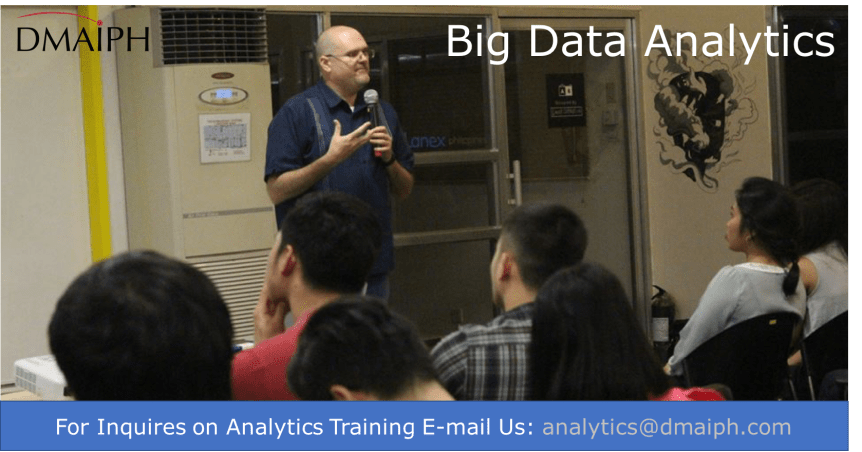
Analytics Consulting – As a founding member of Gloabl Chamber Manila, DMAIPH specializes in a variety of analytics consulting solutions designed to empower analysts, managers and leaders with the tools needed for more data-driven decision-making.

We have helped dozens of companies get more analytics in their business. Contact DMAIPH now at analytics@dmaiph.com or connect with me directly so we can tailor an analytics solution made just for your unique requirements.
DMAIPH is Good at Helping Companies Looking to Expand (1 of 3)

The first type of company we generally get involved with is companies looking to expand. Huge growth is just around the corner and there is a need to staff up quickly,    but given some uncertainty as to how much growth will be needed how soon, you want a little more flexibility in staffing. Our virtual, hybrid staffing solutions will give you access to a very talented work force that is flexible and affordable. We can also assist with developing the expansion strategy with our business intelligence package of demographic profiling, competitive landscaping and market assessment.

10948138_918236694853511_81426736_o

Let me tell you about one of our clients who came to us in expansion mode. We started with six work from home staff who were tasked with adding key words to online auction items. Starting with a small team who would just do a small percentage of the key wording for our client. We quickly found our talent pool was very large and very deep. So we quickly built the team up to a dozen and then 25 and ultimately 50 people. We worked closely with the client at first but over the first six months also built up our own expertise to the point, the client became very hands off.

Work from home positions make a lot of sense for this work as its very independent and easy to assign, track and review. We also got past a lot of challenges with work from home team, but really building the team using social media to connect them and make them feel like part of the larger organization.  This hybrid approach where the employees feel both independent and connected has led to extremely low attrition.

We also found that in the Philippines, there are literally a million former call center employees, with college degrees, good English and the drive to do a good job who left the call center industry to spend more time with family. So our work from home jobs are right in line with their needs.

Things have worked so well, the client has had us add a graphic design team, an email-marketing team, a desktop support team and a customer care team in addition to the key word team. The key word team has added a QA team and a 2nd level support team as well.

From a financial standpoint we helped the client save a lot of money by staffing in multiple locations, added the ability to do 24/7 customer care and never miss a beat with meeting our SLA.

This is the kind of thing we can do for any company looking to expand both rapidly and strategically using our home based, virtual team solution. Just connect with me and I will explain how.

gcmpicture1

Analytics Consulting – As a founding member of Gloabl Chamber Manila, DMAIPH specializes in a variety of analytics consulting solutions designed to empower analysts, managers and leaders with the tools needed for more data-driven decision-making.

We have helped dozens of companies get more analytics in their business. Contact DMAIPH now at analytics@dmaiph.com or connect with me directly so we can tailor an analytics solution made just for your unique requirements.

DMAIPH’s Typical Client Profile

I publish and share a lot of content about helping businesses get a better handle on their analytics in order to build a culture of data-driven decision-making. With so many businesses of various shapes and sizes looking to get more out of their data, I get asked a lot what kinds of businesses do we specialize in helping.

In general, I think we can help just about any business with its data analytics, with using data for business decision-making and in building an analytics centric culture.

That said, success often will hinge on a couple of factors.

  1. How is the data acquired and stored? The more structured the data management the easier.
  2. How serious is top level management about using data to make decisions?
  3. Is there a person or a team who really get the theory of how to optimize a business using data?

If all of those are true, it’s a green light for us no matter what the size or type of business.

If 1-2 are true, it is still possible, but we will have to make sure we keep expectation tied to reality.

If none of factors are in place, then I will probably decline the consulting gig. You can save people who don’t really want to save themselves.

Our business plan is to offer analytics solutions in the things we are best at, (1) talking about analytics, (2) consulting on using data in a business strategy and (3) providing data and/or analytics focused, hybrid staffing solutions.

The 3 kinds of businesses we specialize in helping by offering these solutions are

  1. Ready to expand – companies who are about to kick off a period of significant growth in their operations and need data analytics and/or more staff to be successful.
  2. Ready to revitalize – companies who have hit a rough patch and need to better understand where things went wrong and need a road map on how to get back on track.
  3. Ready to launch – start up companies who need to refine their initial business plan based on solid data analysis and/or need staffing solutions to get things rolling.

jobspicture2

So although I feel we can help just about any business when it comes to analytics, these are the 3 types of service we offer to our target market. I will detail more about how we go about helping businesses and tell you a story about a company we have helped in the next few blog posts.

Analytics Consulting – As a founding member of Gloabl Chamber Manila, DMAIPH specializes in a variety of analytics consulting solutions designed to empower analysts, managers and leaders with the tools needed for more data-driven decision-making. We have helped dozens of companies get more analytics in their business. Contact DMAIPH now at analytics@dmaiph.com or connect with me directly so we can tailor an analytics solution made just for your unique requirements.

Q20: So in conclusion can you explain a little more about your own method for using data to drive better decision making?

I have always been into data. When I was a kid I used to memorize baseball statistics on the backs of baseball cards. It was not uncommon for me to spend a whole weekend constructing fantasy teams and playing what if games between great teams of the past using my favorite players.

Besides sports statistics, another love of mine as a kid was history. Understanding concepts that caused things to happen. Wanting to know what caused wars and lead to significant changes in behavior. And history is chalk full of statistics. Loads of data to help understand what happened and most importantly shed some light on why it happened.

So those two experiences really taught me about how much fun data can be. When I started my first real job out of college, I started using MS Excel. I quickly became the expert in the office and things just kinda spun out from there.

I took a few Excel classes early on, but most of what I have learned has been either side by side with an expert of self-taught. When I started at Wells Fargo, the data guy thing followed me.

One of my first projects was building a sales tracking sheet for each team. Flash forward 15 years and I was doing the same thing, but with much more awesome tools and a lake full of data.

SO what does that tell you about my philosophy about analytics? Its comes from passion and curiosity and my expertise is mostly self-taught. To teach people to be a good analyst you have to first build confidence and generate empowerment. That with the right tools, the right data and the right state of mind, you can solve any data problem.

At this point in my career, besides the passion and the drive, I’ve got 25 years of data gathering, analyzing and sharing under my belt. I can find data on just about anything, knowing where to start looking.

I have a 1,000 bookmarks saved and organized and Im always adding to it. I also as much as possible notate my sources to keep breadcrumbs close at hand to trace back how I got to where I am at. I read a ridiculous amount. Books, blogs, articles, whatever I can that helps me add to my body of knowledge and most importantly gives me access to new places to find data.

4.8

To me the single biggest key to success in analytics is just that… knowing where to look for it. The quicker you identify the data, the less time you have to spend inventorying it and the most time you can spend integrating it.

A lot of people might expect me to say use this application with this model of this method to get these results. That’s to specific. I can list out some awesome tools, but if they aren’t going to be employed in every company then what’s the point.

If you are surrounded by people who know where to find data, you are in a good place. If you are the only one who is going out and finding it, then you are in a lonely place. Making data-driven decision is only really possible if your business culture is at a point where it values these types of decisions.

In conclusion, you have to have curious people, who are empowered to find data, that management will use to make decisions. Focusing on data organization for speed and diversity helps. Spending a lot of time on visualizing your data so it tells a story that drives decision making helps. This is how I do it.

I find data, I use cool tools to analyze it faster and I add awesome visualizations to make it more powerful.

That’s how I empower people to be analysts, how I teach companies to have better analytics and finally and most importantly, how I do analytics.

Q19: How would you describe your approach to teaching analytics?


That’s a great question. I have both a simple answer and a more complex one.

The simple answer is my approach to teaching analytics is all about empowerment.

The keys to being a good analyst are most likely already in you. You just need to find ways to unlock, upgrade and unleash your curiosity and focus it towards making more data-driven decisions.

Learning how to use data across a business to improve things is something everyone can benefit from. So that is where I start.

A more complex answer is that I develop each training to fit the needs of a particular audience. Every organization approaches analytics differently so its nearly impossible to use a single way to talk about analytics. In addition, each person in an organization has different backgrounds and different needs, so a one solution fits all approach doesn’t work.

This open-minded and flexible approach to the subject matter is the same way I approach any challenge. Assess the need, develop a relevant solution, apply the solution and refine and adapt as need be.

Honestly, my approach is fairly unique because I take my formal education as a teacher, mix it with my 15 years of practical experience and offer a training solution that is both engaging and enchanting.

11756770_934770113231654_1677809504_o

So what does that all mean when it comes to actually being on the stage or in front of a classroom?

I have found the following things to be true when it come to talking about analytics:

  • Knowing the audience. What do they need to get from where they are to where they want to be.
  • Asking participants questions directly. Breaking into small group exercises to see the interactions. Having lots of questions in my slides.
  • Real World Exercises. I change the exercise we do based on the make-up of the group. It is much more impactful to solve problems that they can relate too.
  • Too Much Content. Going against conventional wisdom, I pack a lot in. I am not trying to make sure everyone can memorize my slides. I am trying to bring out their curiosity and let them take way what they need to bring the curiosity back to the office with them.
  • Lots of Visuals. Even when I pack a slide with text, I tie it to an image that sticks. People remember the image, then the content will come back to them.
  • Speak with Passion. Another change from conventional wisdom. I talk fast. I jump from topic to topic a lot. I move around the room. Its all because Im speaking with passion. Its contagious and keeps things moving at a fast pace.
  • New Content. I am always tweaking things. My presentations are never exactly the same, because every day there is something new to talk about.

So there you go. Some of why and how I have developed my approach to teaching analytics. I’m always looking for disciples if you want to learn from a man crazy about analytics.

Q18: Can you please talk about recent developments in higher education on how to train more analysts?

The past couple of years have seen some remarkable developments in higher education in regards to analytics. Just a few years ago there were only a handful of colleges and universities in the U.S. that offered any kind of degree in something akin to data science. However, now you can find dozens of schools offering graduate degrees in analytics and/or data science. These changes in higher ed were preceded by several vocational schools and certificate programs. All in, if you do a google search on data science or analytics degree program you will get 100’s of schools in your results.

Besides the U.S., I have seen a few program in the UK and several in India getting more into analytics education. In the Philippines several schools have already started implementing the CHED (Commission on Higher Education) memo requiring schools to offer a business analytics elective series of classes. We have come a long way in a short time, but what is best for you?

If you are thinking about getting some formal education you will need to determine where you are currently with your analytics skills and where you want to be long term. Because of the crazy growth in the field, it can be pretty hard to tell what is the best bang for your buck.

Without pointing to any specific institution or program, I can give you some broad difference to consider. In a latter blog I will actually review some of the best programs and talk about them in on my blog site.

So here are the differences as I see them:

  1. Accidental Analysts. People who are doing a lot of analytics and have for some time, but have no formal training in analytics. These are accidental analysts who still make up a huge % of people doing analytics every day. For people at this level, going back to school full time to get a formal degree is not generally an option. For people in this bracket short term training programs and certifications in specific tools are the best bet to stay on the cutting edge.
  2. Legitimate Data Scientists. Few and far between, people with both the academic credentials and the business experience to do significant data science generally look upwards to getting a masters or even doctorate in a specialized field from a top school. There are a lot of programs out there to do that, but they tend to be pretty expensive and difficult to get into.
  3. Aspiring Data Scientists. If you are still young in your career and/or not finished with college you can consider getting your undergraduate degree in a related field and then progressing on to post graduate work. This is a recent development that poses an opportunity to those just starting out. In the near future these kinds of analysts will replace the accidental analysts for the most part. That is if there are ever enough.
  4. Part Time Analysts. People who do analytics or are part of a data science team, but have already established a career path in a different discipline. For those like you, training programs and certifications abound. It is pretty easy to find one that fits your unique situation and give you the added data muscle you need in your job.
  5. Managers of Analysts. If you are not really the one doing the heavy data lifting, but have team members that do. You need to be able to understand them, but not all the things they do, then you might be looking for a more generalist overview of analytics. Trying to optimize your analytics business culture and lead big data projects are skills you might want to improve on. There are training programs popping up for this need as well.

10406025_10152524531307425_1404103117_n

So where does this take higher education? Some schools and programs are very broad based and offer generalist solutions. Others are quite specific and are geared to producing specialists. Knowing which education option is best for you is the challenge.

Higher Education across the globe is evolving to incorporate more analytics and data science into its curriculums. The need is there and is growing at a break neck pace. Where we are now is lights years from where we were two years ago, but where we need to be is far down the road.

More on that next blog post. In the meantime, if you are trying to figure out how to up your analytics game, drop me a note and I’d be happy to help you figure out what path you should take.