A Few More Thoughts On Leadership

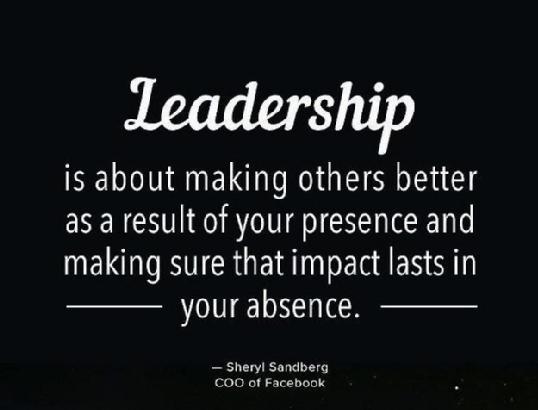
Most of my blog posts the past few weeks have been focused on leadership.

As my company grew from 6 to almost 100 in just 18 months we were forced to make a lot of quick decisions that have not always turned out to be the best long term solutions. So now I reflect on those lessons. How to move away from making snap judgments based and move more into data-driven decision making. That’s always been the goal.

Here are so of my favorite quotes on leadership and how I plan to wrap them into my leadership meeting next week.

Jack Welch said that, “Before you are a leader, success is all about growing yourself. When you become a leader, success is all about growing others.” I firmly believe this and have tried hard to instill this sense of purpose in my leaders. However, we have a lot more work to do before we have an organization full of people looking out for the success of others before looking out for their own success first.

A big part of this is to constantly be pushing the organization to evolve and to never rest. Peter Drucker said that “Leadership is lifting a person’s vision to high sights, the raising of a person’s performance to a higher standard, the building of a personality beyond its normal limitations.” That’s my point exactly. We look at the data, analyze our performance and determine what to improve next.

From our recent survey, we know our team members crave feeling valued and being appreciated more than they depend on being paid well. We need to focus on this and build a recognition program that show value and share appreciation. Sam Walton once said, “Outstanding leaders go out of their way to boost the self-esteem of their personnel. If people believe in themselves, it’s amazing what they can accomplish.” For us to reach the next level of success as a company this sense of empowerment needs to permeate through the ranks.

I hate when I have to manage people because things aren’t being done they way I expect them to get done. Part of that comes from my own failures in instilling this lesson in others. “Leadership is the art of getting someone else to do something you want done because he wants to do it.”  from General Dwight Eisenhower. We do too much bossing and not enough uplifting others to dream the same dream we do.

And finally, from John Quincy Adams, “If your actions inspire others to dream more, learn more, do more and become more, you are a leader.” To me that is the most important measurement for us to look at. Everything else comes next.
8d16381e-298f-4646-a7e2-c8929ffb08cf-medium

Analytics Leadership – DMAIPH specializes in arming the Data-Driven Leader with the tools and techniques they need to build and empower an analytics centric organization. Analytics leadership requires a mastery of not just analytics skill, but also of nurturing an analytics culture. We have guided thousands of Filipino professionals to become better analytics leaders. Contact DMAIPH now at analytics@dmaiph.com or connect with me directly to discuss a uniquely tailored strategy to ensure you are the top of your game when it comes to Analytics Leadership.

Excellent Leaders Are Constantly Pursuing Excellence

https://www.linkedin.com/pulse/nature-authentic-leadership-ben-stewart

Here is an excellent conclusion to a blog post about the nature of authentic leadership…

‘Effective leadership can be an elusive goal with no clear path to direct success.  There are, however, many techniques and practices that are consistently utilized to reach this goal.  It begins with personal responsibility and leadership of oneself.  Before anyone has a chance at leading others,  he or she must take ownership of their thoughts, actions, and beliefs.

Possessing a keen insight into human behavior and thought is also critical.  This includes motivating, retaining, and resolving conflicts among the team.  It is unfortunate today that so many leaders become consumed with the ends that they forget the means.  While the bottom line is most often analyzed and how a leader is judged by superiors, it is the responsibility of the leader to ensure that the team respects its members and is passionate for pursuing excellence.  Neglecting this will bring discouragement and cause a serious threat to whatever goal is being pursued.

Leaders must always incorporate the human aspect into their decisions.  In its essence, leadership is about influence.  For a leader to maximize and improve whatever situation they encounter, requires going beyond spreadsheets and routines.  Taking a genuine interest for the team will include a common respect and appreciation for every individual.  Although this is a cumbersome and lengthy process, leadership will prove abundantly more effective.”

IMG_1849

The need for personal responsibility is most important when times are tough. If you are under pressure, its hard to lead others if your are not comfortable leading yourself.

Knowing how people think, and why they do what they do is a key point of success. Leaders who often try to spend time in their subordinates shoes are much more successful.

Pursing excellence needs to be a top motivator for any leader in DMAIPH. To be effective when it comes to working with me you need to understand the power of your influence and comprehend how it is perceived… so that you can get everyone else to follow along on that pursuit to excellence.

Analytics Leadership – DMAIPH specializes in arming the Data-Driven Leader with the tools and techniques they need to build and empower an analytics centric organization. Analytics leadership requires a mastery of not just analytics skill, but also of nurturing an analytics culture. We have guided thousands of Filipino professionals to become better analytics leaders.

Contact DMAIPH now at analytics@dmaiph.com or connect with me directly to discuss a uniquely tailored strategy to ensure you are the top of your game when it comes to Analytics Leadership.

Leading vs. Managing vs. Bossing

The definition of Leading is exercising leadership by providing direction or guidance.

The definition of Managing is to direct or supervise employees or other staff by exerting control.

The definition of Bossing is to give orders to, especially in an arrogant or domineering manner.

Leaders generally try and empower, educate and uplift people working under them in an organization. At times they many need to manage employees who have gone off track, but generally only use this to optimize short term results. Although sometimes managing and bossing can feel the same to the employee, good leaders never have to result to bossing.

Managers generally try to motivate employees to meet business needs. At times the pressure for results will force managers to exert control over their employees to get results. This can generally fee like bossing. Employees that feel like they are constant being directed to do things that are unclear to them how and/or why they are doing it never feel like they are being lead.

People who are in positions of authority who are always bossing are not well liked by their employees. Employees do not feel valued or appreciated when they are constantly being bossed. Bosses use fear and intimidation to drive results, which generally fall short of business goals.

The ironic thing about these definitions is Bosses don’t generally realize they are Bosses. They think they are good managers and even good leaders. Managers generally know they are not Bosses, which is good, but they generally are not in a situation where they can be good leaders.

On the other hand, Good Leaders are always cautious of trying not to fall into the traps of managing people or being the boss.  They constantly appreciate feedback to help themselves improve and see their own style of running a business as always evolving.

For a business to be successful you need leaders who can occasionally manage and once in a while be a boss, but most of their time is spent trying take the business to a higher level. That’s my dream for DMAIPH.

10322847_10202261942091034_7017264038085105214_n

Analytics Leadership – DMAIPH is a founding member of the Analytics Council of the Philippines and specializes in arming the Data-Driven Leader with the tools and techniques they need to build and empower an analytics centric organization.

Analytics leadership requires a mastery of not just analytics skill, but also of nurturing an analytics culture. We have guided thousands of Filipino professionals to become better analytics leaders. Contact DMAIPH now at analytics@dmaiph.com or connect with me directly to discuss a uniquely tailored strategy to ensure you are the top of your game when it comes to Analytics Leadership.
Mastering The Art Of Account Management

I have been thinking a lot lately about what its take manage the relationship we have with our clients.

A long time ago, I learned that to be a good account manager you need a rare combination of professional and personal characteristics, some of which can’t be taught. To me account management is the art of representing my business to clients and vice versa.

The job requires skill, advocacy, diplomacy, leadership, expectation setting, intelligence, method, heart, patience, experience, and wisdom. It is not easy and it is something I am constantly trying to improve at.

With this concept top of mind, I thought I’d share some of my tips for being an effective account manager.

  1. Under Promise and Over Deliver. I have always strived to under promise and over deliver. Most people get it wrong. They promise to something they cannot deliver and things go downhill quickly from there. Losing your client’s trust is a surefire way to doom your company.
  2. Do What They Want, Not What You Want. We often get so busy we think we have to do it the way we are doing it. Even when it’s clearly not what the client wants. This is another way to doom yourself and your business. They are paying you to do what they want, so don’t expect them to keep paying you to do what you want.
  3. Communicate Bad News Early. It is far, far better to tell you client you will be late on a deadline, or you can meet the requirement or you have to modify what you promised then it is to go silent. Not communication bad news early, or worse to communicating the bad news at all is another strike against you and your hard work, not matter what you intentions.
  4. Be the Expert. When it comes to dealing with a client, they are expecting you to know every answer, sometimes even before they ask it. They are paying you for your expertise. So you need to be the one to find problems before they are problems, fix things before they break and always have a solution at hand. If you are not an expert on what you are being paid for, they will find someone else.
  5. Always Have the Most Data. When your client tells you there is something wrong because they saw it in a report, then you know you have pretty poor analytics. You are doing the job, so you should be the one churning out the reports, championing the sharing of information and setting the agenda for the next meeting.

10592010_10152674958362425_1982237172_n

That’s just a few of the things that come to mind when it comes to being a good account manager.

And just in case I need to remind anyone, and not trying to brag… but I am pretty awesome at this.

Being good at account management is without a doubt one of the key reasons I have thrived throughout my career is keeping the clients happy.

DMAIPH has successfully set up Filipino analytics teams for over a dozen U.S. based businesses. Offering both virtual and office based teams that specialize in problem solving using data, new technology and analytics techniques is our strength. Finding and empowering analytics talent is increasingly challenging, but we have it down to a science.

DMAIPH specializes in arming the Data-Driven Leader with the tools and techniques they need to build and empower an analytics centric organization. Analytics leadership requires a mastery of not just analytics skill, but also of nurturing an analytics culture. We have guided thousands of Filipino professionals to become better analytics leaders. Contact DMAIPH now at analytics@dmaiph.com or connect with me directly to discuss a uniquely tailored strategy to ensure you are the top of your game when it comes to Analytics Leadership.

IBM’s Six Ways To Use Analytics To Manage A Workforce

http://www.forbes.com/sites/ibm/2015/04/06/6-ways-to-use-analytics-to-better-manage-a-workforce/

Interesting article about how to use more analytics in areas that are traditionally data rich, but not a focus of most enterprise analytics solutions.

Right now in the BPO industry in the Philippines, two of the bullet points really got me thinking.

Using analytics in HR to predict if and when employees might leave is a pretty cool concept. Their is plenty of historical data to look at resignation and termination patterns and segment the data in various buckets to see if any meaningful patterns jump out.

This goes hand in hand with higher employee expectations for work life balance and having a strong sense of community within the work place.

Both are things that might require a lot of unstructured analytics as well… although it blurs employee privacy issues, Facebook and Twitter can be an excellent place to glean insights into employee mood and their intentions.

I am curious to see how deep analytics can go into looking at data and trying to predict employee loyalty and stickiness.

The recruitment and retention of top talent is the biggest challenge facing just about every organization. DMAIPH is a leading expert in empowering HR & Recruitment teams with analytics techniques to optimize their talent acquisition and management processes.

jobspicture2

DMAIPH also specializes in arming the Data-Driven Leader with the tools and techniques they need to build and empower an analytics centric organization. Analytics leadership requires a mastery of not just analytics skill, but also of nurturing an analytics culture. We have guided thousands of Filipino professionals to become better analytics leaders. Contact DMAIPH now at analytics@dmaiph.com or connect with me directly to discuss a uniquely tailored strategy to ensure you are the top of your game when it comes to Analytics Leadership.
Analytics Tip > Keep Your Data Clean

http://bicorner.com/2015/03/22/5-nuggets-from-the-big-data-driven-business/

Came across this interesting post on LinkedIn…

Database quality now has an unprecedented impact on the success of Big Data initiatives. To ensure that these databases are as productive as possible, Marketers must maintain good data hygiene.

Five steps for cleaner data:

1) Make sure your data entry team is keying in data accurately in the first place.  Make the data entry team a priority.

2) Incentivize your sales team, call-center squad and other customer facing employees to regularly request updated contact information and other data from the customers they encounter.

3) Use available software, such as Trillium, to streamline the process of cleansing, correcting and updating email and postal addresses.

4) Allow customers access to their records so they can help keep them accurate.  Consider offering discounts as an incentive for customers to participate.

5) Regularly contact customers, either via phone or email, to update records.  This approach is critical with the most important accounts.

Having clean data is very, very important.

img_7731

I have my admin team refresh my connection data on LinkedIn on a regular basis so our mailings lists stay up to date.

We also have audits of our client pipeline to make sure all relevant applicant data is captured for analysis.

Make sure you put some thought into how to keep your data clean!

Analytics is the application of using data and analysis to discover patterns in data. DMAIPH specializes in empowering and enabling leaders, managers, professionals and students with a mastery of analytics fundamentals.

DMAIPH is also a founding member of the Analytics Council of the Philippines and specializes in arming the Data-Driven Leader with the tools and techniques they need to build and empower an analytics centric organization. Analytics leadership requires a mastery of not just analytics skill, but also of nurturing an analytics culture. We have guided thousands of Filipino professionals to become better analytics leaders. Contact DMAIPH now at analytics@dmaiph.com or connect with me directly to discuss a uniquely tailored strategy to ensure you are the top of your game when it comes to Analytics Leadership.

You Don’t Build A Business… You Build People

f2049885-9cdd-4f3d-8370-9ac9600695e0-original

It’s funny to me that I shared this on LinkedIn and someone had the thought to spin it into a negative thing. Someone sarcastically replied that this is false and that big bosses just use people to make money. I’m guessing he sees this as a way to get people to work harder, but it the end only the top people benefit. Or something like that.

When I saw this, I immediately thought about a training program we have just kicked off to address a significant challenge we have in both my business and in my industry. The call center industry in the Philippines is probably one of the most hyper competitive labor markets anywhere in the world today.

To be able to be successful you need to find people who are stick around. So looking at the best way to do that is to build them up. To train them, to empower them, to enchant them.

Being equal parts educator, analyst, entrepreneur… this concept is something I firmly believe in, I have the data to back it up and the success to prove it is working. So take that mister sarcasm… DMAIPH is a great example of this philosophy actually working.

Analytics Leadership – DMAIPH specializes in arming the Data-Driven Leader with the tools and techniques they need to build and empower an analytics centric organization. Analytics leadership requires a mastery of not just analytics skill, but also of nurturing an analytics culture. We have guided thousands of Filipino professionals to become better analytics leaders. Contact DMAIPH now at analytics@dmaiph.com or connect with me directly to discuss a uniquely tailored strategy to ensure you are the top of your game when it comes to Analytics Leadership.

What Is Strategy?

http://bakerstreetpublishing.com/decisioncoaching/2015/02/12/what-are-the-strategic-decisions-we-face/

I came across this perfectly timed blog post on LinkedIn. Tomorrow we will be having our first real leadership planning session in a while and we have a lot of topics on the agenda.

However, before we get into the nitty gritty, I will spend the first part of the meeting talking about strategy. And these concepts will form the core of that conversation.

jobspicture2

“Every business must have three things to be successful: good leadership, good strategic decision making, and the ability to execute. “

  • Good Leadership: To me this means inspiring and empowering team members to take the initiative, to be bold in problem solving and being able to balance client, customer, business and team member needs.
  • Strategic Decision-Making: Taking a logical and data-driven approach to decision-making is the best way to map out your business plan.
  • The Ability to Execute: Good leaders know how to implement decisions quickly and efficiently because they work in a sound framework of empowerment and intelligence.

Looking at closely at the data is key part of this. Good leaders do much more than just manage, and it’s important to constantly remind ourselves of this.

Analytics Leadership – DMAIPH specializes in arming the Data-Driven Leader with the tools and techniques they need to build and empower an analytics centric organization. Analytics leadership requires a mastery of not just analytics skill, but also of nurturing an analytics culture. We have guided thousands of Filipino professionals to become better analytics leaders. Contact DMAIPH now at analytics@dmaiph.com or connect with me directly to discuss a uniquely tailored strategy to ensure you are the top of your game when it comes to Analytics Leadership.

Limiting You Core Values To Just 3

https://www.linkedin.com/pulse/you-have-more-than-3-core-values-think-again-dave-kerpen?trk=tod-home-art-list-small_2

For DMAIPH, I have infused 3 core values into everything we do. They come from having seen companies succeed and seeing companies fail. The ones who succeed have the in common. Here they are:

Partnership

Integrity

Teamwork

For my the core valued of any business starts with the partnerships is has with its industry. For public trainings its all about having a robust network. Being able to get new business, mine existing business, and bringing back old business all comes out of strong partnerships.

Integrity is also super important. Being honest and doing the right thing. Have an identity that makes one thing of likability and trustworthiness. When you have that you take care of your customers, your employees are satisfied and engaged, and you ability to partner gets much easier.

And the third value is teamwork. Teamwork is based on trust. And trust comes from integrity amount partners. Work partnerships, between employer and employee and between each employee with their peers all lead to a more vibrant teamwork.

DMAIPH stands for strong partnerships among analytics providers and consumers, for being know for our rock solid integrity, and for engaged and empowered team we have.

What are your 3 Core Values?

If you cant recite them of the top of your head, then you probably have too many.

DMAI - Logo_ver2-02-01

Analytics Leadership – DMAIPH specializes in arming the Data-Driven Leader with the tools and techniques they need to build and empower an analytics centric organization. Analytics leadership requires a mastery of not just analytics skill, but also of nurturing an analytics culture. We have guided thousands of Filipino professionals to become better analytics leaders. Contact DMAIPH now at analytics@dmaiph.com or connect with me directly to discuss a uniquely tailored strategy to ensure you are the top of your game when it comes to Analytics Leadership.


All I Need To Know About Someone Is What Was The Last Book They Read

I’m not sure where I picked that concept up from, it’s probably a variation of a famous quote whose author escapes me. But for me there is a lot of truth to the statement. When you find out the last book someone read you can tell a lot about them. When you get them talking about it you can gain incredible insight into who they are and what motivates them.

In my case I picked up a book at the airport for my flight and to help me get into trainer mode. The book I picked up was Decisive, a business management and leadership book by the Heath brothers. It was on the top of a lot of 2013 lists and I had heard of it before. Once I started reading it, I quickly saw some key points I could roll into my next analytics training class.

Picture1

Here are some of the key points:

> Most decision are made in an instant and are often just a choice between two options.
> Although helpful, Pro and Con lists are limited in their effectiveness.
> Most business decisions, when looked at a few years later, were failures.

In the book the Decisive, the authors list four tips to help make better decisions:

1. Widen Your Options by eliminating factors that put artificial limits on our choices.

2. Reality-Test Your Assumptions by taking them out of our head and into the real world.

3. Attain Distance Before Deciding, which means don’t rush and gain other perspective.

4. Prepare to be wrong, the willingness to take risks is a challenge for all of us.

Its a great read, pick it up.

HR & Recruitment Analytics – The recruitment and retention of top talent is the biggest challenge facing just about every organization. DMAIPH is a leading expert in empowering HR & Recruitment teams with analytics techniques to optimize their talent acquisition and management processes. Contact DMAIPH now at analytics@dmaiph.com or connect with me directly to learn how to get more analytics in your HR & Recruitment process so you can rise to the top in the ever quickening demand for top talent.