How To Build A Competitive Landscape for Your Marketing Strategy

In preparation for my talk next week at CSB, I wanted to share with you one of the simplest parts of a well-rounded analytics solution.. which is to take account for the competition. I talk about this a lot because it’s often one of the most overlooked.

So, lets say we work for an events management company and we are going to set up a training workshop on business analytics. We need to provide our marketing team with some data to help them in their efforts. To help ensure the program will be a success, there are several data points about the competition we can source to see how we stack up in comparison.

First let us look at pricing. How much are we going to charge for the workshop? We need to make money, so first of all we need to account for expenses and determine an ideal profit margin and then set a target ticket price. That’s simple. However are there other workshops out there that offer similar content for a lower price? Or can we raise our ticket price to be more in line with the market?

To get the data we need to survey the marketplace and gather the intel and put in a simple excel file just to see where our desired price points compares. It may take a few hours of calls, web searches and online inquires, but it all pretty much public data and easy to get.

Second, we can look at format. How long is our workshop? How many speakers? Will there be a panel of experts? We can gather these data points at the same time we capture pricing data, so let’s just add a few more columns to the excel file. This way we can see with some certainty about the number of competitors we have and how our workshop will measure up.
MSP24321b65h584fd76h9i00006996g957h01de5g6

To give a different type of dimension to our landscape, let’s look at reputation. So let’s add one more set up columns to capture year established, number of public training offerings a month and number of cities/provinces used. And then add a final column for general notes. The idea here is we are going to add analysis to how credible a competitor they are. We can see who has been around awhile and who is new to the game, who has a narrow scope and who is everywhere. This way we look at more than just raw numbers.

SO, you take your spreadsheet, you fill it out and then you add a row for our own company and then we can see where we rank in each of the categories (columns). It’s not a 100% scientific, but it will give us a good idea of where we stand in the grand scheme of analytics training options out there.

Based on this analysis we can help the marketing team by showing our relative value to attendees as compared to other options. We can distinguish what it is about our format that gives us an edge. And we can advise marketing on what parts of our credibility we want to promote.

For example, a tagline marketing can use based on our data could be something like Join DMAI, the Philippines most well established name in Analytics, for an innovative approach analytics training next month at a very affordable price.

There you go! 🙂
Analytics In Action: How DMAIPH Uses Data to Drive Decision-Making

Awhile back, I was a guest speaker for a business analytics class at the College of St. Benilde. I had been asked to talk about how DMAIPH uses analytics in our business.

When it comes to sizing up an analytics project, I tend to use a methodology I learned from a couple Stanford professors several years ago. It is pretty simple concept that is applicable across all kinds of projects; (1) identify the data you will need, (2) bring it in to your analysis tools, aka inventory it, (3) and then integrate it into a larger story or context.

I tend to use MS Excel for the majority of my analysis, but when I need to build a map, or prototype a business dashboard or need some high-powered visuals to present my data, I use Tableau Public. In the past I have used a wide range of analytics tools, but they are always specific to a certain type of data I needed to access.

One of my favorite infographics

I am going to show three examples of how we use analytics:

  •  How we built and maintain a competitive landscape looking at the current trends in analytics here in the Philippines. Who is using what, what they are doing and where the talent is coming from.
  • How we built and update a demographic profile based on resume and LinkedIn data for the various types of analyst jobs we are currently employing.
  • And, how we built a business dashboard using Google Drive for the management team to use when looking at who on the team to coach and what to coach them on. It’s a simple way to share KPIs.

In all three cases I will explain how we identified the data we needed, how we inventory it so we can look at historical trends as well as a current snapshot and how we integrate these analytics solutions into our business strategy. It should be a pretty good presentation followed by some great Q+A! 

jobspicture2

Analytics Training – DMAIPH offers a wide range of analytics centric training solutions for professionals and students via public, in-house, on-site, and academic settings. We tailor each training event to meet the unique needs of the audience. If you need empowerment and skills enhancement to optimize the use of analytics in your organization, we are here to help. Contact DMAIPH now at analytics@dmaiph.com or connect with me directly to set up a free consultation to learn which of our DMAIPH analytics training solutions is best for you.

Outsourcing Tip > Size the Opportunity! Not to be confused with Seizing the Opportunity.

When you have an opportunity to get involved with outsourcing, it always sounds like a good way to make some fast money.

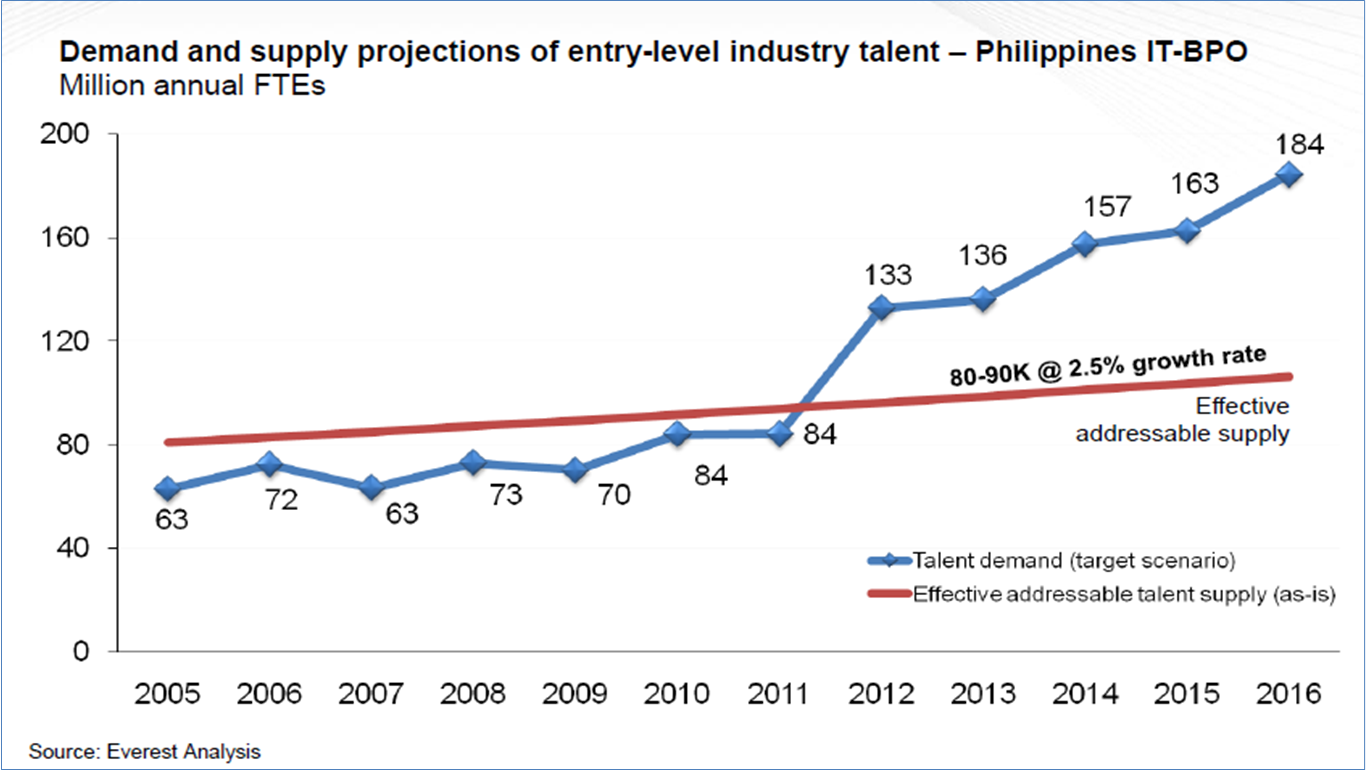
The news has been abuzz for a while now with mounds of data and statistics about the high-speed growth in the outsourcing industry, especially here in the Philippines. Just yesterday I saw a projection that BPOs in the Philippines are expecting to see a 15% growth in revenues in 2014.

Picture1

You couple that with the fact that everyone here knows someone who is making good money as a call center agent or investing in real estate that will be used by call centers, or have a friend in the US who knows someone who wants to save money by outsourcing. It’s one of those everyone is doing it, so why can’t I kinds of things.

This is all good, but there are just as many failures as there are success stories when it comes to small and medium-sized BPOs. Ones where someone had a client, or a building, or an idea but didn’t size it right and misjudged on cost, or talent or market and had to close their doors and lost money.

So when you have an outsourcing opportunity in front of you, whether it be as provider or a client, make sure you size it right. Here are a few things to think about:

  1. Does the client already have an existing business that they want to outsource? If so, fully understand all the requirements of that job as it is currently performed.
  2. Can you find the talent in the Philippines to provide just as good if not a little better service as currently is being provided? A common mistake is thinking that cutting both cost and the level of service will be a win-win.
  3. How scalable is this project? How can both ends be managed in a way that allows for uninterrupted growth? Often things start easy when it’s a pilot, but once you get into production a host of issues can pop up to derail growth and ultimately the partnership.
  4. How stable is the client? Are they a startup that has a great idea and is underfunded? Those are plentiful. Or are they an established business with a strategic plan that includes the fortitude to successfully outsource a key piece of its business? These are hard to find.

That is just a few things that come to mind when I think about sizing the opportunity. Having set up 5 teams in the past year to provide outsourcing services, I have learned a lot about making sure I get the sizing done right. Keeping a client happy is all about under promising and then over delivering when it comes to time, talent and cost.

Analytics Outsourcing – DMAIPH has successful set up Filipino analytics teams for over a dozen U.S. based businesses. Offering both virtual and office based teams that specialize in problem solving using data, new technology and analytics techniques is our strength. Finding and empowering analytics talent is increasingly challenging, but we have it down to a science. Contact DMAIPH now at analytics@dmaiph.com or connect with me directly to learn more about how to set up an analytics-centric team in the Philippines.

Being A Great Analyst > Attribute #2: Visualize Your Data

Most people learn by seeing something… that’s definitely true when it comes to using data. They not only learn more, but data visualization also a quicker sharing of information and also enhances communication.

Here’s an example. My management team was discussing how to enhance our coaching efforts with the team and since each of my direct reports has a different area of responsibility; production, quality and schedule adherence, they were having trouble agreeing on which analysts needed the most coaching. They each produced reports that were stand alone documents that would be shared via email or dropbox.

So I suggested we build a simple business dashboard. A business dashboard looks something like this:

It’s a simple collection of visuals built on top of a data file.

I created a simple Google docs spreadsheet and shared it. Each of the key performance indicators used to evaluate employee success was given a column and I put each employee a row. I then had each of my directs input the relevant data points and quickly we had a rudimentary business dashboard and I now I have a much more in synch management team.

img_7526

Simple analytics solutions like this are at the fingertips of any business. You just need to know when, where, and how best to implement them. Something so simple as a place to share data is so often overlooked by even the most successful businesses.

Analytics Culture – The key to using analytics in a business is like a secret sauce. It is a unique combination of analytics talent, technology and technique that are brought together to enrich and empower an organization. A successful analytics culture is not easy to create, but DMAIPH can show you how. Contact DMAIPH now at analytics@dmaiph.com or connect with me directly so we can build a strategic plan to turn your company into analytics driven success story.

Philippines Analytics Outlook 2014 (4 of 4): Challenges of Hiring Big Data Talent

http://itstaffing.matrixresources.com/opportunities/tech-trends/challenges-hiring-big-data-talent

One of the biggest challenges I see in the Philippines right now is finding the right mix of talent and work ethic in analytics candidates. The core personality trait behind any good analyst is curiosity… the drive to find answers to business questions. The personality trait is however not one that is truly valued within the Filipino business culture. Asking questions can easily be perceived as a threat to authority and to the status quo.

When you look at the current state of things in the U.S., you can easily extrapolate that its even more severe in the Philippines. As the article in the above link demonstrates there is a significant challenge of hiring analytics talent, especially those who can manage and analyze big data.

“Over 300 professionals at the IT executive, director and management levels pinpoints what employers endure while trying to execute big data initiatives and recruit the IT talent needed to handle these initiatives.
• 88% of companies say they are facing a shortage of IT talent able to successfully execute big data initiatives.
• 39% say a lack of available IT talent is negatively affecting their ability to make data-driven decisions, while
• 36% are falling behind in their big data initiatives
• 35% have people in place who are unqualified for the job.
• Only 4% of companies rate the alignment of existing IT employees’ skill sets with big data initiatives as excellent
• while 56% rate them as fair or poor.”

In order to overcome these challenges business are taking steps to recruit new talent or retain existing talent for big data initiatives. The most common solution is to send current employees to external training programs.

External training is easier to implement than starting up internal cross training with other departments or search other departments within the organization for talent. This leads to pirating talent from competitors, which is very unhealthy for the industry as a whole.

So, it you want to stay ahead of the game and find talent that can keep you on the forefront of analytics, the best solution is to engage DMAI to either come in and train your team or send them to one of the DMAI public trainings coming soon.

IMG_1228

Philippines Analytics Outlook 2014 (3 of 4): Most In-Demand IT Skills

http://itstaffing.matrixresources.com/opportunities/tech-trends/most-demand-it-skills

Date: 12/10/2013
Source: Wanted Analytics

The most jobs in demand right now fall under information technology. Wanted Analytics found the most commonly advertised IT skills in this category to see which abilities candidates need to posses to help businesses close gaps.

There are many options for technical training in the Philippines and many schools specialize in producing grads trained in certain applications and programming languages. However, many times they fall short in teaching soft skills.

See my notes on how DMAI can address five of these soft skills needs for businesses operating in the Philippines by our innovative training offerings.

522

Most In-Demand IT Skills
1.Oral and Written Communication > This is Key! So many good analysts have great tech skills, but lack the people skills to be great analysts. This is where my training makes the biggest difference.
2.Software Development
3.Troubleshooting > A lot of times you find that analysis work is more about helping someone understand why things are based on the data. I teach my trainees who to look be a troubleshooter and not just a process follower .
4.Java
5.Project Management
6.Structured Query Language (SQL)
7.Problem Solving > Another weakness of many fresh grads is that they can fix things that make sense, but when faced with unexpected or challenging issues, they lack the confidence to solve problems. I can empower that missing self-confidence.
8.Linux
9.Oracle
10.UNIX
11.JavaScript
12.Quality Assurance (QA)
13.Systems Development Lifecycle (SDLC)
14.Microsoft SQL Server (MS SQL)
15.Microsoft Office
16.Business Requirements Gathering > Knowing what the problem is, communicating it and reporting on it, making sure communication lines are open, involving all stakeholders in requirements gathering, good end-user design, knowing where data lives and how to unlock it… all things we work on through hands on exercises in my trainings.
17.Detail Oriented
18.Self-starting / Self-motivated > Being able to identify a business need or issue and bring it to management before something blows up, is another strength that separates good from great analysts. My trainees are encouraged to do this and taught how to do it a way that is down right enchanting.
19.Application Development
20.Hypertext Markup Language (HTML)

Philippines Analytics Outlook 2014 (2 of 4): Top Skills in Demand

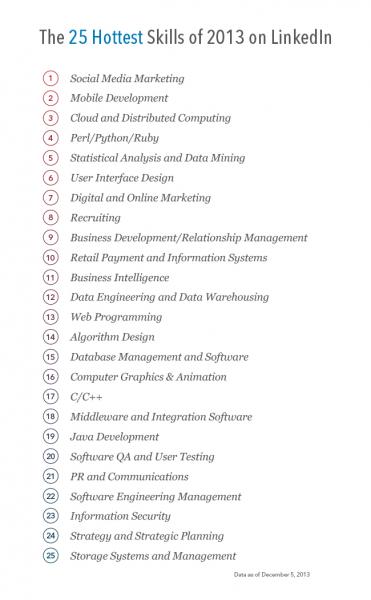
LinkedIn recently came out with the 25 hottest skills from 2013 based on their 259+ million member profiles. As you can see below, this list of skills in demand is dominated by technology skills. Business growth and development also tops the chart, showing growth in next year’s forecast. http://itstaffing.matrixresources.com/opportunities/tech-trends/top-25-skills-linkedin-2013

LI-25-Hottest-Skills-Ranking-List-Final

So what does this mean for us in 2014 and for us going to school or working and doing business in the Philippines?

•Technology skills are highly valued. It’s almost 2014. This shouldn’t come as a big surprise, but if it isn’t already painfully clear why Science, Technology, Engineering, and Math (STEM) education is a top priority for many of the world’s governments, now you know. However in the Philippines, we are still producing more nurses and accountants then we are analysts. So training classes like our are going to be in an ever increasing demand.

•We live in a data-driven world. Cloud and distributed computing (#3), data mining (#5), and data engineering (#12) being highly ranked on our list paints a picture of a world overwhelmed with information, with businesses scrambling to store, retrieve, and make sense of it all. HP and IBM know this and are pushing training into the schools. BPAP knows this has partnered with a number of schools. But in the next 3-5 years its still going to be primarily people like DMAI up training folks to plug the gaps. This gets back to the consistent increase in jobstreet postings for analytics talent.. up 33% from a year ago.

•Businesses are looking to grow. Recruiting (#8), business development (#9), and strategic planning (#24) are all skills that help businesses hire more employees and find new sources of revenue. Expectations of 20% growth in the BPO industry in the Philippines is being lead by “up the value chain” type jobs and many of them require the analytics and data interpretation skills we specialize in.

So, with 2014 fast approaching, its time to think about how to get more training in analytics or how to get more trained analysts in your business. These are high demand, limited supply needs that will only get more extreme in the next few years.

Follow our blog to find out when the next DMAI analytics training is coming.

The Mission of the DMAI Family of Companies: Creating More Analysts

I just wanted to share this blog post from the World Bank as it addresses exactly what we at DMAIPH have been saying and are trying to address; the need for more high end skills training in the Philippines.

12072012489

8 of 12 from this training batch found jobs with BPO companies within a couple weeks of completing the two day Introduction to Analytics training!

http://blogs.worldbank.org/eastasiapacific/node/3096
======================================

The Philippines faces an enormous jobs challenge. Good jobs—meaning jobs that raise real wages or bring people out of poverty—needed to be provided to 3 million unemployed and 7 million underemployed Filipinos—that is those who do not get enough pay and are looking for more work—as of 2012.

In addition, good jobs need to be provided to around 1.15 million Filipinos who will enter the labor force every year from 2013 to 2016. That is a total of 14.6 million jobs that need to be created through 2016.

Did you know that every year in the last decade, only 1 out of every 4 new jobseeker gets a good job? Of the 500,000 college graduates every year, roughly half or only 240,000 are absorbed in the formal sector such as business process outsourcing (BPO) industry (52,000), manufacturing (20,000), and other industries such as finance and real estate.

Around 200,000 new job seekers find work abroad, and around 60,000 will join the ranks of the unemployed, go back to school, or rely on financial support from family for the time being.

This still leaves 600,000 new jobseekers who have no choice but to work in the low-skill and low-pay informal sector in rural and urban areas.

Higher growth can provide more Filipino workers with good jobs. With sustained GDP growth of 7 percent per year and the removal of constraints in fast growing sectors (e.g., addressing skills shortages so that the BPO industry can accelerate its annual growth from 20 to 30 percent), the formal sector will be able to provide good jobs to around 2 million people in the next 4 years – that is double the current figure.

Even so, the majority of Filipino workers will still be left out. By 2016, around 12.4 million Filipinos would still be unemployed, underemployed, or would have to work or create work for themselves in the low pay informal sector such as selling goods in sari-sari stores (small retail stores) and peddling on the streets, and driving tricycles and pedicabs.

Addressing this jobs challenge requires meeting a dual challenge: expanding formal sector employment even faster, while rapidly raising the incomes of those informally employed.

To create good jobs for the 12.4 million, a comprehensive package of reform is needed to create a business environment that is conducive for the private sector to create jobs and increase human capital. Reforms that will secure property rights, open the economy to more competition, simplify business regulations, and increase investments in health, education, and infrastructure are needed.

But will the private sector have the incentive to invest and create jobs for the 12.4 million Filipinos who are left out of the fast growing formal sector?

What do you think is key to creating more and better jobs in the country? Creating jobs for millions is a daunting task, but perhaps we can agree to start somewhere.

call_center

Analytics Training – DMAIPH offers a wide range of analytics centric training solutions for professionals and students via public, in-house, on-site, and academic settings. We tailor each training event to meet the unique needs of the audience.

If you need empowerment and skills enhancement to optimize the use of analytics in your organization, we are here to help. Contact DMAIPH now at analytics@dmaiph.com or connect with me directly to set up a free consultation to learn which of our DMAIPH analytics training solutions is best for you. 

Philippines Analytics Outlook 2014 (1 of 4): My Assessment

049As 2014 is on the near horizon, I have been asked by more than a few people what I think the next year looks like in terms of analytics and its evolution as both a service and a career path. Now more than ever, I think it’s the time to really up our game in both terms of training talent and providing analytics solutions.

Here is why:

• BPAP and some of the big analytics companies like IBM and HP are moving quickly to infuse more analytics focused content into the higher education system. DMAI continues to get more requests to be involved with turning students onto BPO and analytics careers than I can address myself.
• The demand for analysts still far outweighs supply and the talent gap will quicken throughout the year. If you type in analyst in jobstreet.com.ph you will see about 1500 jobs posting on any given day. That’s a 33% jump from where the demand was less that two years ago.
• More companies are looking to the Philippines as place to start-up analytics teams. I’ve had conversations with about a dozen companies on the past six months asking me how to go about it.
• The biggest demand is for Fresh Grads and Undergrads who have the critical thinking skills and decision-making confidence needed for analytics. SO that’s is where DMAI will focus in the first half of 2014
• The SMEs (small and medium-sized entrepreneurs) are starting to see the need for analysts but don’t have access to the talent available. If fresh grads are once again our priority, SME needs is right behind it.

So in the coming months you will see DMAI strive to do the following:

1. Continue to add more positions with DMAI to meet the demand of overseas clients. We plan to grow from 12 to 20 analysts by the end of January alone.
2. Conduct more trainings, including the one we are doing as a charitable effort to support the people directly impacted by the recent typhoon.
3. Present at more schools and professional events to continue to sound the call to action.

If you are interested in joining our team as we charge ahead towards our goal of being THE name brand in analytics in the Philippines, please send me us your resume to analytics@dmaiph.com.

If you’d like to learn more about how our analytics talent and solutions can help your business, please email me directly at danmeyer@dmaiph.com

Analytics and Process Improvement

Had an interesting text conversation yesterday that I thought worth sharing as it brings up a good question… can you have process improvement without analytics?

I got a text randomly yesterday from a friend who is considering a new job as an analyst for a hospital.

flow

Friend: Hi Dan, I got a question on analytics. If I wanted to increase the utilization of rooms in a hospital, what kind of data should I be looking at?

Me: Do you want a well thought out plan or a quick and dirty answer?

Friend: I suppose quick and dirty.

Me: Length of patient stay. % of special needs patients. Physical dimensions of space to see if space is optimized. Understanding of patient process flow to see where wasted time is. Then put it all together to come up with some current metrics and then track against optimal case metrics.

Friend: What exactly do I need to be looking for if I go look at length of stay? What are optimal case metrics?

Me: To optimize usage, you need to gather data for key metrics as they currently are. And then project the same metrics is everything was working at its most efficient state. Length of stay is a key metric as you need to determine what is causing longer than expected patient stays. This will help you minimalism things causing wasted time. Analytics will identify waste and then you use metrics reporting to manage the waste. Make sense? This sounds like as much a process improvement project as it does analyst work doing some new metrics reporting. It could be a very interesting project with both short-term consulting on the process improvement and long-term need for an analyst to monitor the data via metrics reporting.

Friend: Yeah, you are making lots of sense. So, if I were trying to shorten length of stay, I would look at current length of stay per case. Then look for all the factors impacting length of stay, and then improve the process flow for the ones where its taking too long.

Dan: Something like this is how I would start.

Based on my experience, when you are presented with a business problem and asked to help solve it. It’s almost always an issue of a process that is inefficient or wasteful that is the root cause, but you need plenty of data to identify that. A good analyst is just as much a process improvement guru as they are a reporting expert.

IMG_6912

Analytics Consulting – As a founding member of Gloabl Chamber Manila, DMAIPH specializes in a variety of analytics consulting solutions designed to empower analysts, managers and leaders with the tools needed for more data-driven decision-making.

We have helped dozens of companies in both the U.S. and the Philippines, get more analytics in their business.

Contact DMAIPH now at analytics@dmaiph.com or connect with me directly so we can tailor an analytics solution made just for your unique requirements.