Aligning Strategic Business Insights Through HR Analytics

I recently gave a talk about Aligning Strategic Business Insights Through HR  Analytics to a group of HR and Recruitment Managers and Senior Professionals.

Learning Session Description
From sourcing, through hiring, beyond training and towards retention, the best HR teams know their data and use it to stay focused on the overall strategy of the organization.  This learning session is designed for HR and Recruitment professionals to identify key data points and be exposed to analytic techniques  that are paramount to successfully aligning HR to a strategic business plan.

Learning Session Objectives
The specific objectives of this unique fun-filled learning experience were;

  • Be exposed to cutting edge analytic techniques being used by successful HR and Recruitment Team in the Philippines and abroad.
  • Gain a deeper understanding of what key metrics and data points add value to HR teams as they use data to align business strategy.
  • Be empowered to produce actionable reports that give decision-makers the right data at the right time to ensure a more solid business strategy.

Key Benefits from Attending this Learning Session
 In this session, your organization was able to:

  1. Define the most important data points to the organization’s strategic plan.
  2. Develop an analytics strategy around how to better use data in decision-makin
  3. Deliver new analytics techniques to the rest of their team to better align HR and Recruitment with the core business strategy.

In this session, your participants were able to:

  • Identify key data points within their HR and Recruitment business data.
  • Learn how to bring these data points into an inventory that allows quicker and more powerful analysis.
  • Integrate these data points and analysis into management reports full of actionable insights.

Who Should Attend

This session is suitable to a wide range of professionals but will greatly benefit:

  • Executives, Managers and Business Leaders who are looking to empower their HR and Recruitment teams to use more data analysis in their strategic planning.
  • HR and Recruitment Managers who use data and analytics as well as employee analysts to help in strategic planning and business optimization.
  • HR and Recruitment Supervisors and Team Leaders who use data and analysis to manage their teams and implement strategy.
  • Analysts working with HR and recruitment data who add value to the overall HR strategy though their reporting and analysis.

Learning Session Outline

This session was broken into 4 key areas:

  1. Cutting Edge HR Analytics
  2. Finding the Right Data
  3. Key Analytic Techniques
  4. Actionable Reporting

Teams that are successful in each of these 4 areas, will be ahead of the game when it comes to keeping HR at the forefront of defining, aligning and implementing business strategy.

Learning Session Process

This session utilized a variety of proven adult learning techniques to ensure maximum understanding, comprehension and retention of the information presented. This includes thought provoking discussions and analytics solutions presentations.

I can do the same thing for an in-house training for your business. You can either connect with me directly or get in touch with Ariva Events Management for a free consultation on how to get started.

HR & Recruitment Analytics – The recruitment and retention of top talent is the biggest challenge facing just about every organization. DMAIPH is a leading expert in empowering HR & Recruitment teams with analytics techniques to optimize their talent acquisition and management processes. Contact DMAIPH now at analytics@dmaiph.com or connect with me directly to learn how to get more analytics in your HR & Recruitment process so you can rise to the top in the ever quickening demand for top talent.

Only Data Dinosaurs Promise “One Day” or “On the Spot” Hiring

In the ever quickening world of BPO companies in the Philippines, the latest recruitment slogans promise One Day or On the Spot Hiring. I even saw one today that promised a coaching session on how to pass the interview before the interview. Crazy. Like the last dinosaurs, these big companies are making a futile effort to avoid extinction.

Anyone ever involved in recruitment will tell you, that its hard enough to find good candidates, but trying to find rock stars with a one day, end to end, recruitment process is ludicrous. Not using more data and analytics in their process, will lead them to walk with the dinosaurs.

When it comes to trying to compress the recruitment process cutting edge companies look to technology and data analysis to help them narrow the field and make quicker hires. While dinosaurs just through more manpower at the problem. They ramp up with staffing staff and take shortcuts in skills assessment, candidate fit and potential success to meet the ever increasing demand for talent.

dino image

When you see the headlines promising one day hires, you look at the companies and see they are doing things like its still the Jurassic Era. Resume screening in mass, scaled down skills tests and group final interviews. No demographic profiling, no analysis of the candidates distance to work or difficulty of commute, no predictive modeling based on candidate data to show likelihood of employee success. Its like watching a bad sci-fi movie about dinosaurs taking over the planet. It will not end well.

In today’s hyper competitive job market, only the companies who evolve to using more intelligent recruitment methods will prevail. The rest will someday take their place in a museum of failed BPO companies from the early 21st century.

And its not that expensive, not is it really that hard to invest in analytics solutions. The cost of ramping up and hiring more people to do hiring  is always more costly over time then a good business intelligence tool.

Instead of shortening your process to stave off eventual extinction, evolve your business to get with the times. Don’t end up like everyone else offering the promise of expedient hiring to fill seats, that in the end just need to be filled again and again. Hire a recruitment analytics expert, have them dig into your data and come up with a smarter solution.

I can show you how. I have helped dozens of BPO companies come up with analytics solutions that help them avoid the trap of one day hiring. Connect with me if you want to survive.

HR & Recruitment Analytics – The recruitment and retention of top talent is the biggest challenge facing just about every organization. DMAIPH is a leading expert in empowering HR & Recruitment teams with analytics techniques to optimize their talent acquisition and management processes. Contact DMAIPH now at analytics@dmaiph.com or connect with me directly to learn how to get more analytics in your HR & Recruitment process so you can rise to the top in the ever quickening demand for top talent.
Why Analytics Projects Fail – #11: No End User Participation

One the most overlooked and under appreciated parts of assuring a successful analytics implementation is getting the participation of end users. End users being defined as the consumers of either the data, the analysis and/or the reports that come out of the project.

I can tell you countless horror stories about stacks of reports that go unread, email summaries that are never opened and business dashboards that are rarely clicked on. In most cases, all because the end user was not involved in the project or its development process.

One example of this is when the ones who need the reports are not asked what they need in the report.  This is more common than you might think. Requirements, no matter how well thought out, will always overlook something someone needs. Another reason is not finding out how the end users want it to look. They often are omitted from the design phase and just left to use it. Worse it’s possible that what is delivered in not even compatible with other things they do. This leads to failure by not being useful, a complete waste of time and resources, especially yours.

TPS-Report

The best way to assure end user use is to have them involved at the earliest stages of the project. If you are selecting the project team or have influence on the team makeup, make sure you get an end user who can speak for that audience. It might be more than one person.

Another way is to keep the end-users informed and allow for feedback. Finding ways to work feedback into your project is another place you would be surprised by how often it is not done.

And finally make sure you build in a testing period before your project goes into production. In some cases this might include the feedback phase, but in big projects there is often a need for end user testing. If you don’t shepherd this effort, who will?

If you are no sure how to go about involving the end users and/or are not sure of who all the end users might be, then you should really answer those questions as early as possible. No one wants to see their hard earned work just end up in the trash bin because it does not fit the need it was designed for.

The key to using analytics in a business is like a secret sauce. It is a unique combination of analytics talent, technology and technique that are brought together to enrich and empower an organization. A successful analytics culture is not easy to create, but DMAIPH can show you how. Contact DMAIPH now at analytics@dmaiph.com or connect with me directly so we can build a strategic plan to turn your company into analytics driven success story.

Analytics Culture – The key to using analytics in a business is like a secret sauce that fuels Data-Driven Decison-Making. It is a unique combination of analytics talent, technology and technique that are brought together to enrich and empower an organization.

A successful analytics culture is not easy to create, but DMAIPH can show you how. Contact DMAIPH now at analytics@dmaiph.com or connect with me directly so we can build a strategic plan to turn your company into analytics driven success story.

Why Analytics Projects Fail – #8: Lack of Resources

To start with a lack of resources should probably be called lack of time. Lack of time to design an effective strategy. Lack of time to find the right talent. Lack of time to get everyone on the same page.  We are all just too busy and have too much to do. We say lack of resources, but mostly we mean our team doesn’t have time.

A lot of times you hear about failures with analytics projects is because of lack of resources. When I hear about this, I always ask for a better definition of what is meant by lack of resources. Is it lack of leadership support, lack of funding, lack of strategy, lack of focus and vision, lack of talent? They are all often disguised as lack of resources.

In each of the previous seven blogs in this series I talked about a reason why analytics projects fail and since they can all fall under the boarder lack of resources, let’s do a quick recap.

  1. Lack of Focus – People are not on the same page
  2. Lack of Vision – People don’t know where this is going
  3. Lack of Management Support – People don’t know who to follow
  4. Lack of a Champion – People have no one to cheer lead
  5. Lack of Organizational Support – People don’t really care
  6. Lack of Funding – People don’t want to waste money on this
  7. Lack of Talent – People can’t do the job

There are all people driven reasons for why your project may be in danger of failing. They are all fixable using people skills. This is why I often argue a good analyst who can communicate is worth more than a great analyst who cannot. The reasons why analytics projects most often fail is human, not technological.

65732ad3-ba3f-47c3-af82-fa2a6c65bdd7-large

In the end, for whatever of the reasons above, your project is in jeopardy, it will be up to you to show people why they should invest the time needed to get things back on track.

You have to push for focus, share the vision, educated your managers, become a champion, gain organizational support, secure funding and align the right talent to make things work.

I have been in this situation numerous times. In every situation the one constant variable that changed possible failure into a success was me. Bring a truly great analyst means showing people how your project will be a solution to their problems and is well worth their investment of time.

When you do this, they you won’t be in a place where lack of resources dooms your analytics project.

#IamDMAI

Analytics Culture – The key to using analytics in a business is like a secret sauce that fuels Data-Driven Decison-Making. It is a unique combination of analytics talent, technology and technique that are brought together to enrich and empower an organization.

A successful analytics culture is not easy to create, but DMAIPH can show you how. Contact DMAIPH now at analytics@dmaiph.com or connect with me directly so we can build a strategic plan to turn your company into analytics driven success story.

Things Data-Driven Cultures Do

Data-Driven Cultures Do These Things:

  1. They embrace Big Data. They aren’t afraid of it. They relish the addition of new data sources and actively look for more.
  2. Managers use Evidence-Based Management techniques. Just about every choice comes based on data analysis.
  3. Challenges are addressed with Data. When something happens that was unexpected, the challenge is met with a data centric approach.
  4. The right data is being used. A lot of work goes into validating data and keeping it clean and fresh. The concept of having a data lake that supports multiple parts of the business is in place.
  5. The have the right analytics talent. Analysts are empowered to go out and discover not just current challenges, but look for potential ones as well.
  6. The know how to communicate. The sharing of information is done to benefit everyone. You won’t see lots of data trapped in silos. Data has no one true owner.
  7. They take action based on their data and analysis. You don’t see a lot of useless reports that kills a small forest or clog up an inbox with massive files. They keep it smart and simple.

Like most of the blog posts in this series, I took inspiration from Bernard Marr when I came up with this list, adding my own analytics spin.

Data-Driven cultures are a lot harder to find then they should be. In this day and age, every company should have a strategy on how to use data to drive more intelligent decisions, but they don’t .

Success eludes many companies because they don’t have the 7 qualities listed above in place. If you were to ask what they look like it would be something akin to this:

  • Top management is afraid of data. Senior leaders don’t even know how to use MS Excel. There is no analytics champion in the organization to spearhead data projects.
  • Decisions are made based on what worked in the past, relying on experience and gut feel. There is little evidence used to go in any certain direction.
  • When things don’t work out, data and analysts take the blame. You will hear a lot of “why didn’t you tell me” and “I didn’t see it coming” excuses.
  • What data is being used is old, dirty, incomplete, full of errors and doesn’t tell the whole story. Reports are basically useless and just produced to look at what people generally already know. They look for what’s there, oblivious to what’s not.
  • They don’t not share data. They hoard it. They don’t trust anyone else with access to it. The data is stored in unconnected storage places. There is no common understanding how to use data.
  • They fail a lot. Success generally happens by hard work as much as luck. It’s impossible to know for sure what caused what to happen.

It’s not easy to take a company that has little or no data-driven decision-making and turn it into an Intelligent Company, but it can be done. I have done it. I have guided transitions from the stone age to the information age. Let me show you how.

jobspicture2

The Philippines is at the center of the action when it comes to solutions to the global need for analytics. Blessed with a solid foundation of young, educated and English speaking workforce, companies around the world are look for Filipino analytics talent to fill analytics positions.

DMAIPH specializes in arming the Data-Driven Leader with the tools and techniques they need to build and empower an analytics centric organization. Analytics leadership requires a mastery of not just analytics skill, but also of nurturing an analytics culture. We have guided thousands of Filipino professionals to become better analytics leaders. Contact DMAIPH now at analytics@dmaiph.com or connect with me directly to discuss a uniquely tailored strategy to ensure you are the top of your game when it comes to Analytics Leadership.

The Five Stages of HR & Recruitment Analytics

I’ve seen a couple of articles recently espousing a set number of stages  in HR and/or Recruitment Analytics. Based on my knowledge, the 5 stages of analytics a people-centric department can experience are the following:

Stage 1 – The Data Dark Age – No analytics at all. Pipelines are either in MS Excel, a very old proprietary data based or maybe even on paper. Nothing is really analyzed, data quality is bad, and reports are pretty useless. Not collaboration exists between HR, Recruitment and other business lines.

Stage 2 – Living in Data Castles – Only a few people use analytics and most key management decisions are not made based on data, but on experience. Every department has data stored within its own data base. Its nearly impossible to share data due to poor data architecture. HR data is incomplete and the recruitment process does not have any dynamic reporting.

Stage 3 – The Flat Data Organization – Some people use some analytics to make some decisions, but its generally inconsistent across the organization. Data is generally historical and used tactically to understand simple patterns and effects. Some of the data castles have evolved to data explorers, venturing out to find and use new data sources, but many castles still remain in the organization. Generally HR and Recrutiment are using a people management and/or recruitment management software. Reports are useful and drive some decisions by management, but there is major room for improvement. Some data leads to buried treasure, but some leads you off the map… data quality is inconsistent.

Stage 4 – Civilized Data Flow – Most decision makers have access and generally use analytics. Several key team members have strong analyst backgrounds. Data is easily shared between teams. Most managers look at data before making a decision, and analysts have a say in business strategy based on their analysis. People are empowered to do their own discovery and analysis. The organization has answers  to questions about recruitment efforts and HR trends. Waste is controlled with effective people and recruitment management software.  Business dashboards are being used to convey a lot of information.

Stage 5 – Data Nirvana – Every team member from top down knows analytics, has access to the data they need and are empowered to take action on it. There are minimal hindrances to sharing data. It is hard to find a place like this but, when you do recruitment works like a well-oiled machine,  HR analytics are predictive and driving recruitment efforts. There is never a question management asks, that there is not a data driven explanation to answer with. Business dashboards are interactive and real time. Surprises are minimal and solutions come quick and founded on business data and insight. Open posts are filled quickly and people stick around because there needs are proactively being addressed.

So what phase is your organization in? Where do you want it to be? I can help you assess where you are and we can design steps to get your where you want to go.

11756770_934770113231654_1677809504_o


HR & Recruitment Analytics – The recruitment and retention of top talent is the biggest challenge facing just about every organization. DMAIPH is a leading expert in empowering HR & Recruitment teams with analytics techniques to optimize their talent acquisition and management processes.

Contact DMAIPH now at analytics@dmaiph.com or connect with me directly to learn how to get more analytics in your HR & Recruitment process so you can rise to the top in the ever quickening demand for top talent.

Mixing Technique With Empowered Curiousity

Last year I spent some time helping a couple of schools build more analytics centric training into their psychology curriculums. The goal being to help prepare future HR managers and analysts to be ready to deal with real world analytics challenges.

Over the next few blogs, I will share several of the topics I listed in these curriculums that are equally balanced in both the technical and intellectual aspects of HR analytics.

It is a common misconception that HR analytics is all about using tools and techniques to generate reports and share information to management in a way that makes the business more successful. This concept will not generally work because the analysts are not empowered to question, explore and discover new opportunities or to understand hidden risks. All they are expected to do is report things faster and with more flash.

Some of the topics typically taught in your basic HR and/or Recruitment Analytics class include:

  • Stages of HR Analytics
  • HR Metrics – Calibration and Measurement
  • Statistical Analysis Tools like DCOVA (define, collect, organize, visualize and analyze)
  • Enhancing HRIS (Human Resources Information Systems)
  • Optimizing MS Excel for HR Analytics
  • Business Intelligence Tools for HR Teams
  • Predictive Analytics Methods and Models
  • Big Data Analytics for HR Teams

Each topic can be its own training module if you have the time to sit in a class and approach the use of HR analytics academically. The problem is few of us can spare the time.

522

My solution is a mixture of self-education, internal team building dynamics and an empowerment based model of analytics training that will not just make your team better at building reports, but will unlock their minds and free their curiosity allowing them to get outside the box and discover things you can’t even imagine.

No one wants a team of drones who just follow steps in a technique or use a technology to do just exactly what it was designed to do. To really have an HR Analytics team that make a difference, you need a team that thinks differently. If you are serious about building this kind of culture in your business, then I can show you how.

Analytics Culture – The key to using analytics in a business is like a secret sauce. It is a unique combination of analytics talent, technology and technique that are brought together to enrich and empower an organization. A successful analytics culture is not easy to create, but DMAIPH can show you how. Contact DMAIPH now at analytics@dmaiph.com or connect with me directly so we can build a strategic plan to turn your company into analytics driven success story.

Explosive Growth In People Analytics

https://www.jibe.com/ddr/telling-the-story-of-a-data-driven-future-for-talent-acquisition/

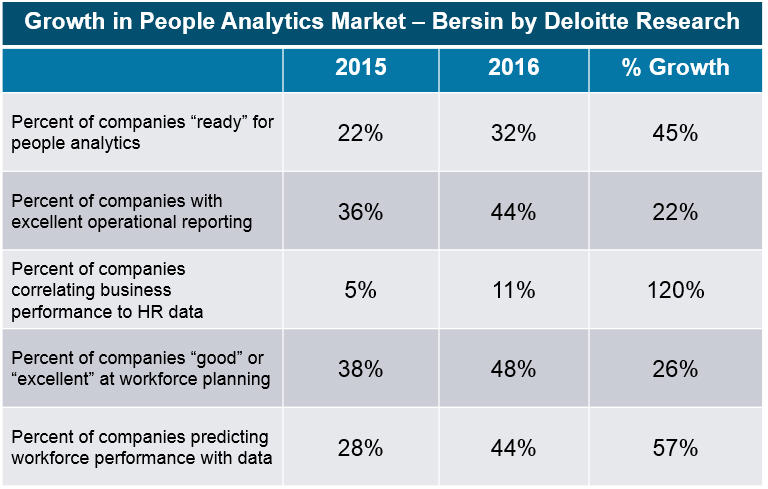
Came across this really interesting table about the explosive growth in HR Analytics.

data-driven-human-resources

(Source:  Deloitte Human Capital Trends 2015 and 2016, 3,300 and 7,100 respondents, respectively) 

The blogger who shared this, Mike Roberts, stated “With advancements in technology, as well as more awareness of the power of data, this is starting to change. Since 2014, we’ve seen an incredible transformation in the way talent acquisition professionals view data. And research from leading analyst firms has been backing that up.”

This is exactly why I have been doing HR & Recruitment Analytics training classess. There is a growing number of options out there, so make sure you get the bang for you buck you are hoping for.

IMG_6912

Connect with me if you want to know more about my approach to using data to drive decision-making in HR and Recruitment. I have recently published a book, Putting Your Data to Work, that can be your guidebook to how to get more people analytics in your HR and Recruitment processes.

HR & Recruitment Analytics – The recruitment and retention of top talent is the biggest challenge facing just about every organization. You really have to Think Through The Box to come up with winning solutions to effectively attract, retain and manage talent in the Philippines today. DMAIPH is a leading expert in empowering HR & Recruitment teams with analytics techniques to optimize their talent acquisition and management processes. Contact DMAIPH now at analytics@dmaiph.com or connect with me directly to learn how to get more analytics in your HR & Recruitment process so you can rise to the top in the ever quickening demand for top talent.

 

HR Recruitment Analytic Techniques

Every recruiting organization is looking for a way to better understand what’s working and what’s not working in their recruiting strategy. By using meaningful HR Recruitment Analytics techniques, your recruitment efforts can be greatly enhanced.

With real-time recruitment metrics & reporting, we can finally know what’s happening in our pipelines and what channels provide us with most qualified candidates.

New technologies like social networks, applicant tracking systems and business intelligence applications are fundamentally changing the entire recruitment process from sourcing to placement.

The pressure to deliver results has never been greater. HR and Recruitment managers are now more than ever required to demonstrate the return on investment their efforts are contributing to the bottom line.

Building analytics centric teams and using techniques taught in this training session will empower more data-driven decision making. This will result in both process efficiency and better return in investment in the recruitment process.

A few months ago, I facilitated a training class on HR Recruitment Analytic Techniques.

The Learning Session Objectives from the training were:

1. To learn analytics techniques that will allow quicker, deeper and more impactful analysis of HR Recruitment Big Data.
2. To be exposed to cutting edge technology being used in other companies to build HR Recruitment business dashboards and design more powerful reports.
3. To assess the current state of analytics in your HR Recruitment process and build a strategy to empower the greater use of analytics in your organization.

The Key Benefits from Attending this Learning Session were:

1.Develop analytic techniques that you can use to improve decision-making and improve the bottom line.
2. Explore analytics tools like business dashboards and data visualization to improve reporting.
3. Build a strategy to move your organization from current state to ideal state when it comes to the use of analytics.

Topics covered in the training included:

  • What is Recruitment Analytics?
  • Self-Assessment of your Recruitment Analytics
  • Analytic Techniques for Finding the Right Data at the Right Time
  • Applicant Tracking Systems & Social Media
  • Big Data and Recruiting Analytic Strategies
  • Business Intelligence, Data Visualization & Business Dashboards Technologies
  • Building Meaningful HR Recruitment Techniques

img_7502

Overall it was a great training class with lots of great discussion. Given that the recruitment and retention of top talent is the biggest challenge facing just about every organization. more conversations are needed.

DMAIPH is a leading expert in empowering HR & Recruitment teams with analytics techniques to optimize their talent acquisition and management processes. Contact DMAIPH now at analytics@dmaiph.com or connect with me directly to learn how to get more analytics in your HR & Recruitment process so you can rise to the top in the ever quickening demand for top talent.


Analytic Techniques to Make Data Driven HR Decisions

On June 22, 2016, in Ortigas, I will be partnering with my good friends at Ariva Events Management to facilitate a workshop on HR Recruitment Analytics.

We are expecting about 100 participants to come and learn more about how to use analytics to empower more data-driven decision-making in their organizations.

Analytics is now commonly being used across all industries, but being able to use the right analytic techniques to harness the power of big data is not so common.

Topics covered in the training include:

  • What is Recruitment Analytics?
  • Self-Assessment of your Recruitment Analytics
  • Analytic Techniques for Finding the Right Data at the Right Time
  • Applicant Tracking Systems & Social Media
  • Big Data and Recruiting Analytic Strategies
  • Business Intelligence, Data Visualization & Business   Dashboards Technologies
  • Building Meaningful HR Recruitment Techniques

New technologies like social networks, applicant tracking systems and business intelligence applications are fundamentally changing the entire recruitment process from sourcing to placement.

IMG_1224

A standard definition of HR Recruitment analytics is simply the metrics and analysis that relates to recruiting in a business.

However, we all know its actually a lot more challenging in practice.

The pressure to deliver results has never been greater.

HR and Recruitment managers are now more than ever required to demonstrate the return on investment their efforts are contributing to the bottom line.

So as the day progresses we will use hands of exercises based on real business cases to come up with solutions to the data challenges around us.

We will also look at several of the biggest trends in HR Recruitment Analytics. Sixmonths into 2016, there are the ones I have identified as the most common:

  1. Millennial Job-Hoppers
  2. Fresh Grad Skills Mismatch
  3. Selling Compelling Brands
  4. Focus Shift on Retention
  5. Social Media is not the magic solution
  6. Go Mobile or Go Dinosaur
  7. Big Data will make life better
  8. Analytics solutions that actually work

Don’t fall behind the competition. Recruiting for top talent in the Philippines is one of the hardest jobs on the planet right now. If your team is not armed with the best analytic techniques it will only get harder to stay a head in the game.

Let me know if you are interested in attending and I will connect you with my business partners at Ariva.