Outsourcing Tip > The Three T’s: Talent, Technology and Technique

I’ve been part of dozens of BPO team set ups and have directly implemented five this past year or so. In ALL five cases, we have had challenges because we didn’t have the right talent at launch, we didn’t have our technology lined up correctly and we didn’t have techniques in place to ensure a smooth transition of work and an optimal business flow.

Finding good talent here in the Philippines can be a difficult. I’ve blogged about this quite often, the skills gap is a major concern for the long-term success of outsourcing to the Philippines. There are so many good people with the right work ethic and the desire to learn, but so few of them are trained in a way that makes them day one ready to go in a call center environment. Making sure you have correctly identified the skills you need, allocating the appropriate recruiting resources, and building a pipeline to replenish loses and fuel expansion, is so much harder than it sounds.

In regards to technology, there are so many ways to connect clients, customers and operations here in the Philippines. The Cloud allows all sorts of processes to be easily shifted to remote staff and the culture in the Philippines is very tech driven, it’s a great match.

The challenge is sometimes the technology needed is not as easy to introduce as expected and telecommunications and online access very greatly across the country and the workforce. Having a tried and test technological solution and being prepared to deal with the connectivity issues will help assure a much smoother transition of work from abroad.

275

Most call center operations I have worked with don’t have a clear concept of what they want the day-to-day to look like. The lift and shift approach where you just take a process from overseas and apply it here never works without adjustments. Many times you can find more optimal ways of doing things when you set up because you are able to look at the process end to end. Taking advantage of fully understandings the process being outsourced, documenting it and training on it with a clear plan are all keys to success.

So in conclusion, often what people assume would be the easy parts turn out to be the hardest when it comes to the talent, technology and technique needed to se up a successful outsourcing operation. DMAIPH specializes in helping call centers bring more data to their decision-making and ensure a more optimal approach.

Analytics Outsourcing – DMAIPH has successful set up Filipino analytics teams for over a dozen U.S. based businesses. Offering both virtual and office based teams that specialize in problem solving using data, new technology and analytics techniques is our strength. Finding and empowering analytics talent is increasingly challenging, but we have it down to a science. Contact DMAIPH now at analytics@dmaiph.com or connect with me directly to learn more about how to set up an analytics-centric team in the Philippines.

Outsourcing Tip > BPO Contract Negotiations: Learn About Both “the Big Picture” and “the Fine Print”

This is the title of a seminar I put together awhile back for small and medium-sized BPO owners, executives and managers. The objective was to address the latest business challenges in the BPO Sector as related to contract negotiations.

We engaged several practitioners to come up with an approach to empower the audience with new and innovative ways to optimize their contract negotiation process.

Here are some of the highlights:
• The biggest challenge that comes with contract negotiations is generally around money. A well thought out and detailed business proposal is key in mitigating misunderstandings and conflict around the cost of outsourcing work.
• The smoothest transitions are generally ones managed by a seasoned project manager, but if you don’t have one, we outlined what needs to be done.
• We also talked about how process mapping can lead to process improvement and how to account for that in the contract.
• Using models to show base, best and worse case scenarios is key to making sure the contract will not become a negative business hindrance to either party.
• We will discuss the importance of clearly and consistently engaging and communicating with key players both internally and with overseas partners.
• Many time negotiations begin informally and just involve the principles as they have a handshake agreement.
• Service Level Agreements and Production Quotas should either be included in the contract or in an addendum that clearly outline expected results.
• If pricing is depending on meeting certain metrics, its imperative that both the goals and how the goals will be measured and reported are included in the contract.

522

At the end of the workshop, attendees should have walked away with the following items of knowledge:
1. An appreciation for all the work that needs to happen before the actual contract is signed between the business and the overseas partner.
2. Several tips on how to make sure the contract is an ironclad as possible in terms of anticipating challenges.
3. Several tools and resources to help them in preparing the BPO contract.
4. A checklist of things to not forget to account for in the actual contract language itself.

So, when it comes to setting up an outsourcing partnership, don’t fall victim to charging ahead without a clear idea of what you need to happen in the contract negotiations process to ensure success!

Analytics Outsourcing – DMAIPH has successful set up Filipino analytics teams for over a dozen U.S. based businesses. Offering both virtual and office based teams that specialize in problem solving using data, new technology and analytics techniques is our strength. Finding and empowering analytics talent is increasingly challenging, but we have it down to a science. Contact DMAIPH now at analytics@dmaiph.com or connect with me directly to learn more about how to set up an analytics-centric team in the Philippines.

Outsourcing Tip > Size the Opportunity! Not to be confused with Seizing the Opportunity.

When you have an opportunity to get involved with outsourcing, it always sounds like a good way to make some fast money.

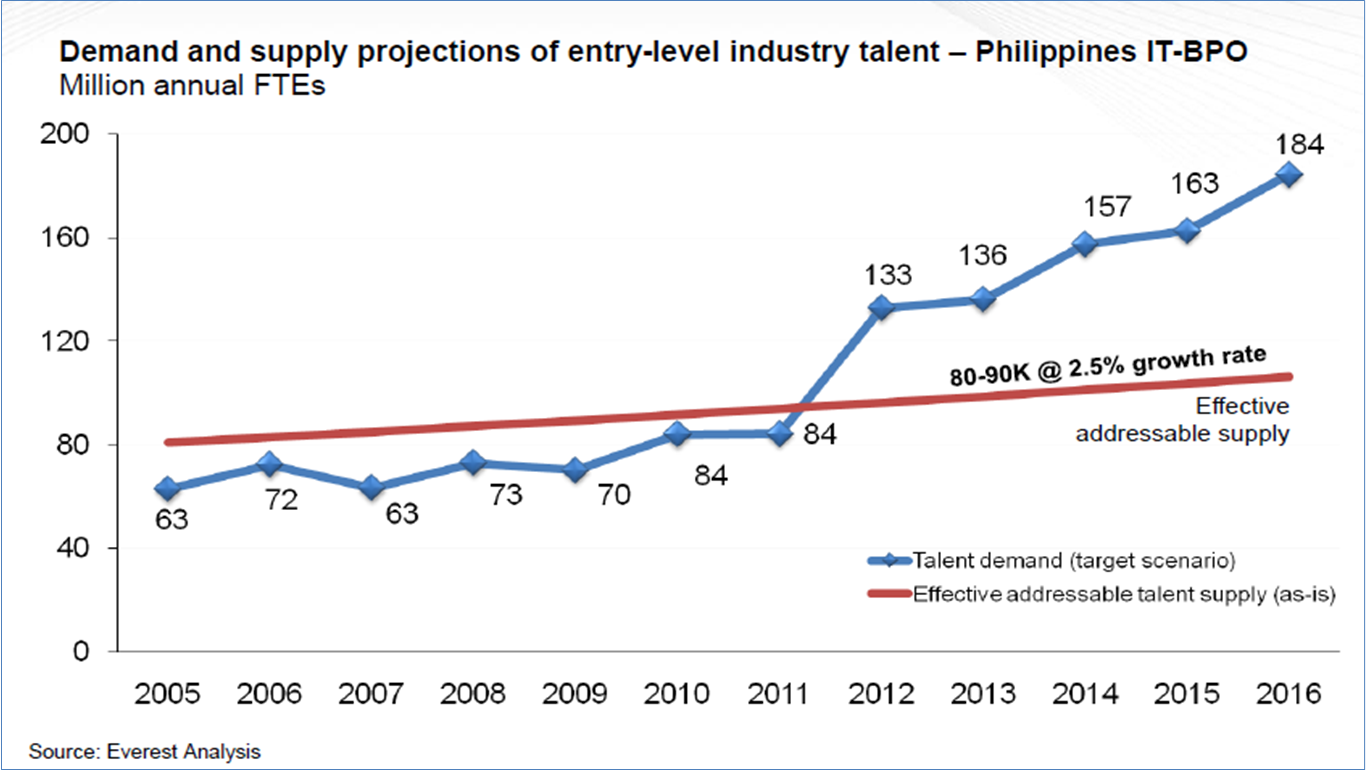
The news has been abuzz for a while now with mounds of data and statistics about the high-speed growth in the outsourcing industry, especially here in the Philippines. Just yesterday I saw a projection that BPOs in the Philippines are expecting to see a 15% growth in revenues in 2014.

Picture1

You couple that with the fact that everyone here knows someone who is making good money as a call center agent or investing in real estate that will be used by call centers, or have a friend in the US who knows someone who wants to save money by outsourcing. It’s one of those everyone is doing it, so why can’t I kinds of things.

This is all good, but there are just as many failures as there are success stories when it comes to small and medium-sized BPOs. Ones where someone had a client, or a building, or an idea but didn’t size it right and misjudged on cost, or talent or market and had to close their doors and lost money.

So when you have an outsourcing opportunity in front of you, whether it be as provider or a client, make sure you size it right. Here are a few things to think about:

  1. Does the client already have an existing business that they want to outsource? If so, fully understand all the requirements of that job as it is currently performed.
  2. Can you find the talent in the Philippines to provide just as good if not a little better service as currently is being provided? A common mistake is thinking that cutting both cost and the level of service will be a win-win.
  3. How scalable is this project? How can both ends be managed in a way that allows for uninterrupted growth? Often things start easy when it’s a pilot, but once you get into production a host of issues can pop up to derail growth and ultimately the partnership.
  4. How stable is the client? Are they a startup that has a great idea and is underfunded? Those are plentiful. Or are they an established business with a strategic plan that includes the fortitude to successfully outsource a key piece of its business? These are hard to find.

That is just a few things that come to mind when I think about sizing the opportunity. Having set up 5 teams in the past year to provide outsourcing services, I have learned a lot about making sure I get the sizing done right. Keeping a client happy is all about under promising and then over delivering when it comes to time, talent and cost.

Analytics Outsourcing – DMAIPH has successful set up Filipino analytics teams for over a dozen U.S. based businesses. Offering both virtual and office based teams that specialize in problem solving using data, new technology and analytics techniques is our strength. Finding and empowering analytics talent is increasingly challenging, but we have it down to a science. Contact DMAIPH now at analytics@dmaiph.com or connect with me directly to learn more about how to set up an analytics-centric team in the Philippines.
Being A Great Analyst > Attribute #2: Visualize Your Data

Most people learn by seeing something… that’s definitely true when it comes to using data. They not only learn more, but data visualization also a quicker sharing of information and also enhances communication.

Here’s an example. My management team was discussing how to enhance our coaching efforts with the team and since each of my direct reports has a different area of responsibility; production, quality and schedule adherence, they were having trouble agreeing on which analysts needed the most coaching. They each produced reports that were stand alone documents that would be shared via email or dropbox.

So I suggested we build a simple business dashboard. A business dashboard looks something like this:

It’s a simple collection of visuals built on top of a data file.

I created a simple Google docs spreadsheet and shared it. Each of the key performance indicators used to evaluate employee success was given a column and I put each employee a row. I then had each of my directs input the relevant data points and quickly we had a rudimentary business dashboard and I now I have a much more in synch management team.

img_7526

Simple analytics solutions like this are at the fingertips of any business. You just need to know when, where, and how best to implement them. Something so simple as a place to share data is so often overlooked by even the most successful businesses.

Analytics Culture – The key to using analytics in a business is like a secret sauce. It is a unique combination of analytics talent, technology and technique that are brought together to enrich and empower an organization. A successful analytics culture is not easy to create, but DMAIPH can show you how. Contact DMAIPH now at analytics@dmaiph.com or connect with me directly so we can build a strategic plan to turn your company into analytics driven success story.

The Mission of the DMAI Family of Companies: Creating More Analysts

I just wanted to share this blog post from the World Bank as it addresses exactly what we at DMAIPH have been saying and are trying to address; the need for more high end skills training in the Philippines.

12072012489

8 of 12 from this training batch found jobs with BPO companies within a couple weeks of completing the two day Introduction to Analytics training!

http://blogs.worldbank.org/eastasiapacific/node/3096
======================================

The Philippines faces an enormous jobs challenge. Good jobs—meaning jobs that raise real wages or bring people out of poverty—needed to be provided to 3 million unemployed and 7 million underemployed Filipinos—that is those who do not get enough pay and are looking for more work—as of 2012.

In addition, good jobs need to be provided to around 1.15 million Filipinos who will enter the labor force every year from 2013 to 2016. That is a total of 14.6 million jobs that need to be created through 2016.

Did you know that every year in the last decade, only 1 out of every 4 new jobseeker gets a good job? Of the 500,000 college graduates every year, roughly half or only 240,000 are absorbed in the formal sector such as business process outsourcing (BPO) industry (52,000), manufacturing (20,000), and other industries such as finance and real estate.

Around 200,000 new job seekers find work abroad, and around 60,000 will join the ranks of the unemployed, go back to school, or rely on financial support from family for the time being.

This still leaves 600,000 new jobseekers who have no choice but to work in the low-skill and low-pay informal sector in rural and urban areas.

Higher growth can provide more Filipino workers with good jobs. With sustained GDP growth of 7 percent per year and the removal of constraints in fast growing sectors (e.g., addressing skills shortages so that the BPO industry can accelerate its annual growth from 20 to 30 percent), the formal sector will be able to provide good jobs to around 2 million people in the next 4 years – that is double the current figure.

Even so, the majority of Filipino workers will still be left out. By 2016, around 12.4 million Filipinos would still be unemployed, underemployed, or would have to work or create work for themselves in the low pay informal sector such as selling goods in sari-sari stores (small retail stores) and peddling on the streets, and driving tricycles and pedicabs.

Addressing this jobs challenge requires meeting a dual challenge: expanding formal sector employment even faster, while rapidly raising the incomes of those informally employed.

To create good jobs for the 12.4 million, a comprehensive package of reform is needed to create a business environment that is conducive for the private sector to create jobs and increase human capital. Reforms that will secure property rights, open the economy to more competition, simplify business regulations, and increase investments in health, education, and infrastructure are needed.

But will the private sector have the incentive to invest and create jobs for the 12.4 million Filipinos who are left out of the fast growing formal sector?

What do you think is key to creating more and better jobs in the country? Creating jobs for millions is a daunting task, but perhaps we can agree to start somewhere.

call_center

Analytics Training – DMAIPH offers a wide range of analytics centric training solutions for professionals and students via public, in-house, on-site, and academic settings. We tailor each training event to meet the unique needs of the audience.

If you need empowerment and skills enhancement to optimize the use of analytics in your organization, we are here to help. Contact DMAIPH now at analytics@dmaiph.com or connect with me directly to set up a free consultation to learn which of our DMAIPH analytics training solutions is best for you. 

How I Use Logic As An Analyst

Here is a follow up to the student I am helping with her class assignment on Logic… She asked me how I apply logic as an analyst with an example and here is what I came up with.

How I Use Logic As An Analyst

According to Webster’s Dictionary, logic is “the science or art of exact reasoning” and analyst is “someone who is skilled at analyzing data”. The two definitions are where I start when how I think back to the application of logic during my career as an analyst.

To solve business problems you need data. You need to identify the right data, analyze it and communicate your results. In all three aspects of analysis work you need to employ logic.

Basil Rathbone as Sherlock Holmes

When you are given a business problem to solve, say how to determine a market for a new project or trying to figure the cause behind a slowdown in production, you need to start with data. What data you get, how you get it and where you get it from is all driven by a combination of your business experience and logic.

Logic helps you eliminate data that useful to the problem at hand. One time when I was looking for data on current remittance flows to China, a logic driven approach would be to start looking at Chinese economic websites. Which I did using the science of logic.

Once I got some data sources on remittances from the US to China, I then used logic in my analysis. Is the data current? Is the source reliable? Is it relevant? Logic dictated that I not use sources that were more than a year old, where not from government sources and where directly providing data on remittances to China.

In my analysis I saw several patterns, most remittances where going to only two provinces. That is logical when you research to see that most immigrants to the US come from these two provinces.

And when I was ready to communicate my results, my choice on which application to use, what tone to use in my language and what visuals to use were all driven by my knowledge of the audience.

Since this was for a senior manager, well-versed in remittance patterns and very comfortable with big data speak, I just cut and past some charts from Excel into an e-mail and gave him 2-3 bullet points about the patterns I saw and noted my source. It was logical that he didn’t need a lot of explanation or easy to see analysis given his pedigree.

If this had been for a more general audience of say fresh grads who have never looked at this kind of data before, it would be logical to use PowerPoint, supply several descriptive notations and some easy to digest visuals that show remittance trends.

Trying to provide students with a report designed for senior managers is illogical for someone like myself with a lot of business analysis experience.

In the end, it is my opinion that few career paths call for a more consistent application of logic then does that of an analyst.

Analytics Leadership – DMAIPH specializes in arming the Data-Driven Leader with the tools and techniques they need to build and empower an analytics centric organization. Analytics leadership requires a mastery of not just analytics skill, but also of nurturing an analytics culture. We have guided thousands of Filipino professionals to become better analytics leaders. Contact DMAIPH now at analytics@dmaiph.com or connect with me directly to discuss a uniquely tailored strategy to ensure you are the top of your game when it comes to Analytics Leadership.

Revisiting the “Services Shift”

The world is currently witnessing a fundamental reorganization in the way services are delivered to customers. This is what is behind the movement to outsource. It’s a lot more than just saving money by shipping jobs overseas. Harvard Business Professor Robert E. Kennedy, call this the “Services Shift”. The globalization of services, in which different tasks are being carried out by different individuals in different locations, is about gaining access to the best combination of talent, resources and markets.

I bring this up because I recently blogged about Medical Transcription work being done in the Philippines. I came across a blog sharing some of the opportunities for nursing graduates in the Philippines to consider a career as an MT for a BPO company. The blog was not the most well written one, but it captured the sense of optimism for those looking for work in a way that perhaps before they had not considered. That really appealed to me so I used it in my blog.

I expected to get some negative reaction, because MT work is one of the areas of employment in the US that has been significantly impacted by the outsourcing of work overseas. MT work is not easy, and those that do it wherever they are employed requires a lot of skill, training and diligence. I see that with the team I’ve been working here in the Philippines. However, in my efforts to share that good story, I ended up also upsetting some hard-working Americans who have seen MT opportunities go abroad. And that made me think of this book the “Services Shift”.

Kennedy quotes several factors that are at play when industries are “outsourced”, they are:
* Technological Innovations like easy access to the internet and stored data.
* Emerging Market Growth in traditionally closed markets
* Global Macroeconomic Liberalization of government polices toward trade
* The Corporate Imperative to both reduce costs and improve quality
* The Convergence of a Global Business Culture based on the English language and American business models.

Given these factors, its easy to see how countries like India and the Philippines have taken advantage of situation and offered MT services as an outsourcing option. To that end I am working with a Philippines based company that is offering it MT and Coding services to companies in the U.S. I have made the choice to build my business on being part of the “Services Shift” and I am looking for like-minded people who see the opportunity to collaborate and find ways to take advantage of their experience and use it in a global partnership.

The Philippines is Going Beast Mode! 2 of 3

ASEAN Demographics

Sharing my thoughts on some great Bloomberg visuals my good friend Justin Calderon used in a recent story he put together.

http://investvine.com/charts-outlining-the-philippines-economic-trajectory/

Beast Mode is an American Football term for a player who singlehandedly dominates a game. This is the second of three visuals I will breakdown and comment on.

This slide tells me so much. Based on this I am convinced that its time to revamp my plans for training fresh grads in analytics. Look at how much younger the Philippines is then its neighbors! Combine this remarkable demographic datapoint with other factors like the investment being made in the BPO/Call Center industry, the education system geared to produce American style English, and the size of the talent pool.

When you do that you see what I see, an amazing opportunity to be in the middle of all the training, skill building and mentoring that will be needed to prepare this population boom for the jobs of the next 10-20 years.

In the previous post, it was noted how quickly the Philippines economy is accelerating and here you see a snapshot of the future. There are still so many potential detractors and possible hindrances ahead, so you have to pay them mind. However, its data points like that, backed up by analysis and on the ground intelligence that have me convinced its time to go back and jump in!

Lesson 9 – January 2013 – New Beginnings

139Ortigas, Metro Manila, Philippines

January 2013 got off to a great start. I set up a training, had a partnership with an events management company set up one in February, I filmed my first promotional video, and we had an official kick off party launch. I looked back at all the lessons I had learned in 2012 and focused in on two key ones; better marketing partnerships and charging more for the trainings.

There are so many important elements to a good marketing campaign. I learned a lot during my time with Wells, but hadn’t done a great job of them up till now. One thing was we needed a video. Something with me talking about analytics in away that gave people a chance to both better understand the topic and walk way feeling that I’m the best person to teach them about it. After some miscues we finally got it right. Another lesson is to have another voice be the one talking me up. We partnered with an events management company to get me in the media and put some polish on things. I guested on a number of TV and Radio shows and we started to sponsor more high profile events.

The next thing to do was reload the staff. At the end of 2012, I was down to one staff and no trainees. I decided to go all in with hiring more staff to help with the marketing and get our message out much broader then before. And with the media exposure we had content, we just needed to get it in front of as many people as possible. Based on the data available, I knew that our best bet was to train young professionals who could pay 3000 PHP for the training and then refer friends and co-workers. So that was the heart of our plan.

At the end of the month I was exactly where I wanted to be, the business had every sign of taking off and reaching the heights I had in mind.

Analytics Tool > KD Nuggets > http://www.kdnuggets.com/

Analytics Concept > Cost Benefit Analysis > http://en.wikipedia.org/wiki/Cost%E2%80%93benefit_analysis

YouTube Resource > http://youtu.be/A0rFj0WVqDQ

My Analytics Story – My passion is solving problems by bringing together the best talent, cutting edge technology and tried and true methodologies. DMAIPH is all about empowering people towards better Decision-Making through the use Analytics and business Intelligence. This is what I do best. Contact DMAIPH now at analytics@dmaiph.com or connect with me directly for a free consultation about getting more analytics into your career and your business.

13 Months in the Philippines – Lesson 7 – November 2012 – Flying Solo

Muntinlupa City, Metro Manila, Philippines

When I got back from the U.S. in early November, things were very different. And that’s and understatement. They weren’t just different everything was starting to fundamentally change. My partners and I split ways. The project in Clark ended. I no longer had an office to go to. My right hand girl left to get married and have a baby. My trainees all found jobs. Professionally I was flying solo for the first time and it was exhilarating. I decided to take what I had learned from BPO Elite’s short coming and apply the lessons to a new company that would become DMAI.

SAM_4385

However, I also knew that even though I was charting my own course, I would need lots of help from people to be successful. I ratcheted up my networking and took on a new consulting gig with a medical transcription company. I started looking for marketing partners who can help me get my message to a broader audience and I started looking for better short term ROIs on my projects.

By the end of the month it was paying off. I was starting to make decent money and had a master plan to launch the new company in January.

From an analytics perspective, I dove deep into the needs of my new client. I did a lot of research on healthcare outsourcing to learn the players, the trends and the sweet spots. Gathering data and fashioning it into a marketing strategy was priority one. Determine which products would give the company the best ROI, updating the marketing message and focusing in on key markets was the plan. It was a well polished business strategy that was deeply grounded in my analysis. The sky is the limit!

Analytics Tool > Microsoft Access > http://office.microsoft.com/en-us/access/

Analytics Concept > Needs Assessment > http://en.wikipedia.org/wiki/Needs_assessment

YouTube Resource > http://youtu.be/AiAHlZVgXjk

My Analytics Story – My passion is solving problems by bringing together the best talent, cutting edge technology and tried and true methodologies. DMAIPH is all about empowering people towards better Decision-Making through the use Analytics and business Intelligence. This is what I do best. Contact DMAIPH now at analytics@dmaiph.com or connect with me directly for a free consultation about getting more analytics into your career and your business.