What Is Strategy?

http://bakerstreetpublishing.com/decisioncoaching/2015/02/12/what-are-the-strategic-decisions-we-face/

I came across this perfectly timed blog post on LinkedIn. Tomorrow we will be having our first real leadership planning session in a while and we have a lot of topics on the agenda.

However, before we get into the nitty gritty, I will spend the first part of the meeting talking about strategy. And these concepts will form the core of that conversation.

jobspicture2

“Every business must have three things to be successful: good leadership, good strategic decision making, and the ability to execute. “

  • Good Leadership: To me this means inspiring and empowering team members to take the initiative, to be bold in problem solving and being able to balance client, customer, business and team member needs.
  • Strategic Decision-Making: Taking a logical and data-driven approach to decision-making is the best way to map out your business plan.
  • The Ability to Execute: Good leaders know how to implement decisions quickly and efficiently because they work in a sound framework of empowerment and intelligence.

Looking at closely at the data is key part of this. Good leaders do much more than just manage, and it’s important to constantly remind ourselves of this.

Analytics Leadership – DMAIPH specializes in arming the Data-Driven Leader with the tools and techniques they need to build and empower an analytics centric organization. Analytics leadership requires a mastery of not just analytics skill, but also of nurturing an analytics culture. We have guided thousands of Filipino professionals to become better analytics leaders. Contact DMAIPH now at analytics@dmaiph.com or connect with me directly to discuss a uniquely tailored strategy to ensure you are the top of your game when it comes to Analytics Leadership.

Achieving Better Results Through Analytics: What’s Your Analytics Strategy?

Just put together a pitch deck for a potential in-house corporate training.

Here’s some of the highlights…

You need an analytics strategy.

Making data-driven decisions is key to success in any business.

Having the right data at the right time makes all the difference.

Data-driven decision-making, as well as improved productivity and better overall outcomes begins with analytics.

Some of the benefits from a good analytics solution include:

  • Provide timely and targeted coaching/training to agents.
  • Ensures that the right materials are assigned.
  • Optimizes process of following agent improvements, leading to skill development and job mastery.
  • Eliminates the need for e-mailing countless excel spreadsheets
  • Schedules coaching/ training at an appropriate time.
  • Optimizes the follow up process to review impact of training and identifies when agent performance requires management attentions.
  • Give’s Management a High Level Overview of important KPIs.

IMG_6912

Business Strategy with Analytics – Aligning a business strategy to drive an organization forward requires a robust analytics solution. Businesses who have good analytics tend to be much more profitable and efficient then ones that do not. DMAIPH has helped dozens of companies in both the U.S. and the Philippines with adding more data analysis in their business strategy.

That’s why we have joined up with our key business partner PMCM Events Management to showcase our solutions at #TechToniPH in July 2017. Contact DMAIPH now at analytics@dmaiph.com or connect with me directly to find out what we can do to help you align your business strategy with analytics.


I Love Jumping In The Deep End First, But Wading Can Be Smarter!

http://sethgodin.typepad.com/seths_blog/2014/10/taking-the-plunge.html

I was reading my blogging hero, Seth Godin’s blog this morning and it made me think about what comes next.

After spending close to a year setting up a 60+ person team for a client from scratch, setting up a call center office and launching a new business to manage it, I am now ready to look for my next challenge.

Like Seth talks about in his blog, wading is a far smarter way to get your foundation set then jumping into the unknown. Starting with a six person work from home team and methodically growing it to a 60+ person team with 2/3 work from home and the rest office based, we went from wading, to swimming, to taking daily plunges off the high dive.

So now I need a new pool to play in and based on what I have learned I can wade into it at first, but before too much time passes I will be doing what I love best… jumping in the deep end.

15220172_10154796376872425_148074038239599249_n

Analytics Leadership – DMAIPH specializes in arming the Data-Driven Leader with the tools and techniques they need to build and empower an analytics centric organization. Analytics leadership requires a mastery of not just analytics skill, but also of nurturing an analytics culture. We have guided thousands of Filipino professionals to become better analytics leaders. Contact DMAIPH now at analytics@dmaiph.com or connect with me directly to discuss a uniquely tailored strategy to ensure you are the top of your game when it comes to Analytics Leadership.

Making You Business More Prominent On The Web

https://www.linkedin.com/today/post/article/20140713020324-277926763-the-biggest-dilemma-for-entrepreneurial-minds?trk=tod-home-art-list-large_0

I came across this blog post on LinkedIn that shares some insights on how an entrepreneur can get their product/service to stand out in the crowded landscape of bright ideas, innovative solutions and be the next big thing.

Here’s what the blogger think needs to happen to make business ideas prominent on the web:

1. People need to understand that their ideas aren’t going to get stolen. People who notice your ideas are either going to a). Simply tell you what they think, b). Want to go into business with you, or c). Become an early adopter of your product. Win/win. The truth is very few people would take the risk necessary to implement your ideas. The few who do become investors, business partners, and employees.

I am a big proponent of this. In fact is other people want to get out there and set up analytics focused companies in the Philippines that do any combination of training, consulting and outsourcing, that’s a good thing. The pie is far bigger then I can eat alone. And competition makes us all better.

2. People need an online platform to publish and collaborate on business ideas. Kind of like open source sites, but for business ideas and plans. This platform would help entrepreneurs reach people with similar business goals and ideas, and connect and collaborate with them.

I use WordPress for this or a number of reasons. It’s easy to use and its free. It allows me to blog about a range of topics like outsourcing, analytics, the Philippines, decision-making and setting up a small business all in one place. WordPress can also be set up to deliver your content to Facebook, LinkedIn and Twitter (among others) automatically. So My 2000 blog followers, 5000 LinkedIn connections and 1500 Facebook friends all get my content beamed right to them.

3. Lastly, people need to be able to reach professionals through this platform.

I make a point of cutting and pasting my blog post links into groups on LinkedIn and Facebook. I add just about anyone on LinkedIn who views my profile (aside from the less 1% who are obvious scammers). I send a reply to everyone I connect with (sometimes I do have to have interns send the initial message) and I follow-up personally on every business lead, student question or well-wisher.

10406025_10152524531307425_1404103117_n

If you are looking to launch a new business, thinking about outsourcing some analytics functions or wondering how to set up a business in the Philippines, DMAI can help!

Communicating Strategy From the Bottom

http://blogs.hbr.org/2014/06/strategy-isnt-what-you-say-its-what-you-do/

Came across the log post about strategy implementation and I think it’s a good one for consultants working with senior management teams. It goes along the lines of walking the talk.

“Strategic choice-making cascades down the entire organization, from top to bottom. This means that every person in the company has a key role to play in making strategy. Performing that role well means thinking hard about four things:

1) What is the strategic intent of the leaders of the level above mine?
2) What are the key choices that I make in my jurisdiction?
3) With what strategic logic can I align those choices with those above me?
4) How can I communicate the logic of my strategy choices to those who report to me?

If you as a manager can do the first three of these four, then you will own your choices and own your strategy. If you do the fourth, you will set up your subordinates to repeat these four things and thereby own their choices and their strategy, and pass on the task to the next layer of the company. If each successive layer assumes this level of ownership, the organization can make its bosses’ statement a real strategy rather than an empty slogan.”

I can personally say that these points are all very important to infuse into the culture of your company. Both from my Wells Fargo experience where these are deeply ingrained in the corporate culture to the smaller scale of my own company, clearly communicated strategy is the key.
When not only your direct reports, but your two downs are spreading the gospel, you will be successful.

If you need help getting your team to walk the talk, I’m happy to help.

Business Strategy with Analytics – Aligning a business strategy to drive an organization forward requires a robust analytics solution. Businesses who have good analytics tend to be much more profitable and efficient then ones that do not. DMAIPH has helped dozens of companies in both the U.S. and the Philippines with adding more data analysis in their business strategy. Contact DMAIPH now at analytics@dmaiph.com or connect with me directly to find out what we can do to help you align your business strategy with analytics.


Outsourcing Tip > Make NASA Jealous! Ensure You Have A Smooth Launch Of Your Outsourcing Efforts

The final area that I have seen countless outsourcing efforts fall short is in having a smooth launch. You have put so much time into sizing the opportunity, negotiating the contract, finding the right people, acquiring the technology you need and building a technique playbook, but you aren’t done yet. You still need to roll it out.

When it comes to outsourcing, there is one thing I have never, ever seen. And that is a full delivery of services, exactly as required on target and without any glitches.

Here are a few keys to ensuring that you go live and avert as many potential disasters as possible.
• First of all, have a risk minded person involved. Someone who is great at looking at something and then coming up with a laundry list of things that can go wrong. And then most importantly, have them in charge of eliminating or mitigating the risks.
• Second, have your processes, the workflow, escalation procedures, and other important documents in writing for the team. No battle plan survives first contact unscathed, but the battle will go much better with one.
• Third, brief everyone. Have a pre-kick off meeting, do a walk through, run lots of tests. Do whatever you can to mimic production so that people get used to having to make decisions just like they will when things are live.
• And finally, hapollo11ave a plan to celebrate. Let everyone know what awaits them if they pull everything off. Give them an extra reason to go an extra step. Everyone wants to be part of a winning team enjoying the celebration of a new start.

That is just a few ideas of what you can do to ensure your launch go as smooth a NASA’s putting a man on the moon!

Analytics Outsourcing – DMAIPH has successful set up Filipino analytics teams for over a dozen U.S. based businesses. Offering both virtual and office based teams that specialize in problem solving using data, new technology and analytics techniques is our strength. Finding and empowering analytics talent is increasingly challenging, but we have it down to a science. Contact DMAIPH now at analytics@dmaiph.com or connect with me directly to learn more about how to set up an analytics-centric team in the Philippines.


Outsourcing Tip > BPO Contract Negotiations: Learn About Both “the Big Picture” and “the Fine Print”

This is the title of a seminar I put together awhile back for small and medium-sized BPO owners, executives and managers. The objective was to address the latest business challenges in the BPO Sector as related to contract negotiations.

We engaged several practitioners to come up with an approach to empower the audience with new and innovative ways to optimize their contract negotiation process.

Here are some of the highlights:
• The biggest challenge that comes with contract negotiations is generally around money. A well thought out and detailed business proposal is key in mitigating misunderstandings and conflict around the cost of outsourcing work.
• The smoothest transitions are generally ones managed by a seasoned project manager, but if you don’t have one, we outlined what needs to be done.
• We also talked about how process mapping can lead to process improvement and how to account for that in the contract.
• Using models to show base, best and worse case scenarios is key to making sure the contract will not become a negative business hindrance to either party.
• We will discuss the importance of clearly and consistently engaging and communicating with key players both internally and with overseas partners.
• Many time negotiations begin informally and just involve the principles as they have a handshake agreement.
• Service Level Agreements and Production Quotas should either be included in the contract or in an addendum that clearly outline expected results.
• If pricing is depending on meeting certain metrics, its imperative that both the goals and how the goals will be measured and reported are included in the contract.

522

At the end of the workshop, attendees should have walked away with the following items of knowledge:
1. An appreciation for all the work that needs to happen before the actual contract is signed between the business and the overseas partner.
2. Several tips on how to make sure the contract is an ironclad as possible in terms of anticipating challenges.
3. Several tools and resources to help them in preparing the BPO contract.
4. A checklist of things to not forget to account for in the actual contract language itself.

So, when it comes to setting up an outsourcing partnership, don’t fall victim to charging ahead without a clear idea of what you need to happen in the contract negotiations process to ensure success!

Analytics Outsourcing – DMAIPH has successful set up Filipino analytics teams for over a dozen U.S. based businesses. Offering both virtual and office based teams that specialize in problem solving using data, new technology and analytics techniques is our strength. Finding and empowering analytics talent is increasingly challenging, but we have it down to a science. Contact DMAIPH now at analytics@dmaiph.com or connect with me directly to learn more about how to set up an analytics-centric team in the Philippines.

Outsourcing Tip > Size the Opportunity! Not to be confused with Seizing the Opportunity.

When you have an opportunity to get involved with outsourcing, it always sounds like a good way to make some fast money.

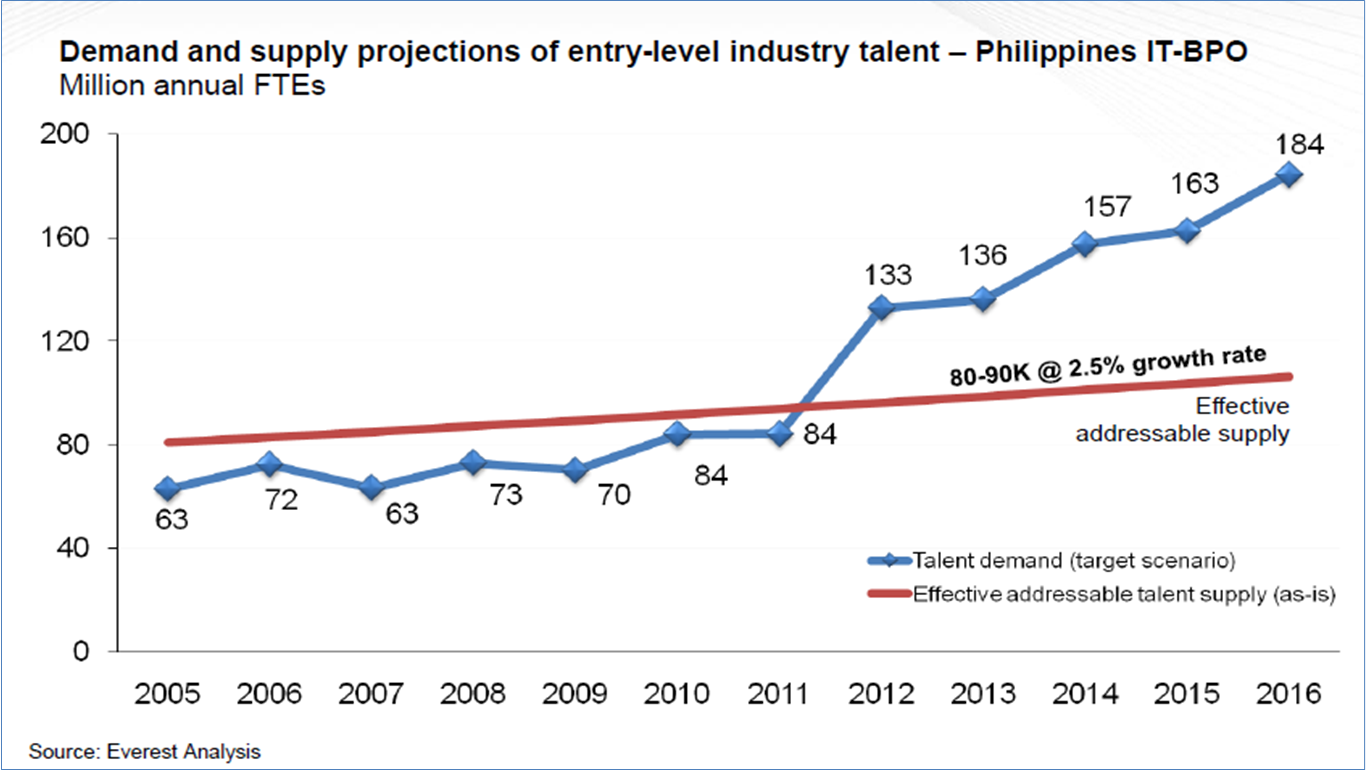
The news has been abuzz for a while now with mounds of data and statistics about the high-speed growth in the outsourcing industry, especially here in the Philippines. Just yesterday I saw a projection that BPOs in the Philippines are expecting to see a 15% growth in revenues in 2014.

Picture1

You couple that with the fact that everyone here knows someone who is making good money as a call center agent or investing in real estate that will be used by call centers, or have a friend in the US who knows someone who wants to save money by outsourcing. It’s one of those everyone is doing it, so why can’t I kinds of things.

This is all good, but there are just as many failures as there are success stories when it comes to small and medium-sized BPOs. Ones where someone had a client, or a building, or an idea but didn’t size it right and misjudged on cost, or talent or market and had to close their doors and lost money.

So when you have an outsourcing opportunity in front of you, whether it be as provider or a client, make sure you size it right. Here are a few things to think about:

  1. Does the client already have an existing business that they want to outsource? If so, fully understand all the requirements of that job as it is currently performed.
  2. Can you find the talent in the Philippines to provide just as good if not a little better service as currently is being provided? A common mistake is thinking that cutting both cost and the level of service will be a win-win.
  3. How scalable is this project? How can both ends be managed in a way that allows for uninterrupted growth? Often things start easy when it’s a pilot, but once you get into production a host of issues can pop up to derail growth and ultimately the partnership.
  4. How stable is the client? Are they a startup that has a great idea and is underfunded? Those are plentiful. Or are they an established business with a strategic plan that includes the fortitude to successfully outsource a key piece of its business? These are hard to find.

That is just a few things that come to mind when I think about sizing the opportunity. Having set up 5 teams in the past year to provide outsourcing services, I have learned a lot about making sure I get the sizing done right. Keeping a client happy is all about under promising and then over delivering when it comes to time, talent and cost.

Analytics Outsourcing – DMAIPH has successful set up Filipino analytics teams for over a dozen U.S. based businesses. Offering both virtual and office based teams that specialize in problem solving using data, new technology and analytics techniques is our strength. Finding and empowering analytics talent is increasingly challenging, but we have it down to a science. Contact DMAIPH now at analytics@dmaiph.com or connect with me directly to learn more about how to set up an analytics-centric team in the Philippines.

Being A Great Analyst > Attribute #2: Visualize Your Data

Most people learn by seeing something… that’s definitely true when it comes to using data. They not only learn more, but data visualization also a quicker sharing of information and also enhances communication.

Here’s an example. My management team was discussing how to enhance our coaching efforts with the team and since each of my direct reports has a different area of responsibility; production, quality and schedule adherence, they were having trouble agreeing on which analysts needed the most coaching. They each produced reports that were stand alone documents that would be shared via email or dropbox.

So I suggested we build a simple business dashboard. A business dashboard looks something like this:

It’s a simple collection of visuals built on top of a data file.

I created a simple Google docs spreadsheet and shared it. Each of the key performance indicators used to evaluate employee success was given a column and I put each employee a row. I then had each of my directs input the relevant data points and quickly we had a rudimentary business dashboard and I now I have a much more in synch management team.

img_7526

Simple analytics solutions like this are at the fingertips of any business. You just need to know when, where, and how best to implement them. Something so simple as a place to share data is so often overlooked by even the most successful businesses.

Analytics Culture – The key to using analytics in a business is like a secret sauce. It is a unique combination of analytics talent, technology and technique that are brought together to enrich and empower an organization. A successful analytics culture is not easy to create, but DMAIPH can show you how. Contact DMAIPH now at analytics@dmaiph.com or connect with me directly so we can build a strategic plan to turn your company into analytics driven success story.

Why the Philippines? Q+A

539735_206746759470775_461235919_nRecently I received a LinkedIn message regarding my blog series about my 13 months living and setting up a business in the Philippines. The message contained some pretty good questions so I thought the best way to answer it would be to share the conversation with you.

Q: I’m always curious to hear why people have chosen the Philippines over other countries to start a business in?

A: From my perspective, the Philippines is a truly phenomenal place to be right now. I ask everyone is there any country today in a better position to make such significant and long lasting positive changes in the very fabric of the country? Being the home of some many overseas workers and their remittances, being the call center capital of the world, be positioned close to some of the biggest markets in the world and blessed with a unique connection to the United States are just some of the reasons. Its on the verge of something truly special. You can feel it where you are there. So for professional reasons that’s why I decided to move there and set up a business. There are even more personal reasons why I love the Philippines, but that’s a different question.

Q: Even given some of the press around about the difficulties with traffic, weather, corruption?

A: They are all significant challenges that can indeed hinder growth. However, I think the Philippines is being forced to evolve as a nation by some key demographics that make its growth unavoidable. The average being 23, the level of English taught and used, the culture of embracing work either coming from or going to the rest of the world. The traffic is a nightmare in Manila, but you are seeing a lot of growth in the provinces as a result. The weather is a problem, but the county is big enough and the important economic drivers are diverse enough to weather major calamities. Corruption is a huge problem, but its getting better. It is being addressed at all level of society and progress is being made. I survived getting stuck in traffic on EDSA, caught in flood waters up to my waste and forced to pay a fixer to get some things done faster and none these things lesson my confidence in the Philippines.

Q: From a business perspective, I see a growing trend in being able to provide customized types of products and services. Are niche businesses offering customized products and services viable?

A: When I compare the challenges of setting up a small business and taking your product/service to the market, its 10x easier than it is in the U.S. There challenges are very different. In the Philippines your success will depend on who you know and how your business identity is perceived. You have to but a lot more effort into making connections and making sure everyone is happy and engaged. There is a lot of bureaucracy that goes with setting up a business there so it’s key to have the right connections to smooth things out.

Q: I am looking to recruit some people to do some web design work. Is it better to look for established workers or go with college age students.

A: I tend to go with younger, less proven talent in most cases. This goes against conventional wisdom in the Philippines. I have noticed that in general Filipinos place a higher value on certifications and accomplishments than most. And the school systems push out a lot of graduates with similar training and skills sets. Conformity and coloring within the lines is expected for most white collar jobs. The more time spent in this rigid system the harder it is to find someone who thinks outside the box. So going with the whole I prefer to train a blank slate versus having to untrain someone who is already programmed. However, the flipside is they will probably need more supervision and direction then someone with experience.

Q: I would love to hear more about which things you would do differently second time around.

A: To quote one of the most quoted saying of all time… “I shall return!” And when I do I will make these three significant changes in my approach. (1) I will be more hands on with the people I hire. I will not micromanage like many do, but I will be more active in empowering and teaching successful work habits to the people on my team. (2) I will be more frugal in my expenses. I overspent a lot on things because I was charged foreigner prices. Having a Filipino negotiate things for you is key. (3) I will live more like a Filipino and less like a foreigner. By the time I left I took Jeepneys and Buses more often than taxis. I was eating more Filipino food from small vendors and avoiding high priced meals at chains in the mall. Things like that go a long way in both making you fit in a little more and saving you a lot of money.

I am always happy to share my insights and experiences. I hope that helps!