
Current Trends in Small Business Analytics

Analytics as a discipline is constantly evolving. Advances in technology allow what was once expensive and difficult to now be at the fingertips of any business user.  The goal of analytics is “to turn data into information, and information into insight.” -Carly Fiorina, Former CEO of HP

Fiorina, highlighted some of the key steps in analytics. Reporting turns raw data into information that can be consumed by a company, and through analysis you turn information into insights. Taking her comments one important step further, you need to turn insight into action if you want to progress down the path to value with analytics.

Analytics is constantly evolving, so staying current is paramount to success.

Staying current is all about being strategic in time management. I have to stay up to date on current trends in analytics as well as with new analytics applications and technologies. Besides just staying current for my own benefit, I share relevant updates with my colleagues, clients and followers.

Every few months I devote a day to discover what the current trends in analytics are. I do this both to refresh the slides in my presentation and to refresh my mind to see what I may have missed.

The amount of literature out there on analytics continues to blossom at an amazing rate, making it a true challenge to stay well versed on what’s hot and what’s not. I read a new analytics themed book about once a month and I have well over 200 blogs, web sites and social media groups cataloged. So I like to think I’m pretty well versed on what is current.

If I had to pick 5 current trends in small business analytics to talk about it would be:

(1) Picking a Good Business Intelligence Tool,

(2) Mining Public Unstructured Data,

(3) Mapping Your Business Data Environment,

(4) Centralizing Various Data Sources,

(5) Understanding Data Science and Big Data Analytics.

Every time I go to list the top 5 analytics trends, I find that some things change and some stay the same. Ever since I have been writing about analytics, data visualization is near the top. Business dashboards continue to be a big need. Business Intelligence (BI) tools evolve and new ones’ pop up, but Tableau continues to be a market leader.

Small Businesses who want to optimize the use of analytics need to start with finding a good BI tool to help them make sense of their business data. MS Excel is the most common option to get started with.

jobspicture2

Small Business Analytics – The field of small business analytics is just starting to blossom as companies are looking for more data-driven decision-making to prosper in the age of Big Data. DMAIPH is at the fore front of providing analytics training, consulting and outsourcing options to small businesses. Contact DMAIPH now at analytics@dmaiph.com or connect with me directly to set up a free consultation on how to get more analytics in your small business.
Global Demand for Analytics and Data Science Talent

There are not enough analytics experts and data scientists to go around.

I say this a lot.

Just did a quick google search to put some recent data points and commentary to back up what I say.

The mass adoption of big data has seen companies across sectors scramble to hire enough data scientists to glean insights and drive decision making.

A decade ago, explaining data science to employers was challenging. Few people understood the value of a skill set that combines computer science, statistics, operations research, engineering, business insights and strategy and the impact it can have on a business.

But things have changed over the last five years. Not only has the term “data science” become commonplace, but data scientists have become highly sought after in the marketplace

According to a 2015 MIT Sloan Management Review, 40 percent of the companies surveyed were struggling to find and retain the data analytics talent. And the picture is starting to look even bleaker.

International Data Corporation (IDC) predicts a need by 2018 for 181,000 people with deep analytical skills, and a requirement five times that number for jobs with the need for data management and interpretation skills.

A report by McKinsey & Company is frequently referenced, stating that by 2018, the United States alone could face a shortage of 140,000 to 190,000 people with deep analytical skills as well as 1.5 million managers and analysts with the know-how to use the analysis of big data to make effective decisions.

Deloitte’s Analytics Trends 2016 report notes that while there is a rising number of university analytics and data science programs (more than 100 just in the U.S.), they nonetheless can’t crank out enough sufficiently trained people to meet demand.

Consequently, the report recommends that companies should:

  • Actively recruit on campuses with data analytics programs.
  • Develop internships and student projects both as a recruiting tool and to groom students for an efficient transition to the general business world and company culture.
  • Establish meaningful and rewarding career paths with an infrastructure in place most likely to interest and attract new talent.

In a recent blog post, Facebook listed a number of tips for students to prepare for such fields. Chief among them: “Take all the math you can possibly take,” including probability and statistics. (And while you’re at it, the company recommends, make sure you take some computer science, and try to squeeze in engineering, economics, philosophy of knowledge, and the latest brain research, too.)

One of the reasons I am so bullish about 2017, is that appetite for analytics and datas science is through the roof. Finally, everyone is starting to get serious about how to infuse their decision-making with more data.

DMAIPH specializes in empowering and enabling leaders, managers, professionals and students with a mastery of analytics fundamentals. Contact DMAIPH now at analytics@dmaiph.com or connect with me directly to find out what we can do to help you acquire the analytics mastery you and your organization need to be successful in today’s data-driven global marketplace.

img_7737

Sources

http://www.business.com/recruiting/big-data-big-problem-coping-with-shortage-of-talent-in-data-analysis/

https://techcrunch.com/2015/12/31/how-to-stem-the-global-shortage-of-data-scientists/

https://content.pivotal.io/blog/mckinsey-report-highlights-the-impending-data-scientist-shortage

http://www.mckinsey.com/business-functions/digital-mckinsey/our-insights/big-data-the-next-frontier-for-innovation

https://code.facebook.com/posts/384869298519962/artificial-intelligence-revealed/


Most Impactful Ways To Becoming a Great Analyst

As a follow up to a survey I sent to several hundred of my LinkedIn connections a few months back. I sent the survey to connections working with data analytics on a regular basis.

I told them I was talking with a young professional just getting started in his analytics career. During our conversation we discussed what is most important to being a great analyst. I asked for their opinion, of the following ways to learn about analytics, which one has been the most important in your career path?

  1. Formal Education – A degree or certificate in an analytics related field.
  2. Self-Learning – Using trial and error and online resources.
  3. Subject Matter Experts – Being trained/mentored by an expert.
  4. Seminars/Workshops – Attending events to acquire new knowledge.
  5. Technical Training – Attend training on specific technical areas.
  6. Other – Please provide a brief description


Here are some pearls of wisdom from some of the replies I got… keep in mind these are all from well established analytics professionals:

“the most important in my career path is self-learning as most of the things we’re doing like journal reading and implementing algorithms needs less dependency with the people you are working with but requires collaboration with them and this requires you to solve problems by yourself and implement things by yourself but communicate them properly to the people you’re working with.”

If you don’t have the drive to do this, you will be an analyst in name only.

“Self-Learning – Using trial and error and online resources. World changes too fast for any of those others to matter.”

In the 15 years I have been doing analytics without any formal education in data-related fields I can say that this is 100% true. To be a great analyst you have to always been learning.

“your ability to tell the story behind all the numbers will make you an indispensable asset and an outlier in the increasingly growing population of analysts. Management almost always don’t have the time to read all the numbers in tables, spreadsheets, and reports, but they will surely appreciate instantly seeing the big picture presented in a “one-pager” report prepared by analysts. That almost always makes an analyst “great” in the eyes of the report consumers.”

Yes! If what you spend your blood, sweat and tears on does influence decisions, then you are working on the wrong place.

#2 and #3 have been important. Having a mentor to coach you side by side gives you accountability to progress in your work and learning curve. Naturally, this will push you to self-learn: trying out what you’ve learned and testing.”

Having a mentor is so important to help you get access to the actual learning experiences you need to evolve and excel as an analyst.

“spending time with the consumers of the analytics is especially important. Learning how they look at the data, and/or want to look at the data. What is important to them. What really matters. Too much non-essential information and you’ll loose them. Targeting their needs with relevance and precision will win them.”

Another big point that is often overlooked, if you are spending time producing repots and they don’t take customer insights into account, you have a big blindside.

“The most important thing to being a great analyst is to have a great sense of awareness. For me, self-learning has been the most important.”

I cannot imagine anyone being a great analyst if you didn’t have at least a bit of an ego mixed in with a Superman complex. Great analysts live to fix things.

It’s interesting to note that only 2 of the 50+ replies I got form surveying my LinkedIn connections said formal education is the most important.

jobspicture2

Analytics Survey – DMAIPH conducts quarterly analytics surveys to collect data on current trends in analytics. We specialize in surveys that assess analytics culture and measuring how aligned an organization is to using data and analytics  in its decision-making. Contact DMAIPH now at analytics@dmaiph.com or connect with me directly to find out more about how DMAIPH can conduct surveys to help you assess the analytics culture in your business.


Analytics in the Philippines: It Either Happens in 2017 or It Might Never Happen

A few years ago the then country manager of IBM Philippines, Mariels Winhoffer, kicked off a project to help push the Philippines towards being an analytics hub for the booming growth in Big Data and the Global Analytics Talent War. That was in 2013.

With 3 factors in play; the world calls outsourcing services of the Philippines, the exponential growth of Big Data the fact that the demand for analytics talent far out weighs the supply; it makes total sense that the Philippines step up and fill the need. Now in 2017 we have not really gotten much closer.

There are some schools offering some subjects in analytics related areas, but its far from being significant enough to meet the needs.

The government has given some attention to supercharging analytics, but the current outlook is not one where we will see enough to propel us forward.

Big BPO companies who are offering analytics as a service have tried desperately to fill seats,  but have generally seen limited success.

Now it seems that most Filipino companies have gotten a grasp of the power of a good analytics team and are trying to catch up.

As 2017 begins, there has never been as much thought about Analytics in the Philippines as there is right now. However, the big question is it too little to late?

To me 2017 will be the watershed year for Analytics in the Philippines. We will either make significant progress towards being both a global hub for analytics and a significant domestic user of analytics or we will find that the opportunity was just too challenging to tackle.

I’m all in on betting on the former… lets make 2017 the year that Analytics in the Philippines became a success story.

img_7737

Analytics in the Philippines – The Philippines is at the center of the action when it comes to solutions to the global need for analytics. Blessed with a solid foundation of young, educated and English speaking workforce, companies around the world are look for Filipino analytics talent to fill analytics positions. DMAIPH was set up to facilitate these solutions and bring the talent and the business together. Contact DMAIPH now at analytics@dmaiph.com or connect with me directly so we can help you take advantage of this unique global opportunity.

Fast Data is the New Big Data

Starting to hear a new buzzword for analytics… Fast Data. Everyone knows about Big Data that is growing almost exponentially.

It is coming to us in mind boggling sizes, from all across the Internet of Things and quicker then ever before.  The traditional 3 V’s of data (volume, variety and velocity) don’t seem to be enough anymore to describe the challenges we have before us.

SO now we are looking for Fast Data solutions, which means getting the right data you need at the right time with minimal delay.

The concept of waiting for reports to be pushed to you so you can analyze them is so 20th Century.

Now its all about being fast.

I can show you a thing or two (or a dozen) about how to supercharge your analytics by moving past management repots and even past business dashboard to start looking for solutions that get data to the decision-makers without any middle man.

Big Data is now Fast Data. Don’t get left behind.

data-analytics-feb21-001

Join me this coming Feb 21 2017 for a Data Analytics Seminar in Ortigas where we talk about how to take your Big Data and make it your Fast Data.

DMAIPH specializes in arming the Data-Driven Leader with the tools and techniques they need to build and empower an analytics centric organization. Analytics leadership requires a mastery of not just analytics skill, but also of nurturing an analytics culture. We have guided thousands of Filipino professionals to become better analytics leaders.

To that end, DMAIPH offers a wide range of analytics centric training solutions for professionals and students via public, in-house, on-site, and academic settings. We tailor each training event to meet the unique needs of the audience. If you need empowerment and skills enhancement to optimize the use of analytics in your organization, we are here to help.

Contact DMAIPH now at analytics@dmaiph.com or connect with me directly to set up a free consultation on which of our DMAIPH analytics training solutions is best for you.

Key Analytics Tip – Build A Data Map

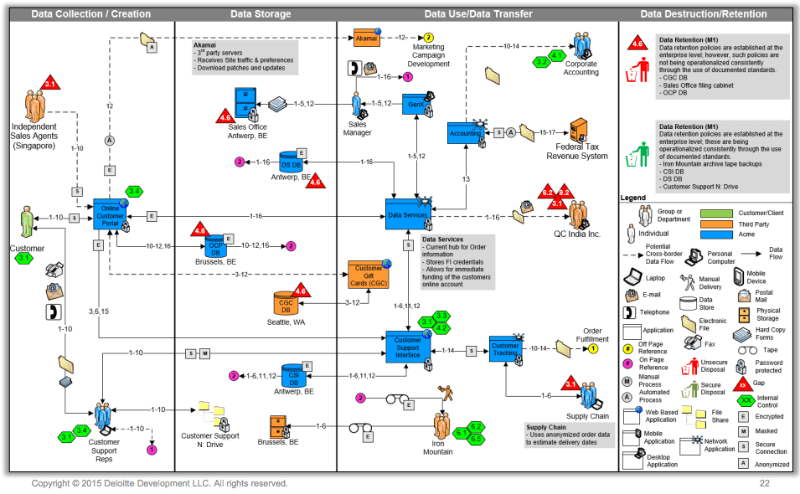
One of the keys to being successful with analytics is having a clear view of how all the data flows into and through your business.

Building a data map to show all the entry points, all the places where data is stored, who and how it is  accessed  and what filters might change your data is one of the things I can help you do.

This is step one towards data integration and is a great exercise for a half day in-house training/seminar for any business or organization that is struggling to get valued out of it’s big data.

Per Wikipedia… Data integration involves combining data residing in different sources and providing users with a unified view of these data. Data integration appears with increasing frequency as the volume and the need to share existing data explodes.

If you can imagine a map of your business in your mind you are half way there. The next step is to build a flow chart like the one below

datamap

If you have something like this then you are on ahead of the game.

If you don’t, let us set up some time to discuss how to get started.

Analytics Culture – The key to using analytics in a business is like a secret sauce. It is a unique combination of analytics talent, technology and technique that are brought together to enrich and empower an organization. A successful analytics culture is not easy to create, but DMAIPH can show you how. Contact DMAIPH now at analytics@dmaiph.com or connect with me directly so we can build a strategic plan to turn your company into analytics driven success story. 


In The Information Age Knowledge Truly is Power > Power Up on Feb 21

SO many companies are trying to figure out how to get more valued of their data, but most dont know where to start.

Let me show you how on February 21, 2017 @ Discovery  Suites in Ortigas (Pasig City, Metro Manila).

E mail for more information about our data analytics seminar, so you can learn to unlock that elusive knowledge buried within the data of your business. 15442108_1022250554587054_3902952314714042475_n

Analytics Culture – The key to using analytics in a business is like a secret sauce. It is a unique combination of analytics talent, technology and technique that are brought together to enrich and empower an organization. A successful analytics culture is not easy to create, but DMAIPH can show you how. Contact DMAIPH now at analytics@dmaiph.com or connect with me directly so we can build a strategic plan to turn your company into analytics driven success story.

Adding Three More Metrics to the Next 5-Year Plan

So, as year five winds down and I have reflected on the key metrics I established back in 2012, it seems the right time to add a few more data points to the mix.

For me, having metrics that you can measure against progress and use to make educated course corrections is the most important part of any business plan.

My first five-year plan was all about establishing myself as one of the top Analytics experts in the Philippines. Based on the number of Filipinos I have trained, the number of Filipino colleges and universities I have worked with and having established a profitable business, it is now time to think about how to expand my horizons.

Going forward the goal is not to just have one of the top analytics brands in the Philippines, but to expand that brand name outward. We will expand in terms of both geography and in terms of content offerings.

I love new things, so the sky is the limit, but I have these 3 things in mind.

The first new metric I will add will be number of trainings with partner speakers. I want to take analytics out of just being for analyst and find ways to use my gifts to empower and educate non analytics people as well.

To do this, we will partner with other innovative and progressive minded trainers and speakers here in the Philippines.

The second metric will be based on geography. I have given talks and trainings mostly in Metro Manila. On the average I have visited about one province a year to deliver a presentation or conduct a training.

Over the next 5 years we will plan activities outside not only Manila, but outside the Philippines as well. I already have one webinar lined up for a U.S. audience in February and will be looking for more places to talk about analytics. Sharing my passion with the world!

The third metric will involve revenue. I can’t imagine any business being successful and not having good analytics when it comes to increasing revenue and growing profits.

Originally the primary financial metric I cared about was net profit. Could I build a business based on analytics that could generate enough money for me to comfortably live on?

Now that we can positively answer that question with a resounding yes, the next question is can we sustain it?

When I started, I had one source of income, analytics training.

As of now we have revenue coming in from 4 sources of income; analytics training, management consulting, outsourcing and book sales.

I need to add at least 3 more streams of income over the next five years to reach my personal goal of having 7 streams of income.

The most likely source will be investing in side business that can generate income without my day to day involvement.

So, I have just doubled the key metrics I am tracking to measure the success of my efforts.

Over the next few years I will monitor the results to see if I need to make more course corrections to get me to the end goal of successfully having executed my second 5-year plan.

Stay tuned! It’s going to be even more of an adventure then the last five years!

Business Strategy with Analytics – Aligning a business strategy to drive an organization forward requires a robust analytics solution. Businesses who have good analytics tend to be much more profitable and efficient then ones that do not. DMAIPH has helped dozens of companies in both the U.S. and the Philippines with adding more data analysis in their business strategy. Contact DMAIPH now at analytics@dmaiph.com or connect with me directly to find out what we can do to help you align your business strategy with analytics.

Five Year Plans – What Analytics Do You Use?

As the 5th year of my original business plan comes to a close, it seems like a good time to reflect on how things have played out.

There are plenty of data points to look at to determine how sound my original plan was and if the course changes made along the way proved to be the right ones to take.

The single most important metrics in my 2012 business plan where # of Filipinos trained to be analysts, # of schools I have worked with and $ of revenue I have generated.

Looking first at the revenue, because if you cant make a profit after 5 years then you are doing something seriously wrong. I started making a profit I year 3, which is pretty typical of business startups.

I made my most money in year 4, but had a more diversified revenue stream in year 5. Revenues have been closer to my actual target as year 4 was one of almost too much growth.

Originally just making money from public trainings, over the years I have added paid speaking engagements, consulting, outsourcing and most recently publishing a book.

SO based on $, I have achieved my original plans and am able to comfortably move on to the financial goals of my next 5 year plan.

When it comes to working with schools, who represent the future of analytics in the Philippines, I have consistently given talks, been part of activities and mentored interns/OJT.

When I check off the list of schools I have worked with in the past 5 years I can definitely say I have met this metric.

The third data point I look at is number of Filipinos trained.

When talking about public trainings we are about 1000 persons over the past 5 years. When we add the number of attendees of public speaking engagements, the number gets closer to 5,000. And that’s paid events.

If I add the number of students and free events we are getting close to 10,000.

SO, I have fall surpassed my expectations from 5 years ago on that metric.

When assessing the success of a business plan you need to measure data over time to make sure you are making progress.

You also need to be able to make course corrections.

Before the training business started taking off, I did some consulting. To generate consistent revenue, I got into outsourcing.

Both course changes allowed me to continue pursuing my original goal of training Filipinos to use more data in their decision making and to empower analytics centric cultures.

So what are the key metric of your business plan? How do you measure them and make sure you are making progress. Do you have a threshold that you set to make course changes if you are not meeting that threshold?

To effectively execute a business plan, you need good analytics in place.

Dr. Data_Analytics in the Philippines

Analytics in the Philippines – The Philippines is at the center of the action when it comes to solutions to the global need for analytics. Blessed with a solid foundation of young, educated and English speaking workforce, companies around the world are look for Filipino analytics talent to fill analytics positions. DMAIPH was set up to facilitate these solutions and bring the talent and the business together. Contact DMAIPH now at analytics@dmaiph.com or connect with me directly so we can help you take advantage of this unique global opportunity.


Big Data Analytics > The Art of Presenting Big Data


It has been my experience that presenting Big Data requires quite a bit of artistic ability.

I will be talk about the Art of Presenting Big Data among other topics at an event this coming February 21 in Ortigas.

For me there is a clear need to Apply a Process to Present Big Data Clearly
. This process has 3 parts.

  1. Selecting the Appropriate Presentation Format to Communicate Your Findings Effectively to Your Audience
  2. Mastering the Power of Enchantment
  3. Sharing Findings from Big Data to Drive Decisions Within Your Organization

Knowing How to Select the Appropriate Presentation Format to Communicate Your Findings Effectively to Your Audience is where we will stat.

To that end I have a checklist I use before every presentation I share involving Big Data:

  • Know Your Audience
  • Consider Time Constraints
  • How Will The Data Be Consumed?
  • Can The Data and Analysis Be Accessed?
  • Make it Interactive

DMAIPH offers a wide range of analytics centric training solutions for professionals and students via public, in-house, on-site, and academic settings. We tailor each training event to meet the unique needs of the audience. If you need empowerment and skills enhancement to optimize the use of analytics in your organization, we are here to help. Contact DMAIPH now at analytics@dmaiph.com or connect with me directly to set up a free consultation on which of our DMAIPH analytics training solutions is best for you.