Training Opportunity To Train the Teachers Who Teach Business Analytics

The more I sink my teeth into the CHED memo, I find more and more business opportunites.

CHED is requiring that all faculty members should posses the educational qualifications, professional experience, and teaching ability for the successful conduct of the program.

Requirements include:

  1. At least a bachelor’s degree holder
  2. At least 2 years experience in the field of specialization that will be taught by the faculty or has undergone specializes training in Business Analytics from reputable institutions and has some experience in the required field of specialization.
  3. Industry practitioners and entrepreneurs in knowledge-based enterprises and services even without a master’s degree will be allowed to team teach with a designated faculty member. Industry practitioners will be allowed to each with a designated faculty member.
  4. Industry associations and companies wihc are engaged in service knowledge enterprise and services practically in IT education and business analytics should provide opportunities for faculty development to improve their teaching skills and upgrade course materials as well as continuing education for professional growth and research. It is strongly suggested that and HEI should at least have one industry partner with a MOA to ensure technology transfer, faculty training and OJT placements.
  5. Top academic institutions should invite knowledgeable speakers and professors to conduct seminars and training programs on the Business Analytics to help enhance the ideas of the faculty training on Business Analytics.

Just coming up with training materials and doing workshops alone is one thing DMAI will be launching soon to meet this need.

31a061c

Why The Philippines? The Shift In Services Across The Globe Leads to My Adopted Country

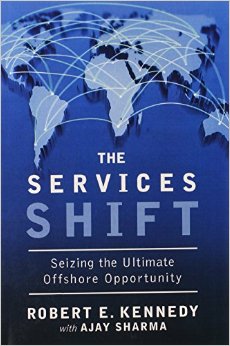
“The world is currently witnessing a fundamental reorganization in the way services are delivered to customers. This is what is behind the movement to outsource. It’s a lot more than just saving money by shipping jobs overseas.” – Harvard Professor Robert E. Kennedy

In his book the Services Shift, Kennedy outlines 5 primary reasons for this shift in services. All 5 have a great deal of influence on why the Philippines has become the call center capital of the world.

The globalization of services, in which different tasks are being carried out by different individuals in different locations, is about gaining access to the best combination of talent, resources and markets.

  • Technological Innovations like easy access to the internet and stored data.
  • Emerging Market Growth in traditionally closed markets
  • Global Macroeconomic Liberalization of government polices toward trade
  • The Corporate Imperative to both reduce costs and improve quality
  • The Convergence of a Global Business Culture based on the English language and American business models.

RA_Mar28_2


There are so many forces for this move to outsource and analytics has moved to the top of everyone’s wish list of things to look globally for.

If you have been thinking about getting your feet wet in setting up a team in the Philippines, I can help. I have set up a dozen different teams of all shapes and sizes for various U.S. companies.

Adding a team in the Philippines will add a lot of value to your business, so connect with men and we can discuss a specific solution for you.

HR & Recruitment Analytics – The recruitment and retention of top talent is the biggest challenge facing just about every organization. You really have to Think Through The Box to come up with winning solutions to effectively attract, retain and manage talent in the Philippines today.

DMAIPH is a leading expert in empowering HR & Recruitment teams with analytics techniques to optimize their talent acquisition and management processes. Contact DMAIPH now at analytics@dmaiph.com or connect with me directly to learn how to get more analytics in your HR & Recruitment process so you can rise to the top in the ever quickening demand for top talent.

What Makes A Good Analyst?

Three different sources on what makes a good analyst…

From one of the most influential books I have ever read,  the Accidental Analyst… An ANALYST is a person who analyzes and skilled in analysis. Four Character Traits that most analysts have:

  • PASSION for helping people solve real problems
  • KNOWLEDGE of the business being analyzed
  • EXPOSURE to thinking analytically and problem solving tools
  • EXPERIENCE using data to solve problems

Certain personality types most analysts have:

  • reflective
  • intuitive
  • deep-thinkers
  • and able to make quick judgments

In addition, the International Institute for Analytics and Vendor Talent Analytics, Corp. surveyed 302 analytics professionals in 2013. Curiosity came out as the top skill in a study of the characteristics of analytics pros.

And finally from KDnuggets.com:

“The Analytics Professionals in our 2012 Study are very creative and curious. They have an insatiable thirst to learn; wanting to look everything up on the Internet immediately because they simply “have to know.”. When something doesn’t work, they’ll assume there is a rational explanation and jump in to find and solve it.”

Print

Guidelines For BS in Business Adminstration Track In Business Analytics.

file:///C:/Users/Dan/Desktop/CHED%20CMO-No.-11-s2013.pdf

This is pretty school stuff! To the best of my knowledge, no other government body anywhere in the world is taking such an active approach to updating college curriculums to implement analytics training.

Recent innovations “have developed new tools and techniques enabling business management and public institutions to adopt business analytics into their organizational processes and information ecosystems. Necessarily, from such innovations emerged corresponding demand for human resources with skills and competencies defined by users of business analytics and translated by CHED into industry led curriculum.”

DMAI has been actively taking part in both awareness building around the demand for analysts and in training on business analytics for over 2 years now. The time is NOW to take things to the next level!

MSP24321b65h584fd76h9i00006996g957h01de5g6

Training, Training, Training, There Is No Other Solution

The the longer I am here in the Philippines, working in the BPO industry, the clearer this concept becomes.

As of today, there are over 2,000 analyst jobs available on jobstreet.com.ph

If you take all the students enrolled in all the recently analytics centric courses imagine that wouldnt even fill up 1/4 of the open slots.

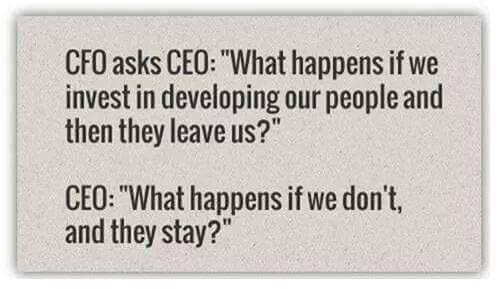
So when I saw this image…

707022c7-f35e-4427-91c0-653a382a3689-medium

I’m immediately thinking this is where so many decision-makers continue to get it wrong… you HAVE to invest in training your own people and/or training near hires. If you keep trying to pirate someone, you are just making the problem worse.

You end up with a mix of undertrained (and undermotivated) lifers and job-hoppers ready to take off as soon as something that pays more comes along.

You Don’t Build A Business… You Build People

f2049885-9cdd-4f3d-8370-9ac9600695e0-original

It’s funny to me that I shared this on LinkedIn and someone had the thought to spin it into a negative thing. Someone sarcastically replied that this is false and that big bosses just use people to make money. I’m guessing he sees this as a way to get people to work harder, but it the end only the top people benefit. Or something like that.

When I saw this, I immediately thought about a training program we have just kicked off to address a significant challenge we have in both my business and in my industry. The call center industry in the Philippines is probably one of the most hyper competitive labor markets anywhere in the world today.

To be able to be successful you need to find people who are stick around. So looking at the best way to do that is to build them up. To train them, to empower them, to enchant them.

Being equal parts educator, analyst, entrepreneur… this concept is something I firmly believe in, I have the data to back it up and the success to prove it is working. So take that mister sarcasm… DMAIPH is a great example of this philosophy actually working.

Analytics Leadership – DMAIPH specializes in arming the Data-Driven Leader with the tools and techniques they need to build and empower an analytics centric organization. Analytics leadership requires a mastery of not just analytics skill, but also of nurturing an analytics culture. We have guided thousands of Filipino professionals to become better analytics leaders. Contact DMAIPH now at analytics@dmaiph.com or connect with me directly to discuss a uniquely tailored strategy to ensure you are the top of your game when it comes to Analytics Leadership.

The 3 V’s of Big Data: Volume, Velocity, & Variety

The value of big data isn’t in the amount of data it can process, but in the insight that big data analytics can yield. Big data has value because it can assimilate vast amounts of different types of data. The three V’s – volume, velocity, variety – are wbrainhat give big data its value, and what powers these three V’s is more and better data.

Source: im-techsolutions.com

Analytics is all about looking for patterns in data that give you actionable insights.

IBM’s SMART Approach to Analytics

Came across this 5 point methodology for applying analytics in a business… very similar to the 3 I’s that I use in my training. I’ll start using both going forward.

S=Start with Strategy
What problems do you need big data to help you solve? If you’re running a business you might think it’s as simple as “How do I increase my profits?” But a question like that is inevitably going to lead you to more questions.
How do you generate more sales? How do you increase visitors to your site or store? How do you make your customers happier?

In this first step you need to be clear about your strategic objectives as well as the key strategic questions you want to have an answer to. You need to have this nailed down before you worry about collecting your first kilobyte of data.

M = Measure metrics and data
Once you know what data you need to answer your most strategic business questions, you can work out how you are going to capture it. Everything we do, online and, increasingly, in the real world, is capable of being recorded and stored. If we visit a website, records are kept of how long we browse for and where we head off to next. GPS systems in our phones as well as CCTV surveillance keep track of our physical movements.

Of course much of it is (hopefully) anonymized. Big data collection isn’t about tracking individuals, it’s about tracking the masses, so patterns can be spotted giving clues to overall trends. This part of the process involves designing the actual systems that will collect what your strategy tells you is needed.

A = Apply analytics
Increasingly, we are finding that the sort of data which contains really valuable insights is very messy. The slightly more technical term we use for this is that it is unstructured data. The sort of neat and tidy data you get when, for example, you ask someone to fill in a form giving you their age, height, weight and data of birth, is structured. The sort of messy, disjoined data you get when you analyze the contents of an email exchange or CCTV recording is unstructured.

The hidden value in this unstructured data is where most big data divers are finding the real sunken treasures. If you’re a business, being able to spot trends affecting your industry before your competitors is what will give you your edge. In order to implement this part of the process you will need to get to grips with the ever-growing range of tools and methods becoming available for making sense of messy, complex data sets.

R = Report results
The most insightful insight ever is useless if you can’t explain what it means to the key decision-makers in your business. Presenting the information necessary to drive change in a clear and digestible format is as vital as any other step of the operation. This part of the process has analogies to storytelling. There will be a beginning, a middle and an end, detailing why you need the insights, what you did to find them, and how they will result in everyone living happily ever after.

If you use data visualization and narratives to tell that story in a focused and interesting way, it’s far more likely people will understand what you are trying to do, and be as motivated as you are yourself about implementing data-driven change.

T = Transform your business
Change—specifically positive change—is the ultimate aim. Transformations you make to your products, service, marketing strategies or internal processes, guided by insights from your Smart Big Data analysis, is the catalyst which will drive that change.
cropped-dmai-fb-cover-photo1.jpg

The Secrets of Money Ball Recruiting

http://youtu.be/6MStL5QIyCw

“There are rich call centers, with big budgets and huge recruitment teams. There are poor call centers with small budgets and just a few people. Then there is 50 feet of crap. And there is us.”

I conducted a Recruitment Analytics Training yesterday and shared one of my methodologies. Based on the movie (and book) Moneyball, I talked about how to be successful you need to find undervalued candidates who other call centers have passed on.

“If we try and play like Convergys in here (with our recruitment efforts), we will lose to Convergys out there (on the streets looking for talent)”.

10421381_626225777522869_8061177028338978985_n

So we need to boil down the recruitment process to the one thing most important for our business in every single employee.

Some of my points:

  1. We spend too much time looking for trainable skills like Good English, Good Communicators and Good Interview Takers.
  2. We need to stop hiring job hoppers and people looking to move up without having paid their dues.
  3. The one skill set we cannot teach, that we need to start making our top priority… is dependability.
  4. Will they show up on time every day for work is the single biggest need we have.

So that’s the one personality trait we are placing at the top of our recruitment process. We need to probe and dig and research, to find out will they be someone who will show up for their shift everyday.

That’s our “get’s on base” metric like in MoneyBall.  We can’t help the customer if we are not at work ready to help the customer.

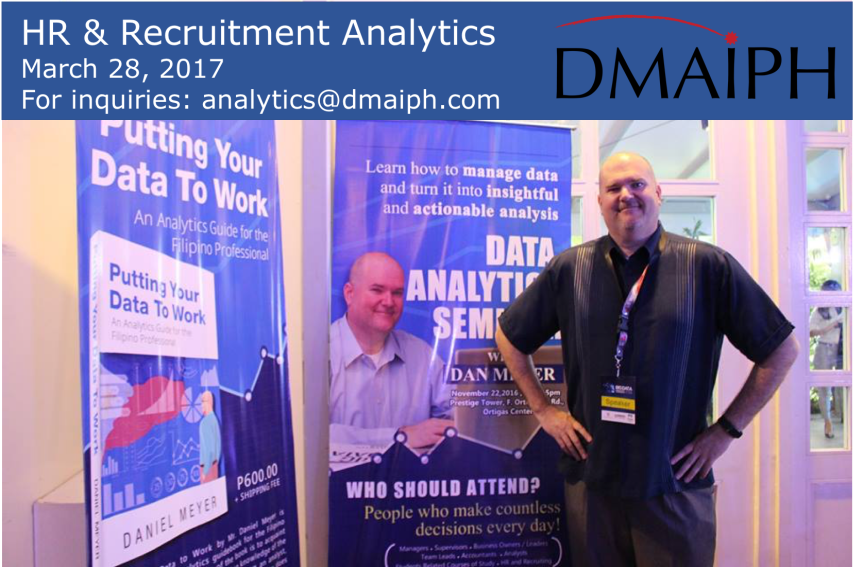
HR & Recruitment Analytics – The recruitment and retention of top talent is the biggest challenge facing just about every organization. DMAIPH is a leading expert in empowering HR & Recruitment teams with analytics techniques to optimize their talent acquisition and management processes. Contact DMAIPH now at analytics@dmaiph.com or connect with me directly to learn how to get more analytics in your HR & Recruitment process so you can rise to the top in the ever quickening demand for top talent.

Five LinkedIn Tips To Grab Attention From A LinkedIn All-Star

By now its clear that LinkedIn is the best way to network for job openings, new clients and professional partnerships. There really is nothing else like it when it comes to linking you to new opportunities.

As I’ll be speaking to a half dozen audiences in the next few weeks on a range of analytics topics, the one point of advice I will give every attendee is to get the maximum out of LinkedIn.

Here are 5 tips that guide me in being a LinkedIn All-Star:

  1. Have a professional AND engaging profile picture. You can go a little casual here with dress, but you definitely need to maintain a professional appeal to people. Make sure you smile and look engaging. It’s a biased and unfair world, but looks really do matter. I’ll be honest, my blue eyes are a selling point so I make sure they standout. We all have our own eye catching features… don’t waste them.
  2. You need a catchy headline. Use the space at the top of your profile wisely. I use my tagline, making data-driven decisions. It needs to stick. Think of catchy logos, mottos and taglines and use something that is personal to you and shows your passion.
  3. Use the summary wisely. This is like your cover letter or professional objective. What you write here greatly impacts how much further a recruiter will read. Like the headline it has to speak to your passions and show a real person not just another job seeker. Keep it short and simple. 2-3 sentences that engage and enchant. I talk about training and analytics the merger of my passion and my top skill set.
  4. Get some great recommendations. Focus on finding advocates who will sell you based on solutions you have provided, problems you fixed or business that you generated. These recommendations are the only thing that’s proof you are good at what you say you are good at. Maximize their effectiveness like I did by asking people who can talk about what I did to make their lives better.
  5. Join lots of relevant groups. Groups are the best way to expand your network and connect with people who are doing the same things you want to do and/or can influence hiring decisions. LinkedIn is all about networking and posting and sharing on groups is the key to being noticed. Get and stay active.

1075177_10151826941667425_1417094118_n

Here is the original article I based my five tips on. They are pretty universal, but you can always take the extra 10 seconds to share your source and give credit: http://www.ion-search.com/news/5-ways-to-ensure-that-your-linkedin-profile-grabs-a-recruiters-attention-social-hire/