The Five Stages of HR & Recruitment Analytics

I’ve seen a couple of articles recently espousing a set number of stages  in HR and/or Recruitment Analytics. Based on my knowledge, the 5 stages of analytics a people-centric department can experience are the following:

Stage 1 – The Data Dark Age – No analytics at all. Pipelines are either in MS Excel, a very old proprietary data based or maybe even on paper. Nothing is really analyzed, data quality is bad, and reports are pretty useless. Not collaboration exists between HR, Recruitment and other business lines.

Stage 2 – Living in Data Castles – Only a few people use analytics and most key management decisions are not made based on data, but on experience. Every department has data stored within its own data base. Its nearly impossible to share data due to poor data architecture. HR data is incomplete and the recruitment process does not have any dynamic reporting.

Stage 3 – The Flat Data Organization – Some people use some analytics to make some decisions, but its generally inconsistent across the organization. Data is generally historical and used tactically to understand simple patterns and effects. Some of the data castles have evolved to data explorers, venturing out to find and use new data sources, but many castles still remain in the organization. Generally HR and Recrutiment are using a people management and/or recruitment management software. Reports are useful and drive some decisions by management, but there is major room for improvement. Some data leads to buried treasure, but some leads you off the map… data quality is inconsistent.

Stage 4 – Civilized Data Flow – Most decision makers have access and generally use analytics. Several key team members have strong analyst backgrounds. Data is easily shared between teams. Most managers look at data before making a decision, and analysts have a say in business strategy based on their analysis. People are empowered to do their own discovery and analysis. The organization has answers  to questions about recruitment efforts and HR trends. Waste is controlled with effective people and recruitment management software.  Business dashboards are being used to convey a lot of information.

Stage 5 – Data Nirvana – Every team member from top down knows analytics, has access to the data they need and are empowered to take action on it. There are minimal hindrances to sharing data. It is hard to find a place like this but, when you do recruitment works like a well-oiled machine,  HR analytics are predictive and driving recruitment efforts. There is never a question management asks, that there is not a data driven explanation to answer with. Business dashboards are interactive and real time. Surprises are minimal and solutions come quick and founded on business data and insight. Open posts are filled quickly and people stick around because there needs are proactively being addressed.

So what phase is your organization in? Where do you want it to be? I can help you assess where you are and we can design steps to get your where you want to go.

11756770_934770113231654_1677809504_o


HR & Recruitment Analytics – The recruitment and retention of top talent is the biggest challenge facing just about every organization. DMAIPH is a leading expert in empowering HR & Recruitment teams with analytics techniques to optimize their talent acquisition and management processes.

Contact DMAIPH now at analytics@dmaiph.com or connect with me directly to learn how to get more analytics in your HR & Recruitment process so you can rise to the top in the ever quickening demand for top talent.
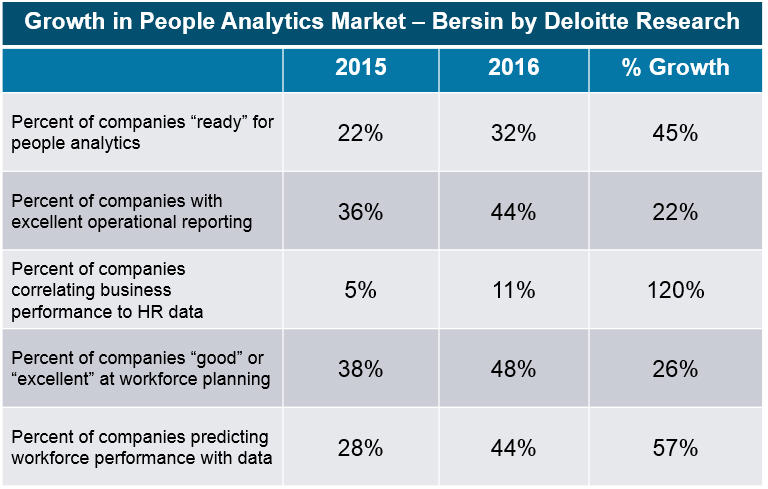
Explosive Growth In People Analytics

https://www.jibe.com/ddr/telling-the-story-of-a-data-driven-future-for-talent-acquisition/

Came across this really interesting table about the explosive growth in HR Analytics.

data-driven-human-resources

(Source:  Deloitte Human Capital Trends 2015 and 2016, 3,300 and 7,100 respondents, respectively) 

The blogger who shared this, Mike Roberts, stated “With advancements in technology, as well as more awareness of the power of data, this is starting to change. Since 2014, we’ve seen an incredible transformation in the way talent acquisition professionals view data. And research from leading analyst firms has been backing that up.”

This is exactly why I have been doing HR & Recruitment Analytics training classess. There is a growing number of options out there, so make sure you get the bang for you buck you are hoping for.

IMG_6912

Connect with me if you want to know more about my approach to using data to drive decision-making in HR and Recruitment. I have recently published a book, Putting Your Data to Work, that can be your guidebook to how to get more people analytics in your HR and Recruitment processes.

HR & Recruitment Analytics – The recruitment and retention of top talent is the biggest challenge facing just about every organization. You really have to Think Through The Box to come up with winning solutions to effectively attract, retain and manage talent in the Philippines today. DMAIPH is a leading expert in empowering HR & Recruitment teams with analytics techniques to optimize their talent acquisition and management processes. Contact DMAIPH now at analytics@dmaiph.com or connect with me directly to learn how to get more analytics in your HR & Recruitment process so you can rise to the top in the ever quickening demand for top talent.
 

Finding The Time To Talk About Analytics Strategies

One of the biggest frustrations I hear from people when we are talking about how empower more data-driven decision-making in an organization is that no one has enough free time to get serious about analytics.

When facing this kind of challenge, a short presentation full of useful data can be used to start the ball rolling. When people say they are too busy then they are often actually saying I have too many things to keep track of and I am not as organized as I should/could be.

There are indeed times when there is more work than can be done in 40 hours a week, but that is actually not the case in most situations. Most corporate cultures reward those with the “I’m so busy I don’t have time to waste on reports” badge of honor.

To counter this you need to do some research into what are the potential time and cost savings that come from fixing the reports and getting better data to decision-makers. It wont take long to find a lot of numbers to use in your business case after a quick Google search. LinkedIn is also a good place to find lots of supporting documentation.

Once you have that info, you can add it to your own assumptions about what KPIs are not being used or what KPIs are missing from current reporting or which KPIs are miss reporting. This can all be turned into a short, compelling case for others taking the time to talk about broader reporting across the organization.

11756770_934770113231654_1677809504_o

To really add some punch to your argument, ask one of the too busy people to give  you a few minutes of time to ask them what more they want/need out of their reports. Hardly anyone is truly happy with the reports they get. Gain a few allies in your crusade.

Most people think that using analytics effectively is all about the technology, but the real secret to success is getting the people on board and on the same page. True analytics centric cultures are based on engagement and that engagement needs a facilitator.

Once you have your story and a few key advocates it will be a lot easier to get closer to the data-driven decision-making you are looking for.  If you need help polishing your story or advice on how to get the engagement of a really tough “I’m too busy” co-worker, let me know. I’m sure I can lend a hand.

Analytics Culture – The key to using analytics in a business is like a secret sauce. It is a unique combination of analytics talent, technology and technique that are brought together to enrich and empower an organization. A successful analytics culture is not easy to create, but DMAIPH can show you how. Contact DMAIPH now at analytics@dmaiph.com or connect with me directly so we can build a strategic plan to turn your company into analytics driven success story.

Sharing My Analytics Story

Sometimes I get asked to share my analytics story. It’s pretty awesome when that happens.

I’ve have gotten so accustomed to talking about my analytics story that I do speaking engagements, public training seminars and write this blog. Talking about analytics and sharing how I have and do use data to facilitate data-driven decision-making is my favorite thing to do.

A lot of people would like to share their analytics story, but they never feel like they are in the right place to do so.

Some are not confident enough in what they are doing and afraid of looking like they don’t know what they are doing. Well, when it comes to analytics most of us don’t always know what they are doing… the whole point of analytics is discovery and looking outside the box.

IMG_1249

Other people chose not to share their analytics stories because they don’t have a complete understanding of analytics in general. They know their niche, whatever they are in charge of back at the office. But they are not part of the bigger data picture in their company.

I have also find that others don’t share their analytics stories because they think what they are doing is to simple or not relevant to a broader conversation. Well, hardly anyone does the same thing as someone else when it comes to working with data. How we use data in our jobs is a individual as how we dress in the morning.

SO, when I speak, or present or write, I do my best to get others to participate. I love to learn about what challenges people are having and help them come up with solutions. A lot of analytics trainings are follow this method or use this technology, but few actually solve any problems. They give you tools but no instructions on how to use them in context of your own data environment.

I have found that the best way to build better reports is to talk about them. The quickest way to build engagement for more analytics is to talk about how to use analytics.

It’s all about taking the data in your head and constructing engaging conversations. That’s why in every opportunity I have to talk about analytics, I finish talking about how to market your analysis and how to make it enchanting to your audience.

I’ll be doing a training in Ortigas this coming June 15 and a seminar on June 22. If you are interested in sharing your story and coming up with some solutions to your data challenges, I’d be happy to see you there.

Who Is Best In Your Organization When It Comes To Analytics?

I am currently sharing a survey asking my LinkedIn connections about what part of their business is the most successful when it comes to using analytics to drive decision-making.

If by chance you follow my blog, but don’t get my LinkedIn e-mails. Here is the survey:

As you may know, I have been working on a book about analytics and the data-driven cultures of companies who successfully use analytics. I have a quick question to ask you that will help me in my research.

1508982_603376689807778_4892012849582809050_n

Of the following business lines, which one is the business line in your organization that in your opinion best uses analytics when making key business decisions?  (Pick One)

  1. Sales & Business Development
  2. Marketing
  3. Operations
  4. Supply Chain/Inventory
  5. Legal, Risk & Compliance
  6. Customer Service
  7. Human Resources/Recruitment
  8. Strategic Planning
  9. No one really uses analytics in decision-making effectively.

Thanks for taking the time to reply, it will be really helpful.

Sincerely,

Daniel Meyer, Analytics Guru

danmeyer@dmaiph.com


I’d like to validate what my experience tells me are the areas who generally best do analytics. I’m also looking forward to finding out there people see as general weak spots.

I’ll be happy to share the overall results of the survey once it is complete.

Conversation About the Reporting Mess

The other day I was hanging out with some friends who work for a company I used to work for and they were talking about challenges they were having with some reports. As I listened, images started filling my mind of the challenges so many companies face. Not having a good data strategy within a business is a killer to both productivity and morale, opens up a company to extra risk and blinds people to opportunities.

The first problem I suggested they tackle is validating their current Key Performance Indicators (KPIs). They need to analyze what is currently being reported to find out what is not useful to the business in making educated decisions.

The second problem is that the people who “own” the data don’t like sharing.  The place where I’d start with this challenges is mapping out the data flow. It would be really powerful to illustrate the different touch points within the flow and most importantly where things get stuck. Then it’s a matter of explaining the big picture to those who might be causing slowdowns.

The third problem is that everyone is too busy to sit down and figure out how to fix things. To solve this challenge, we will need to get everyone on the same page and agree to a common data strategy. This will not be a one and done meeting, but a series of conversations.

So to solve this, my friends need to start with asking questions about what do people really need. In many cases I would expect the answer is no. This is where knowing the architecture comes in handy, so you know where the data lives that is currently missing. After this it’s a matter of storytelling and influencing the “owners” of the data to understand how access to key data would generate more powerful KPIs which would allow everyone to get on the same page.

10592010_10152674958362425_1982237172_n

It sounds pretty easy and it should be. The ultimate challenge is really getting people to all agree on how to use the data. In some cases, it might take senior management support to get everyone to play nice. And my friends will need data to support their argument on how thing can be better and put some numbers behind their vision of a stronger data-driven culture.

This is where I come in. When inside politics and no one has time to lead the charge, an outside consultant might be the best solution. An expert in not just identifying the challenges and sharing findings, but someone who can actually help facilitate cultural change. People who are equally skilled in both the technical world of analytics and the social world of team building are pretty rare birds.

If you are in a situation like my friends, then I’m ready to help you like I helped them.

Analytics Consulting – DMAIPH specializes in a variety of analytics consulting solutions designed to empower analysts, managers and leaders with the tools needed for more data-driven decision-making. We have helped dozens of companies get more analytics in their business. Contact DMAIPH now at analytics@dmaiph.com or connect with me directly so we can tailor an analytics solution made just for your unique requirements.

Data Analytics Training on Nov 22

Just sharing some details on an upcoming training I’ll be delivering.

This innovative and one of a kind workshop will provide you with easy to
implement strategies to increase your effectiveness in decision- making.

Objectives
– We will start with a basic overview of analytics, current trends in
the field and how analytics is being used here in the Philippines.
– Through a couple of hands on exercises, we will practice finding data,
analyzing it and reporting our findings.
– We will go in depth understand several key components of analytics
including business intelligence, competitive landscaping, data
visualization and business dashboards.
– We conclude the day by taking an assessment of each of our own
business and starting to develop strategies to enhance the analytics
culture in our business.
– Learn more about Big Data and Data Warehousing

Key Topics:
– What is Data Analytics?
– Overview of Data Analytcs in the Philippines
– Self- Assessment of your own analytics
– Finding Data (Mining and Presenting the Data)
– Big Data and Data Warehousing
– Discussion about Descriptive, Predictive and Prescriptive Analytics
– Business Intelligence and Business Dashboards
– Using Data Analytics to Drive Decisions
– Enchant your audience

Group Exercises will focus on mining data from public data sources, working on a marketing strategy based on business analytics and building a business dashboard prototype.

In today’s global marketplace, businesses are challenged with endless streams of data of immense volume, variety and velocity coming from around the world. Having people on your team who can use the data in your business to drive more data based decisions in no longer an added value. It is a fundamental cornerstone of success.

522

SEMINAR FEE

PHP 6,000/regular participant inclusive of VAT, training materials
(workbook), am/pm snacks, lunch and certificate of completion

*Group DISCOUNT (Minimum of 5):*

PHP 4,800/ participant inclusive of VAT, training materials (workbook),
am/pm snacks, lunch and certificate of completion.

To register, please call 09177992827 or send an email to info@sonicanalytics.com

Analytics Training – DMAIPH and our partners at Sonic Analytics offer a wide range of analytics centric training solutions for professionals and students via public, in-house, on-site, and academic settings. We tailor each training event to meet the unique needs of the audience. If you need empowerment and skills enhancement to optimize the use of analytics in your organization, we are here to help. Contact DMAIPH now at analytics@dmaiph.com or connect with me directly to set up a free consultation on which of our DMAIPH analytics training solutions is best for you.

DMAIPH’s Typical Client Profile

I publish and share a lot of content about helping businesses get a better handle on their analytics in order to build a culture of data-driven decision-making. With so many businesses of various shapes and sizes looking to get more out of their data, I get asked a lot what kinds of businesses do we specialize in helping.

In general, I think we can help just about any business with its data analytics, with using data for business decision-making and in building an analytics centric culture.

That said, success often will hinge on a couple of factors.

  1. How is the data acquired and stored? The more structured the data management the easier.
  2. How serious is top level management about using data to make decisions?
  3. Is there a person or a team who really get the theory of how to optimize a business using data?

If all of those are true, it’s a green light for us no matter what the size or type of business.

If 1-2 are true, it is still possible, but we will have to make sure we keep expectation tied to reality.

If none of factors are in place, then I will probably decline the consulting gig. You can save people who don’t really want to save themselves.

Our business plan is to offer analytics solutions in the things we are best at, (1) talking about analytics, (2) consulting on using data in a business strategy and (3) providing data and/or analytics focused, hybrid staffing solutions.

The 3 kinds of businesses we specialize in helping by offering these solutions are

  1. Ready to expand – companies who are about to kick off a period of significant growth in their operations and need data analytics and/or more staff to be successful.
  2. Ready to revitalize – companies who have hit a rough patch and need to better understand where things went wrong and need a road map on how to get back on track.
  3. Ready to launch – start up companies who need to refine their initial business plan based on solid data analysis and/or need staffing solutions to get things rolling.

jobspicture2

So although I feel we can help just about any business when it comes to analytics, these are the 3 types of service we offer to our target market. I will detail more about how we go about helping businesses and tell you a story about a company we have helped in the next few blog posts.

Analytics Consulting – As a founding member of Gloabl Chamber Manila, DMAIPH specializes in a variety of analytics consulting solutions designed to empower analysts, managers and leaders with the tools needed for more data-driven decision-making. We have helped dozens of companies get more analytics in their business. Contact DMAIPH now at analytics@dmaiph.com or connect with me directly so we can tailor an analytics solution made just for your unique requirements.

Q20: So in conclusion can you explain a little more about your own method for using data to drive better decision making?

I have always been into data. When I was a kid I used to memorize baseball statistics on the backs of baseball cards. It was not uncommon for me to spend a whole weekend constructing fantasy teams and playing what if games between great teams of the past using my favorite players.

Besides sports statistics, another love of mine as a kid was history. Understanding concepts that caused things to happen. Wanting to know what caused wars and lead to significant changes in behavior. And history is chalk full of statistics. Loads of data to help understand what happened and most importantly shed some light on why it happened.

So those two experiences really taught me about how much fun data can be. When I started my first real job out of college, I started using MS Excel. I quickly became the expert in the office and things just kinda spun out from there.

I took a few Excel classes early on, but most of what I have learned has been either side by side with an expert of self-taught. When I started at Wells Fargo, the data guy thing followed me.

One of my first projects was building a sales tracking sheet for each team. Flash forward 15 years and I was doing the same thing, but with much more awesome tools and a lake full of data.

SO what does that tell you about my philosophy about analytics? Its comes from passion and curiosity and my expertise is mostly self-taught. To teach people to be a good analyst you have to first build confidence and generate empowerment. That with the right tools, the right data and the right state of mind, you can solve any data problem.

At this point in my career, besides the passion and the drive, I’ve got 25 years of data gathering, analyzing and sharing under my belt. I can find data on just about anything, knowing where to start looking.

I have a 1,000 bookmarks saved and organized and Im always adding to it. I also as much as possible notate my sources to keep breadcrumbs close at hand to trace back how I got to where I am at. I read a ridiculous amount. Books, blogs, articles, whatever I can that helps me add to my body of knowledge and most importantly gives me access to new places to find data.

4.8

To me the single biggest key to success in analytics is just that… knowing where to look for it. The quicker you identify the data, the less time you have to spend inventorying it and the most time you can spend integrating it.

A lot of people might expect me to say use this application with this model of this method to get these results. That’s to specific. I can list out some awesome tools, but if they aren’t going to be employed in every company then what’s the point.

If you are surrounded by people who know where to find data, you are in a good place. If you are the only one who is going out and finding it, then you are in a lonely place. Making data-driven decision is only really possible if your business culture is at a point where it values these types of decisions.

In conclusion, you have to have curious people, who are empowered to find data, that management will use to make decisions. Focusing on data organization for speed and diversity helps. Spending a lot of time on visualizing your data so it tells a story that drives decision making helps. This is how I do it.

I find data, I use cool tools to analyze it faster and I add awesome visualizations to make it more powerful.

That’s how I empower people to be analysts, how I teach companies to have better analytics and finally and most importantly, how I do analytics.

Q19: How would you describe your approach to teaching analytics?


That’s a great question. I have both a simple answer and a more complex one.

The simple answer is my approach to teaching analytics is all about empowerment.

The keys to being a good analyst are most likely already in you. You just need to find ways to unlock, upgrade and unleash your curiosity and focus it towards making more data-driven decisions.

Learning how to use data across a business to improve things is something everyone can benefit from. So that is where I start.

A more complex answer is that I develop each training to fit the needs of a particular audience. Every organization approaches analytics differently so its nearly impossible to use a single way to talk about analytics. In addition, each person in an organization has different backgrounds and different needs, so a one solution fits all approach doesn’t work.

This open-minded and flexible approach to the subject matter is the same way I approach any challenge. Assess the need, develop a relevant solution, apply the solution and refine and adapt as need be.

Honestly, my approach is fairly unique because I take my formal education as a teacher, mix it with my 15 years of practical experience and offer a training solution that is both engaging and enchanting.

11756770_934770113231654_1677809504_o

So what does that all mean when it comes to actually being on the stage or in front of a classroom?

I have found the following things to be true when it come to talking about analytics:

  • Knowing the audience. What do they need to get from where they are to where they want to be.
  • Asking participants questions directly. Breaking into small group exercises to see the interactions. Having lots of questions in my slides.
  • Real World Exercises. I change the exercise we do based on the make-up of the group. It is much more impactful to solve problems that they can relate too.
  • Too Much Content. Going against conventional wisdom, I pack a lot in. I am not trying to make sure everyone can memorize my slides. I am trying to bring out their curiosity and let them take way what they need to bring the curiosity back to the office with them.
  • Lots of Visuals. Even when I pack a slide with text, I tie it to an image that sticks. People remember the image, then the content will come back to them.
  • Speak with Passion. Another change from conventional wisdom. I talk fast. I jump from topic to topic a lot. I move around the room. Its all because Im speaking with passion. Its contagious and keeps things moving at a fast pace.
  • New Content. I am always tweaking things. My presentations are never exactly the same, because every day there is something new to talk about.

So there you go. Some of why and how I have developed my approach to teaching analytics. I’m always looking for disciples if you want to learn from a man crazy about analytics.