Why Analytics Projects Fail – #11: No End User Participation

One the most overlooked and under appreciated parts of assuring a successful analytics implementation is getting the participation of end users. End users being defined as the consumers of either the data, the analysis and/or the reports that come out of the project.

I can tell you countless horror stories about stacks of reports that go unread, email summaries that are never opened and business dashboards that are rarely clicked on. In most cases, all because the end user was not involved in the project or its development process.

One example of this is when the ones who need the reports are not asked what they need in the report.  This is more common than you might think. Requirements, no matter how well thought out, will always overlook something someone needs. Another reason is not finding out how the end users want it to look. They often are omitted from the design phase and just left to use it. Worse it’s possible that what is delivered in not even compatible with other things they do. This leads to failure by not being useful, a complete waste of time and resources, especially yours.

TPS-Report

The best way to assure end user use is to have them involved at the earliest stages of the project. If you are selecting the project team or have influence on the team makeup, make sure you get an end user who can speak for that audience. It might be more than one person.

Another way is to keep the end-users informed and allow for feedback. Finding ways to work feedback into your project is another place you would be surprised by how often it is not done.

And finally make sure you build in a testing period before your project goes into production. In some cases this might include the feedback phase, but in big projects there is often a need for end user testing. If you don’t shepherd this effort, who will?

If you are no sure how to go about involving the end users and/or are not sure of who all the end users might be, then you should really answer those questions as early as possible. No one wants to see their hard earned work just end up in the trash bin because it does not fit the need it was designed for.

The key to using analytics in a business is like a secret sauce. It is a unique combination of analytics talent, technology and technique that are brought together to enrich and empower an organization. A successful analytics culture is not easy to create, but DMAIPH can show you how. Contact DMAIPH now at analytics@dmaiph.com or connect with me directly so we can build a strategic plan to turn your company into analytics driven success story.

Analytics Culture – The key to using analytics in a business is like a secret sauce that fuels Data-Driven Decison-Making. It is a unique combination of analytics talent, technology and technique that are brought together to enrich and empower an organization.

A successful analytics culture is not easy to create, but DMAIPH can show you how. Contact DMAIPH now at analytics@dmaiph.com or connect with me directly so we can build a strategic plan to turn your company into analytics driven success story.

Why Analytics Projects Fail – #8: Lack of Resources

To start with a lack of resources should probably be called lack of time. Lack of time to design an effective strategy. Lack of time to find the right talent. Lack of time to get everyone on the same page.  We are all just too busy and have too much to do. We say lack of resources, but mostly we mean our team doesn’t have time.

A lot of times you hear about failures with analytics projects is because of lack of resources. When I hear about this, I always ask for a better definition of what is meant by lack of resources. Is it lack of leadership support, lack of funding, lack of strategy, lack of focus and vision, lack of talent? They are all often disguised as lack of resources.

In each of the previous seven blogs in this series I talked about a reason why analytics projects fail and since they can all fall under the boarder lack of resources, let’s do a quick recap.

  1. Lack of Focus – People are not on the same page
  2. Lack of Vision – People don’t know where this is going
  3. Lack of Management Support – People don’t know who to follow
  4. Lack of a Champion – People have no one to cheer lead
  5. Lack of Organizational Support – People don’t really care
  6. Lack of Funding – People don’t want to waste money on this
  7. Lack of Talent – People can’t do the job

There are all people driven reasons for why your project may be in danger of failing. They are all fixable using people skills. This is why I often argue a good analyst who can communicate is worth more than a great analyst who cannot. The reasons why analytics projects most often fail is human, not technological.

65732ad3-ba3f-47c3-af82-fa2a6c65bdd7-large

In the end, for whatever of the reasons above, your project is in jeopardy, it will be up to you to show people why they should invest the time needed to get things back on track.

You have to push for focus, share the vision, educated your managers, become a champion, gain organizational support, secure funding and align the right talent to make things work.

I have been in this situation numerous times. In every situation the one constant variable that changed possible failure into a success was me. Bring a truly great analyst means showing people how your project will be a solution to their problems and is well worth their investment of time.

When you do this, they you won’t be in a place where lack of resources dooms your analytics project.

#IamDMAI

Analytics Culture – The key to using analytics in a business is like a secret sauce that fuels Data-Driven Decison-Making. It is a unique combination of analytics talent, technology and technique that are brought together to enrich and empower an organization.

A successful analytics culture is not easy to create, but DMAIPH can show you how. Contact DMAIPH now at analytics@dmaiph.com or connect with me directly so we can build a strategic plan to turn your company into analytics driven success story.
The Five Stages of HR & Recruitment Analytics

I’ve seen a couple of articles recently espousing a set number of stages  in HR and/or Recruitment Analytics. Based on my knowledge, the 5 stages of analytics a people-centric department can experience are the following:

Stage 1 – The Data Dark Age – No analytics at all. Pipelines are either in MS Excel, a very old proprietary data based or maybe even on paper. Nothing is really analyzed, data quality is bad, and reports are pretty useless. Not collaboration exists between HR, Recruitment and other business lines.

Stage 2 – Living in Data Castles – Only a few people use analytics and most key management decisions are not made based on data, but on experience. Every department has data stored within its own data base. Its nearly impossible to share data due to poor data architecture. HR data is incomplete and the recruitment process does not have any dynamic reporting.

Stage 3 – The Flat Data Organization – Some people use some analytics to make some decisions, but its generally inconsistent across the organization. Data is generally historical and used tactically to understand simple patterns and effects. Some of the data castles have evolved to data explorers, venturing out to find and use new data sources, but many castles still remain in the organization. Generally HR and Recrutiment are using a people management and/or recruitment management software. Reports are useful and drive some decisions by management, but there is major room for improvement. Some data leads to buried treasure, but some leads you off the map… data quality is inconsistent.

Stage 4 – Civilized Data Flow – Most decision makers have access and generally use analytics. Several key team members have strong analyst backgrounds. Data is easily shared between teams. Most managers look at data before making a decision, and analysts have a say in business strategy based on their analysis. People are empowered to do their own discovery and analysis. The organization has answers  to questions about recruitment efforts and HR trends. Waste is controlled with effective people and recruitment management software.  Business dashboards are being used to convey a lot of information.

Stage 5 – Data Nirvana – Every team member from top down knows analytics, has access to the data they need and are empowered to take action on it. There are minimal hindrances to sharing data. It is hard to find a place like this but, when you do recruitment works like a well-oiled machine,  HR analytics are predictive and driving recruitment efforts. There is never a question management asks, that there is not a data driven explanation to answer with. Business dashboards are interactive and real time. Surprises are minimal and solutions come quick and founded on business data and insight. Open posts are filled quickly and people stick around because there needs are proactively being addressed.

So what phase is your organization in? Where do you want it to be? I can help you assess where you are and we can design steps to get your where you want to go.

11756770_934770113231654_1677809504_o


HR & Recruitment Analytics – The recruitment and retention of top talent is the biggest challenge facing just about every organization. DMAIPH is a leading expert in empowering HR & Recruitment teams with analytics techniques to optimize their talent acquisition and management processes.

Contact DMAIPH now at analytics@dmaiph.com or connect with me directly to learn how to get more analytics in your HR & Recruitment process so you can rise to the top in the ever quickening demand for top talent.

Mixing Technique With Empowered Curiousity

Last year I spent some time helping a couple of schools build more analytics centric training into their psychology curriculums. The goal being to help prepare future HR managers and analysts to be ready to deal with real world analytics challenges.

Over the next few blogs, I will share several of the topics I listed in these curriculums that are equally balanced in both the technical and intellectual aspects of HR analytics.

It is a common misconception that HR analytics is all about using tools and techniques to generate reports and share information to management in a way that makes the business more successful. This concept will not generally work because the analysts are not empowered to question, explore and discover new opportunities or to understand hidden risks. All they are expected to do is report things faster and with more flash.

Some of the topics typically taught in your basic HR and/or Recruitment Analytics class include:

  • Stages of HR Analytics
  • HR Metrics – Calibration and Measurement
  • Statistical Analysis Tools like DCOVA (define, collect, organize, visualize and analyze)
  • Enhancing HRIS (Human Resources Information Systems)
  • Optimizing MS Excel for HR Analytics
  • Business Intelligence Tools for HR Teams
  • Predictive Analytics Methods and Models
  • Big Data Analytics for HR Teams

Each topic can be its own training module if you have the time to sit in a class and approach the use of HR analytics academically. The problem is few of us can spare the time.

522

My solution is a mixture of self-education, internal team building dynamics and an empowerment based model of analytics training that will not just make your team better at building reports, but will unlock their minds and free their curiosity allowing them to get outside the box and discover things you can’t even imagine.

No one wants a team of drones who just follow steps in a technique or use a technology to do just exactly what it was designed to do. To really have an HR Analytics team that make a difference, you need a team that thinks differently. If you are serious about building this kind of culture in your business, then I can show you how.

Analytics Culture – The key to using analytics in a business is like a secret sauce. It is a unique combination of analytics talent, technology and technique that are brought together to enrich and empower an organization. A successful analytics culture is not easy to create, but DMAIPH can show you how. Contact DMAIPH now at analytics@dmaiph.com or connect with me directly so we can build a strategic plan to turn your company into analytics driven success story.

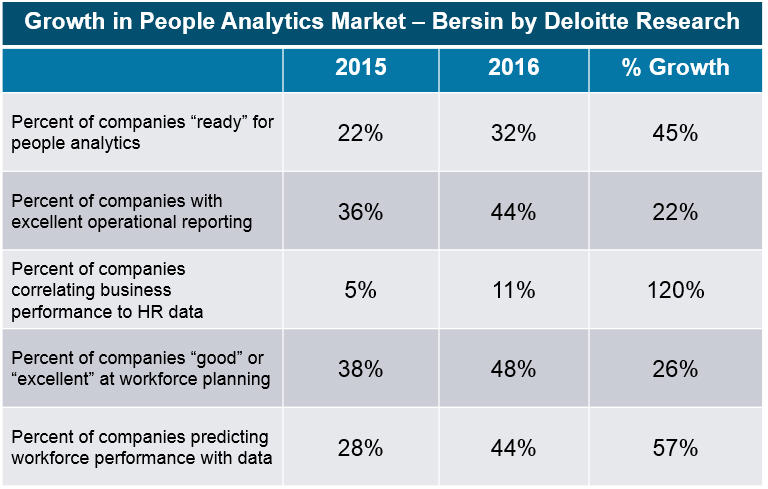
Explosive Growth In People Analytics

https://www.jibe.com/ddr/telling-the-story-of-a-data-driven-future-for-talent-acquisition/

Came across this really interesting table about the explosive growth in HR Analytics.

data-driven-human-resources

(Source:  Deloitte Human Capital Trends 2015 and 2016, 3,300 and 7,100 respondents, respectively) 

The blogger who shared this, Mike Roberts, stated “With advancements in technology, as well as more awareness of the power of data, this is starting to change. Since 2014, we’ve seen an incredible transformation in the way talent acquisition professionals view data. And research from leading analyst firms has been backing that up.”

This is exactly why I have been doing HR & Recruitment Analytics training classess. There is a growing number of options out there, so make sure you get the bang for you buck you are hoping for.

IMG_6912

Connect with me if you want to know more about my approach to using data to drive decision-making in HR and Recruitment. I have recently published a book, Putting Your Data to Work, that can be your guidebook to how to get more people analytics in your HR and Recruitment processes.

HR & Recruitment Analytics – The recruitment and retention of top talent is the biggest challenge facing just about every organization. You really have to Think Through The Box to come up with winning solutions to effectively attract, retain and manage talent in the Philippines today. DMAIPH is a leading expert in empowering HR & Recruitment teams with analytics techniques to optimize their talent acquisition and management processes. Contact DMAIPH now at analytics@dmaiph.com or connect with me directly to learn how to get more analytics in your HR & Recruitment process so you can rise to the top in the ever quickening demand for top talent.


Turning Data Owners Into Data Resources

One of the biggest challenges I hear about when I do public trainings is how to get people who are stingy with their data to share it.

My answer is always the same… buy them a doughnut.

Seriously, when I reflect back to what made me a great analyst when I was with Wells Fargo, one of the biggest reason was I made sure all the data guys liked me.

Just about every company has someone who likes to keep their data close. Sometimes it is a result of security risks. But most of the time it is because they just don’t like to share. It is also possible they just don’t like someone on your team. Whatever the reason, you have to get them to lower the gate and let you in to play with their data.

From my perspective, I generally see a few types of data gate keepers who have very different reasons to keeping you out of their data playground.

  1. They are afraid to share the data, because they know the data is not 100% trustworthy.
  2. They are afraid to share the data, because they worry you will use the data to do things they can’t.
  3. They are afraid to share the data, because they had a bad experience with you or someone like you.
  4. They are afraid to share the data, because you play for a different team.
  5. They are afraid to share the data, because you won’t need them anymore.
  6. They can’t share the data because it’s a security risk.

1075177_10151826941667425_1417094118_n

In every case, even the last, engagement is the key. Share with them why you need the data, demonstrate how much more awesome your analysis and reporting will be if you can include their data.

One of the advantages I have enjoyed in my career is that I really get along with people. I make an effort to be likeable and trustworthy. To be a great analyst, you will need to be likeable and trustworthy too.

And I kid you not, buying them a doughnut and dropping it off at their cube works more often than you might imagine.

The key to using analytics in a business is like a secret sauce. It is a unique combination of analytics talent, technology and technique that are brought together to enrich and empower an organization. A successful analytics culture is not easy to create, but DMAIPH can show you how. Contact DMAIPH now at analytics@dmaiph.com or connect with me directly so we can build a strategic plan to turn your company into analytics driven success story.
When Your KPIs Aren’t Really KPIs

One question I get asked a lot is what should someone do when they know the data they are reporting and/or using in their analysis is not the best data to available?

No matter what part of the business you work in, the first thing to do is to define the current Key Performance Indicators (KPIs) being used in decision-making.  Often right off the bat, some of the KPIs being reported aren’t even being used.

You can do a simple survey, asking end users to rank in order of importance the KPIs they get. Also ask if the ones at the bottom are even useful or should they be eliminated if no one is using them.

Growthink_Dashboard_Hero_w_Background_PSD_0

At the same time you should be working on understanding what computations go into each KPI. Often we just do simple counts, total and averages that mask more important data. On the flip side, we tend to over complicate things with extravagant weighing and scoring. Either way, we need to make sure we know exactly what is being reported and how does the final data point come to its end state.

The next step is to look at the data architecture to make sure there is nothing happening upstream that might impact the data we are using in the KPIs. Before making changes to the KPIs we want to have the full view of what happens before the data gets to the end user.

Now we are at the point where we can start experimenting. What happens when we swap out data points? Or if we change a variable in a calculation? Or we pull the data from a different source? The questions are endless. Pick a few, make some changes in a test environment and start sharing the updated KPI data. See if it has more value with the end users.

Again, this shouldn’t be hard. But of course in many organizations a lot of consequences can result from a simple change to just one KPI. Spreadsheets may have to be reformatted, review processes may have to be updated, dashboards may have to be redesigned. But in the end, what is more important… making decisions with crappy data or setting a standard to let the reporting process evolve as the business evolves?

This come back to my point earlier, changing KPIs is as much sales as it is analysis… that you have to be ready to share a story, back it up with data, and really influence the minds of senior management that updating the KPIs makes good business sense.

If you are at a point where you are trying to figure out what KPIs aren’t working anymore or you need help is building a business case to change some KPIs, let me know. I’m here to help.

jobspicture2

General Analytics – Analytics is the application of using data and analysis to discover patterns in data. DMAIPH specializes in empowering and enabling leaders, managers, professionals and students with a mastery of analytics fundamentals. To this end we have parterned with Ariva Events Management/Ariva Academy to offer a wide range of analytics themed trainings across the Philippines. Contact DMAIPH now at analytics@dmaiph.com or connect with me directly to find out what we can do to help you acquire the analytics mastery you and your organization need to be successful in today’s data-driven global marketplace.

Q8: Here’s something a lot of us are wondering, what exactly is big data?

Think about some of the things you do in your daily life. You get up, you eat, go to work/school, shop, do something for entertainment, bank, go online and do things on social media. Everything you do generates data. That data is captured in countless ways. And then its stored in countless places. And analyzed by countless numbers of people. And then used in countless ways by businesses to market, design, advertise, build, sell, and so on.

Every time you check your phone to see if there are any updates on Facebook you generate a lot of data for your phone manufacturer, your service provider and Facebook itself. Everything you like or comment on can be turned into a data point. The time, place and length of your connection all provide useful data. Get the point? Its endless.

That’s big data.

In general, big data is thought of as all the data businesses capture and store in a database that they can use for business decision-making.

When you think of data collections that have millions and millions of rows of data like big bank transaction data, or traffic data for major cities, or all the statistics captured everyday across professional sports. Way too much for man to analyze without help from technology. That’s all big data.

Every business defines its big data a little differently. There is no one way to look at how best to manage big data because big data is such a living, evolving, never ending flow of information. It’s like lakes of water that are too big to swim across and too deep to dive to the bottom of without help. And no two lakes are alike.

Data analysts and data s2.5.2cientists are the ones who know the lake and guide you across or build you a submarine to explore the bottom.

As I have mentioned in previous posts, knowing the data environment is key to your success. And big data just adds weight to that statement. If you don’t know where all the data is coming from, can’t be sure if its clean, then you will get lost in the deluge of big data.

The Fundamental of Business Analytics – Business Analytics is the application of talent, technology and technique on business data for the purpose of extracting insights and discovering opportunities.

DMAIPH specializes in empowering organizations, schools, and businesses with a mastery of the fundamentals of business analytics. Contact DMAIPH now at analytics@dmaiph.com or connect with me directly to find out how you can strengthen your business analytics fundamentals.


Q7: What exactly is data science and why the rapid rise of data scientists?

A year ago I might have found it challenging to really answer this question. The first time I had heard of the term data science and a data scientist wasn’t that long ago. And I have been doing some pretty advanced analytics for close to 20 years now.  I know the term has been around in academic and research circles awhile longer, but 2014 is the first time I ever saw a job posting for data scientist in big business.

So what is data science? Besides simply being the study of data, it generally refers to using complex models, machine learning, predictive and prescriptive analytics and powerful technology to analyze business data in much greater volume, velocity and variety then possible a few years ago.

And of course the ones charged with doing the data science are data scientists. They understand math, statistics, and theories that can be applied to business data using new technologies and methodologies.

The biggest challenge to being a true data scientist is that you have to be adapt at both technology and working with people. Being a business data expert, knowing how to code and doing higher math are only half the job. You have to also share your data, communicate it in ways that drive action, share and engage with non-data centric people. It’s hard to find people who are good at both.

ByugG_cIEAAL6wM

Image from Forbes Magazine. 

In addition, whole some data scientists are educated to be data scientists, very, very few actually have any kind of degree in data science. That kind of degree really didn’t exist until very recently. Instead most data scientists have advanced degrees is related subjects and have migrated into the business world do to market demand.

That demand has been growing at a staggering rate the past few years as every day we generate more and more data across the planet. President Obama first employed a data scientist for his campaign in 2012. The White House now has a chief data scientist position.

If you were to compare results from job board searches form 2012, you’d see maybe 100 data scientist job postings. Now its easily in the 1000’s.  So that’s why the job market for data scientist is one of the hottest around.  Lack of training programs, having both tech and people skills, and the booming demand due to unending new data to being analyzed.

Some people ask me if I’m a data scientist I am careful with my answer. True data science is not something I am academically prepared for nor I have never published anything in a scholarly journal. But my real world experience working with data has made me an expert on many aspects of data science.

I guess I feel more like an analyst, but a freakin awesome analyst who can do a lot of things using data that are super important to a business.

img_8168

Analytics Education – Facilitating a mastery of the fundamentals of analytics is what DMAIPH does best. As a key parnter of the Data Science Philippines Meetup Group, DMAIPH champions the use of using data. All across the world, companies are scrambling to hire analytics talent to optimize the big data they have in their businesses.

We can empower students and their instructors with the knowledge they need to prepare for careers in analytics. Contact DMAIPH now at analytics@dmaiph.com or connect with me directly so we can set a guest lecturer date, On-the-Job Training experience or other analytics education solution specifically tailored to your needs.

Q6: Can you provide some tips on how to manage data?

So you have the data lake, the messy version of the lake or data swamp and then the pristine, well managed version of the data lake called the data reservoir.

08-data-reservoir-walter-with-hard-hat

Imagine how a reservoir of fresh water is used for multiple purposes… fishing, drinking, watering crops, providing electricity. That’s how your data should be structured. Even if you are working with multiple data sources made up of a lot of unstructured data from social media, you need to be organized with your data.

I’m willing to bet that if you are reading this then you are by nature pretty organized. Analysts tend to be. If you are working in an data swamp and the company culture is not data-driven, the best advice I can give you, no joke, is to find another job.

What to look for in a data-driven company? Are the data warehouses easy to use? Is their documentation on the data architecture? Is there a knowledge base? Are there experts and are they open to helping you?

If you say yes to questions like that, then your data management tasks are generally about optimization, data blending, adding new sources and being a kick ass analyst.

If you say no to questions like that, then your data management tasks are generally about cleaning data, lots of data validation and having your analysis be filled with caveats that you might be missing something.

So a few tips I have for those in good data companies; get your documentation fresh, do a lot of bread crumb dropping, save your queries and models.

Keep the data architects,database admins and/or IT staff in your circle. Share with them how powerful your analysis is because of their help. And most importantly, show you masterly of the data lake.  Tell your story. And teach others how to fish in it.

For those of you not so blessed with good data cultures. You have to start on both ends. Map out the data flow. Try and assess where the data goes bad. Is it the input or capture of the data, is it a loading process, is it filers? Once you get a start on the front end, then go to the back end.

Who needs the data? How much of what data is being provided now is actually usable? Eliminate any unnecessary data. Basically start cleaning up the swamp at the same time you map it. And again tell this story. Don’t make excuses, but you do need to educate. Let people know there is a problem with the data and outline what you will do to correct for it.

In either case, before you go out and request or purchase new tools or start adding new data… make sure you have the architecture figured out. That’s the best tip I can give you about managing data.

jobspicture2

The Fundamental of Business Analytics – Business Analytics is the application of talent, technology and technique on business data for the purpose of extracting insights and discovering opportunities. DMAIPH specializes in empowering organizations, schools, and businesses with a mastery of the fundamentals of business analytics. Contact DMAIPH now at analytics@dmaiph.com or connect with me directly to find out how you can strengthen your business analytics fundamentals.