
Stone Age Analytics

I was chatting with a friend about Peter Drucker’s famous quote, “Culture eats strategy for breakfast.”

He made a point that made me think this lesson is still hard to actually put into practice even though it’s a 50+ year old concept. In fact the idea that a good culture is more important than a good strategy is as probably as old as man.

My reply was the best run caves where probably run by the caveman with the most efficient hunters and gathers, who felt a common purpose that their leader empowered in them.

In many senses, analytics has been around since day one. Even before we had basic math, just by observation cave men that survived told stories to explain where the best hunting grounds where and things like saber toothed tigers are bad for your health.

Centuries before Lean and Six Sigma, human engaged in process improvement. And Im sure the smartest cave man (or woman) in the cave ended up being the data guy who did some kind of simple analytics to advice the chief on who was the best hunter and who was the best candidate to use as bait to stampede a mammoth into a box canyon.

My point is, analytics is not anything new. In fact most businesses don’t have good analytics because they think its too complicated and too expensive. Now maybe employing a data scientist to build a state of the art predictive modeling tool, is a bit to Space Age for some, but everyone needs to have at least Stone Age Analytics.

That’s where DMAIPH comes in. We specialize in helping companies who feel like their analytics are stuck in the Stone Age evolve.

may18

Analytics Training – DMAIPH offers a wide range of analytics centric training solutions for professionals and students via public, in-house, on-site, and academic settings. We tailor each training event to meet the unique needs of the audience. If you need empowerment and skills enhancement to optimize the use of analytics in your organization, we are here to help. Contact DMAIPH now at analytics@dmaiph.com or connect with me directly to set up a free consultation to learn which of our DMAIPH analytics training solutions is best for you.
Data Analytics or HR Analytics? Which Should I Attend?

Here at DMAIPH we offer a variety of analytics training solutions to organizations here in the Philippines.

Our two most popular offerings are Data Analytics and HR/Recruitment Analytics.

We get asked a lot, what is the difference.

Well, in general the Data Analytics classes like our Big Data Analytics & Business Intelligence training this coming May 18, are designed for a general audience.

may18

HR/Recruitment Analytics classes like the upcoming HR Big Data & Recruitment Analytics training on March 14 in Ortigas, is designed for a much more specific audience of HR and Recruitment professionals.


Data Analytics attendees come from a wide range of companies and have perform a variety of job functions. The one thing they all have in common is that they are looking for data analytics techniques and technologies to help them get a handle on all the Big Data they have to work with everyday.

HR/Recruitment Analytics attendees are all working as part of Talent Management teams in HR, Recruitment, Training, Operations and other parts of an organization that primarily handle people data. So case studies, exercises and the lesson plan itself are all focused on how to use the people data in the business to enhance and empower people centric decision-making.

RA_Mar28_1

HR and Recruitment professionals can benefit a lot from attending the Data Analytics trainings and we generally have a few do just that. However, for a more focused approach to getting a handle on people data, the ones who attend the HR/Recruitment Analytics trainings will probably get a little more practical application to use when they return to the office.

Target Attendees for Data Analytics:

  • Data and Business Analysts
  • Managers and Supervisors of Analysts
  • Professional Staff who create reports and manage data
  • Decision-Makers who need more analytics

Target Attendees for HR/Recruitment Analytics:

  • HR and Recruitment Analysts
  • HR and Recruitment Managers and Supervisors
  • HR and Recruitment staff who work with a lot of people data
  • Data and Business Analysts who work closely with people data

Hope that helps you decide which one to attend.

Analytics Training – DMAIPH offers a wide range of analytics centric training solutions for professionals and students via public, in-house, on-site, and academic settings. We tailor each training event to meet the unique needs of the audience. If you need empowerment and skills enhancement to optimize the use of analytics in your organization, we are here to help. Contact DMAIPH now at analytics@dmaiph.com or connect with me directly to set up a free consultation to learn which of our DMAIPH analytics training solutions is best for you.

HR & Recruitment Analytics: 3 Reasons You Need More (Mar 28 – Ortigas)

On March 14, 2017 in Ortigas, I will be conducting a learning session on HR and recruitment analytics entitled HR Big Data & Recruitment Analytics.

Click here for more details and instructions on how to register >>>

The 3 top reasons for anyone working in human resources and/or recruitment to attend are:

  1. To learn analytics techniques that will allow quicker, deeper and more impactful analysis of HR Big Data & Recruitment Analytics.
  2. To be exposed to cutting edge technology being used to build predictive HR models for all aspects of talent management from recruitment to training to retention.
  3. To assess the current state of analytics in your business and build a strategy to empower the greater use of both descriptive and predictive analytics in your organization’s decision-making processes.

16649482_10155094449802425_5080201225679087647_nHR Big Data & Recruitment Analytics – The recruitment and retention of top talent is the biggest challenge facing just about every organization. You really have to Think Through The Box to come up with winning solutions to effectively attract, retain and manage talent in the Philippines today.

DMAIPH is a leading expert in empowering HR & Recruitment teams with analytics techniques to optimize their talent acquisition and management processes. Contact DMAIPH now at analytics@dmaiph.com or connect with me directly to learn how to get more analytics in your HR & Recruitment process so you can rise to the top in the ever quickening demand for top talent.

HR & Recruitment Analytics: Win The Talent War (Mar 28 in Ortigas)

Updated 11/19/16

It’s pretty clear to anyone who is paying attention that the current talent acquisition challenges facing BPO’s in the Philippines is getting worse at an alarming pace.

This trend is echoed across the planet as we have had a global failure in approaches to preparing the youth for the careers we need them to fill. There are several initiative underway in the Philippines to address this, but at this point its just a drop in the bucket when you look at the projections for talent with analytics skills, management potential and a strong work ethic.

war_for_talent

Check out our next training on March 14 in Ortigas. Here is the link >>>

I recently came across this post on LinkedIn that outlined 5 things that we need to work together to do to make sure the generation hitting the workforce now and especially the generation now in school, ready for prime time.

The talent shortage is particularly serious at the middle-management level as companies dither over how to develop high-potential entry-level employees into more senior roles within their organisations.

Solving it requires planning for the long-term and building a talent investment strategy into the corporate culture, which suggests that solving the talent shortage calls for new thinking, new approaches, and collaboration on an industry-wide scale.

Relying on the traditional education path – universities – to fill the talent needs won’t work because that will take years. We a faster solution – one that combines a multi-pronged approach, and one that is collaborative across all players in the business.

The article concludes with five ways of helping to solve the talent crisis threatening companies small and large all across the globe.

  1. Industry collaboration: Industry leaders joining forces to work with universities, colleges and trade associations to develop specific education programs to fill the expected openings.
  2. Expanded in-house and external education options: A growing number of firms are developing their own education programs making full use of senior existing internal expertise.
  3. Job rotation programs: A ‘talent exchange’ rotation to promote cross-functional development, which would also keep employee interest.
  4. Formalised knowledge transfer: Capturing people’s knowledge before it “literally walks out of the door” into retirement.
  5. Becoming an employer of choice: Taking steps to ensure that the company is an attractive place to work by providing competitive salaries linked to a valued career path.

img_0122

DMAIPH can help you by consulting with your management team on how to get ahead of the curve, by providing training to your team on how to optimize your talent acquisition an retention programs and/or by providing you with talent to fill your open positions.

HR & Recruitment Analytics – The recruitment and retention of top talent is the biggest challenge facing just about every organization. You really have to Think Through The Box to come up with winning solutions to effectively attract, retain and manage talent in the Philippines today.

DMAIPH is a leading expert in empowering HR & Recruitment teams with analytics techniques to optimize their talent acquisition and management processes. Contact DMAIPH now at analytics@dmaiph.com or connect with me directly to learn how to get more analytics in your HR & Recruitment process so you can rise to the top in the ever quickening demand for top talent.

The Three T’s of Recruitment Analytics (next training on Mar 28 in Ortigas)

I often talk about how having good recruitment analytics takes a combination of the right talent, the right technology and the right technique. As a talent management professional, I am sure you have valuable insight into which of the 3 T’s you see as your organizations strongest and weakest point. From your perspective, is it:

Talent: You have to have people who get the recruitment process that are curious, comfortable playing with data and are good communicators. That have to be able to identify data, analyze it and provide actionable reports.

Technology: You need tools to help you leverage the opportunities stored in your recruitment data. The tools need to take data from different sources and blend it into a central analysis tool. The results should be displayed in reports and business dashboards that allow managers and decision-makers to act quickly and efficiently.

Technique: Your entire team needs to be part of the analytics process. Analysts can do the bulk of the work, but everyone needs to be empowered to use data to discover patterns, exploit opportunities and mitigate risks.

Which one of the three is the one your team has the biggest challenges with?

11709268_10153506561077425_1608720566061502683_nIn my experience, most recruitment teams have good talent in place, and many have the technology they need to be successful. The missing element is often technique. Few recruitment teams are truly skilled in using analytics to get the right candidates, one’s who will stick around, at the right time.

Infusing recruitment teams with tried and true analytics techniques in one of my specialties. Connect with me and I will show you how to get more bang for your buck when it comes to filling open positions and keeping them filled.

Join us for our next training on March 14 in Ortigas. Click here for more details >>>

HR & Recruitment Analytics – The recruitment and retention of top talent is the biggest challenge facing just about every organization. You really have to Think Through The Box to come up with winning solutions to effectively attract, retain and manage talent in the Philippines today.

DMAIPH is a leading expert in empowering HR & Recruitment teams with analytics techniques to optimize their talent acquisition and management processes. Contact DMAIPH now at analytics@dmaiph.com or connect with me directly to learn how to get more analytics in your HR & Recruitment process so you can rise to the top in the ever quickening demand for top talent.

Using Data To Recruit Better Candidates (Next Training Mar 28)

A few blog posts ago I mentioned 2 important recruitment analytics data points that can be used to help better understand attrition; distance to work and difficulty of commute. If a recruitment team has a way to use data on these two metrics in their screening process, they will be able to spend less time on high risk candidates and more time on candidates who have a much higher chance of sticking with the company.

It is not hard to start tracking these data points, as long as you have their home address, a general knowledge of traffic patterns and two very useful free  tools to help in your analysis. The free tools can be found at www.itouchmap.com and www.tableau.com/public

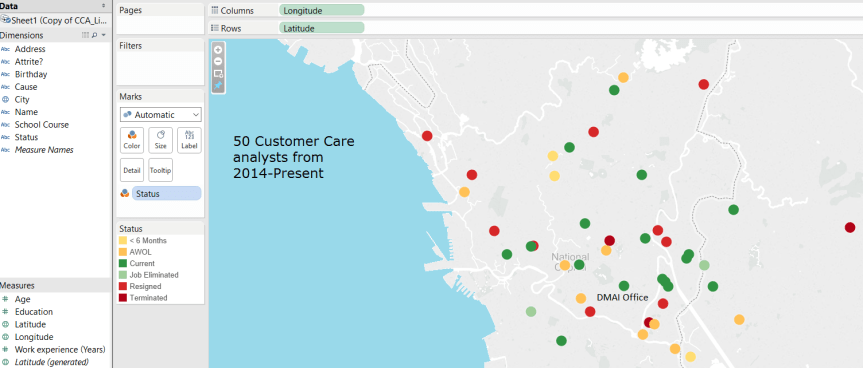
Based on the 50 Customer Care Analysts my team has hired for our 17 seat customer care team over the past 2.5 years, you can see some clear patterns when you look at their home addresses and commute on a map.

As you can see below, the majority of our candidates who turn into long term hires live closer to the office and along easier traffic routes. As a general rule, one direct ride (bus, train or shuttle) generally equates to stickiness of the candidate. Even some who live closer distance wise, but face multiple rides have a higher attrition rate than those who live a little further but have one ride. For example, taking a bus from the central part of Quezon City might be easier then 2-3 jeepney rides from Taugig, even though the distance from Taguig is much closer.

CS_Tbleu

The map, created in Tableau Public, is generated on knowing the latitude and longitude of their home address (from their resume), which can be looked on using itouchmap. The whole project took less then 2 hours to compile, organize and upload the data into Tableau, then seconds to build the map.

During our first year as we hired people from a wider range of places we had much higher attrition (65%), but as we matured as a business along with our understanding of these and other key metrics, our attrition has dropped significantly in the past year (28%).

As elaborated on more in detail in previous posts, distance to work and difficulty of commute are not on their own data points to be used to screen candidates, but when combined with their interview scores, test and assessment results and reference checks, you can have a much more well-rounded view of the candidate’s potential.

If you would like some help us setting up this same process of capturing distance to work and difficulty of commute and building a map to visualize them, feel free to reach out to me. I have a book, this blog, lots of training materials and I speak about analytics frequently. I’m here to help.

Our next training is March 14 in Ortigas, click here to learn more >>>

HR & Recruitment Analytics – The recruitment and retention of top talent is the biggest challenge facing just about every organization. You really have to Think Through The Box to come up with winning solutions to effectively attract, retain and manage talent in the Philippines today.

DMAIPH is a leading expert in empowering HR & Recruitment teams with analytics techniques to optimize their talent acquisition and management processes. Contact DMAIPH now at analytics@dmaiph.com or connect with me directly to learn how to get more analytics in your HR & Recruitment process so you can rise to the top in the ever quickening demand for top talent.

HR & Recruitment Analytics: Getting “IT”

HR Data is integral to the success of business strategy.

HR Data Analysis can drive decision-making and not just align, but shape business strategy.

HR Data and Analysis that uses Data Visualization and feeds Business Dashboards is enchanting to decision-makers.

When you have IT in your HR Analytics process you are enchanting. That should be your goal.

So how how exactly do you align your HR data to the business strategy.

  • Have the 3 T’s (talent, tech and technique)
  • Use the 3 I’s (identify, inventory and integrate)
  • Make Friends
  • Think Outside the HR Box
  • Keep Your Data Lake Clean
  • Share Your Data and Analysis
  • Visualize and Enchant

jobspicture2

HR & Recruitment Analytics – The recruitment and retention of top talent is the biggest challenge facing just about every organization. You really have to Think Through The Box to come up with winning solutions to effectively attract, retain and manage talent in the Philippines today. DMAIPH is a leading expert in empowering HR & Recruitment teams with analytics techniques to optimize their talent acquisition and management processes. Contact DMAIPH now at analytics@dmaiph.com or connect with me directly to learn how to get more analytics in your HR & Recruitment process so you can rise to the top in the ever quickening demand for top talent.

HR Predictive Analytics is the Next Big Thing in Talent Management (Mar 28 in Ortigas)

Predictive analytics are a rapidly upcoming trend in Human Resources.

Even though a lot of people talk about predictive analytics in HR, hardly any organizations are really able to tie success in HR with success to the bottom line. By applying predictive analytics to business data, HR should be able to add value as a strategic partner that relies on proven and data-driven predictive models, instead of relying on gut feeling and soft science.

Last year, Towers Watson found that one in three organizations planned to increase spend on their HR function by more than 20 percent, and HR data and analytics tools rated as one of the top areas for investment.

However, just looking at HR data in isolation does not represent the best opportunity to make an impact. In fact organizations today need to be able to use predictive analytics for a wide range of functions, especially to:

  1. Measure employee engagement and workforce perceptions
  2. Predict employee turnover
  3. Predict employee performance
  4. Monitor impact of business interventions

This learning session is specifically designed to provide HR teams with a strategic road map to bring together all the relevant data in a business and to use it to predict successful outcomes. Join us March 14, 2017 in Ortigas. HR Predictive Analytics is just one of the topics we will discuss. Click here for more info >>>

jobspicture2

HR & Recruitment Analytics – The recruitment and retention of top talent is the biggest challenge facing just about every organization. You really have to Think Through The Box to come up with winning solutions to effectively attract, retain and manage talent in the Philippines today.

DMAIPH is a leading expert in empowering HR & Recruitment teams with analytics techniques to optimize their talent acquisition and management processes. Contact DMAIPH now at analytics@dmaiph.com or connect with me directly to learn how to get more analytics in your HR & Recruitment process so you can rise to the top in the ever quickening demand for top talent.

They Have Got It All Wrong! Why Most Analytics Training Fails.

Four years ago, I was just about the only one speaking professionally in the Philippines about  Analytics. Now so called experts are a dime a dozen. The demand for this kind of training has skyrocketed as companies are losing the war for talent all across the globe, with few jobs as hard to fill with good talent as BPO jobs in the Philippines. But these training mostly have it all wrong. They will teach you a lot of technical things that sound great in a class room, but are extremely hard to implement unless you work in an enlightened company that encourages curiosity and empowers data-driven decisions across to organization.

So one big thing right now is using analytics in HR to find more candidates, to hire better candidates, and retain them.  Its working in the U.S and all across the globe. This is a direct reflection of overwhelming demand for so called white collar professional jobs The hot answer going around right now to this challenge is sending analysts, managers and leaders to trainings. Hoping they will learn about hot new trends and analytics techniques to get more out of an investment in the company’s analytics plans. However, from my perspective, this is the flavor of the month thinking. And you know what? It’s not going to work.

Why? Good Analytics doesn’t come from just external training and technology. Those two pieces are important to an overall analytics strategy. But the most important piece, and the one being overlooked right now is the business culture. If the business culture is not ready to truly accept a shift towards data-driven decision-making an away from old school methods and decisions made off of gut feel, then the going to one of these trainings wont amount to a hill of beans at the end of the day.

This is why I spend so much of my time talking about culture, and why I expose that analytics is as much art as it is science. You need the technology, which is abundant. You need the talent, which is hard to find but out there. And you need the culture, where you analysts can use the technology to not just build reports and mine big data, but to illustrate opportunities and discover solutions that can really drive the business forward.

That is what you want out of a training on HR analytics. Not just technobabble and reporting tricks, but something that will truly help you mold the culture of your business to get the most out of your analytics.

In closing, I have recently published a guidebook for using analytics in your business. If you are interested in learning more and would like to get a copy of Putting Your Data To Work , connect with me via e-mail at analytics@dmaiph.com

#IamDMAIPH

The Philippines is at the center of the action when it comes to solutions to the global need for analytics. Blessed with a solid foundation of young, educated and English speaking workforce, companies around the world are look for Filipino analytics talent to fill analytics positions.

DMAIPH HR & Recruitment Analytics – The recruitment and retention of top talent is the biggest challenge facing just about every organization. You really have to Think Through The Box to come up with winning solutions to effectively attract, retain and manage talent in the Philippines today. DMAIPH is a leading expert in empowering HR & Recruitment teams with analytics techniques to optimize their talent acquisition and management processes. Contact DMAIPH now at analytics@dmaiph.com or connect with me directly to learn how to get more analytics in your HR & Recruitment process so you can rise to the top in the ever quickening demand for top talent.

Introduction to Recruitment Analytics

A standard definition of Recruitment Analytics is simply the metrics and analysis that relates to recruiting in a business.

However, we all know it’s actually a lot more challenging in practice.

When did you start first thinking about analytics in your recruitment process?

From my experience very few recruitment professionals actually have a solid grasp of how to use the data in their business to drive recruitment related decision-making.

Adding to the lack of analytics knowledge, we have new technologies like social networks, applicant tracking systems and business intelligence applications that are fundamentally changing the entire recruitment process from sourcing to placement.

What are some of the recent technological changes you have seen in recruitment? Are you using technology to your advantage?

Most of your peers are not. Based on my observations and interactions I’d say only about 20% of companies currently operating in the Philippines are using anything beyond MS Excel to manage their talent pipeline.

This is true even though the pressure to deliver results has never been greater.

Recruitment managers are now more than ever required to demonstrate the return on investment their efforts are contributing to the bottom line.

Now we are starting to see a wide spread interest in bringing more analytics into the recruitment process.

Are you expected by your boss to find ways to use analytics to bring about change with recruitment in your organization?

Every recruiting organization is looking for a way to better understand what’s working and what’s not working in their recruiting strategy.

With real-time recruitment metrics & reporting, we can finally know what’s happening in our pipelines and what channels provide us with most qualified candidates.

I often say recruitment here in the Philippines is one of the hardest jobs on the planet. Given the great demand for skilled labor and the lack of day one ready talent, there is just not enough supply to go around.

So wondering where do you start?

Some of the typical questions we all start out with when we think about analytics and recruitment include:

What metrics are important to my organization?

  • What are the metrics which enable me to measure my team’s effectiveness?
  • Which tool should I use to have better analytics?
  • How can I understand the ROI (return on investment) of my recruiting efforts?

If you are ready to answer these questions, then connect with me and we will provide you with An Introduction to Recruitment Analytics.

jobspicture2

Analytics Training – DMAIPH offers a wide range of analytics centric training solutions for professionals and students via public, in-house, on-site, and academic settings. We tailor each training event to meet the unique needs of the audience. If you need empowerment and skills enhancement to optimize the use of analytics in your organization, we are here to help. Contact DMAIPH now at analytics@dmaiph.com or connect with me directly to set up a free consultation on which of our DMAIPH analytics training solutions is best for you.