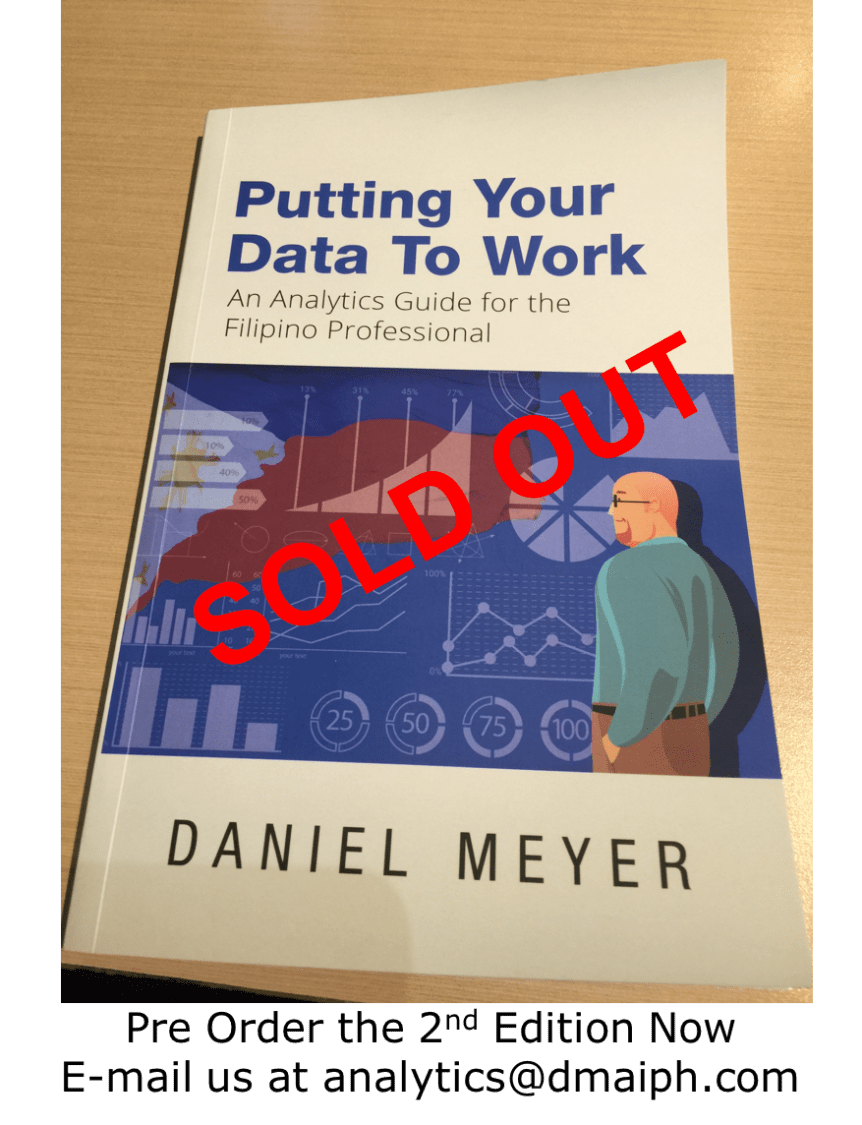
Putting Your Data to Work is SOLD OUT! Working on the 2nd Edition Now!

I feel so excited to share with you all that we are now completely sold out of my recent book, Putting Your Data To Work: An Analytics Guidebook for the Filipino Professional.

I am currently working on a 2nd addition with additional images, content and an expanded section on predictive analytics.

If you would like to pre-order a copy of the 2nd Edition, send us an e-mail at analytics@dmaiph and we will add you to the waiting list.

My plan is to have copies available by mid March if not sooner.

Thanks so much to all of you who purchased a copy of the 1st edition. I’m proud to say that we’ve gotten some fantastic feedback from readers that I will incorporate into the new edition.

jobspicture2

2017 is the year that Analytics will go mainstream across the Philippines. My book is a great guide for ensuring your organization has a solid analytics foundation as the era of Big Data is upon us.

My Analytics Story – My passion is solving problems by bringing together the best talent, cutting edge technology and tried and true methodologies. DMAIPH is all about empowering people towards better Decision-Making through the use Analytics and business Intelligence. This is what I do best. Contact DMAIPH now at analytics@dmaiph.com or connect with me directly for a free consultation about getting more analytics into your career and your business.

Learn Analytics Leadership From The Analytics Council of the Philippines

The Analytics Council of the Philippines was founded in December 2016.

Our mission is to serve as a forum for furthering the training, teaching and use of analytics across the Philippines.

Our mission statement and upcoming events will be posted soon.

outsourcing-seo-services-in-the-philippines-forward-solutions-seo-and-web-design-company

DMAIPH is a founding member of the Analytics Council of the Philippines and specializes in arming the Data-Driven Leader with the tools and techniques they need to build and empower an analytics centric organization. Analytics leadership requires a mastery of not just analytics skill, but also of nurturing an analytics culture.

We have guided thousands of Filipino professionals to become better analytics leaders. Contact DMAIPH now at analytics@dmaiph.com or connect with me directly to discuss a uniquely tailored strategy to ensure you are the top of your game when it comes to Analytics Leadership.

Looking Ahead To The Most Awesome Analytics Year Ever

A little over 5 years ago my Analytics Story begun.

The first year was all about validating my business plan of being an analytics resource to Filipino schools, companies and to a large number of Filipinos themselves.

The 2nd year was taking the concept, basic analytics training, and getting it in front of a variety of audiences to see what where the biggest needs in the marketplace.

Year Three saw us start focusing on the things that gave me both profit and satisfaction. Trainings for groups of professionals who were hungry to get more analytics into their businesses.

By the 4th year my priorities evolved to firming up the foundation of the business to ensure smooth operations so that I could focus more on what I do best; empowering analysts to use data to drive decision-making.

Last year saw it all come together. Year 5 was all about building a network to take my passion and do much more with it then my small team could take on alone. I trained more Filipinos across a wider range of need then I could have imagined. And yeah, we made a nice profit too. Also got my first analytics book published.

img_7910Now, as I look at year six I see the fruits of our blood, sweat and tears and I see nothing but growth. More and more Filipinos empowered to use data, across an even wider swath of backgrounds and in an ever increasing footprint.

2017 is going to be the most awesome analytics year ever, not just for me. Not just for my business. But for my beloved adopted home, the Philippines.


Let’s See How the Wind Blows: YouTube Video

For those who missed it: On CGTN, #Philippines and #ASEAN economies and security hang in the balance as Donald Trump takes over as U.S. President. Happy to add my perspective to current events impacting business in the Philippines.

Analytics in the Philippines – The Philippines is at the center of the action when it comes to solutions to the global need for analytics. Blessed with a solid foundation of young, educated and English speaking workforce, companies around the world are look for Filipino analytics talent to fill analytics positions. DMAIPH was set up to facilitate these solutions and bring the talent and the business together. Contact DMAIPH now at analytics@dmaiph.com or connect with me directly so we can help you take advantage of this unique global opportunity.

Global Demand for Analytics and Data Science Talent

There are not enough analytics experts and data scientists to go around.

I say this a lot.

Just did a quick google search to put some recent data points and commentary to back up what I say.

The mass adoption of big data has seen companies across sectors scramble to hire enough data scientists to glean insights and drive decision making.

A decade ago, explaining data science to employers was challenging. Few people understood the value of a skill set that combines computer science, statistics, operations research, engineering, business insights and strategy and the impact it can have on a business.

But things have changed over the last five years. Not only has the term “data science” become commonplace, but data scientists have become highly sought after in the marketplace

According to a 2015 MIT Sloan Management Review, 40 percent of the companies surveyed were struggling to find and retain the data analytics talent. And the picture is starting to look even bleaker.

International Data Corporation (IDC) predicts a need by 2018 for 181,000 people with deep analytical skills, and a requirement five times that number for jobs with the need for data management and interpretation skills.

A report by McKinsey & Company is frequently referenced, stating that by 2018, the United States alone could face a shortage of 140,000 to 190,000 people with deep analytical skills as well as 1.5 million managers and analysts with the know-how to use the analysis of big data to make effective decisions.

Deloitte’s Analytics Trends 2016 report notes that while there is a rising number of university analytics and data science programs (more than 100 just in the U.S.), they nonetheless can’t crank out enough sufficiently trained people to meet demand.

Consequently, the report recommends that companies should:

  • Actively recruit on campuses with data analytics programs.
  • Develop internships and student projects both as a recruiting tool and to groom students for an efficient transition to the general business world and company culture.
  • Establish meaningful and rewarding career paths with an infrastructure in place most likely to interest and attract new talent.

In a recent blog post, Facebook listed a number of tips for students to prepare for such fields. Chief among them: “Take all the math you can possibly take,” including probability and statistics. (And while you’re at it, the company recommends, make sure you take some computer science, and try to squeeze in engineering, economics, philosophy of knowledge, and the latest brain research, too.)

One of the reasons I am so bullish about 2017, is that appetite for analytics and datas science is through the roof. Finally, everyone is starting to get serious about how to infuse their decision-making with more data.

DMAIPH specializes in empowering and enabling leaders, managers, professionals and students with a mastery of analytics fundamentals. Contact DMAIPH now at analytics@dmaiph.com or connect with me directly to find out what we can do to help you acquire the analytics mastery you and your organization need to be successful in today’s data-driven global marketplace.

img_7737

Sources

http://www.business.com/recruiting/big-data-big-problem-coping-with-shortage-of-talent-in-data-analysis/

https://techcrunch.com/2015/12/31/how-to-stem-the-global-shortage-of-data-scientists/

https://content.pivotal.io/blog/mckinsey-report-highlights-the-impending-data-scientist-shortage

http://www.mckinsey.com/business-functions/digital-mckinsey/our-insights/big-data-the-next-frontier-for-innovation

https://code.facebook.com/posts/384869298519962/artificial-intelligence-revealed/


The Huge Growth Opportunity of Analytics in the Philippines

The Philippines is standing on the precipice of a huge opportunity.

We are in a similar place to where we were 10 years ago when the Call Center Industry was just taking off.

Now instead of becoming a global hub for customer service calls, the opportunity is becoming a center for analytics and data science.

There is nowhere to go but up.

Here is why…

  • A well-documented need for analytics talent globally.
  • A youthful workforce of English speakers with an affinity for Western Culture.
  • Leadership from within the government and higher education pushing the inclusion of analytics and data science into college and even high school curriculums.
  • A vibrant work force of young professionals that have experience working for international companies and assisting people from all over the world.
  • A strong sense of self-preservation in the BPO industry to offer “up the value chain” services to their clients.
  • Industry leaders and business owners with an insatiable appetite to keep the county’s economic momentum in growth mode.
  • A collection of thought leaders, analytics experts and actual data scientists that are
    highly motivated to lead the country to data-driven success.

There are undoubtedly many more.

The bottom line is 2017 is looking like it will be the year the analytics and data science are firmly established as strengths of doing business in and with the Philippines.

cropped-dr-data_analytics-in-the-philippines1.jpg

Analytics in the Philippines – The Philippines is at the center of the action when it comes to solutions to the global need for analytics. Blessed with a solid foundation of young, educated and English speaking workforce, companies around the world are look for Filipino analytics talent to fill analytics positions. DMAIPH was set up to facilitate these solutions and bring the talent and the business together. Contact DMAIPH now at analytics@dmaiph.com or connect with me directly so we can help you take advantage of this unique global opportunity.

7 Reasons for Filipinos To Get into Analytics Right Now

Some people ask why did I come to the Philippines.

Why did I leave a great analytics career at Wells Fargo and move 6,000 miles away to set up a business?

Was it just for the money? What really motivated me?

Am I worried about the current political forces that can potentially divide my home country and my adopted country?

Am i really gonna stick it out with the Philippines?

Well the answer to all those questions is simple. For the past 5 years I have worked to help empower Filipinos with more analytics. I will keep doing it as long as I can because I have faith in this country, the Filipino people and my ability to make a difference.

Below are 7 reasons why I believe what I believe. And these have held true for the past 5 years and will most certainly hold true for at least the next 5 years.

7 Reasons for Filipinos To Get into Analytics Right Now

  1. Huge Growth Opportunity
  2. Awesome Salaries
  3. Global Demand
  4. Empowers Curiosity
  5. Technology Driven
  6. Unlock Your Potential
  7. The Sky is the Limit

I will write a series of blog posts with more detail on each of the 7 points, but the bottom line is that for someone like me who has a passion for teaching analytics, there is no where in the world better to be.

The Huge Growth Opportunity of Analytics in the Philippines. I see this an undeniable fact  that both global and domestic forces are pushing the Philippines forward to new types of jobs and new skills sets that will likely continue to boom.

The Awesome Salaries Filipino Analytics Professionals Can Earn. There is a lot of money to be made if you are a data geek and the amazing rise in salaries and the salaries being offered to fill new positions are very high. The need for analytics talent is driving a buyer’s market.

The Global Demand for Analytics Talent is Looking at the Philippines Right Now. There just aren’t enough people across the globe who can do analytics well. Like with call centers and with OFWs the Philippines is considered a top potential source of talent.

Filipino Companies Who Get Analytics Empower Curiosity. When you come across a domestic company that understand analytics you find truly engaged employees. They know they are valued because the see the data and it empowers them to be curious and to think outside the box.

Filipinos with an Affinity for Technology are Natural Born Analysts. Social Media, Programming, IT. Computer Science… there are a number of factors at play that imbue the millennial workforce with a penchant for working with data to solve problems.

Analytics Careers in the Philippines can Unlock Your Potential. The need to fill all levels of analytics jobs creates opportunities for quick advancement. It its generally merit based, so the harder you work the more opportunity you can create for yourself.

The Sky is the Limit for Analytics in the Philippines. There is no where to go but up. On both a country wide as well as an individual level, there is really no hard ceiling on what we can do. It really is completely up to us how high we go.

jobspicture2

General Analytics – Analytics is the application of using data and analysis to discover patterns in data. DMAIPH specializes in empowering and enabling leaders, managers, professionals and students with a mastery of analytics fundamentals. Contact DMAIPH now at analytics@dmaiph.com or connect with me directly to find out what we can do to help you acquire the analytics mastery you and your organization need to be successful in today’s data-driven global marketplace.

Why Analytics Projects Fail – #11: No End User Participation

One the most overlooked and under appreciated parts of assuring a successful analytics implementation is getting the participation of end users. End users being defined as the consumers of either the data, the analysis and/or the reports that come out of the project.

I can tell you countless horror stories about stacks of reports that go unread, email summaries that are never opened and business dashboards that are rarely clicked on. In most cases, all because the end user was not involved in the project or its development process.

One example of this is when the ones who need the reports are not asked what they need in the report.  This is more common than you might think. Requirements, no matter how well thought out, will always overlook something someone needs. Another reason is not finding out how the end users want it to look. They often are omitted from the design phase and just left to use it. Worse it’s possible that what is delivered in not even compatible with other things they do. This leads to failure by not being useful, a complete waste of time and resources, especially yours.

TPS-Report

The best way to assure end user use is to have them involved at the earliest stages of the project. If you are selecting the project team or have influence on the team makeup, make sure you get an end user who can speak for that audience. It might be more than one person.

Another way is to keep the end-users informed and allow for feedback. Finding ways to work feedback into your project is another place you would be surprised by how often it is not done.

And finally make sure you build in a testing period before your project goes into production. In some cases this might include the feedback phase, but in big projects there is often a need for end user testing. If you don’t shepherd this effort, who will?

If you are no sure how to go about involving the end users and/or are not sure of who all the end users might be, then you should really answer those questions as early as possible. No one wants to see their hard earned work just end up in the trash bin because it does not fit the need it was designed for.

The key to using analytics in a business is like a secret sauce. It is a unique combination of analytics talent, technology and technique that are brought together to enrich and empower an organization. A successful analytics culture is not easy to create, but DMAIPH can show you how. Contact DMAIPH now at analytics@dmaiph.com or connect with me directly so we can build a strategic plan to turn your company into analytics driven success story.

Analytics Culture – The key to using analytics in a business is like a secret sauce that fuels Data-Driven Decison-Making. It is a unique combination of analytics talent, technology and technique that are brought together to enrich and empower an organization.

A successful analytics culture is not easy to create, but DMAIPH can show you how. Contact DMAIPH now at analytics@dmaiph.com or connect with me directly so we can build a strategic plan to turn your company into analytics driven success story.

DMAIPH’s Typical Client Profile

I publish and share a lot of content about helping businesses get a better handle on their analytics in order to build a culture of data-driven decision-making. With so many businesses of various shapes and sizes looking to get more out of their data, I get asked a lot what kinds of businesses do we specialize in helping.

In general, I think we can help just about any business with its data analytics, with using data for business decision-making and in building an analytics centric culture.

That said, success often will hinge on a couple of factors.

  1. How is the data acquired and stored? The more structured the data management the easier.
  2. How serious is top level management about using data to make decisions?
  3. Is there a person or a team who really get the theory of how to optimize a business using data?

If all of those are true, it’s a green light for us no matter what the size or type of business.

If 1-2 are true, it is still possible, but we will have to make sure we keep expectation tied to reality.

If none of factors are in place, then I will probably decline the consulting gig. You can save people who don’t really want to save themselves.

Our business plan is to offer analytics solutions in the things we are best at, (1) talking about analytics, (2) consulting on using data in a business strategy and (3) providing data and/or analytics focused, hybrid staffing solutions.

The 3 kinds of businesses we specialize in helping by offering these solutions are

  1. Ready to expand – companies who are about to kick off a period of significant growth in their operations and need data analytics and/or more staff to be successful.
  2. Ready to revitalize – companies who have hit a rough patch and need to better understand where things went wrong and need a road map on how to get back on track.
  3. Ready to launch – start up companies who need to refine their initial business plan based on solid data analysis and/or need staffing solutions to get things rolling.

jobspicture2

So although I feel we can help just about any business when it comes to analytics, these are the 3 types of service we offer to our target market. I will detail more about how we go about helping businesses and tell you a story about a company we have helped in the next few blog posts.

Analytics Consulting – As a founding member of Gloabl Chamber Manila, DMAIPH specializes in a variety of analytics consulting solutions designed to empower analysts, managers and leaders with the tools needed for more data-driven decision-making. We have helped dozens of companies get more analytics in their business. Contact DMAIPH now at analytics@dmaiph.com or connect with me directly so we can tailor an analytics solution made just for your unique requirements.

How to Build Your Business Strategy

Business strategy is something that comes naturally to me. I’m good at anticipating challenges, at doing research to assess the risk and reward to multiple options and I love to use data to validate or refute initial findings.

Though easy for me, I have found that being successful with business strategy is not as natural for most business owners, senior managers and decision-makers.

IMG_1849

When I set up my first company, it was based on a year of research and lots of networking. When I launched my second business it was based not just on research and networking, but learning from the mistakes made the first time with financial planning and partner relationships. Now on my third business, having taken the best of everything that worked before and finding ways to mitigate the things that went wrong before.

Now, for most business leaders you can’t just hit the rest button every few years, but you should hit the reset button on your initial strategy. Adapt to changes in the market. Glean new insights on cutting edge technology. Stay on top of industry trends.

That’s the first key to business strategy. Understanding that it is a continual process that evolves. Many businesses fail because they don’t change with the times or because leaders just stick with what has always worked. That’s dinosaur thinking.

Any good business strategy has to adopt a continuous process improvement policy, using something Six Sigma or Lean to keep things form getting stale.

A good business strategy also seeks out new technologies that can disrupt both their business and their business marketplace. What was cutting edge and trendy six months ago most likely be as effective six months from now. Good Business intelligence tools that can do cool data visualizations and build business dashboards help us stay ahead of the game. I show a lot of people how to do this using Tableau Public, which is free and easy to learn.

The next key to business strategy is integrating customer insights into everything you do. If you don’t listen to your customers, if you can’t predict what they need, and if you have a strategy that puts profit before customer experience you will probably fail.

It amazes me when I see bad customer service, products that no longer meet customer needs being produced and unimaginative marketing campaigns. In this day and age, with access to our customers at unprecedented levels, there is no excuse for failing to get it right the first time.  We do a lot of surveying and engage using social media to stay connected.

The third key I include in my business strategy planning and consulting is understanding the competitive landscape. Knowing where we stack up in the marketplace, what are our strengths and weaknesses, what is hot and what is not… you need to put as much focus on what is happening outside the business as you need to know what’s happening inside.

Almost everyone I talk with about their competitors share with me one common feeling… I don’t really know what my competitors are doing. In fact a high percentage even struggle to identify who their key competitors are. We are active in industry organizations, online social media groups and attend competitors events to stay up to date.

Business strategy is a lot more than just business intelligence, customer insights, and competitive landscapes, but it is a good start. If you are able to add these to financial models and demographic data, you will have a well-rounded business strategy. And then its just a matter of keeping it fresh, resetting it every so often to make sure you don’t become a dinosaur.

Let me know if I can help. In the past few years I have helped companies of all shapes and sizes refine their business strategy using my keys to success.

Business Strategy with Analytics – Aligning a business strategy to drive an organization forward requires a robust analytics solution. Businesses who have good analytics tend to be much more profitable and efficient then ones that do not. DMAIPH has helped dozens of companies in both the U.S. and the Philippines with adding more data analysis in their business strategy. Contact DMAIPH now at analytics@dmaiph.com or connect with me directly to find out what we can do to help you align your business strategy with analytics.