Why Focus on Data Analytics Competencies?

Later this week I will be attending the APEC Project DARE (Data Analytics Raising Awareness) Advisory Council in Singapore to discuss Recommended APEC Data Analytics Competencies.

Why Focus on Data Analytics Competencies?

Jobs requiring a familiarity with data analysis are forecasted to dramatically rise, resulting in a massive shortage of qualified employees. According to reports, some economies face a shortage of up to 1.5 million data analytics-enabled managers and analysts, costing billions of dollars in lost revenue annually. There is an urgent need to ensure that the future workforce is equipped with data analytics competencies to secure the jobs of tomorrow and move with ease in the labor market.

This is where Project DARE comes in. Project DARE aims to facilitate development of a data analytics-enabled workforce across the APEC region to effectively support sustainable economic growth and prosperity in the Asia-Pacific region. To do so, Project DARE developed a set of Recommended APEC Data Analytics Competencies which will be a resource to academic institutions and governments to align curricula, courses and programs so APEC economies are equipped to educate its workforce with the data analytics skills needed by employers in a data-driven future.

How was the Recommended Data Analytics Competencies Developed?

The Recommended APEC Data Analytics Competencies was developed through a public-private partnership with input from over 40 Advisory Group members (see Acknowledgements) comprised of distinguished business and higher education leaders who oversee data science and analytics needs for their organization and data science inter-disciplinary initiatives and curriculum. The Advisory Group was led by the private sector partner co- chairs, global skills and knowledge company Wiley and the Business Higher Education Forum (BHEF), with technical support by the EDISON (Education for Data Intensive Science to Open New Science Frontiers) Project.

17426122_1095825400562902_5936762267508985241_n

DMAIPH and Analytics Education

Facilitating a mastery of the fundamentals of analytics is what DMAIPH does best. As a key parnter of the Data Science Philippines Meetup Group, DMAIPH champions the use of using data. All across the world, companies are scrambling to hire analytics talent to optimize the big data they have in their businesses. We can empower students and their instructors with the knowledge they need to prepare for careers in analytics. Contact DMAIPH now at analytics@dmaiph.com or connect with me directly so we can set a guest lecturer date, On-the-Job Training experience or other analytics education solution specifically tailored to your needs.

About Project DARE

Project DARE is an initiative of the Asia-Pacific Economic Cooperation led by the United States (U.S. Department of Labor) with co-sponsorship from the governments of Australia, Japan, Malaysia, Peru, Chinese Taipei, and Viet Nam. As a project of APEC’s Human Resources and Development Working Group (HRDWG), Project DARE seeks to enable APEC workforce with the data analytics competencies demanded by employers today and to secure the jobs of tomorrow.

Analytics in the Philippines 2020

The year 2020 used to sound like it was so far off in the future.

Yet, there it is on the calendar… just a little more then 2.5 years away.

recipes-for-unlocking-value-from-big-data-3-638

2017 is the fifth year of my original five year plan for DMAIPH.

Now I’m starting to think about the next big strategic plan and for this iteration I’m gonna work with a 2.5 year plan. Because things are evolving so quickly when it comes to analytics in the Philippines.

For the rest of 2017 the big goal is to evolve our public and in-house training options with our partners at Ariva Events Management and the Rock Stars of Data.

At the same time we will work in solidifying several key business partnerships with the Analytics Council, APEC Project DARE, BASE (Business Analytics Society of Educators), Data Science Philippines and Global Chamber Manila.

There are so many amazing things happening right now in the Philippines that about a year ago seemed to be distant horizon stuff. Its both amazing and a little scary to think where things might be a year for now. Let alone 5.

17426122_1095825400562902_5936762267508985241_nSo the birth of the 2.5 year strategy plan is here.

By 2017, my goal was to make DMAIPH one of the top names in analytics in the Philippines. Mission accomplished.

By 2020, my goal is to make DMAIPH “the” top name for analytics training in the Philippines.

Come along for the ride!

Business Strategy with Analytics – Aligning a business strategy to drive an organization forward requires a robust analytics solution. Businesses who have good analytics tend to be much more profitable and efficient then ones that do not. DMAIPH has helped dozens of companies in both the U.S. and the Philippines with adding more data analysis in their business strategy. We have joined up with our key business partner PMCM Events Management to showcase our solutions at #TechToniPH in July 2017. Contact DMAIPH now at analytics@dmaiph.com or connect with me directly to find out what we can do to help you align your business strategy with analytics.

Sales Analytics Tip: How To Size Your Market

The Sales Champ, Jonathan Petalver, and the Analytics Guru, Dan Meyer, will be conducting a two day workshop on Sales Analytics on July 24-25 in Ortigas.

https://dmaiph.com/analytics-solutions/sales-analytics-quantitative-results-through-qualitative-approaches/

One of the tips we will share with attendees is our strategies for assessing the size of your market. Every business, every product or service, every salesperson has a unique market that it is trying to capture.

As analytics guru, Bernard Marr said, “If you don’t understand the size and potential of your market you can easily jump to conclusions about how viable your business proposition is. Market size analytics is the process of working out how large the market is for your products and services, and whether there is sufficient growth potential.”

The size of your market can be measured terms of volume (how many units sold), value (money spent in that market) or frequency (how often a product or service is sold). It is important to start to gather data points like these and track them over time. You will be able to build a strategy built on numbers, not just gut feel or your best guess.

Useful data includes government data, trade association data, financial data from competitors, and customer surveys. You will be surprised how much data is available just by doing a google search. They you can look at sites that produce and share data for free. And finally you might even consider buying data for your analytics.

strategy_istock_olm26250_thumb800Another important tip Just because a market is large doesn’t mean it’s profitable – especially if most of the customers that want a particular product or service already have one and are unlikely to want another. A lot of people get caught up in the width of the market, but forget about the depth. Sales analytics will help you determine opportunity in both dimensions.

Analytics in the Philippines – The Philippines is at the center of the action when it comes to solutions to the global need for analytics. Blessed with a solid foundation of young, educated and English speaking workforce, companies around the world are look for Filipino analytics talent to fill analytics positions. DMAIPH was set up to facilitate these solutions and bring the talent and the business together. And that is exactly why I wrote Putting Your Data to Work, the first analytics guidebook designed specifically for the Philippines. Contact DMAIPH now at analytics@dmaiph.com or connect with me directly so we can help you take advantage of this unique global opportunity.

Chief Data Officer – The Data Geek in the Room

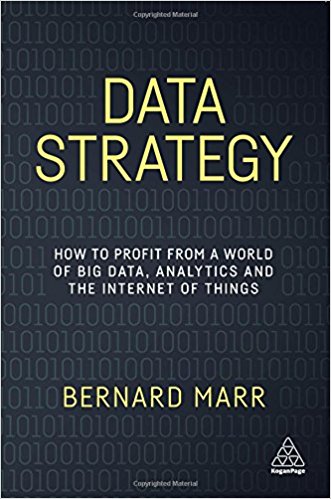
In his latest book Data Strategy, analytics guru Bernard Marr, discusses how to profit from a world of big data, analytics and the internet of things. Marr breaks down the importance of having a data strategy to ensure data-driven decision-making, improve business operations and to monetize the data in a business.

data strategy

One of the key takeaways from his book is the emerging role of Chief Data Officer. This is a separate C-Level Suite position form the more traditional Chief Technology Officer or Chief Information Officer as this person should serve as both an analytics cheerleader and data-driven decision-making champion.

Big companies have CDOs, but even smaller and medium sized companies need to have someone who acts in this role even if its not an official title. I often say that analysts have to not only analyze data, but be champions of using data for decision-making. They have to be the data cheerleaders to educate, enable, and empower the use of data and analytics across the organization.

There are six primary areas a CDO should oversee; (1) high level vision, (2) implementations, (3) data governance, (4) business opportunities, (5) data culture leader and (6) sees data as a commodity.

  1. CDOs have to have either a seat at the C-Suite table or the ear of the top decision-maker in the company. They are the ones who make sure that data is properly channeled to the right people at the right time to ensure data-driven strategies.
  2. CDOs have to be the one ultimately responsible for data project implementations. This is not an IT thing. IT should be involved, but not the owners of data and analytics.
  3. CDO’s have to make sure good data governance is followed. Data has to be stored, secure and accurate.
  4. CDO’s are the ones who have the task of discovering business opportunities and identifying risks. They should have access to all the data they need to do both.
  5. CDO’s are the ones who consistently and clearly articulate the importance of data and the value of data-driven decision-making.
  6. CDO’s see data for its monetary value. Data is a commodity that in itself can be used to not just help the company, but to generate revenue itself.

So if you have a Chief Data Officer, or just a chief data geek, you are on the right path. If you don’t have one of these in your organization then your organization are likely going to be left behind.

may 17-18Analytics Culture – The key to using analytics in a business is like a secret sauce that fuels Data-Driven Decison-Making. It is a unique combination of analytics talent, technology and technique that are brought together to enrich and empower an organization. A successful analytics culture is not easy to create, but DMAIPH can show you how. Contact DMAIPH now at analytics@dmaiph.com or connect with me directly so we can build a strategic plan to turn your company into analytics driven success story.

DMAIPH Analytics Apprenticeship Program Starts May 15, 2017

Analytics Apprenticeship Program Starts May 15, 2017

This is a 3-6 month, paid apprenticeship program that will provide in-depth and hands on training with a range of analytics skills needed across various industries today. At the end of the apprenticeship, you will a very strong change of staying with DMAIPH or being referred to one of our key business partners.

We are looking for 3-4 highly motivated, tech savvy, young professionals or fresh grads to join our program. Past apprentices have gone on to have successful analyst careers in a wide range of companies including HP, Emerson, Citibank, Wells Fargo and

Skills all analysts will learn

  • How to apply the DMAI methodology of business analytics
  • Advanced Excel Skills like Pivot Tables, Marcos, Formulas and Data Visualization
  • Using Tableau for Business Dashboards
  • Using SQL and R for Predictive Analytics
  • The key aspects of Data Storytelling

In addition, each track will focus on specific skill sets including but not limited to:

  1. Business Analyst
  • Analytics Assessment Facilitation
  • Project Planning and Documentation
  • Management Metrics Reporting
  1. Finance Analyst
  • Financial Forecasts
  • Budget Planning
  • Expense Tracking & Reporting
  1. Events Management Analyst
  • Competitor Intelligence
  • Market Research
  • Lead Generation, Tracking and Reporting

Compensation package is dependent on experience and skills, but in the range of P20,000 a month.

Interested applicants should send an updated resume to danmeyer@dmaiph.com as well as plan on attending a group interview exercise on April 29 in Ortigas.  Group interviews will be held from 10am-12noon and from 5pm-7pm at Unit 1704 Prestige Tower on Emerald Ave (F. Ortigas Jr. Rd) at the office of IBA.

jobspicture2

Analytics Jobs – DMAIPH hires, refers and connects Filipino analytics talent. The Philippines is at the center of the action when it comes to solutions to the global need for analytics. Working with DMAIPH to find work, hire analytics talent or set up analytics teams will ensure you are tapped into the best of the best when it comes to analytics in the Philippines. Contact DMAIPH now at analytics@dmaiph.com or connect with me directly to find out how to take advantage of this booming opportunity.

The Rock Stars of Data: Big Data Analytics & Data Management

How to master big data analytics and data management?

The Rock Stars of Data: Big Data Analytics & Data Management

2-day Class: Big Data Analytics and Data Management

June 27-28, 2017

Discovery Suites, ADB Ave., Ortigas Center, Pasig City

9AM-5PM

Rock Stars of Data Series: Big Data Analytics & Data Management

Data Rock Stars Dan Meyer (DMAIPH) and Dominic Ligot (Cirrolytix) have joined forces to offer a unique training focusing on both the Analysis and the Management of Big Data.

To find out more about our next scheduled public learning session on May 18-19, 2017 in Ortigas or to set-up an in-house training, send an e-mail to analytics@dmaiph.com

Learning Session Description

Building The Data Value Chain. Data is pervasive – everything we do in the modern world uses and generates data in some shape or form: from web sites we surf, the social media we consume, to the mobile devices we use to connect and communicate. Modern businesses also use and generate data, from financial data, to customer data, to transaction data and sensor data.

But data is only a raw material. Regardless of amount, the real importance of data is only determined by the value people and businesses derive from it. Getting data is the first step. Then the challenge becomes transforming the raw material into a processed good: information. Information enables decisions, and decisions create value.

This session is about the basics of transforming data into information: the data value chain. Attendees will learn how to identify the right data, about how data can be efficiently stored, then transformed into a friendly form for analysis, and finally how data analysis can yield insights.

RS_Data Management_062717

This seminar will lightly touch on each aspect of data identification, collection, storage, transformation, and analysis and involve hands-on use of common data management and analysis tools such as Excel, Tableau and SQL, but is designed for those with little to no prior experience with these tools.

Learning Session Objectives

  1. Apply cutting edge technologies to organize, interpret, and summarize Big Data in your business.
  2. Create a process to analyze data and identify patterns not apparent at first glance
  3. Understand the components of The Data Value Chain: Ingestion, Storage, Transformation, Analysis – and how they are all important to deriving value from data.
  4. Learn database manipulation and processing basics using the Structured Query Language (SQL)
  5. Connect a data analysis tool such as MS Excel or Tableau to a database to be able to perform analysis on processed and stored data

In this session, your organization will be able to use:

  • Specific skills to effectively frame the problem you’re addressing to uncover key opportunities and drive growth
  • Critical marketing steps of orientation necessary before engaging tools and technology
  • How to simply and quickly amplify decision making by separating the signal from the noise
  • A framework for asking the right questions, allowing the ability to link analytics to business strategy

In this session, your participants will be able to:

  • Learn the best practices for organizing, summarizing, and interpreting quantitative data
  • Create a repeatable process for analyzing your data
  • Shorten the time between analysis and action to avoid “analysis paralysis”
  • Know how to get from hard data to well-reasoned conclusions

Who Should Attend

  • Business Analysts, Data Analysts and other Analytics Professionals
  • Business professionals who are involved in day-to-day analysis of data.
  • Data analysts who are already performing analysis using spreadsheets but struggle with manual data processing.
  • Managers of analysts or staff who spend a significant amount of their time collecting, analyzing and reporting data.
  • IT and Development Staff that work closely with business leaders and decision-makers.

Section One – Big Data—It’s Not Just Size That Matters

  • Understand the 3 T’s of Analytics: Talent, Technique and Technology.
  • Describe the importance of effectively, analyzing big data in Business today.
  • Develop a Data Map to analyze the Big Data in your Business.
  • Recognize when to employ Descriptive, Predictive or Prescriptive Analytics.
  • Establish clear objectives when analyzing Big Data.

Section Two – Assess Your Current Analytics Culture

  • Define What Is an Analytics Centric Culture.
  • Describe the issues and trends in today’s analytics field.
  • Discover how to find the most important KPIs.
  • Learn how to build better management reports.
  • Optimize your use of MS Excel for Big Data Analytics

Section Three – Using Business Intelligence Tools

  • An overview of BI Tools.
  • Tableau Public Demonstration,
  • Discuss the Concept of Data Visualization.
  • Build A Business Dashboard Prototype.
  • Apply a Process to Present Big Data Clearly.

Section Four – Interpreting Your Data and Analysis

  • Articulate the importance of accurately interpreting Data.
  • Determine how to validate your data analysis.
  • Mitigate and analyze Risk, Uncertainty, And Probability.
  • Spot patterns and trends through Statistical Analysis.
  • Use findings from Big Data to Drive Decisions within your Organization.

Section Five: Presenting the Data Value Chain and Databases

  • Discuss the components of The Data Value Chain and the various users and roles involved in transforming data to value: Database and ETL engineers, Data analysts, Business users.
  • Learn about basic data architecture and the role of databases in processing data.
  • Understand the basics of databases, tables and views.
  • Learn about the Structured Query Language (SQL) and SELECT statements.

Section Six: Data Processing with SQL

  • Discuss the additional value that can be derived from using SQL for Data Processing.
  • Go into detail on various ways of processing and preparing data using SQL.
  • Learn about aggregates, conditions, how to join tables, and run queries within queries.

Section Seven: Accessing SQL Tables with Excel

  • Learn about Open Database Connectivity (ODBC) and how Excel uses ODBC to connect to external data sources.
  • Discover how SQL tables and views can be read by Excel into instant Pivot Tables and Pivot Graphs.
  • Understand how changes in database table or view via SQL Inserts, Deletes, and Updates are reflected on Excel.

Section Eight: Performing analysis of SQL-based data using Excel

  • Learn about how SQL data can be dissected using the Data Analysis functions in Excel.
  • Talk about form tools and macros that can automate manual reporting.
  • Discuss tips for reporting and sharing the results of your analysis.

Minimum Hardware and Software Requirements.

  1. Laptop with Intel Core i3 and 4GB RAM.
  2. Windows OS with Excel 2007 or greater.
  3. ODBC and database connections will be provided during class.

Case Studies and Exercises

Dan and Doc will use case studies and group exercises throughout the two-day class. In these activities, the group is divided into teams. Each team will analyze datasets using the principals learned in the various learning sessions. These exercises will also use elements from the case studies as we progress from finding data, to conducting analysis on the data and finally presenting the data.

16649482_10155094449802425_5080201225679087647_n

Learning Investment for 2-day Seminar:

Exclusive Offer!!

Early Bird Rate

P 12,000.00 + VAT

(Pay the full amount on or before April 20, 2017)

Group Rate (Minimum of 5)

P13,000.00 + VAT

Regular Rate:

P 14,600.00 + Vat

(starting April 21, 2017)

All investments includes: 2-day Analytics Seminar with two of the most in-demand Analytics and Data Management Guru in the Philippines, complete with Training Materials, AM/PM Snacks, Lunch and Certificates.

ABOUT THE SPEAKERS

Dominic Ligot, Data Scientist

Doc’s areas of expertise focus on Fintech, Big Data Analytics, and Digital Transformation.

Click here to see Doc’s full speaker/trainer profile >>>

Daniel Meyer, Analytics Champion

Dan specializes in a variety of analytics themed training and speaking option including HR& Recruitment Analytics, Data Analytics, Data-Driven Decision-Making and Analytics for CEO’s.

Click here to see Dan’s full speaker/trainer profile >>>

Reserve your seat here >>>


Philippine BPO’s urged to prepare for Artificial Intelligence

Sharing from the Global Chamber® Manila Newsletter

April 7, 2017

Philippine BPO’s urged to prepare for Artificial Intelligence

An American technology and business expert urges Business Process Outsourcing (BPO) companies to prepare for the disruption that will be brought about by artificial intelligence (AI). The Department of Science and Technology (DOST) recently held a talk about how to prepare for the time when intelligent computers take over call center agents’ jobs.


Dr. Ted Ladd, who is on a lecture tour of the Philippines, says the technology for artificial intelligence is already here. While some experts say AI’s impact on BPO’s will be felt in five years, Ladd says BPO’s and entrepreneurs should already be preparing for this and start looking for new opportunities that will be opened up by AI. According to Ladd, “We don’t have to wait for the industry to show cracks before entrepreneurs prepare new solutions.  AI is not just going to create new products or services but will create new business models which entrepreneurs could take advantage of.

DMAIPH is working on a new learning session offering entitled Surfing Into The Storm; A Guidebook on How to Turn Your Call Center into an Analytics Hub. Stay tuned for more info on the upcoming course.

482x140

You can also catch the topic on Augmented Intelligence: Robotic Process Automation in BPO at the Digital Transformation Summit on May 24 & 25 at SMX Aura Convention Center, BGC

As a founding member of Gloabl Chamber Manila, DMAIPH specializes in a variety of analytics consulting solutions designed to empower analysts, managers and leaders with the tools needed for more data-driven decision-making. We have helped dozens of companies get more analytics in their business. Contact DMAIPH now at analytics@dmaiph.com or connect with me directly so we can tailor an analytics solution made just for your unique requirements.

Decision-Making with Data Learning Session with Ariva Events

This coming Friday, March 31, in Ortigas, I will be Data-Driven Decision-Making for Executives, Managers and Leaders. I will focus on proven strategies of data mastery go a long way to becoming a Data-Driven Leader.

This master class  is for you if you feel like you’re drowning in data and unsure which data to use to drive your companies decision-making processes.

Information is supposed to make decision-making faster and easier, but more often than not, it simply overwhelms our ability to accurately use the data we have in our business.

The truth is that the amount of data available to help run your business is greater than ever before. To effectively use this information, exeuctives, managers and leaders must consider the practical side of big data and how best to use it to make better decisions…because what matters to you is how do you grow and build a team to make smarter decisions. Much of the information out there just discusses the promise of the data deluge.

The challenge is not the volume of data but rather the judgment needed to use it. This learning session  is specifically designed for executives, managers and leaders to learn techniqeues that will ensure reliable business decisions can be made based on the massive amounts of data at your fingertips.

Through a series of case studies, exercises and interactive lecture, we will cover the following:

  • Specific skills to effectively frame the problem you’re addressing to uncover key opportunities and drive growth
  • Critical marketing steps of orientation necessary before engaging tools and technology
  • How to simply and quickly amplify decision making by separating the signal from the noise
  • A framework for asking the right questions, allowing the ability to link analytics to business strategy

Attendees will also be able to learn how to do the following things for their team:

  • Learn the best practices for organizing, summarizing, and interpreting quantitative data
  • Create a repeatable process for analyzing your data
  • Bring out patterns in data that were not apparent at first glance
  • Identify and explain tools for data analysis
  • Shorten the time between analysis and action to avoid “analysis paralysis”
  • Know how to get from hard data to well-reasoned conclusions

There are still seats available, contact me at danmeyer@dmaiph.com so I can connect with you my events partner, Ariva.

http://www.ariva.com.ph/data-driven-decision-making/

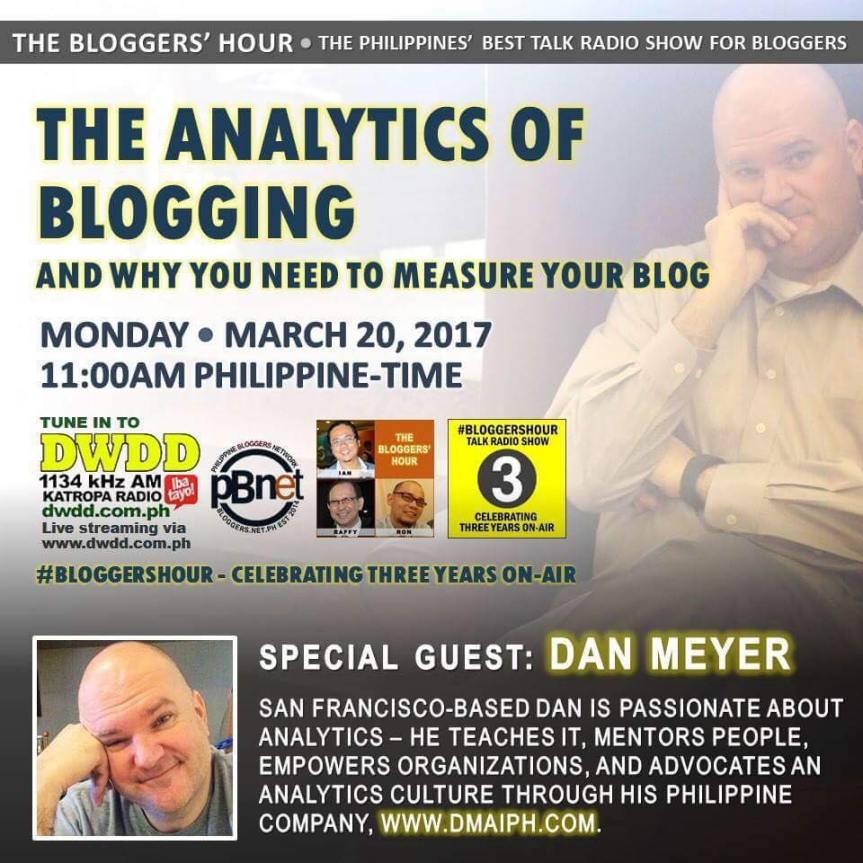
Radio DWDD today @ 11am – The Analytics of Blogging

Blogging has been around for quite some time now, but many who venture into blogging do not realize who is reading their blogs, what are they reading, why are they visiting and reading their blogs, and so on.

So, today I have the honor of being a special guest on DWDD to help listeners go through the realms of the analytics of blogging.

The topics I plan on covering include:
– What is analytics?
– What title/position/employee is involved in anlytics?
– What university/college course do you take to learn analytics?
– What kind of companies uses analytics?

And Blogger-specific topics will include:
– Should bloggers learn to use analytics?
– Why use analytics in blogging?
– How does a blogger begin to use analytics?
– Can analytics make the blogger earn money?

Come join me and my good friends Raffy, Ron and Ian to discuss how to get more data into your blogging efforts. Its easy and for the most part its free.
#TODAY 20th March at 11:00AM, the BLOGGERS’ HOUR talks about Blogging and Analytics, and why bloggers need to start measuring their blogs beyond just views and hits. To help us understand how to do this is Analytics Expert Dan Meyer from San Francisco who has set up shop in the Philippines with his advocacy of teaching Filipinos the art of analytics.

Tweet or post your questions in advance using the Hashtag #BLOGGERSHOUR.

LIKE http://www.facebook.com/bloggershour to be notified when the Facebook LIVE stream begins.

Tune in to DWDD 1134 kHz AM or live streaming via http://www.dwdd.com.ph or http://www.ustream.tv/channel/dwdd-katropa-live.

TWITTER:

Listen to the #BLOGGERSHOUR talk radio show, Monday 20th March 11:00AM as we talk about blogging & analytics with Dan Meyer @BPOElite1


Data Science Philippines – Feb 2017 Meet Up

My talk is the 2nd one, a little over half way through the video. Listen first to some real data scientists talking about their trade, then it’s my turn where I talk about just how many data scientists there are in the  Philippines right now. Thanks to DataSeer for asking us to sponsor and for setting up the event. Looking forward to many more to come! 🙂