Data Analytics or HR Analytics? Which Should I Attend?

Here at DMAIPH we offer a variety of analytics training solutions to organizations here in the Philippines.

Our two most popular offerings are Data Analytics and HR/Recruitment Analytics.

We get asked a lot, what is the difference.

Well, in general the Data Analytics classes like our Big Data Analytics & Business Intelligence training this coming May 18, are designed for a general audience.

may18

HR/Recruitment Analytics classes like the upcoming HR Big Data & Recruitment Analytics training on March 14 in Ortigas, is designed for a much more specific audience of HR and Recruitment professionals.


Data Analytics attendees come from a wide range of companies and have perform a variety of job functions. The one thing they all have in common is that they are looking for data analytics techniques and technologies to help them get a handle on all the Big Data they have to work with everyday.

HR/Recruitment Analytics attendees are all working as part of Talent Management teams in HR, Recruitment, Training, Operations and other parts of an organization that primarily handle people data. So case studies, exercises and the lesson plan itself are all focused on how to use the people data in the business to enhance and empower people centric decision-making.
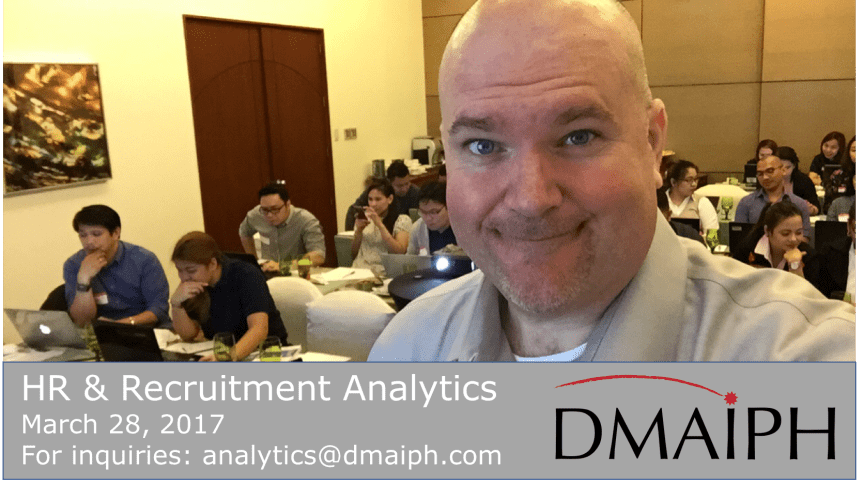
RA_Mar28_1

HR and Recruitment professionals can benefit a lot from attending the Data Analytics trainings and we generally have a few do just that. However, for a more focused approach to getting a handle on people data, the ones who attend the HR/Recruitment Analytics trainings will probably get a little more practical application to use when they return to the office.

Target Attendees for Data Analytics:

  • Data and Business Analysts
  • Managers and Supervisors of Analysts
  • Professional Staff who create reports and manage data
  • Decision-Makers who need more analytics

Target Attendees for HR/Recruitment Analytics:

  • HR and Recruitment Analysts
  • HR and Recruitment Managers and Supervisors
  • HR and Recruitment staff who work with a lot of people data
  • Data and Business Analysts who work closely with people data

Hope that helps you decide which one to attend.

Analytics Training – DMAIPH offers a wide range of analytics centric training solutions for professionals and students via public, in-house, on-site, and academic settings. We tailor each training event to meet the unique needs of the audience. If you need empowerment and skills enhancement to optimize the use of analytics in your organization, we are here to help. Contact DMAIPH now at analytics@dmaiph.com or connect with me directly to set up a free consultation to learn which of our DMAIPH analytics training solutions is best for you.


They Have Got It All Wrong! Why Most Analytics Training Fails.

Four years ago, I was just about the only one speaking professionally in the Philippines about  Analytics. Now so called experts are a dime a dozen. The demand for this kind of training has skyrocketed as companies are losing the war for talent all across the globe, with few jobs as hard to fill with good talent as BPO jobs in the Philippines. But these training mostly have it all wrong. They will teach you a lot of technical things that sound great in a class room, but are extremely hard to implement unless you work in an enlightened company that encourages curiosity and empowers data-driven decisions across to organization.

So one big thing right now is using analytics in HR to find more candidates, to hire better candidates, and retain them.  Its working in the U.S and all across the globe. This is a direct reflection of overwhelming demand for so called white collar professional jobs The hot answer going around right now to this challenge is sending analysts, managers and leaders to trainings. Hoping they will learn about hot new trends and analytics techniques to get more out of an investment in the company’s analytics plans. However, from my perspective, this is the flavor of the month thinking. And you know what? It’s not going to work.

Why? Good Analytics doesn’t come from just external training and technology. Those two pieces are important to an overall analytics strategy. But the most important piece, and the one being overlooked right now is the business culture. If the business culture is not ready to truly accept a shift towards data-driven decision-making an away from old school methods and decisions made off of gut feel, then the going to one of these trainings wont amount to a hill of beans at the end of the day.

This is why I spend so much of my time talking about culture, and why I expose that analytics is as much art as it is science. You need the technology, which is abundant. You need the talent, which is hard to find but out there. And you need the culture, where you analysts can use the technology to not just build reports and mine big data, but to illustrate opportunities and discover solutions that can really drive the business forward.

That is what you want out of a training on HR analytics. Not just technobabble and reporting tricks, but something that will truly help you mold the culture of your business to get the most out of your analytics.

In closing, I have recently published a guidebook for using analytics in your business. If you are interested in learning more and would like to get a copy of Putting Your Data To Work , connect with me via e-mail at analytics@dmaiph.com

#IamDMAIPH

The Philippines is at the center of the action when it comes to solutions to the global need for analytics. Blessed with a solid foundation of young, educated and English speaking workforce, companies around the world are look for Filipino analytics talent to fill analytics positions.

DMAIPH HR & Recruitment Analytics – The recruitment and retention of top talent is the biggest challenge facing just about every organization. You really have to Think Through The Box to come up with winning solutions to effectively attract, retain and manage talent in the Philippines today. DMAIPH is a leading expert in empowering HR & Recruitment teams with analytics techniques to optimize their talent acquisition and management processes. Contact DMAIPH now at analytics@dmaiph.com or connect with me directly to learn how to get more analytics in your HR & Recruitment process so you can rise to the top in the ever quickening demand for top talent.

Learn Analytics Leadership From The Analytics Council of the Philippines

The Analytics Council of the Philippines was founded in December 2016.

Our mission is to serve as a forum for furthering the training, teaching and use of analytics across the Philippines.

Our mission statement and upcoming events will be posted soon.

outsourcing-seo-services-in-the-philippines-forward-solutions-seo-and-web-design-company

DMAIPH is a founding member of the Analytics Council of the Philippines and specializes in arming the Data-Driven Leader with the tools and techniques they need to build and empower an analytics centric organization. Analytics leadership requires a mastery of not just analytics skill, but also of nurturing an analytics culture.

We have guided thousands of Filipino professionals to become better analytics leaders. Contact DMAIPH now at analytics@dmaiph.com or connect with me directly to discuss a uniquely tailored strategy to ensure you are the top of your game when it comes to Analytics Leadership.

Small Business, Big Data

“Without big data, you are blind and deaf and in the middle of a freeway.” Geoffrey Moore – Author of Crossing the Chasm & Inside the Tornado.

Without analytics, your company is vulnerable. However, just owning analytics tools isn’t enough. Extracting value from your analytics investment requires sufficient staff, well-defined processes, a clear business strategy, and leadership support.

All the Data We Create Each Day

Think about some of the things you do in your daily life. You get up, you eat, go to work/school, shop, do something for entertainment, bank, go online and do things on social media. Everything you do generates data. That data is captured in countless ways. And then it’s stored in countless places. And analyzed by countless numbers of people. And then used in countless ways by businesses to market, design, advertise, build, sell, and so on.

Every time you check your phone to see if there are any updates on Facebook you generate a lot of data for your phone manufacturer, your service provider and Facebook itself. Everything you like or comment on can be turned into a data point. The time, place and length of your connection all provide useful data. Get the point? It’s endless.

That’s big data.

In general, big data is thought of as all the data businesses capture and store in a database that they can use for business decision-making.

When you think of data collections that have millions and millions of rows of data like big bank transaction data, or traffic data for major cities, or all the statistics captured everyday across professional sports. Way too much for man to analyze without help from technology. That’s all big data.

Every business defines its big data a little differently. There is no one way to look at how best to manage big data because big data is such a living, evolving, never ending flow of information. It’s like lakes of water that are too big to swim across and too deep to dive to the bottom of without help. And no two lakes are alike.

jobspicture2

Small Business Analytics – The field of small business analytics is just starting to blossom as companies are looking for more data-driven decision-making to prosper in the age of Big Data. DMAIPH is at the fore front of providing analytics training, consulting and outsourcing options to small businesses. Contact DMAIPH now at analytics@dmaiph.com or connect with me directly to set up a free consultation on how to get more analytics in your small business.


Analytics in the Philippines: It Either Happens in 2017 or It Might Never Happen

A few years ago the then country manager of IBM Philippines, Mariels Winhoffer, kicked off a project to help push the Philippines towards being an analytics hub for the booming growth in Big Data and the Global Analytics Talent War. That was in 2013.

With 3 factors in play; the world calls outsourcing services of the Philippines, the exponential growth of Big Data the fact that the demand for analytics talent far out weighs the supply; it makes total sense that the Philippines step up and fill the need. Now in 2017 we have not really gotten much closer.

There are some schools offering some subjects in analytics related areas, but its far from being significant enough to meet the needs.

The government has given some attention to supercharging analytics, but the current outlook is not one where we will see enough to propel us forward.

Big BPO companies who are offering analytics as a service have tried desperately to fill seats,  but have generally seen limited success.

Now it seems that most Filipino companies have gotten a grasp of the power of a good analytics team and are trying to catch up.

As 2017 begins, there has never been as much thought about Analytics in the Philippines as there is right now. However, the big question is it too little to late?

To me 2017 will be the watershed year for Analytics in the Philippines. We will either make significant progress towards being both a global hub for analytics and a significant domestic user of analytics or we will find that the opportunity was just too challenging to tackle.

I’m all in on betting on the former… lets make 2017 the year that Analytics in the Philippines became a success story.

img_7737

Analytics in the Philippines – The Philippines is at the center of the action when it comes to solutions to the global need for analytics. Blessed with a solid foundation of young, educated and English speaking workforce, companies around the world are look for Filipino analytics talent to fill analytics positions. DMAIPH was set up to facilitate these solutions and bring the talent and the business together. Contact DMAIPH now at analytics@dmaiph.com or connect with me directly so we can help you take advantage of this unique global opportunity.

Fast Data is the New Big Data

Starting to hear a new buzzword for analytics… Fast Data. Everyone knows about Big Data that is growing almost exponentially.

It is coming to us in mind boggling sizes, from all across the Internet of Things and quicker then ever before.  The traditional 3 V’s of data (volume, variety and velocity) don’t seem to be enough anymore to describe the challenges we have before us.

SO now we are looking for Fast Data solutions, which means getting the right data you need at the right time with minimal delay.

The concept of waiting for reports to be pushed to you so you can analyze them is so 20th Century.

Now its all about being fast.

I can show you a thing or two (or a dozen) about how to supercharge your analytics by moving past management repots and even past business dashboard to start looking for solutions that get data to the decision-makers without any middle man.

Big Data is now Fast Data. Don’t get left behind.

data-analytics-feb21-001

Join me this coming Feb 21 2017 for a Data Analytics Seminar in Ortigas where we talk about how to take your Big Data and make it your Fast Data.

DMAIPH specializes in arming the Data-Driven Leader with the tools and techniques they need to build and empower an analytics centric organization. Analytics leadership requires a mastery of not just analytics skill, but also of nurturing an analytics culture. We have guided thousands of Filipino professionals to become better analytics leaders.

To that end, DMAIPH offers a wide range of analytics centric training solutions for professionals and students via public, in-house, on-site, and academic settings. We tailor each training event to meet the unique needs of the audience. If you need empowerment and skills enhancement to optimize the use of analytics in your organization, we are here to help.

Contact DMAIPH now at analytics@dmaiph.com or connect with me directly to set up a free consultation on which of our DMAIPH analytics training solutions is best for you.

In The Information Age Knowledge Truly is Power > Power Up on Feb 21

SO many companies are trying to figure out how to get more valued of their data, but most dont know where to start.

Let me show you how on February 21, 2017 @ Discovery  Suites in Ortigas (Pasig City, Metro Manila).

E mail for more information about our data analytics seminar, so you can learn to unlock that elusive knowledge buried within the data of your business. 15442108_1022250554587054_3902952314714042475_n

Analytics Culture – The key to using analytics in a business is like a secret sauce. It is a unique combination of analytics talent, technology and technique that are brought together to enrich and empower an organization. A successful analytics culture is not easy to create, but DMAIPH can show you how. Contact DMAIPH now at analytics@dmaiph.com or connect with me directly so we can build a strategic plan to turn your company into analytics driven success story.

Big Data Analytics > The Art of Presenting Big Data


It has been my experience that presenting Big Data requires quite a bit of artistic ability.

I will be talk about the Art of Presenting Big Data among other topics at an event this coming February 21 in Ortigas.

For me there is a clear need to Apply a Process to Present Big Data Clearly
. This process has 3 parts.

  1. Selecting the Appropriate Presentation Format to Communicate Your Findings Effectively to Your Audience
  2. Mastering the Power of Enchantment
  3. Sharing Findings from Big Data to Drive Decisions Within Your Organization

Knowing How to Select the Appropriate Presentation Format to Communicate Your Findings Effectively to Your Audience is where we will stat.

To that end I have a checklist I use before every presentation I share involving Big Data:

  • Know Your Audience
  • Consider Time Constraints
  • How Will The Data Be Consumed?
  • Can The Data and Analysis Be Accessed?
  • Make it Interactive

DMAIPH offers a wide range of analytics centric training solutions for professionals and students via public, in-house, on-site, and academic settings. We tailor each training event to meet the unique needs of the audience. If you need empowerment and skills enhancement to optimize the use of analytics in your organization, we are here to help. Contact DMAIPH now at analytics@dmaiph.com or connect with me directly to set up a free consultation on which of our DMAIPH analytics training solutions is best for you.


Philippines Analytics Review – 2016

There is no doubt that analytics is now a big deal in the Philippines.

Now that 2016 is in the books, I can proudly say I spent the better part of the past year helping Filipino get more analytics in their businesses.

My primary goal for the year has been meet, so let’s recap how that happened…

My involvement in empower Filipino companies, students and professionals to make data-driven decisions has renewed my passion for being a top name brand for analytics in the Philippines.

As I think back the Recruitment Analytics training that DMAIPH and Sonic Analytics put on early in the year, I think about how HR professionals are now actively looking to get more analytics in their business.

The simple fact is there are more white collar, professional staff jobs out there then there are qualified candidates. And its only getting worse. Recruitment Analytics is the only way to stay on the cutting edge.

This was even more evident when I spoke in front of close to 100 HR professionals at a workshop called HR & Recruitment Analytics Techniques put on by my good friends at Ariva Events Management.

We spent the day talking about how get IT when it comes to recruitment. The 3 I’s of analytics; identify, inventory and integrate data as well as the 3 T’s; talent, technology and technique needed to make sense to the data.

I once again joined Ariva for their annual Philippines HR Congress. One of the central themes of the conference attended by over 1000 HR professionals was Aligning HR Strategy with Analytics.

HR teams are sitting on a gold mine of insightful data, but in most cases have not been able to take advantage of it.

Big Data Analytics has come so fast and furious, that it takes a lot of effort to become analytics champions and try and move a company culture towards more data-driven decision-making. This was top of mind for all the attendees.

At the same time I have been doing speaking and public training, CHED has been training teachers on how to teach business analytics. Their efforts to explain the Fundamentals of Business Analytics to faculty and students will go a long way in making the Philippines a significant analytics hub.

I have been honored to have helped several schools in adding my two centavos to the discussion about analytics careers for fresh grads.

Another moment of great personal pride came when I published my newest book, Putting Your Data to Work. This guidebook is designed to help Filipino professionals who aren’t too familiar with analytics, get started.

In early November, I was part of a panel discussion at the Big Data Conference at Enduran college. I was and still am super excited about the topic, The Future of Big Data Analytics in the Philippines. This is my passion, turning students and young professionals interested in analytics on to the huge opportunity they have in front of them.

A week later I conducted a Data Analytics seminar with DMAIPH and Sonic Analytics. The primary goal here was to demonstrate how having a thorough understanding of the data environment in a business can lead to huge successes.

Next up was a job fair at Trinoma mall put on by Job Quest PH. My goal here was to recruiting a few young professionals looking to get started in analytics as DMAIPH is looking for some marketing analysts.

A few days later I attended a Data Science event being set up by my good friends at Talas. This free event saw a meeting of the minds of a lot of thought leaders in data science as well as industry leaders in employing analysts and data science. Pretty exciting stuff.

The final 2016 event on my schedule was another full day training organized by my key business partner Ariva. The topic, Big Data and Business Intelligence, which proved to be a great opportunity to help people gain a stronger handle on analytics and how they can be an analytics champion in their business.

IMG_6912

2016 turned out to be my most successful year yet. Analytics in now mainstream and I love it.

Analytics in the Philippines – The Philippines is at the center of the action when it comes to solutions to the global need for analytics. Blessed with a solid foundation of young, educated and English speaking workforce, companies around the world are look for Filipino analytics talent to fill analytics positions. DMAIPH was set up to facilitate these solutions and bring the talent and the business together. Contact DMAIPH now at analytics@dmaiph.com or connect with me directly so we can help you take advantage of this unique global opportunity.


It’s No Longer Just Enough To Know

In a recent conversation about using more analytics in the measurement and evaluation of public policies and programs, one of my colleagues said that in today’s world, “It’s no longer just enough to know.”

The point being if you aren’t using data and analysis to enhance your efforts and empower decision-makers with actionable insights, then you are not serving the public to the best of your ability.

A lot of government programs, non-profits and philanthropic organizations are what he called, “Information Rich, but Data Poor.”

Check out my upcoming webinar on Feb 15, 2017! https://dmaiph.com/2017/01/14/analytics-and-data-driven-decision-making-webinar-on-feb-15/

Just because you gather massive amounts of information in the form of data points, does not mean the data is adding value. In fact one of the biggest challenges the corporate world has been dealing with the past few years is how to optimize Big Data.

We live in a world where so much data is produced and captured, then analyzed and published in reports and article, yet the data and analysis alone is often not having the impact our policies and projects were intended to have.

In effect, we might know things, but we aren’t able to influence decisions because our data is not compelling enough.

To this end, I have advocated importing some analytics themed best practices from the corporate world to educate more on what to do with the data and how to put the data to use. To in short, be Information Rich, Data Rich to move towards more Data-Driven Decision-Making.

Starting backwards, I will first focus my training on the How. How do we make more data-driven decisions?

The I will focus on the Why. Why do we need to make more data-driven decisions?

From there we will go into several business analytics concepts like Data Visualizations, Public Data Mining, Data Lakes, Demographic Profiling using Big Data, and Data Blending.

amupicture1

A final topic of interest that I will bring to the discussion is the Plus Minus Implications for Unstructured and Qualitative Data. Things that at first can be hard to assign a number too, but are just important as any piece of traditional data used in decision-making.

At the conclusion of my work, public policy and project reporting will be much more data rich, influence will improve and decision-making enhanced.

Now we won’t just know, we will be able to champion what we know in ways that will make a difference.

Analytics Education – Facilitating a mastery of the fundamentals of analytics is what DMAIPH does best. All across the world, companies are scrambling to hire analytics talent to optimize the big data they have in their businesses. We can empower students and their instructors with the knowledge they need to prepare for careers in analytics. Contact DMAIPH now at analytics@dmaiph.com or connect with me directly so we can set a guest lecturer date, On-the-Job Training experience or other analytics education solution specifically tailored to your needs.