Promote Your Own Data Geeks

In analytics, there has been a huge boom lately in trying to find data scientists, who like a superhero, can do everything well and swoop in and take a company’s analytics to a whole new level. They are called unicorns as in creatures that really don’t exist.

One thing that has always amazed me about the culture of so many businesses is the belief that bringing in someone from the outside when there are good people on the inside.

Occasionally I come across the argument that its better to build a data science team from within as opposed to looking for a data scientist who can code, analyze, build models, understand higher math, communicate with non-technical leaders and understand the business.

In many cases the sum of the parts can give you a great solution that in the long run is better for the business then finding someone who is all the parts in one.

To do that, you need to understand your people and what they can do. You have to then understand what skills they need to add to be awesome at analytics. Generally, it’s just a matter of training and empowerment to push the envelope.

I look for people who have these 3 qualities before assessing technical skill and job fit.

First I assess their work ethic based on job experience, educational achievement and reasons behind their transitions in life. Note that internal hires already have a track record to assess work ethic.

Second I assess their curiosity based on assessment responses and problem solving during the interview process. Again, people who have been with you most likely have routinely demonstrated the curiosity.

Third I ask them to analyze something. Looking for how they approach data, how they analyze it and how they report it. Again, compare what data you have on hand versus the data of what might or not be valid.

After that, just about anything can be added via training, mentoring, coaching and self-empowerment.

It’s a lot easier for me to work with a known quality and build them up then it is to take in someone who is largely unknown and roll the dice that things will work out.

But don’t take my opinion. Look at your data.

jobspicture2

What % of new hires succeed. What % of promotion succeed? I’ll be shocked if you find that new hires add more value to your organization then veterans who are rewarded with new challenges.

So before you go out in the hyper competitive job market for a data geek, make sure you don’t have some people already on your payroll who can rise up and do the job.

If you need help assessing the inner data geek of your current staff, let me know. I can help you come up with roadmaps towards data geekdom that you can use to build a kick ass analytics team better than just about any data scientist aka unicorn you hire off the street.

Analytics Jobs – DMAIPH hires, refers and connects Filipino analytics talent. The Philippines is at the center of the action when it comes to solutions to the global need for analytics. Working with DMAIPH to find work, hire analytics talent or set up analytics teams will ensure you are tapped into the best of the best when it comes to analytics in the Philippines. Contact DMAIPH now at analytics@dmaiph.com or connect with me directly to find out how to take advantage of this booming opportunity.

Learn How to Turn Your Data Into Insightful and Actionable Analysis

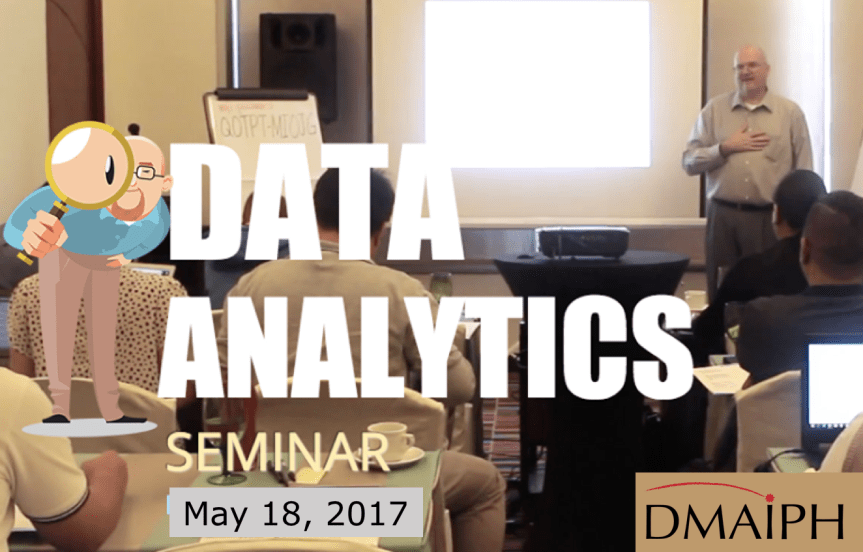
Data Analytics Seminar

February 21,2017

9:00am- 5:00pm

Discovery Suites, ADB Drive, Ortigas Center

Objectives

  •  We will start with a basic overview of analytics, current trends in the field and how analytics is being used here in the Philippines.
  • Through a couple of hands on exercises, we will practice finding data, analyzing it and reporting our findings.
  • We will go in depth understand several key components of analytics including business intelligence, competitive landscaping, data visualization and business dashboards.
  • We conclude the day by taking an assessment of each of our own business and starting to develop strategies to enhance the analytics culture in our business.
  • Learn more about Big Data and Data Warehousing

Key Topics

  1. What is Data Analytics?
  2. Overview of Data Analytics in the Philippines
  3. Self- assessment of your own Analytics
  4. Finding Data, Mining and Presenting Data
  5. Internet Research Tips
  6. Management Reporting
  7. Reporting Using Excel
  8. Big Data and Data Warehousing
  9. Discussion about Descriptive, Predictive and Prescriptive Analytics
  10. Business Intelligence and Business Dashboards
  11. Using Data Analytics to Drive Decisions

At the end of this course you will learn:

  • How to do public data mining
  • How to provide data for Business Intelligence
  • How to build better reports in Excel
  • How to manage data for a business dashboard

Requirements: At least basic knowledge of Microsoft Excel

Who should attend?

People who make countless decisions every day!

  • Managers
  • Supervisors
    • Business Owners / Leaders
  • Team Leads
    • Accountants
    • Analysts
    • Students Enrolled In Related Courses of Study
  • Human Resources and Recruiting

This innovative and one of a kind workshop will provide you with easy to implement strategies to increase your effectiveness in decision- making.

While most people have an idea of what analytics is: data, analysis, metrics, and business intelligence are just the start… it is an abstract concept that is difficult to summarize in a sentence or two. Most business leaders know that they need more analytics based decision making in their operations, however few have figured out how to obtain it as analytics software or engaging high priced consultants doesn’t suffice.

This is where we come in. Daniel Meyer spent 15 years as an analyst with Wells Fargo Bank in the US, has combined that practical experience with his educational background; has a master’s degree in education, and developed an innovative training approach to analytics. DMAIPH specializes in a variety of analytics training solutions including ones designed for call center managers, recruiters, HR professionals, fresh grads, and analysts.

Learning Investment  IMG_7203

Exclusive Offer!! 

P 5,800.00 + VAT

This offer includes:

An Analytics Book especially designed for Filipino Professional

(Pay the full amount on or before January 20, 2017)

Group Rate (Minimum of 5)

P5,400.00

 Regular Rate: 

P 6,600.00 + Vat

(starting January 21, 2017)

All rates includes: Training Modules, AM/PM Snacks, Lunch and Certificate of Completion.

Registration 

Kindly email us your Name, Company, Job Title and Phone Number. With the Subject: Data Analytics Seminar 

info@sonicanalytics.com | analytics@dmaiph.com

You may contact us at (0917)799-2827 | (02) 959-8017

Terms and Conditions

  1. Seminar Registration shall be carried out via Sonic Analytics’ Website or the link provided by Sonic Analytics or DMAIPH, by entering the necessary information into the relevant online application form.
  2. After registration, the following will be e-mailed to the registrants: A) Confirmation email; and  B) the Invoice
  3. Contract for the seminar shall be deemed to be completed upon the receipt of the confirmation email. If a registrant’s application cannot be accepted due to lack of vacancies or for any other reasons, he/she will be informed immediately
  4. Cancellation by the delegate will be subject to cancellation charges as follows: More than 15 days prior to commencement of the course: No penalty.6 to 14 days prior to commencement of the course: 25% of course fee.5 days  prior to commencement of the course: 100% of course fee.Failure to attend course without prior notice being given: 100% of course fee.

Sonic Analytics and DMAIPH reserves the right to cancel or reschedule a Public Course and in these situations every effort will be made to accommodate delegates on an alternative course or refund payment in full.

  • Payment of the full course fee is required within 7 days of receipt of invoice. Failed to do so, the reservation shall be forfeited
  • The course fee covers training, venue, training materials, am/pm snacks, lunch and certificate of completion.
  • All stated fees are exclusive of VAT

Mode of Payment

  • DMAI accepts Cash and Cheque only
  • You may deposit the amount on our BPI Account:
  • Account Name: DMAIPH DATA ANALYTICS
  • Account Number: 3553-3662-74

About the Speaker 

Daniel Meyer

Analytics Expert and Author

-President and Founder of DMAIPH and Sonic Analytics

-15 years of experience in the banking industry.

-Masters’ in Education

-5 years college teaching experience

-Published an Analytics Book titled “Putting Your Data to Work”

Having spent 15 years as an analyst in Wells Fargo Bank, Mr. Meyer gets analytics. With the combination of his practical experience and his educational background; Mr. Meyer has developed a unique and innovative training approach to analytics.

P600.00+ Shipping Fee

Putting Your Data to Work by Mr. Daniel Meyer is designed to be an analytics guidebook for the Filipino Professional. The primary aim of the book is to acquaint everyday professionals with a working knowledge of the key concepts of analytics. Whether you are an analyst, do analysis in your job or manage someone who does analysis, this book will help you get started with using more data in your decision-making.

To avail the book or get a free short version of the book, kindly email us your details:

Name, Company, Job Title, Full Address (for shipping) and Phone Number

For inquiries please call us at (02) 959-8017 and (0917) 799-2827

analytics@dmaiph.com | info@sonicanalytics.com

Testimonials 

“I really learned a lot especially in terms of how to maximize the wealth of talent-related information that we have in PMFTC. I am pleased to inform you that I am downloading tableau as i type this message. I am also currently outlining a report that i want to present to my boss by Monday. I am also thinking about ways to improve our team’s regular reporting to HR Managers, being that none of the HR Business Partners seems to read the weekly report that we publish. I am looking at making it more like an infographic rather than just a collection of pivot tables that it is today. I can go on and on about the things that i want do to with everything I learned today. Thanks again for today’s learning-filled session.”

-Patricia

PMFTC

“The training was informative. Learning the fundamentals of recruitment analytics will really help me in providing quality work to the team”

-Raine

Convergys

“Dan’s pretty good. Can’t wait to do something more practical in forms of the application of training lessons.”

-George

Accenture

15442108_1022250554587054_3902952314714042475_n

Analytics Training – DMAIPH offers a wide range of analytics centric training solutions for professionals and students via public, in-house, on-site, and academic settings. We tailor each training event to meet the unique needs of the audience. If you need empowerment and skills enhancement to optimize the use of analytics in your organization, we are here to help. Contact DMAIPH now at analytics@dmaiph.com or connect with me directly to set up a free consultation on which of our DMAIPH analytics training solutions is best for you.

Aligning Strategic Business Insights Through HR Analytics

I recently gave a talk about Aligning Strategic Business Insights Through HR  Analytics to a group of HR and Recruitment Managers and Senior Professionals.

Learning Session Description
From sourcing, through hiring, beyond training and towards retention, the best HR teams know their data and use it to stay focused on the overall strategy of the organization.  This learning session is designed for HR and Recruitment professionals to identify key data points and be exposed to analytic techniques  that are paramount to successfully aligning HR to a strategic business plan.

Learning Session Objectives
The specific objectives of this unique fun-filled learning experience were;

  • Be exposed to cutting edge analytic techniques being used by successful HR and Recruitment Team in the Philippines and abroad.
  • Gain a deeper understanding of what key metrics and data points add value to HR teams as they use data to align business strategy.
  • Be empowered to produce actionable reports that give decision-makers the right data at the right time to ensure a more solid business strategy.

Key Benefits from Attending this Learning Session
 In this session, your organization was able to:

  1. Define the most important data points to the organization’s strategic plan.
  2. Develop an analytics strategy around how to better use data in decision-makin
  3. Deliver new analytics techniques to the rest of their team to better align HR and Recruitment with the core business strategy.

In this session, your participants were able to:

  • Identify key data points within their HR and Recruitment business data.
  • Learn how to bring these data points into an inventory that allows quicker and more powerful analysis.
  • Integrate these data points and analysis into management reports full of actionable insights.

Who Should Attend

This session is suitable to a wide range of professionals but will greatly benefit:

  • Executives, Managers and Business Leaders who are looking to empower their HR and Recruitment teams to use more data analysis in their strategic planning.
  • HR and Recruitment Managers who use data and analytics as well as employee analysts to help in strategic planning and business optimization.
  • HR and Recruitment Supervisors and Team Leaders who use data and analysis to manage their teams and implement strategy.
  • Analysts working with HR and recruitment data who add value to the overall HR strategy though their reporting and analysis.

Learning Session Outline

This session was broken into 4 key areas:

  1. Cutting Edge HR Analytics
  2. Finding the Right Data
  3. Key Analytic Techniques
  4. Actionable Reporting

Teams that are successful in each of these 4 areas, will be ahead of the game when it comes to keeping HR at the forefront of defining, aligning and implementing business strategy.

Learning Session Process

This session utilized a variety of proven adult learning techniques to ensure maximum understanding, comprehension and retention of the information presented. This includes thought provoking discussions and analytics solutions presentations.

I can do the same thing for an in-house training for your business. You can either connect with me directly or get in touch with Ariva Events Management for a free consultation on how to get started.

HR & Recruitment Analytics – The recruitment and retention of top talent is the biggest challenge facing just about every organization. DMAIPH is a leading expert in empowering HR & Recruitment teams with analytics techniques to optimize their talent acquisition and management processes. Contact DMAIPH now at analytics@dmaiph.com or connect with me directly to learn how to get more analytics in your HR & Recruitment process so you can rise to the top in the ever quickening demand for top talent.

Only Data Dinosaurs Promise “One Day” or “On the Spot” Hiring

In the ever quickening world of BPO companies in the Philippines, the latest recruitment slogans promise One Day or On the Spot Hiring. I even saw one today that promised a coaching session on how to pass the interview before the interview. Crazy. Like the last dinosaurs, these big companies are making a futile effort to avoid extinction.

Anyone ever involved in recruitment will tell you, that its hard enough to find good candidates, but trying to find rock stars with a one day, end to end, recruitment process is ludicrous. Not using more data and analytics in their process, will lead them to walk with the dinosaurs.

When it comes to trying to compress the recruitment process cutting edge companies look to technology and data analysis to help them narrow the field and make quicker hires. While dinosaurs just through more manpower at the problem. They ramp up with staffing staff and take shortcuts in skills assessment, candidate fit and potential success to meet the ever increasing demand for talent.

dino image

When you see the headlines promising one day hires, you look at the companies and see they are doing things like its still the Jurassic Era. Resume screening in mass, scaled down skills tests and group final interviews. No demographic profiling, no analysis of the candidates distance to work or difficulty of commute, no predictive modeling based on candidate data to show likelihood of employee success. Its like watching a bad sci-fi movie about dinosaurs taking over the planet. It will not end well.

In today’s hyper competitive job market, only the companies who evolve to using more intelligent recruitment methods will prevail. The rest will someday take their place in a museum of failed BPO companies from the early 21st century.

And its not that expensive, not is it really that hard to invest in analytics solutions. The cost of ramping up and hiring more people to do hiring  is always more costly over time then a good business intelligence tool.

Instead of shortening your process to stave off eventual extinction, evolve your business to get with the times. Don’t end up like everyone else offering the promise of expedient hiring to fill seats, that in the end just need to be filled again and again. Hire a recruitment analytics expert, have them dig into your data and come up with a smarter solution.

I can show you how. I have helped dozens of BPO companies come up with analytics solutions that help them avoid the trap of one day hiring. Connect with me if you want to survive.

HR & Recruitment Analytics – The recruitment and retention of top talent is the biggest challenge facing just about every organization. DMAIPH is a leading expert in empowering HR & Recruitment teams with analytics techniques to optimize their talent acquisition and management processes. Contact DMAIPH now at analytics@dmaiph.com or connect with me directly to learn how to get more analytics in your HR & Recruitment process so you can rise to the top in the ever quickening demand for top talent.

Looking for Unicorns – One Reason It Is So Hard To Find Good Analytics Talent

When I look at job requirements for analytics jobs I generally find myself thinking, is this person recruiting from the same talent pool the rest of us are? Or do they really believe that the narrowly focused and hyper specific skill set they are looking for don’t really exist.

Often I am asked by HR and Recruitment professionals here in the Philippines to help them figure out how to bring more analytics into their talent acquisition process. Before going to deep, I generally review job requirements to see how realistic the requirements are.

You would be surprised how often the people doing the hiring have no idea how hard it will be to find candidates, let alone if they even exist.

For example, a Data Analysts with an advanced degree in analytics, 5+ years related experience, with knowledge in a wide range of specific coding languages (SQL and R) and business intelligence applications (Tableau and IBM Cognos), and who also know how to perform advanced predictive modeling. And willing to work in an office (Eastwood in QC), that is hard to get to during commute hours for a total compensation package that is way below market rates (45,000 PHP).

That’s a real posting I just pulled off jobstreet.com

Good Luck with that.

05_a_q_winhoffer

Seriously, recruiters are often tasked to find analytics professionals that in reality are few and far between. There are no degree programs in analytics. You need to know what related course work will potentially make a good analyst like statistics or computer science. This broadens your talent pool when you know what schools have been producing graduates who have the foundation of analytics when they leave school.

Work experience is a tough one to gauge based on titles. I have seen far more “analysts” who are just doing basic reporting then I have true analysts with the ability to discover patterns in business data and turn them into actionable insights. You need to dig deeper to find out what data they were working with, what tools they used to analyze it and how they presented it to decision-makers.

Knowing certain coding languages is a plus, but given few businesses have the exact same data structures, it will take as much adaptability as experience to be successful in your job. Same with BI tools, just because you know how to refresh and share a business dashboard in Tableau doesn’t mean you know how to build a new one from scratch. Having experience is important as it lessens ramp up time. But don’t be fooled that it gaurantees success.

Analysts are in super high demand right now. Getting them to work like a traditional office worker lessens their ability to optimize your business. They need space to be curious, autonomy to discover and flexibility to put energy into projects that make a significant difference. 9 to 5 office hours, chained to a desk, following all the controls in place for a traditional office staff member is a waste of a beautiful mind.

And when it comes to pay. Six figures is not as farfetched as it might sound.  If you are able to do a real cost analysis of what the analyst will save the company and/or new revenue they can help generate, they really are priceless.

SO before posting that job requirement, do a little analytic yourself to make sure you are not hunting for a unicorn.

Let me know if you need helping recruiting analytics talent. I can help you attract their attention and assure they will be successful once you get them.

General Analytics – Analytics is the application of using data and analysis to discover patterns in data. DMAIPH specializes in empowering and enabling leaders, managers, professionals and students with a mastery of analytics fundamentals.

To this end we have parterned with Ariva Events Management/Ariva Academy to offer a wide range of analytics themed trainings across the Philippines. Our next learning event will be on March 31 in Ortigas. It is called Data-Driven Decision-Making for Owners, Managers and Leaders. Click here to find out more >>>

Contact DMAIPH now at analytics@dmaiph.com or connect with me directly to find out what we can do to help you acquire the analytics mastery you and your organization need to be successful in today’s data-driven global marketplace.


Why Analytics Projects Fail – #11: No End User Participation

One the most overlooked and under appreciated parts of assuring a successful analytics implementation is getting the participation of end users. End users being defined as the consumers of either the data, the analysis and/or the reports that come out of the project.

I can tell you countless horror stories about stacks of reports that go unread, email summaries that are never opened and business dashboards that are rarely clicked on. In most cases, all because the end user was not involved in the project or its development process.

One example of this is when the ones who need the reports are not asked what they need in the report.  This is more common than you might think. Requirements, no matter how well thought out, will always overlook something someone needs. Another reason is not finding out how the end users want it to look. They often are omitted from the design phase and just left to use it. Worse it’s possible that what is delivered in not even compatible with other things they do. This leads to failure by not being useful, a complete waste of time and resources, especially yours.

TPS-Report

The best way to assure end user use is to have them involved at the earliest stages of the project. If you are selecting the project team or have influence on the team makeup, make sure you get an end user who can speak for that audience. It might be more than one person.

Another way is to keep the end-users informed and allow for feedback. Finding ways to work feedback into your project is another place you would be surprised by how often it is not done.

And finally make sure you build in a testing period before your project goes into production. In some cases this might include the feedback phase, but in big projects there is often a need for end user testing. If you don’t shepherd this effort, who will?

If you are no sure how to go about involving the end users and/or are not sure of who all the end users might be, then you should really answer those questions as early as possible. No one wants to see their hard earned work just end up in the trash bin because it does not fit the need it was designed for.

The key to using analytics in a business is like a secret sauce. It is a unique combination of analytics talent, technology and technique that are brought together to enrich and empower an organization. A successful analytics culture is not easy to create, but DMAIPH can show you how. Contact DMAIPH now at analytics@dmaiph.com or connect with me directly so we can build a strategic plan to turn your company into analytics driven success story.

Analytics Culture – The key to using analytics in a business is like a secret sauce that fuels Data-Driven Decison-Making. It is a unique combination of analytics talent, technology and technique that are brought together to enrich and empower an organization.

A successful analytics culture is not easy to create, but DMAIPH can show you how. Contact DMAIPH now at analytics@dmaiph.com or connect with me directly so we can build a strategic plan to turn your company into analytics driven success story.

Why Analytics Projects Fail – #8: Lack of Resources

To start with a lack of resources should probably be called lack of time. Lack of time to design an effective strategy. Lack of time to find the right talent. Lack of time to get everyone on the same page.  We are all just too busy and have too much to do. We say lack of resources, but mostly we mean our team doesn’t have time.

A lot of times you hear about failures with analytics projects is because of lack of resources. When I hear about this, I always ask for a better definition of what is meant by lack of resources. Is it lack of leadership support, lack of funding, lack of strategy, lack of focus and vision, lack of talent? They are all often disguised as lack of resources.

In each of the previous seven blogs in this series I talked about a reason why analytics projects fail and since they can all fall under the boarder lack of resources, let’s do a quick recap.

  1. Lack of Focus – People are not on the same page
  2. Lack of Vision – People don’t know where this is going
  3. Lack of Management Support – People don’t know who to follow
  4. Lack of a Champion – People have no one to cheer lead
  5. Lack of Organizational Support – People don’t really care
  6. Lack of Funding – People don’t want to waste money on this
  7. Lack of Talent – People can’t do the job

There are all people driven reasons for why your project may be in danger of failing. They are all fixable using people skills. This is why I often argue a good analyst who can communicate is worth more than a great analyst who cannot. The reasons why analytics projects most often fail is human, not technological.

65732ad3-ba3f-47c3-af82-fa2a6c65bdd7-large

In the end, for whatever of the reasons above, your project is in jeopardy, it will be up to you to show people why they should invest the time needed to get things back on track.

You have to push for focus, share the vision, educated your managers, become a champion, gain organizational support, secure funding and align the right talent to make things work.

I have been in this situation numerous times. In every situation the one constant variable that changed possible failure into a success was me. Bring a truly great analyst means showing people how your project will be a solution to their problems and is well worth their investment of time.

When you do this, they you won’t be in a place where lack of resources dooms your analytics project.

#IamDMAI

Analytics Culture – The key to using analytics in a business is like a secret sauce that fuels Data-Driven Decison-Making. It is a unique combination of analytics talent, technology and technique that are brought together to enrich and empower an organization.

A successful analytics culture is not easy to create, but DMAIPH can show you how. Contact DMAIPH now at analytics@dmaiph.com or connect with me directly so we can build a strategic plan to turn your company into analytics driven success story.

The Five Stages of HR & Recruitment Analytics

I’ve seen a couple of articles recently espousing a set number of stages  in HR and/or Recruitment Analytics. Based on my knowledge, the 5 stages of analytics a people-centric department can experience are the following:

Stage 1 – The Data Dark Age – No analytics at all. Pipelines are either in MS Excel, a very old proprietary data based or maybe even on paper. Nothing is really analyzed, data quality is bad, and reports are pretty useless. Not collaboration exists between HR, Recruitment and other business lines.

Stage 2 – Living in Data Castles – Only a few people use analytics and most key management decisions are not made based on data, but on experience. Every department has data stored within its own data base. Its nearly impossible to share data due to poor data architecture. HR data is incomplete and the recruitment process does not have any dynamic reporting.

Stage 3 – The Flat Data Organization – Some people use some analytics to make some decisions, but its generally inconsistent across the organization. Data is generally historical and used tactically to understand simple patterns and effects. Some of the data castles have evolved to data explorers, venturing out to find and use new data sources, but many castles still remain in the organization. Generally HR and Recrutiment are using a people management and/or recruitment management software. Reports are useful and drive some decisions by management, but there is major room for improvement. Some data leads to buried treasure, but some leads you off the map… data quality is inconsistent.

Stage 4 – Civilized Data Flow – Most decision makers have access and generally use analytics. Several key team members have strong analyst backgrounds. Data is easily shared between teams. Most managers look at data before making a decision, and analysts have a say in business strategy based on their analysis. People are empowered to do their own discovery and analysis. The organization has answers  to questions about recruitment efforts and HR trends. Waste is controlled with effective people and recruitment management software.  Business dashboards are being used to convey a lot of information.

Stage 5 – Data Nirvana – Every team member from top down knows analytics, has access to the data they need and are empowered to take action on it. There are minimal hindrances to sharing data. It is hard to find a place like this but, when you do recruitment works like a well-oiled machine,  HR analytics are predictive and driving recruitment efforts. There is never a question management asks, that there is not a data driven explanation to answer with. Business dashboards are interactive and real time. Surprises are minimal and solutions come quick and founded on business data and insight. Open posts are filled quickly and people stick around because there needs are proactively being addressed.

So what phase is your organization in? Where do you want it to be? I can help you assess where you are and we can design steps to get your where you want to go.

11756770_934770113231654_1677809504_o


HR & Recruitment Analytics – The recruitment and retention of top talent is the biggest challenge facing just about every organization. DMAIPH is a leading expert in empowering HR & Recruitment teams with analytics techniques to optimize their talent acquisition and management processes.

Contact DMAIPH now at analytics@dmaiph.com or connect with me directly to learn how to get more analytics in your HR & Recruitment process so you can rise to the top in the ever quickening demand for top talent.

When Your KPIs Aren’t Really KPIs

One question I get asked a lot is what should someone do when they know the data they are reporting and/or using in their analysis is not the best data to available?

No matter what part of the business you work in, the first thing to do is to define the current Key Performance Indicators (KPIs) being used in decision-making.  Often right off the bat, some of the KPIs being reported aren’t even being used.

You can do a simple survey, asking end users to rank in order of importance the KPIs they get. Also ask if the ones at the bottom are even useful or should they be eliminated if no one is using them.

Growthink_Dashboard_Hero_w_Background_PSD_0

At the same time you should be working on understanding what computations go into each KPI. Often we just do simple counts, total and averages that mask more important data. On the flip side, we tend to over complicate things with extravagant weighing and scoring. Either way, we need to make sure we know exactly what is being reported and how does the final data point come to its end state.

The next step is to look at the data architecture to make sure there is nothing happening upstream that might impact the data we are using in the KPIs. Before making changes to the KPIs we want to have the full view of what happens before the data gets to the end user.

Now we are at the point where we can start experimenting. What happens when we swap out data points? Or if we change a variable in a calculation? Or we pull the data from a different source? The questions are endless. Pick a few, make some changes in a test environment and start sharing the updated KPI data. See if it has more value with the end users.

Again, this shouldn’t be hard. But of course in many organizations a lot of consequences can result from a simple change to just one KPI. Spreadsheets may have to be reformatted, review processes may have to be updated, dashboards may have to be redesigned. But in the end, what is more important… making decisions with crappy data or setting a standard to let the reporting process evolve as the business evolves?

This come back to my point earlier, changing KPIs is as much sales as it is analysis… that you have to be ready to share a story, back it up with data, and really influence the minds of senior management that updating the KPIs makes good business sense.

If you are at a point where you are trying to figure out what KPIs aren’t working anymore or you need help is building a business case to change some KPIs, let me know. I’m here to help.

jobspicture2

General Analytics – Analytics is the application of using data and analysis to discover patterns in data. DMAIPH specializes in empowering and enabling leaders, managers, professionals and students with a mastery of analytics fundamentals. To this end we have parterned with Ariva Events Management/Ariva Academy to offer a wide range of analytics themed trainings across the Philippines. Contact DMAIPH now at analytics@dmaiph.com or connect with me directly to find out what we can do to help you acquire the analytics mastery you and your organization need to be successful in today’s data-driven global marketplace.

Data Analytics Training on Nov 22

Just sharing some details on an upcoming training I’ll be delivering.

This innovative and one of a kind workshop will provide you with easy to
implement strategies to increase your effectiveness in decision- making.

Objectives
– We will start with a basic overview of analytics, current trends in
the field and how analytics is being used here in the Philippines.
– Through a couple of hands on exercises, we will practice finding data,
analyzing it and reporting our findings.
– We will go in depth understand several key components of analytics
including business intelligence, competitive landscaping, data
visualization and business dashboards.
– We conclude the day by taking an assessment of each of our own
business and starting to develop strategies to enhance the analytics
culture in our business.
– Learn more about Big Data and Data Warehousing

Key Topics:
– What is Data Analytics?
– Overview of Data Analytcs in the Philippines
– Self- Assessment of your own analytics
– Finding Data (Mining and Presenting the Data)
– Big Data and Data Warehousing
– Discussion about Descriptive, Predictive and Prescriptive Analytics
– Business Intelligence and Business Dashboards
– Using Data Analytics to Drive Decisions
– Enchant your audience

Group Exercises will focus on mining data from public data sources, working on a marketing strategy based on business analytics and building a business dashboard prototype.

In today’s global marketplace, businesses are challenged with endless streams of data of immense volume, variety and velocity coming from around the world. Having people on your team who can use the data in your business to drive more data based decisions in no longer an added value. It is a fundamental cornerstone of success.

522

SEMINAR FEE

PHP 6,000/regular participant inclusive of VAT, training materials
(workbook), am/pm snacks, lunch and certificate of completion

*Group DISCOUNT (Minimum of 5):*

PHP 4,800/ participant inclusive of VAT, training materials (workbook),
am/pm snacks, lunch and certificate of completion.

To register, please call 09177992827 or send an email to info@sonicanalytics.com

Analytics Training – DMAIPH and our partners at Sonic Analytics offer a wide range of analytics centric training solutions for professionals and students via public, in-house, on-site, and academic settings. We tailor each training event to meet the unique needs of the audience. If you need empowerment and skills enhancement to optimize the use of analytics in your organization, we are here to help. Contact DMAIPH now at analytics@dmaiph.com or connect with me directly to set up a free consultation on which of our DMAIPH analytics training solutions is best for you.