HR Predictive Analytics is the Next Big Thing in Talent Management (Mar 28 in Ortigas)

Predictive analytics are a rapidly upcoming trend in Human Resources.

Even though a lot of people talk about predictive analytics in HR, hardly any organizations are really able to tie success in HR with success to the bottom line. By applying predictive analytics to business data, HR should be able to add value as a strategic partner that relies on proven and data-driven predictive models, instead of relying on gut feeling and soft science.

Last year, Towers Watson found that one in three organizations planned to increase spend on their HR function by more than 20 percent, and HR data and analytics tools rated as one of the top areas for investment.

However, just looking at HR data in isolation does not represent the best opportunity to make an impact. In fact organizations today need to be able to use predictive analytics for a wide range of functions, especially to:

  1. Measure employee engagement and workforce perceptions
  2. Predict employee turnover
  3. Predict employee performance
  4. Monitor impact of business interventions

This learning session is specifically designed to provide HR teams with a strategic road map to bring together all the relevant data in a business and to use it to predict successful outcomes. Join us March 14, 2017 in Ortigas. HR Predictive Analytics is just one of the topics we will discuss. Click here for more info >>>

jobspicture2

HR & Recruitment Analytics – The recruitment and retention of top talent is the biggest challenge facing just about every organization. You really have to Think Through The Box to come up with winning solutions to effectively attract, retain and manage talent in the Philippines today.

DMAIPH is a leading expert in empowering HR & Recruitment teams with analytics techniques to optimize their talent acquisition and management processes. Contact DMAIPH now at analytics@dmaiph.com or connect with me directly to learn how to get more analytics in your HR & Recruitment process so you can rise to the top in the ever quickening demand for top talent.

I Have Always Admired People Who Have “Grit”!

DMAIPH hires, refers and connects Filipino analytics talent. The Philippines is at the center of the action when it comes to solutions to the global need for analytics. Working with DMAIPH to find work, hire analytics talent or set up analytics teams will ensure you are tapped into the best of the best when it comes to analytics in the Philippines. Contact DMAIPH now at analytics@dmaiph.com or connect with me directly to find out how to take advantage of this booming opportunity.

In short we are looking for a people who have grit!

http://www.forbes.com/sites/margaretperlis/2013/10/29/5-characteristics-of-grit-what-it-is-why-you-need-it-and-do-you-have-it/

jobspicture2

Came across this interesting Forbes article. What makes up “grit”?

1. Courage

2. Conscientiousness 

3. Follow Through

4. Resilience

5. Excellence

Yeah, I got those. 🙂

So do most of the people who I surround myself with.

Grit is something that got me to where I am and will get me to where I’m going.

Do you have grit?

DMAIPH specializes in arming the Data-Driven Leader with the tools and techniques and the grit they need to build and empower an analytics centric organization. Analytics leadership requires a mastery of not just analytics skill, but also of nurturing an analytics culture. We have guided thousands of Filipino professionals to become better analytics leaders. Contact DMAIPH now at analytics@dmaiph.com or connect with me directly to discuss a uniquely tailored strategy to ensure you are the top of your game when it comes to Analytics Leadership.

Small Business, Big Data

“Without big data, you are blind and deaf and in the middle of a freeway.” Geoffrey Moore – Author of Crossing the Chasm & Inside the Tornado.

Without analytics, your company is vulnerable. However, just owning analytics tools isn’t enough. Extracting value from your analytics investment requires sufficient staff, well-defined processes, a clear business strategy, and leadership support.

All the Data We Create Each Day

Think about some of the things you do in your daily life. You get up, you eat, go to work/school, shop, do something for entertainment, bank, go online and do things on social media. Everything you do generates data. That data is captured in countless ways. And then it’s stored in countless places. And analyzed by countless numbers of people. And then used in countless ways by businesses to market, design, advertise, build, sell, and so on.

Every time you check your phone to see if there are any updates on Facebook you generate a lot of data for your phone manufacturer, your service provider and Facebook itself. Everything you like or comment on can be turned into a data point. The time, place and length of your connection all provide useful data. Get the point? It’s endless.

That’s big data.

In general, big data is thought of as all the data businesses capture and store in a database that they can use for business decision-making.

When you think of data collections that have millions and millions of rows of data like big bank transaction data, or traffic data for major cities, or all the statistics captured everyday across professional sports. Way too much for man to analyze without help from technology. That’s all big data.

Every business defines its big data a little differently. There is no one way to look at how best to manage big data because big data is such a living, evolving, never ending flow of information. It’s like lakes of water that are too big to swim across and too deep to dive to the bottom of without help. And no two lakes are alike.

jobspicture2

Small Business Analytics – The field of small business analytics is just starting to blossom as companies are looking for more data-driven decision-making to prosper in the age of Big Data. DMAIPH is at the fore front of providing analytics training, consulting and outsourcing options to small businesses. Contact DMAIPH now at analytics@dmaiph.com or connect with me directly to set up a free consultation on how to get more analytics in your small business.


Most Impactful Ways To Becoming a Great Analyst

As a follow up to a survey I sent to several hundred of my LinkedIn connections a few months back. I sent the survey to connections working with data analytics on a regular basis.

I told them I was talking with a young professional just getting started in his analytics career. During our conversation we discussed what is most important to being a great analyst. I asked for their opinion, of the following ways to learn about analytics, which one has been the most important in your career path?

  1. Formal Education – A degree or certificate in an analytics related field.
  2. Self-Learning – Using trial and error and online resources.
  3. Subject Matter Experts – Being trained/mentored by an expert.
  4. Seminars/Workshops – Attending events to acquire new knowledge.
  5. Technical Training – Attend training on specific technical areas.
  6. Other – Please provide a brief description


Here are some pearls of wisdom from some of the replies I got… keep in mind these are all from well established analytics professionals:

“the most important in my career path is self-learning as most of the things we’re doing like journal reading and implementing algorithms needs less dependency with the people you are working with but requires collaboration with them and this requires you to solve problems by yourself and implement things by yourself but communicate them properly to the people you’re working with.”

If you don’t have the drive to do this, you will be an analyst in name only.

“Self-Learning – Using trial and error and online resources. World changes too fast for any of those others to matter.”

In the 15 years I have been doing analytics without any formal education in data-related fields I can say that this is 100% true. To be a great analyst you have to always been learning.

“your ability to tell the story behind all the numbers will make you an indispensable asset and an outlier in the increasingly growing population of analysts. Management almost always don’t have the time to read all the numbers in tables, spreadsheets, and reports, but they will surely appreciate instantly seeing the big picture presented in a “one-pager” report prepared by analysts. That almost always makes an analyst “great” in the eyes of the report consumers.”

Yes! If what you spend your blood, sweat and tears on does influence decisions, then you are working on the wrong place.

#2 and #3 have been important. Having a mentor to coach you side by side gives you accountability to progress in your work and learning curve. Naturally, this will push you to self-learn: trying out what you’ve learned and testing.”

Having a mentor is so important to help you get access to the actual learning experiences you need to evolve and excel as an analyst.

“spending time with the consumers of the analytics is especially important. Learning how they look at the data, and/or want to look at the data. What is important to them. What really matters. Too much non-essential information and you’ll loose them. Targeting their needs with relevance and precision will win them.”

Another big point that is often overlooked, if you are spending time producing repots and they don’t take customer insights into account, you have a big blindside.

“The most important thing to being a great analyst is to have a great sense of awareness. For me, self-learning has been the most important.”

I cannot imagine anyone being a great analyst if you didn’t have at least a bit of an ego mixed in with a Superman complex. Great analysts live to fix things.

It’s interesting to note that only 2 of the 50+ replies I got form surveying my LinkedIn connections said formal education is the most important.

jobspicture2

Analytics Survey – DMAIPH conducts quarterly analytics surveys to collect data on current trends in analytics. We specialize in surveys that assess analytics culture and measuring how aligned an organization is to using data and analytics  in its decision-making. Contact DMAIPH now at analytics@dmaiph.com or connect with me directly to find out more about how DMAIPH can conduct surveys to help you assess the analytics culture in your business.



Analytics and Data-Driven Decision Making – Webinar on Feb 15

With Daniel Meyer, President and Founder, Decision-Making, Analytics & Intelligence Philippines… that’s me! 🙂

I have the honor of conducting  a webinar next month in partnership with American University.

Here is the promotional copy for the webinar… hope some of my followers like you are able to join us. 

Evaluators can learn from the ways that the corporate sector uses business analytics to understand, interpret, and display Big Data. Key aspects from the corporate sector that are useful for monitoring and evaluation include identifying what data is important, and finding ways to visualize it for consumption. In this webinar, Daniel Meyer discusses analytics solutions relevant to measurement and evaluation.

Daniel Meyer is passionate about solving problems by bringing together the best talent, cutting edge technology, and successful methodologies. He is an expert on data-driven decision-making, multi-industry analytics and business intelligence. He is the author of Putting Your Data to Work and the Fundamentals of Business Analytics. Learn more about Dan Meyer.

Webinar details:

February 15, 2017

1pm Eastern

Webpage with webinar registration links: http://programs.online.american.edu/msme/webinars

 IMG_6912Daniel Meyer

Daniel Meyer is President & Founder of DMAIPH (Decision-Making, Analytics & Intelligence Philippines), an analytics, consulting, training and outsourcing company with offices in Manila and the San Francisco Bay Area. Mr. Meyer is one of the top analytics experts in the Philippines. With a team of over 40 analysts, DMAIPH provides a variety of analytics solutions to companies in the U.S. and Asia. Mr. Meyer is also one of the most sought after public speakers in the country and has personally trained thousands of Filipinos in various analytics functions. Before setting up his own company, Mr. Meyer worked as a Senior Analytics Consultant for Wells Fargo Bank for 15 years. Mr. Meyer provided executive management analytics for the bank’s Remittance Service including developing business dashboards, overseeing competitive intelligence gathering, managing data analytics outsourcing projects and facilitating audit and risk management. Mr. Meyer recently published Putting Your Data to Work, an analytics guidebook designed to provide organizations with a solid foundation in using analytics to empower more data-driven decisions. Mr. Meyer earned a B.A. in History with a minor in International Studies from Sonoma State University and a M.A. in Education with a focus on Student Affairs in Higher Education from the Indiana University of Pennsylvania.


7 Reasons for Filipinos To Get into Analytics Right Now

Some people ask why did I come to the Philippines.

Why did I leave a great analytics career at Wells Fargo and move 6,000 miles away to set up a business?

Was it just for the money? What really motivated me?

Am I worried about the current political forces that can potentially divide my home country and my adopted country?

Am i really gonna stick it out with the Philippines?

Well the answer to all those questions is simple. For the past 5 years I have worked to help empower Filipinos with more analytics. I will keep doing it as long as I can because I have faith in this country, the Filipino people and my ability to make a difference.

Below are 7 reasons why I believe what I believe. And these have held true for the past 5 years and will most certainly hold true for at least the next 5 years.

7 Reasons for Filipinos To Get into Analytics Right Now

  1. Huge Growth Opportunity
  2. Awesome Salaries
  3. Global Demand
  4. Empowers Curiosity
  5. Technology Driven
  6. Unlock Your Potential
  7. The Sky is the Limit

I will write a series of blog posts with more detail on each of the 7 points, but the bottom line is that for someone like me who has a passion for teaching analytics, there is no where in the world better to be.

The Huge Growth Opportunity of Analytics in the Philippines. I see this an undeniable fact  that both global and domestic forces are pushing the Philippines forward to new types of jobs and new skills sets that will likely continue to boom.

The Awesome Salaries Filipino Analytics Professionals Can Earn. There is a lot of money to be made if you are a data geek and the amazing rise in salaries and the salaries being offered to fill new positions are very high. The need for analytics talent is driving a buyer’s market.

The Global Demand for Analytics Talent is Looking at the Philippines Right Now. There just aren’t enough people across the globe who can do analytics well. Like with call centers and with OFWs the Philippines is considered a top potential source of talent.

Filipino Companies Who Get Analytics Empower Curiosity. When you come across a domestic company that understand analytics you find truly engaged employees. They know they are valued because the see the data and it empowers them to be curious and to think outside the box.

Filipinos with an Affinity for Technology are Natural Born Analysts. Social Media, Programming, IT. Computer Science… there are a number of factors at play that imbue the millennial workforce with a penchant for working with data to solve problems.

Analytics Careers in the Philippines can Unlock Your Potential. The need to fill all levels of analytics jobs creates opportunities for quick advancement. It its generally merit based, so the harder you work the more opportunity you can create for yourself.

The Sky is the Limit for Analytics in the Philippines. There is no where to go but up. On both a country wide as well as an individual level, there is really no hard ceiling on what we can do. It really is completely up to us how high we go.

jobspicture2

General Analytics – Analytics is the application of using data and analysis to discover patterns in data. DMAIPH specializes in empowering and enabling leaders, managers, professionals and students with a mastery of analytics fundamentals. Contact DMAIPH now at analytics@dmaiph.com or connect with me directly to find out what we can do to help you acquire the analytics mastery you and your organization need to be successful in today’s data-driven global marketplace.

Data-Driven Leaders

Came across this blog post recently

https://analyticsweek.com/content/the-10-commandments-for-data-driven-leaders/

I love the points made here. For the sake of brevity, data-driven leaders do these 10 things:

  1. Don’t try to do it all alone.
  2. Do what you say, actions need to follow words.
  3. Analytics leadership has to come from the top. The boss has to be a user of data.
  4. Data-Driven Leaders use analytics to make sure they have a feel for the culture of their business. They have the pulse of it at their fingertips.
  5. You need to surround yourself with people who speak data. It has to be ingrained in your leaders for your leadership to work.
  6. When your data brings business problems to light, then tackle them swiftly.
  7. Always look for new data geek recruits. Find apostles.
  8. Tell your story. If you are doing it right with analytics, then you need to let the world know about it. IMG_6912
  9. Constantly refresh your strategy with new data and new analysis. Dont make decisions on stale information.
  10. Always keep an eye on the long term. Balance your time and focus between tactical and strategic needs.

When you strive to do these things, you make those around you better. You will empower them to start doing the same thing and you will be well on your way to not just being a Data-Driven Leader, But running a Data-Driven Organization.

Analytics Leadership – DMAIPH specializes in arming the Data-Driven Leader with the tools and techniques they need to build and empower an analytics centric organization. Analytics leadership requires a mastery of not just analytics skill, but also of nurturing an analytics culture. We have guided thousands of Filipino professionals to become better analytics leaders. Contact DMAIPH now at analytics@dmaiph.com or connect with me directly to discuss a uniquely tailored strategy to ensure you are the top of your game when it comes to Analytics Leadership.

Analytics in the Philippines: It Either Happens in 2017 or It Might Never Happen

A few years ago the then country manager of IBM Philippines, Mariels Winhoffer, kicked off a project to help push the Philippines towards being an analytics hub for the booming growth in Big Data and the Global Analytics Talent War. That was in 2013.

With 3 factors in play; the world calls outsourcing services of the Philippines, the exponential growth of Big Data the fact that the demand for analytics talent far out weighs the supply; it makes total sense that the Philippines step up and fill the need. Now in 2017 we have not really gotten much closer.

There are some schools offering some subjects in analytics related areas, but its far from being significant enough to meet the needs.

The government has given some attention to supercharging analytics, but the current outlook is not one where we will see enough to propel us forward.

Big BPO companies who are offering analytics as a service have tried desperately to fill seats,  but have generally seen limited success.

Now it seems that most Filipino companies have gotten a grasp of the power of a good analytics team and are trying to catch up.

As 2017 begins, there has never been as much thought about Analytics in the Philippines as there is right now. However, the big question is it too little to late?

To me 2017 will be the watershed year for Analytics in the Philippines. We will either make significant progress towards being both a global hub for analytics and a significant domestic user of analytics or we will find that the opportunity was just too challenging to tackle.

I’m all in on betting on the former… lets make 2017 the year that Analytics in the Philippines became a success story.

img_7737

Analytics in the Philippines – The Philippines is at the center of the action when it comes to solutions to the global need for analytics. Blessed with a solid foundation of young, educated and English speaking workforce, companies around the world are look for Filipino analytics talent to fill analytics positions. DMAIPH was set up to facilitate these solutions and bring the talent and the business together. Contact DMAIPH now at analytics@dmaiph.com or connect with me directly so we can help you take advantage of this unique global opportunity.

Fast Data is the New Big Data

Starting to hear a new buzzword for analytics… Fast Data. Everyone knows about Big Data that is growing almost exponentially.

It is coming to us in mind boggling sizes, from all across the Internet of Things and quicker then ever before.  The traditional 3 V’s of data (volume, variety and velocity) don’t seem to be enough anymore to describe the challenges we have before us.

SO now we are looking for Fast Data solutions, which means getting the right data you need at the right time with minimal delay.

The concept of waiting for reports to be pushed to you so you can analyze them is so 20th Century.

Now its all about being fast.

I can show you a thing or two (or a dozen) about how to supercharge your analytics by moving past management repots and even past business dashboard to start looking for solutions that get data to the decision-makers without any middle man.

Big Data is now Fast Data. Don’t get left behind.

data-analytics-feb21-001

Join me this coming Feb 21 2017 for a Data Analytics Seminar in Ortigas where we talk about how to take your Big Data and make it your Fast Data.

DMAIPH specializes in arming the Data-Driven Leader with the tools and techniques they need to build and empower an analytics centric organization. Analytics leadership requires a mastery of not just analytics skill, but also of nurturing an analytics culture. We have guided thousands of Filipino professionals to become better analytics leaders.

To that end, DMAIPH offers a wide range of analytics centric training solutions for professionals and students via public, in-house, on-site, and academic settings. We tailor each training event to meet the unique needs of the audience. If you need empowerment and skills enhancement to optimize the use of analytics in your organization, we are here to help.

Contact DMAIPH now at analytics@dmaiph.com or connect with me directly to set up a free consultation on which of our DMAIPH analytics training solutions is best for you.

Key Analytics Tip – Build A Data Map

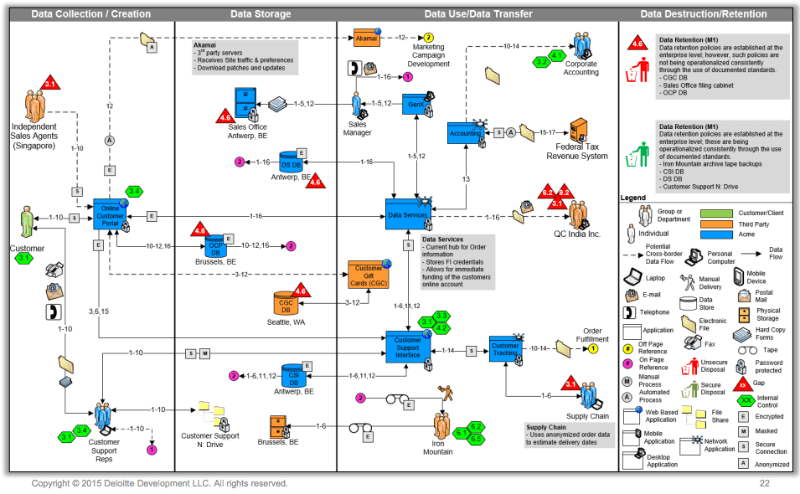
One of the keys to being successful with analytics is having a clear view of how all the data flows into and through your business.

Building a data map to show all the entry points, all the places where data is stored, who and how it is  accessed  and what filters might change your data is one of the things I can help you do.

This is step one towards data integration and is a great exercise for a half day in-house training/seminar for any business or organization that is struggling to get valued out of it’s big data.

Per Wikipedia… Data integration involves combining data residing in different sources and providing users with a unified view of these data. Data integration appears with increasing frequency as the volume and the need to share existing data explodes.

If you can imagine a map of your business in your mind you are half way there. The next step is to build a flow chart like the one below

datamap

If you have something like this then you are on ahead of the game.

If you don’t, let us set up some time to discuss how to get started.

Analytics Culture – The key to using analytics in a business is like a secret sauce. It is a unique combination of analytics talent, technology and technique that are brought together to enrich and empower an organization. A successful analytics culture is not easy to create, but DMAIPH can show you how. Contact DMAIPH now at analytics@dmaiph.com or connect with me directly so we can build a strategic plan to turn your company into analytics driven success story.